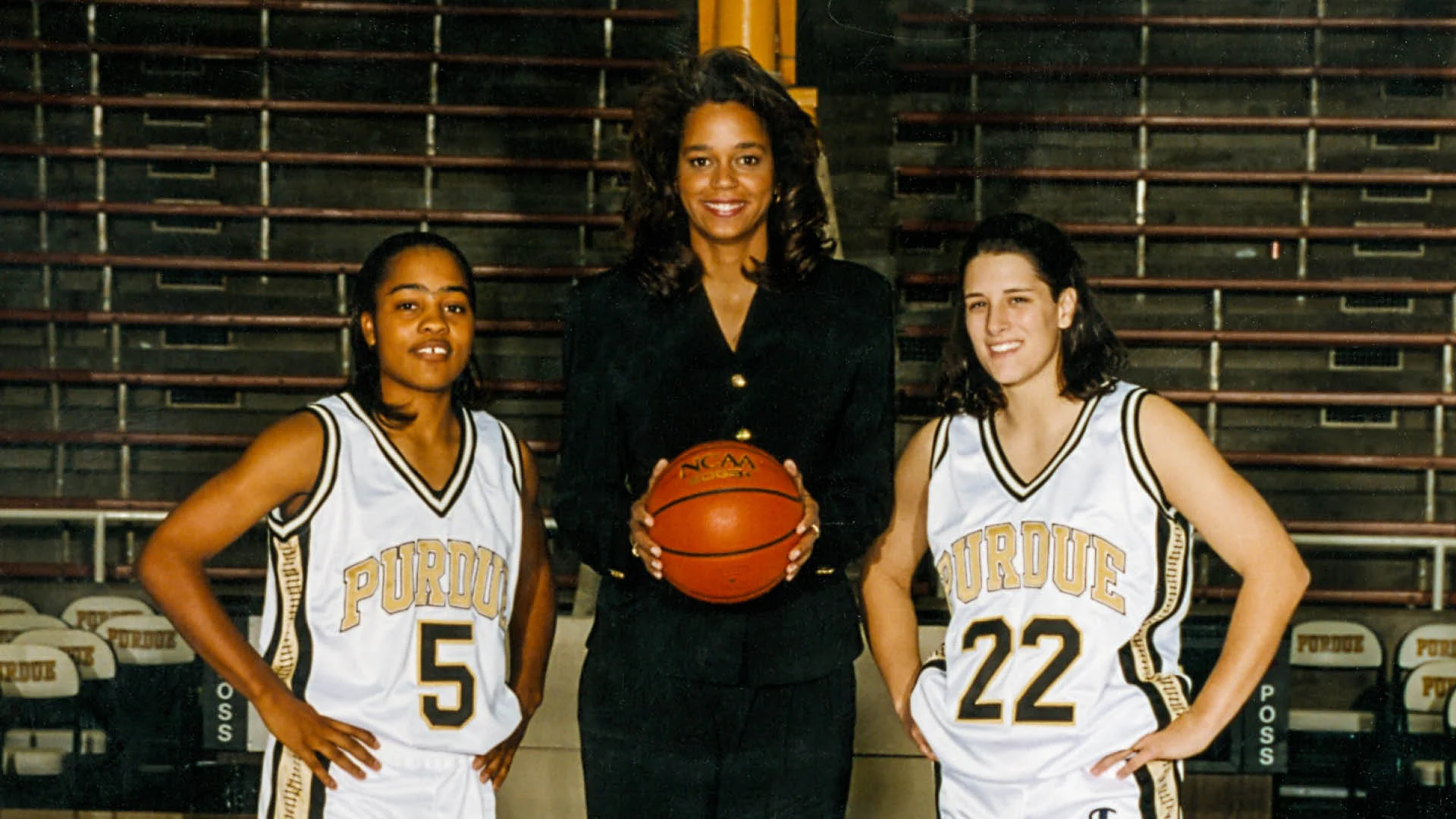
Purdue's first NCAA women's basketball championship
Purdue won the 1999 NCAA women's basketball championship by defeating Duke 62-45 on March 28 in San Jose, California. Carolyn Peck's Boilermakers finished 34-1, closed the season with thirty-two consecutive victories and captured the program's first NCAA national title. The champions were the 1998-99 Purdue team, led by senior guards Ukari Figgs and Stephanie White-McCarty.
This championship capped success at three levels. Purdue won the Big Ten regular-season title with a 16-0 conference record, added the Big Ten Tournament championship and then completed six NCAA tournament wins. The school's twenty-fifth anniversary account records that sweep of the conference and national competitions. The trophies represented different achievements within the same season.
The national title did not emerge from a brief run by a team that had struggled for months. A 34-1 record means Purdue lost only once across thirty-five games. Its thirty-two-game closing streak covered far more than March. The Boilermakers arrived at the NCAA tournament with a season's worth of winning behind them, then maintained that standard when one loss would have ended the campaign.
The quality of the opposition strengthens that picture. Purdue finished 10-0 against teams ranked in the Associated Press poll, according to the school. Its opening victory over three-time defending champion Tennessee ended the Lady Vols' forty-six-game winning streak. The season began with evidence that Purdue could beat the sport's established champion and ended with the Boilermakers holding the trophy themselves.
The final required a different kind of proof. Duke led at halftime, and White-McCarty suffered an ankle injury late in the game. The contemporary championship report describes Purdue responding to both setbacks. The seventeen-point final margin was the result of that response, rather than a lead the Boilermakers held throughout the night.
To understand why this team finished the job, follow the complete bracket route and the different responsibilities of its players. Figgs' scoring, White-McCarty's leadership, Katie Douglas' contributions and Camille Cooper's interior play belonged to one coordinated team. The final brought those roles together under pressure.
The six victories that brought Purdue to the title
Purdue entered the NCAA tournament as the Midwest region's number-one seed. The Boilermakers opened at home in West Lafayette, advanced through the regional in Normal, Illinois, and finished in San Jose. Their original final-season statistics preserve the dates and scores, while the school's tournament history table identifies the rounds and locations.
| Date | Round | Opponent | Purdue result | Location |
|---|---|---|---|---|
| March 13 | First round | Oral Roberts | 68-48 | West Lafayette |
| March 15 | Second round | Kansas | 55-41 | West Lafayette |
| March 20 | Regional semifinal | North Carolina | 82-59 | Normal, Illinois |
| March 22 | Regional final | Rutgers | 75-62 | Normal, Illinois |
| March 26 | National semifinal | Louisiana Tech | 77-63 | San Jose |
| March 28 | National championship | Duke | 62-45 | San Jose |
Camille Cooper led Purdue with nineteen points in the opening win over Oral Roberts. Two nights later, Katie Douglas led with fifteen against Kansas. The Boilermakers scored only fifty-five points in the second game, their lowest total of the NCAA run, but held Kansas to forty-one. Advancing did not require reproducing the opening game's offensive total.
The Kansas game is a particularly useful example of finding points when field goals are difficult. Purdue made seventeen of fifty shots, a 34 percent rate, but converted seventeen of twenty-one free throws. Those made foul shots supplied nearly a third of its fifty-five points. A low shooting percentage did not become an elimination because Purdue had another substantial source of scoring and kept its opponent's total down.
From the Midwest regional to the national final
Against North Carolina, the offensive pattern changed sharply. Purdue made thirty-one of fifty shots, a 62 percent rate, and recorded twenty-three assists in an 82-59 victory. Figgs led with twenty-four points. The Boilermakers took the same number of field-goal attempts as they had against Kansas and made fourteen more of them. The contrast shows how different two consecutive tournament wins can look.
Rutgers presented another kind of game in the regional final. Purdue won 75-62, with White-McCarty scoring twenty-two. The team attempted forty-six free throws and made thirty, while committing only nine turnovers. The free-throw total was much larger than in the North Carolina game, and Purdue's ability to finish with so few turnovers helped preserve its scoring opportunities.
The Louisiana Tech semifinal moved the run to San Jose. Purdue won 77-63, with Figgs again scoring twenty-four. The Boilermakers made seven of fourteen three-point attempts that night. That fifty-percent outside shooting supplied twenty-one points and helped send Purdue into its first national championship game against Duke.
Cooper, Douglas, White-McCarty and Figgs each led Purdue in scoring in at least one of the six NCAA games. The changing leaders are a compact illustration of the team's range of contributors. They also explain why a history focused only on the player who scored most in the final would miss much of the work required to reach it.
All six victories came by double digits. The smallest margin was thirteen points against Rutgers, while the largest was twenty-three against North Carolina. Those final margins establish a consistently successful tournament; the championship game would still test Purdue's ability to reverse a deficit within a game rather than simply protect a lead.
The players on Purdue's 1998-99 championship team
Purdue's regular starting group combined senior leadership with important younger players. White-McCarty and Figgs were seniors, Michelle Duhart was a junior, and Douglas and Cooper were sophomores. The school's historical starting-lineup record identifies those players and classes, keeping them distinct from the Purdue team that reached another title game in 2001.
The original season statistics include fifteen players who appeared in games. Mary Jo Noon also belonged to the season's roster context as a redshirt, as marked in Purdue's historical record. She should not be assigned game totals that she did not record.
| Player | Games | Starts |
|---|---|---|
| Stephanie White-McCarty | 35 | 35 |
| Ukari Figgs | 35 | 35 |
| Katie Douglas | 35 | 35 |
| Camille Cooper | 35 | 34 |
| Kelly Komara | 35 | 0 |
| Michelle Duhart | 35 | 35 |
| Mackenzie Curless | 29 | 1 |
| Tiffany Young | 33 | 0 |
| Candi Crawford | 31 | 0 |
| Mo-nique Langston | 9 | 0 |
| Connie Murdock | 17 | 0 |
| Amy Shaffer | 10 | 0 |
| Danielle Bird | 12 | 0 |
| Beth Lapaich | 4 | 0 |
| Shayla Potter | 1 | 0 |
Ukari Figgs and Stephanie White-McCarty led the backcourt
White-McCarty averaged 20.2 points and 4.5 assists across the full thirty-five-game season. Figgs averaged 16.3 points and 4.2 assists. Both started every game, with White-McCarty averaging 35.9 minutes and Figgs 35.3. Those minutes show how consistently Purdue relied on its senior creators; these are season averages, not statistics limited to the NCAA tournament.
Their outside-shooting lines offer a useful comparison. Figgs made sixty-nine three-pointers, while White-McCarty made sixty-two. White-McCarty converted 43.7 percent of her three-point attempts; Figgs converted 34.2 percent. Figgs made more threes overall, but White-McCarty made a higher percentage. Looking at both totals and accuracy gives a better picture than treating either number as a complete ranking of their shooting.
Figgs also made 86.3 percent of her free throws during the season. That skill would become particularly valuable when Purdue needed to preserve its championship-game lead at the line. Her senior role combined scoring, distributing and converting uncontested points; it was broader than the eighteen points she eventually scored against Duke.
In the university's twenty-fifth anniversary conversation, Figgs and White described their complementary approaches as co-captains. Those later reflections add a personal perspective to the responsibility visible in the minutes and starts. They are memories of the season, while the statistical record supplies the measurable workload.
Katie Douglas, Camille Cooper and the supporting roster
Douglas was much more than a third scoring option. She averaged 14.1 points and a team-leading 6.2 rebounds and finished with ninety-one steals. A guard contributing that much on the boards changes where a team's rebounding comes from. Purdue's leading rebounder was not its center, and its scoring hierarchy alone would conceal that fact.
Cooper provided a different source of efficiency. She made 64.2 percent of her field-goal attempts, averaged 9.7 points and recorded fifty-four blocked shots. Duhart, meanwhile, averaged only 3.7 points but collected 5.7 rebounds per game. Her ninety-four offensive rebounds led the team. She created extra opportunities that a points-only description of the lineup would undervalue.
Komara appeared in all thirty-five games without a start, averaging 17.5 minutes and 5.3 points. She made twenty-six three-pointers at a 41.3 percent rate. Her line demonstrates that meaningful playing time and outside shooting were available beyond the starting five. Curless, Young and Crawford each appeared in at least twenty-nine games, while the remaining players complete the season's participation record.
The team thus combined a stable starting group with several kinds of support: guard rebounding, efficient interior finishing, offensive boards and reserve shooting. These are specific responsibilities supported by the season totals. They help explain how Purdue could win with different leading scorers across the tournament and still retain a recognizable team identity.
The second-half turnaround against Duke
Purdue scored seventeen points in the first half and trailed Duke 22-17. Figgs missed all seven of her field-goal attempts before the break. The eventual champions were behind after twenty minutes, with their senior guard still scoreless. The game was played in two halves, so the halftime deficit represented half of regulation already gone.
The Associated Press championship account describes a change toward attacking the basket during Purdue's decisive stretch. Trailing 30-28, the Boilermakers began a 12-1 run. Douglas scored on a drive, Figgs put Purdue ahead with a bank shot, and contributions from White-McCarty and Cooper helped extend the lead to 40-31.
That sequence provided a concrete answer to the first-half scoring problem. Purdue found points through drives and interior finishes rather than waiting for outside jumpers to rescue the offense. Figgs scored six points during the run and eventually finished with eighteen, all after halftime. Her second half transformed both her individual game and Purdue's position in the final.
Duke still reduced the deficit to 42-38 with 7:48 remaining. Douglas then made a three-pointer to stretch the lead. That basket deserves attention precisely because Purdue made so few threes all night: one successful outside shot arrived at an especially useful moment in a game the Boilermakers mostly had to win elsewhere.
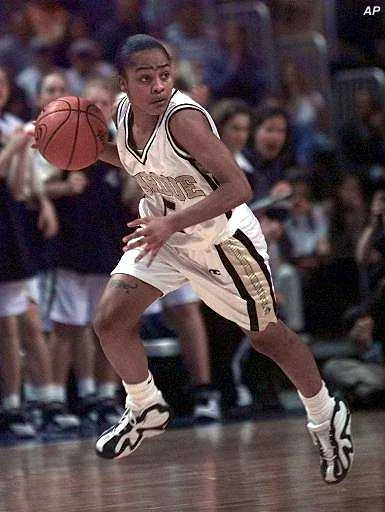
The late injury to White-McCarty created another test. She sprained her left ankle and left with 4:01 remaining. A Hilary Howard three-pointer had brought Duke within 47-42. Purdue therefore had to close a five-point game without the senior who had led its scoring across the season.
The finish came at the free-throw line. Purdue made fifteen of sixteen foul shots over the final 3:49, according to the contemporary report. Those points kept Duke from turning the injury and narrowed margin into a final comeback. The closing stretch gave the game its eventual separation; it did not depend on White-McCarty returning to score again.
Shot-making, blocked shots and the 62-45 final
Purdue outscored Duke 45-23 after halftime, calculated from the first-half and final totals. The Boilermakers' second-half advantage was twenty-two points, enough to reverse the five-point deficit and produce a seventeen-point victory. Figgs' eighteen points formed a major part of that reversal, while Douglas and Cooper each finished with thirteen and White-McCarty added twelve.
The original Purdue game statistics show twenty-one made field goals in fifty-five attempts and just one made three-pointer in thirteen attempts. This was not a championship won through a barrage of outside shooting. Purdue's three-point total had fallen dramatically from the seven makes in its semifinal, yet it found enough two-point baskets and foul shots to finish the tournament.
At the line, Purdue made nineteen of twenty-eight overall. Duke's season record lists four made free throws in six attempts against Purdue. The difference in made foul shots was fifteen points. That gap was large relative to the seventeen-point final margin, even though Purdue's overall free-throw percentage was well below its near-perfect closing stretch.
Purdue also recorded three blocked shots and committed only eight turnovers. The blocks were one part of a defensive performance that held Duke to a season-low forty-five points and 32.7 percent field-goal shooting. Three blocks alone do not account for an entire game's missed shots; the low opposing total and Purdue's limited giveaways describe a wider effort to control what happened between scoring chances.
The final combined an offensive adjustment with a composed finish. Purdue recovered from a scoreless first half by Figgs, built a lead through attacking play and preserved it after losing White-McCarty. Its season-long balance became especially valuable when the championship could no longer be closed by the usual starting group intact.
Carolyn Peck's championship and Purdue's place in history
Peck's time as Purdue's head coach lasted only two seasons, but it produced an Elite Eight appearance followed by a national championship. The school's Hall of Fame account records a 57-11 mark over those two years. She then moved to the Orlando Miracle for the WNBA team's inaugural 1999 season.
The 1999 title also established an important first. Peck became the first Black woman head coach to win the NCAA Division I women's basketball championship. Her Women's Basketball Hall of Fame profile recognizes that achievement and lists her in the Class of 2023. The milestone belongs alongside the basketball results when assessing what Purdue's victory meant.
For the senior co-captains, the championship completed a college career that had included significant coaching change. White-McCarty and Figgs had played under three coaches in their first three seasons. Their final year with Peck brought stability at the point when a veteran group had its last chance to finish together. The later anniversary conversation gives their relationship with the coach a personal dimension beyond the win-loss total.
The team's legacy also rests on the way it spread responsibility. Four different players led Purdue in scoring during the NCAA tournament. Duhart's offensive rebounding and Komara's reserve minutes contributed over the season, while the final required teammates to finish without White-McCarty on the court. The championship's best-known names were central, but they operated inside a team with several useful answers.
The women's champions-by-year history records Purdue's 1999 victory as one season's result. Returning to the actual run reveals its larger shape: conference champions, a thirty-two-game closing streak, six double-digit NCAA wins and a final transformed after halftime. Purdue's first title was both the reward for an exceptional season and a championship that still had to be earned when the game became difficult.
Join the conversation
Share a question or a thought about the women's game. Comments are reviewed before they appear. Keep it friendly, stay on topic and leave out personal information.
No comments yet. Start the conversation.
Sign in with Google to leave a comment. Your email address is not displayed with your comment.