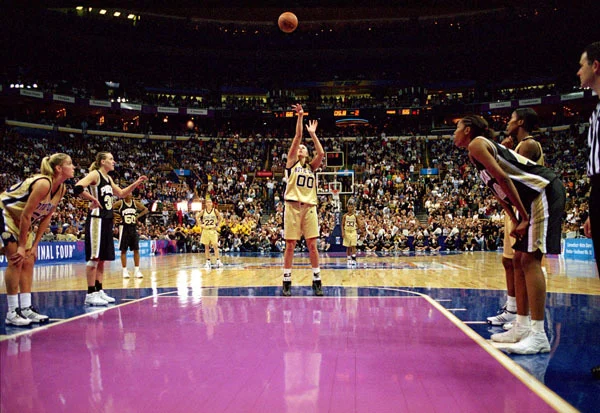
Notre Dame won the 2001 NCAA women's basketball championship by beating Purdue 68-66 on April 1 at the Savvis Center in St. Louis. Muffet McGraw's Fighting Irish finished 34-2 and claimed the program's first national title. Ruth Riley scored the winning points on two free throws with 5.8 seconds remaining.
Cover: Ruth Riley shoots a free throw during the 2001 championship final. Photo: Notre Dame Athletics archive.
Notre Dame beat Purdue 68-66 to win its first NCAA title
The title completed the 2000-01 season, with Riley and point guard Niele Ivey among the central figures. It belongs to a different generation from Notre Dame's 2018 champions. The first championship was decided by free throws against Purdue in St. Louis, rather than the later last-second three-pointer against Mississippi State in Columbus.
The official championship box score records the Irish at 34-2 and Purdue at 31-7. That final record is one win beyond the 33-2 mark Notre Dame carried into the game. The last victory was still necessary: reaching the championship final and winning the national championship were separate accomplishments.
The occasion paired two Indiana universities on a neutral floor in Missouri. Purdue was seeking another title after winning in 1999, while Notre Dame was trying to finish a first. Familiarity did not make the outcome routine. The two-point margin meant that the closing sequence could still have changed the champion, even after the Irish had recovered from an early deficit.
Riley received the Final Four's Most Outstanding Player award. The contemporary title report makes clear that the finishing points followed a much larger contribution. Notre Dame also needed several teammates to score in double figures and had to withstand productive games from Purdue's leading players. One decisive moment can identify a final without explaining all the work required to reach it.
That is what makes the full run rewarding to revisit. The Irish had to win four NCAA games before St. Louis, overturn a difficult semifinal against defending champion Connecticut, and then solve a different opponent in the final. The roster and the individual games show how those tasks were distributed, rather than reducing the season to the last two free throws.
The players behind the 2000-01 championship
Notre Dame's final starting five was Ruth Riley, Niele Ivey, Alicia Ratay, Ericka Haney and Kelley Siemon. Each averaged double figures in scoring over the completed season. The school's final season statistics identify all 12 players and show how responsibility was spread beyond the two names most closely associated with the title.
| Player | 2000-01 points per game | Championship participation |
|---|---|---|
| Ruth Riley | 18.7 | Starter |
| Alicia Ratay | 12.9 | Starter |
| Niele Ivey | 12.1 | Starter |
| Kelley Siemon | 11.3 | Starter |
| Ericka Haney | 11.0 | Starter |
| Jeneka Joyce | 5.2 | Reserve |
| Meaghan Leahy | 3.1 | Season roster; did not play in final |
| Monique Hernandez | 2.6 | Season roster; did not play in final |
| Le'Tania Severe | 1.9 | Season roster; did not play in final |
| Amanda Barksdale | 1.4 | Reserve |
| Imani Dunbar | 1.4 | Season roster; did not play in final |
| Karen Swanson | 1.2 | Season roster; did not play in final |
Ruth Riley and Niele Ivey carried different responsibilities
Riley led the team with 18.7 points and 7.8 rebounds per game, made 62.8% of her field-goal attempts and blocked 113 shots. Her offensive and defensive influence both centered on the interior. The shooting percentage indicates how efficiently she converted her attempts; the blocks show a repeated contribution at the other basket. Neither side of her season depends solely on the final's famous finish.
Ivey's responsibility was different. She finished with 247 assists, about 6.9 per game across 36 appearances, and 94 steals. She also averaged 12.1 points. That combination gave Notre Dame a guard who could create for teammates while contributing her own scoring and defensive pressure. Riley and Ivey supplied complementary strengths, rather than competing for the same statistical role.
The final required particularly long stretches from Ivey: she played all 40 minutes, scored 12 points and recorded six steals. Riley played 35 minutes. The distinction helps explain why a center's spectacular scoring total did not make the guard's work secondary. Notre Dame still needed someone to keep its offense moving and handle possessions throughout a game that remained close to the final buzzer.
Ratay, Haney, Siemon and the reserve rotation
Ratay supplied an exceptional season from three-point range, making 81 of 148 attempts for 54.7%. Her threat was established over the whole schedule, even though the championship game became a difficult shooting night. Haney and Siemon added productive forward play: Haney averaged 11.0 points and 5.7 rebounds, while Siemon averaged 11.3 and 7.1.
Siemon also finished the season with 99 assists. In the final, she had six assists, nine rebounds and 10 points while joining Ivey in playing the entire game. Those numbers make her contribution unusually visible. She could help finish possessions, extend them through rebounding and pass to a teammate for a basket. Her role was broader than waiting for Riley to receive the ball.
The championship rotation narrowed to seven players. Joyce played 20 minutes and made both her free throws, while Barksdale supplied two blocks in five minutes. The five starters scored 66 of Notre Dame's 68 points. That distribution is a description of the final, rather than a claim that the other five roster members had no role in the season that brought the team there.
Barksdale's wider season illustrates the difference. She recorded 58 blocks in 35 appearances, giving Notre Dame another source of shot blocking beyond Riley. Leahy, Hernandez, Severe, Dunbar and Swanson also appear in the official season totals. A complete championship roster should preserve their names, even when the last game's workload was concentrated among fewer players.
Six victories from South Bend to St. Louis
Notre Dame entered the NCAA tournament as the Midwest Region's No. 1 seed. The Irish began at home in South Bend, won the regional in Denver and completed the championship in St. Louis. The official season results preserve the six victories in order.
| Date in 2001 | Round | Opponent | Notre Dame result | City |
|---|---|---|---|---|
| March 17 | First round | Alcorn State | 98-49 | South Bend |
| March 19 | Second round | Michigan | 88-54 | South Bend |
| March 24 | Sweet 16 | Utah | 69-54 | Denver |
| March 26 | Elite Eight | Vanderbilt | 72-64 | Denver |
| March 30 | National semifinal | UConn | 90-75 | St. Louis |
| April 1 | National championship | Purdue | 68-66 | St. Louis |
The opening 98-49 victory over Alcorn State gave the Irish a comfortable start. The Michigan game then produced a useful demonstration of their offensive range. Notre Dame made eight of 18 three-pointers and shot above 50% from the field in each half. The 88-54 result came with 21 points from Riley, 16 from Siemon and 14 from Joyce.
The opponent's official box score shows that Joyce made four three-pointers and Ivey supplied eight assists. All 12 Notre Dame players scored. That game gives the reserves a substantial part of the tournament story, even though the final would use a much smaller rotation. Joyce's shooting helped make the second-round result comfortable; her championship free throws would matter in a far narrower game.
Utah reduced Notre Dame's scoring to 69 in the regional semifinal, but the Irish still won by 15. Riley had 24 points and 14 rebounds. The lower team total did not require the same broad scoring distribution as the Michigan game. A strong interior performance and control of the result were sufficient to move the team into the regional final.
Vanderbilt made that next game a serious test. The score was tied 40-40 at halftime, and Riley finished with a season-high 32 points, including 22 after the break. The regional final report describes how Chantelle Anderson's foul trouble changed Vanderbilt's available interior defense. Riley took advantage of the matchup and helped Notre Dame win the second half 32-24.
Ratay added 17 points and Siemon 16 against Vanderbilt, so the regional title was still supported by more than one scorer. Riley's outstanding individual game provided the largest contribution, while teammates supplied enough offense to complete the win. Her regional Most Outstanding Player award recognized the two-game achievement that sent the Irish to the final weekend.
The last two victories were both comebacks, yet they asked different things of Notre Dame. Connecticut forced a substantial second-half recovery in the semifinal. Purdue kept the championship final close enough to be decided in its last seconds. The route became progressively more demanding, and the Irish had to keep finding an answer after the comfortable home results were behind them.
The semifinal comeback against defending champion UConn
Notre Dame's 90-75 semifinal victory on March 30 was much more precarious than its final margin suggests. Connecticut led by 16 points in the first half, when foul trouble separated the Irish from both their center and their point guard. Riley sat out the final 6:35 of the half with two fouls, while Ivey left with three fouls and 2:32 remaining. Without those two organizing forces, Notre Dame faced the possibility of losing contact with the defending national champion before halftime.
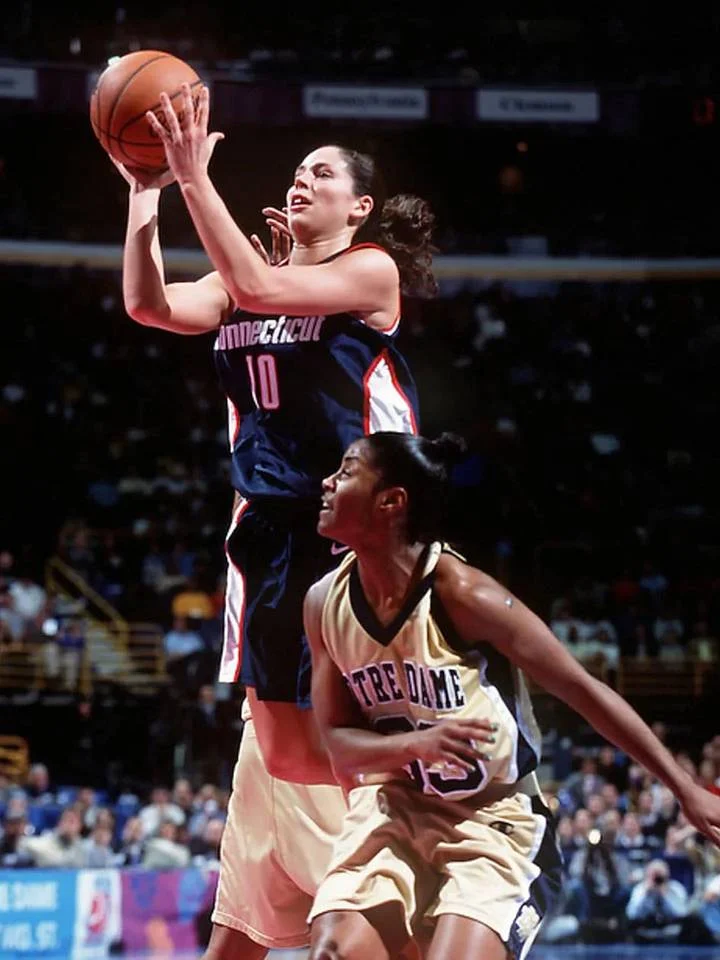
Late three-pointers by Joyce and Ratay helped reduce the damage to a 49-37 halftime deficit. Bird then opened the second half with another three, pushing the gap back to 15. The Irish therefore needed more than an encouraging possession before the break. They still had to change the game over a sustained stretch against a team that had already beaten them in the Big East championship game.
The second half changed which team controlled the game
The contemporary semifinal report traces the comeback through several contributors. Ratay's three-pointer gave Notre Dame its first lead, 61-59, with 12:37 left. Connecticut briefly recovered, taking its last lead at 65-63 on a Tamika Williams reverse layup with 10:30 remaining. Notre Dame then scored 14 consecutive points to go ahead 77-65. That was the decisive separation: the Irish converted a narrow contest into a double-digit lead while the Huskies went more than five minutes without scoring.
That run included a Ratay jumper and three-pointer, Ivey's free throws, an Ivey steal leading to Joyce's free throws, a Riley putback and free throw, and Haney's free throws. Its variety matters. Notre Dame could score from the perimeter, recover a missed shot and convert at the line, while defensive disruption supplied another opportunity. The sequence gives a more useful explanation of the turnaround than crediting the entire comeback to a single scorer.
Riley finished with 18 points after scoring only two before halftime. Ivey had 21, Ratay 20, and Haney added 15 points and 10 rebounds. Connecticut shot 33.8 percent overall and made six of 30 three-point attempts. Freshman Diana Taurasi scored four points on one-for-15 shooting, but the Huskies were also playing without injured stars Shea Ralph and Svetlana Abrosimova. Those absences are part of the opponent's circumstances; the Irish still had to beat the available lineup on the court.
In her 2015 first-person recollection, Bird described UConn's early focus on containing Riley and remembered Ratay's late first-half three as a significant moment. Her memory helps convey how the game felt to a participant. The scoring sequence shows what followed: Notre Dame's important early recovery became a sustained second-half reversal, earning a first appearance in the national final.
How the Irish survived the Purdue championship final
Purdue presented a different problem from UConn. Notre Dame trailed 19-7 early and 32-26 at halftime, then opened the second half with eight consecutive points to move ahead 34-32. The Boilermakers answered rather than collapsing. They later led 49-41 with 12:32 remaining, forcing the Irish to recover again. Joyce's two free throws tied the score at 55 with 7:55 left, setting up a finish in which both teams repeatedly threatened to take control.
The final also took away an important Notre Dame strength. After Ratay's 20-point semifinal, she scored only three points against Purdue, and the Irish made one of 10 three-point attempts. Her lone make nevertheless tied the game at 62 with 4:02 left. A low scoring total can obscure an important contribution: that basket kept a difficult shooting night from becoming an insurmountable deficit.
Riley's inside production and the decisive free throws
Riley's championship performance combined volume with efficiency. The official final box score credits her with 28 points on nine-for-13 shooting, 13 rebounds and seven blocks. She also made 10 of 14 free throws, supplying two-thirds of Notre Dame's 15 made foul shots. Her scoring sustained the offense on a night when the usual perimeter production was scarce, while her rebounding and shot blocking gave that performance value at the other end.
The closing sequence required more than one successful trip to the line. Katie Douglas gave Purdue a 66-64 lead with 1:22 remaining by turning a steal into a layup and an additional free throw. Riley answered with a basket in the lane at 1:01, tying the game. She then rebounded Shereka Wright's missed shot, allowing Notre Dame to play for the lead rather than defend another Purdue opportunity.
Wright fouled Riley on the next Irish attack. With 5.8 seconds left, Riley made the first free throw, waited through a Purdue timeout, and made the second. Those attempts completed Notre Dame's final four points. Purdue still had a chance: Douglas took an 18-foot jumper at the buzzer and missed. The contemporary championship report makes clear how close the ending remained. Riley put Notre Dame ahead; the title was secure only after Purdue's last shot failed.
Purdue's perimeter scoring kept the outcome in doubt
Douglas finished with 18 points, seven rebounds, five assists and five steals. Wright and Shalicia Hurns scored 17 apiece, giving Purdue three substantial scoring threats. Douglas made three three-pointers, Wright two and Kelly Komara two. Their combined seven-for-17 outside shooting helped Purdue compensate for a lower overall field-goal percentage: 37.3 percent compared with Notre Dame's 46.4 percent.
The scoring arithmetic explains the two-point margin. Purdue outscored Notre Dame 21-3 from three-point range, an 18-point advantage. Notre Dame answered with 50 points from two-point baskets against Purdue's 36, plus a 15-9 advantage at the foul line. Those two differences totaled 20 points, just enough to overcome the outside deficit. Riley's interior scoring was central to that balance, but Haney's 13 points, Ivey's 12 and Siemon's 10 were also necessary.
Purdue also won the rebounding total 41-38 and collected 17 offensive rebounds against Notre Dame's 11. Its 67 field-goal attempts exceeded the Irish's 56. Those figures show why a shooting-percentage advantage did not let Notre Dame relax: Purdue continued finding additional attempts and scoring from farther out. Camille Cooper's four fouls limited her to 23 minutes and six points, while the Boilermaker reserves went scoreless. The starters still brought Purdue within one final shot of changing the championship's outcome.
What the first championship changed for Notre Dame
The 2001 team gave Notre Dame women's basketball its first NCAA championship season, a specific benchmark against which later teams could be remembered. The accomplishment belonged to a 34-2 team that had already demonstrated its quality across the season, then answered six different opponents in the tournament. It did not need an undefeated record to establish its place in the program's history.
That status remained visible in the school's plans nearly a decade later. An October 2010 reunion announcement set out a November weekend celebrating the champions, including recognition at women's basketball and football games. The announcement treated the entire squad and coaching staff as part of the achievement. That is an appropriate way to remember a championship whose final possession is famous but whose earlier victories required contributions from throughout the rotation.
Notre Dame's second NCAA women's title came on April 1, 2018, exactly 17 years after the first. McGraw again coached the champions, but the players and finish were different: Arike Ogunbowale's late three-pointer beat Mississippi State 61-58. The NCAA women's champions timeline places those two results in their respective seasons. Riley's free throws against Purdue belong to 2001; Ogunbowale's title-winning shot belongs to 2018.
The first title deserves more than a mention before that later triumph. Ratay's shooting and Ivey's direction helped rescue the UConn semifinal. Riley's scoring, rebounding and free throws decided the Purdue final, with Haney and Siemon providing substantial support. The early rounds also preserve Joyce's productive appearance against Michigan. Taken together, those games explain how a team remembered for one tense finish reached the position to win it.
Join the conversation
Share a question or a thought about the women's game. Comments are reviewed before they appear. Keep it friendly, stay on topic and leave out personal information.
No comments yet. Start the conversation.
Sign in with Google to leave a comment. Your email address is not displayed with your comment.