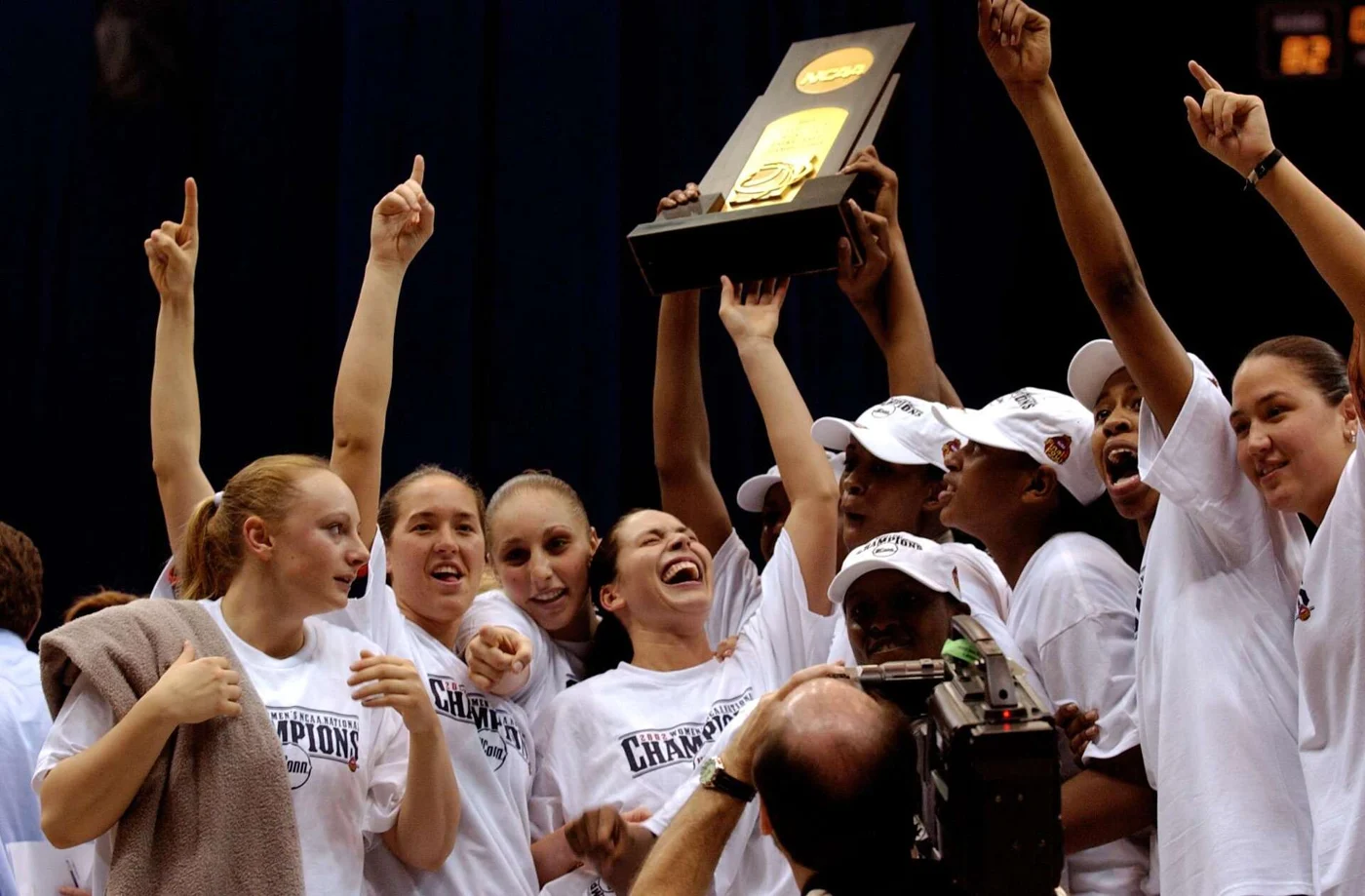
UConn won the 2002 NCAA women's basketball championship 82–70 over Oklahoma and completed a perfect 39–0 season. Five starters scored in double figures in a final that tested the Huskies more seriously than their reputation might suggest. Swin Cash's double-double, the frontcourt's production and a late Diana Taurasi answer helped Connecticut finish its third national title.
Cover: UConn's 2002 championship celebration. Archive photograph via Hearst Connecticut Media.
UConn’s 82–70 title win and the perfect record
UConn won the 2002 NCAA Division I women's basketball championship by beating Oklahoma 82–70 on March 31 at the Alamodome in San Antonio, Texas. The Huskies completed a 39–0 season under Geno Auriemma. Oklahoma, coached by Sherri Coale, finished 32–4 after reaching its first national final. Connecticut's championship was the program's third, following its titles in 1995 and 2000.
The unbeaten record is the quickest way to identify this UConn team. It is also worth distinguishing the completed 39–0 season from the 38–0 record with which the Huskies entered the final. The last win was still required. A team can arrive undefeated and leave without the championship; UConn's achievement was finishing both jobs on the same evening.
The final was not an effortless extension of the season's reputation. UConn led 42–30 at halftime, but Oklahoma kept answering and moved within six late in the second half. The Huskies' contemporary report describes a game in which the favored team needed several separate responses. An early run created a lead, a late first-half burst restored a cushion, and a decisive Diana Taurasi basket helped resist Oklahoma's closing threat.
Those changes give the 82–70 score its proper shape. UConn won the first half by 12 and the teams scored 40 apiece after halftime. The final margin was therefore established before the break, but it was not protected through a motionless second half. Oklahoma closed the gap and the Huskies reopened enough of it. A tied second-half total can contain considerable pressure within the sequence.
The championship rotation featured Sue Bird, Taurasi, Swin Cash, Asjha Jones and Tamika Williams. All five scored in double figures in the final, and their combined 78 points accounted for almost the entire Connecticut total. That distribution is an unusually direct answer to a common historical question: was the 2002 team simply a vehicle for one famous player? The championship game was won by five starters each supplying a significant share of the scoring.
The names have become even more recognizable because of what several players achieved later, but this team should first be understood through its college season. Bird and the senior frontcourt were completing their UConn careers. Taurasi was a sophomore. Their later professional histories do not need to be imported into the final to establish its quality; the result and the production already show how many capable players Oklahoma had to solve.
The perfect season did not require Connecticut to play a perfect final. The Huskies had turnovers, missed perimeter shots and a late opponent run to handle. Winning while managing those problems is part of the achievement. The last evening added a different kind of evidence to the unbeaten record: this champion could find the necessary answer even when the game became less comfortable than its previous results had trained observers to expect.
The five starters who made the champion more than one star
UConn's starting five combined for 78 of the team's 82 points in the final. Cash scored 20, Jones 19, Bird 14, Taurasi 13 and Williams 12. There was no single scoring line that Oklahoma could erase to solve the entire game. The individual totals were also attached to different kinds of production: rebounding in traffic, interior finishes, guard distribution and free throws under late pressure.
Swin Cash’s championship-game double-double
Cash finished with 20 points and 13 rebounds and was named the Final Four's Most Outstanding Player. She had already collected 13 points and seven rebounds by halftime. That first-half work helped build the cushion that Connecticut ultimately preserved. Her award was supported by production before the closing possessions, not simply a prominent place in the celebration afterward.
The official championship box score allows Cash's scoring to be read beside the work of the other forwards. Jones added nine rebounds and five blocks to her 19 points; Williams had nine rebounds with her 12. The three forwards therefore supplied major scoring while repeatedly ending or extending possessions on the glass. Their combined presence was the central answer when the perimeter shots did not fall.
A double-double is a convenient label, but the timing matters too. Cash's early contribution helped create a 12-point halftime lead in a game Connecticut was not handling cleanly. Points scored while a team is turning the ball over can preserve a lead that might otherwise disappear. Her rebounding offered a separate form of protection by putting the ball back in Connecticut's hands.
Bird, Taurasi, Jones and Williams gave UConn several answers
Bird made all eight of her free throws and added four assists. Her late accuracy helped close the game after Oklahoma had moved within striking distance. A point guard can influence a championship through shot-making, distribution and the ability to finish possessions at the line. In this final, her free throws were particularly important because they added points without needing Connecticut to solve another live-ball defensive possession.
Taurasi's 13 points included a late three-point play after a difficult shooting night. The winning sequence did not require her to have dominated the preceding 38 minutes. It required her to deliver when Oklahoma had reduced the lead to six. That distinction is useful when watching famous players in historical games: an important closing contribution does not turn every earlier attempt into a successful one, and earlier misses do not prevent a player from making the decisive response.
Connecticut finished without a made three-pointer, going zero for nine beyond the arc, and committed 21 turnovers. Those weaknesses gave the final a different shape from a picture of an unbeatable shooting exhibition. The frontcourt's finishing and rebounding, along with the guards' ability to produce points in other ways, supplied an alternative route. UConn had enough complementary production to win without its outside shooting working.
The roster's balance is also why later fame can distort the memory of 2002. Taurasi's career makes her an obvious starting point for a modern reader, but Cash, Jones, Bird and Williams were not supporting names around a one-player championship. The final's scoring distribution and interior statistics show a team with several players capable of being the answer to a particular problem. Oklahoma made that team use more than one of those answers.
The season averages reinforce that interpretation. In the official championship review, Cash averaged 14.9 points, Taurasi 14.5, Bird 14.4, Jones 14.0 and Williams 10.1. Only half a point separated Cash from Bird, and four starters averaged between 14 and 15. The final's balance therefore continued an established season pattern rather than representing a sudden redistribution of responsibility for one evening.
Bird also averaged 5.9 assists and Taurasi 5.3. Both guards were creating baskets as well as scoring them. An opponent concentrating on the leading scorer still had to account for another guard capable of delivering the ball to the forwards. That blend of shared scoring and shared creation helps explain how Connecticut could change its main source of points from round to round.
How the Huskies won six NCAA tournament games
UConn entered the NCAA tournament 33–0 and won six more games to complete the season. The opponents were St. Francis of Pennsylvania, Iowa, Penn State, Old Dominion, Tennessee and Oklahoma. The Huskies' first four victories delivered the Mideast Regional title, before the national weekend in San Antonio settled the championship.
The opening scores were 86–37 against St. Francis and 86–48 against Iowa. Those margins established the favorite's authority but did not remove the requirement to keep winning as the opposition changed. A national title is a sequence of successful games, not an average margin large enough to excuse one bad result. Connecticut maintained the unbeaten record every time its season was placed back in the bracket.
The Sweet 16 victory over Penn State finished 82–64. Bird scored 24 points, and the contemporary UConn report describes a competitive first half before the Huskies extended control. The 18-point final margin is therefore best understood as the result of gaining separation, rather than proof that Penn State never offered meaningful resistance.
Old Dominion was the regional-final opponent, and Connecticut won 85–64. Bird scored 26 points, following her 24-point Sweet 16 with another major offensive performance. The Huskies made their first 13 shots in the regional final, according to the contemporary Final Four field report. Such an opening can force the opponent into a chase before it has established its own normal scoring rhythm.
The Tennessee semifinal finished 79–56. Bird and Jones each scored 18, Taurasi had 17 points and ten rebounds, and Cash added 13 points. It was another demonstration of production distributed among several players. Tennessee could not turn the game into a matter of stopping a single Husky and waiting for the rest of the offense to stall.
There is also a useful contrast between the semifinal and final. Connecticut scored 79 against Tennessee and 82 against Oklahoma, yet the margins were 23 and 12. The offensive total alone does not describe how demanding the final was. Oklahoma produced more of its own points and kept recovering ground. The Huskies had to maintain a different level of late-game attention despite scoring slightly more than they had in the semifinal.
The official season review preserves all six scores. Every NCAA win came by at least 12 points, but that consistency should not be confused with identical games. Some required a first-half separation, some began with extraordinary shooting, and the final required an answer to a late six-point threat. Together they supplied the evidence behind 39–0.
The route also keeps the season's honors in their proper order. Connecticut had already won the Big East tournament before NCAA play began. Its national championship was a further six-game achievement against a wider field. The league title secured one part of the season; the national bracket required the Huskies to validate their superiority again against opponents from several conferences.
Oklahoma’s challenge and the place of the 2002 team
Oklahoma had earned its championship opportunity by beating Duke 86–71 in the national semifinal. Rosalind Ross scored 26 points and collected ten rebounds. The Sooners' original semifinal report describes a team completing a major rebuilding journey under Coale. Oklahoma's first final was a substantial program achievement before it became a difficult opponent for an unbeaten champion.
That distinction matters because UConn's reputation can turn the opponent into an anonymous obstacle in retellings. Stacey Dales, Ross and LaNeishea Caufield gave Oklahoma identifiable sources of scoring and resistance. Dales scored 18 in the final and Ross added 17. Their work made Connecticut continue solving the game long after an early double-digit lead might have suggested a simpler conclusion.
Why the Sooners remained competitive in the final
Late in the first half, Oklahoma had reduced Connecticut's lead to 34–30. UConn then finished the half with eight unanswered points. That burst created the 42–30 halftime score and prevented the Sooners from carrying a one- or two-possession deficit into the break. Bird's jumper ended a Connecticut scoring drought and started the separation. The timing of a basket can therefore matter beyond its ordinary two-point value by interrupting a difficult stretch at the moment the opponent is gaining ground.
Connecticut later led by 16, but Oklahoma again narrowed the distance. With 1:31 remaining, the score was 73–67. Taurasi answered with a basket from inside the foul line and converted the additional free throw, making it 76–67. Bird then helped finish the game at the line. The final's closing question was whether Oklahoma could turn a six-point deficit into a genuine last-possession opportunity; UConn's response prevented that scenario.
The Sooners had benefited from the Huskies' mistakes, including the 21 turnovers, and did not need Connecticut's perimeter shooting to be successful in order to threaten. A powerful favorite can still give an opponent a route back through lost possessions. Oklahoma kept taking that route, while UConn's interior production supplied enough points to protect the lead. The result was a championship in which the undefeated team had to display resilience as well as superiority.
The wider season supplied a stronger basis for historical comparisons than one close stretch in the final. Connecticut went 39–0 and repeatedly won by large margins. The university later recognized the entire team in its Huskies of Honor program, as described in the 2012 university retrospective. That recognition treated the team itself as the achievement, preserving the shared identity behind the famous individual names.
Calling one team the greatest of all time introduces a different question from identifying the champion. It requires deciding whether to value unbeaten records, margins, strength of opposition, roster quality or success in the final game most heavily. The 2002 Huskies have evidence in several of those categories. No historical result, however, can establish the score of an unplayed game against a champion from another era.
The useful comparison begins with what this team actually did. It completed every game of the season without a defeat, won all six NCAA games by double figures, received major championship production from all five starters and answered Oklahoma when the final became uncomfortable. For the complete title sequence, the champions-by-year guide records the third UConn crown. The score was 82–70; the season behind it was 39–0.
Join the conversation
Share a question or a thought about the women's game. Comments are reviewed before they appear. Keep it friendly, stay on topic and leave out personal information.
No comments yet. Start the conversation.
Sign in with Google to leave a comment. Your email address is not displayed with your comment.