
UConn repeated as NCAA women's basketball champion in 2003, defeating Tennessee 73–68 in Atlanta. Diana Taurasi led the final with 28 points, but a changed roster also needed Ann Strother's scoring and free throws, Maria Conlon's steady handling and Ashley Battle's closing defensive play. The title completed a 37–1 season after four starters had departed from the previous champion.
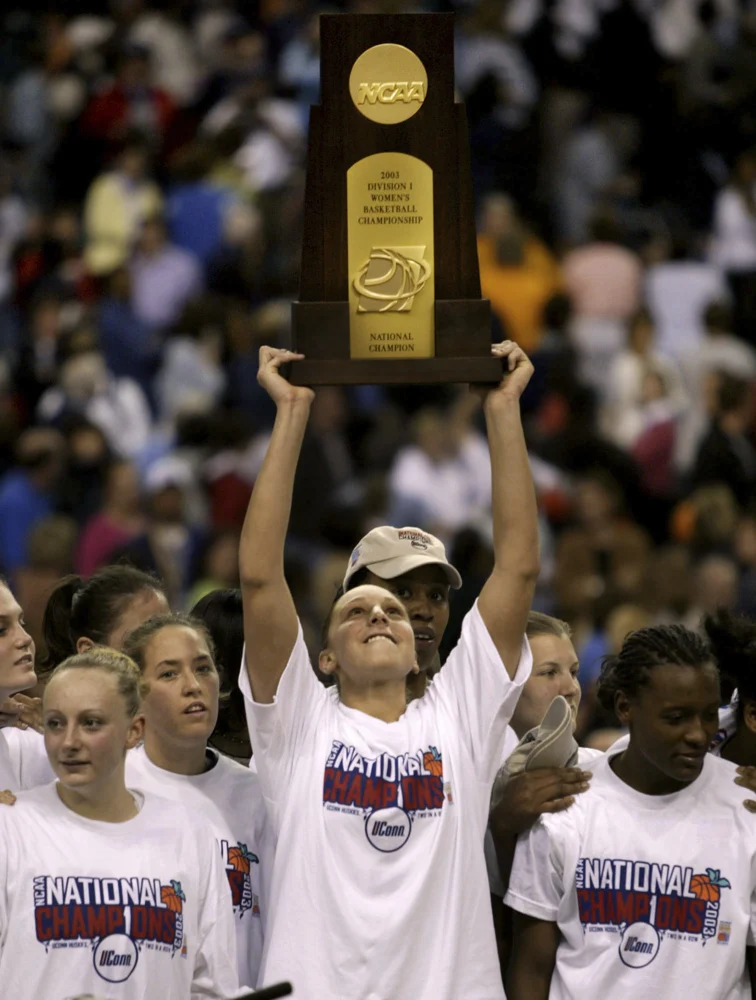
Cover: UConn celebrates the 2003 national championship. Archive photograph via Hearst Connecticut Media.
UConn’s fourth championship came with a different roster
UConn won the 2003 NCAA Division I women's basketball championship by defeating Tennessee 73–68 on April 8 at the Georgia Dome in Atlanta. The Huskies finished 37–1, while the Lady Vols ended 33–5. It was Connecticut's fourth national championship and its second consecutive title, following the undefeated 2002 season.
Diana Taurasi scored 28 points in the final and received the Final Four's Most Outstanding Player award. Her individual performance was the largest part of the scoring, but the result also required a major contribution from freshman Ann Strother and a defensive finish from Ashley Battle. The championship belongs to a team that had changed substantially even though its coach and the name on the uniform remained familiar.
The team that followed the undefeated 2002 champions
Sue Bird, Swin Cash, Asjha Jones and Tamika Williams had completed their college careers after the 2002 championship. That removed four starters from a 39–0 team. Taurasi returned as the established star, while Maria Conlon, Jessica Moore, Strother and Barbara Turner formed the starting group around her in the 2003 final. The repeat was therefore not simply the previous champion playing another season with the same senior core.
The university's official championship retrospective identifies the 2003 Huskies as the first team to win the NCAA women's title without a senior on the roster. Experience still existed: Taurasi and several teammates had been part of the previous championship group. But the responsibility attached to that experience had changed. Players who had occupied smaller roles now had to supply longer minutes and more consequential possessions.
The full-season numbers show the change in Taurasi's workload. In the official final season statistics, she averaged 17.9 points, compared with Moore's 10.6, Strother's 10.1 and Turner's 10.0. UConn still had several double-digit scorers, but the separation between its leading player and the next scorers was much larger than it had been in 2002. The championship final would ask Taurasi to exceed even that leading season average.
The team's only defeat came against Villanova, 52–48, in the Big East tournament final. That loss distinguishes 2003 from the previous perfect season. Connecticut remained a national contender after losing its league tournament; the NCAA bracket presented a new competition with a separate title available. The response was six straight victories, rather than an attempt to erase a result that had already happened.
The distinction also helps identify the season correctly in historical searches. UConn's 2003 championship was a 37–1 repeat with a young roster. Its 2002 title was the 39–0 season that ended against Oklahoma. Taurasi played an important role in both, but the roster, opponent, final score and balance of responsibility differed. Keeping those details separate makes the achievement of the second team easier to appreciate.
What carried over was the standard of competing for the last game. What had to be rebuilt was the way Connecticut reached that standard on court. The 2003 final supplied a direct answer: Taurasi's scoring could lead a changed group, while younger teammates could make the plays needed to turn that leadership into a completed championship.
How Taurasi and Strother held off Tennessee
Connecticut never trailed, but the final repeatedly asked it to stop Tennessee from turning pressure into a lead. The first half was tied 30–30 late before Taurasi made a three. Conlon then stole the ball and began a break that ended with Willnett Crockett scoring just before halftime. UConn entered the locker room ahead 35–30 instead of having to restart from an even score.
That five-point finish was more than a decorative flourish before the break. UConn began the second half with a cushion already in place. Connecticut expanded the lead to 47–34 with 16:15 remaining. Tennessee answered again, cutting it to 50–44. The final's repeated pattern was a UConn separation followed by a Lady Vol recovery, with the Huskies needing another source of scoring to prevent the gap from disappearing.
Strother supplied one of those important answers. Her three with 9:50 left, when Connecticut led 55–49, helped launch a run to 67–54. She finished with 17 points on six-of-11 shooting. A freshman's production mattered at both ends of the closing phase: first by helping rebuild a double-digit lead, and later by making the free throws that kept Tennessee beyond one successful possession.
Taurasi's 28 points came on eight-of-15 shooting, including four threes. The Tennessee-hosted contemporary report describes a scorer producing from several locations rather than simply accumulating points through one type of shot. The resulting difficulty for the opponent is clear: a defense cannot treat every attempt as the same problem when a player can score at the arc and nearer the basket.
Conlon contributed 11 points and six assists without a turnover, according to the official UConn game report. Turner added ten points. Those contributions are essential to the interpretation of Taurasi's leading performance. Her scoring provided the largest share, but a composed point guard and two productive freshmen made the offense more than a question of whether one star could create every point.
The rebounding figures ran strongly in Tennessee's favor: 40–22 overall and 20–5 on the offensive glass. Connecticut still won while shooting 25 of 49 from the field, or 51 percent. That combination explains why the Lady Vols could remain threatening despite trailing. They kept recovering misses and creating another attempt, while UConn converted a higher share of the shots it was able to take. The champion's statistical strength was different from the opponent's.
Tennessee's offensive rebounds produced 16 second-chance points. That category helped keep the game close, but it did not deliver the last few points needed to change the winner. The distinction between earning another chance and converting it is important. Recovering the ball places another scoring opportunity in the offense's hands; it does not put the points on the scoreboard by itself.
The Lady Vols closed to 71–68 with 21 seconds left. Strother made two free throws, and Battle intercepted the ensuing inbound pass. Connecticut then moved the ball until time expired. This was a collective closing sequence: one player protected the lead at the line, another took away Tennessee's attempt to answer, and the group kept possession. Taurasi had led the scoring, but the final required teammates to complete the last jobs.
The five-point final margin therefore describes a game in which UConn created and defended several leads. Tennessee made the Huskies earn their security repeatedly. Connecticut's ability to find another basket, then a free throw and a defensive possession, explains the repeat more fully than the fact that it never fell behind.
The six-game route to the 2003 title
UConn's six NCAA victories came against Boston University, TCU, Boston College, Purdue, Texas and Tennessee. The first four scores were 91–44, 81–66, 70–49 and 73–64. Those results sent the Huskies from Storrs through the East Regional in Dayton and into the national weekend in Atlanta. The familiar final pairing against Tennessee was the conclusion of that route, not a game assigned to the defending champion in advance.
Taurasi’s scoring carried the early rounds
The TCU second-round game gives the clearest early example of how much Taurasi could change a contest. Connecticut trailed 35–33 at halftime. The Huskies opened the second half with 14 unanswered points, including eight from Taurasi, and turned a deficit into a 47–35 lead. A strong response immediately after the break changed both the scoreboard and the amount of pressure attached to each subsequent possession.
Taurasi finished with 35 points, making 12 of 17 shots, five of eight threes and all six free throws. The official second-round account also records Battle's 16 points and 11 rebounds and Moore's 12 points and nine rebounds. Even on the evening of Taurasi's biggest scoring total, teammates supplied important work in the paint and on the boards.
That balance kept the run from being only a matter of an exceptional guard making difficult attempts. The supporting production gave Connecticut another way to finish possessions and made TCU account for threats inside. Taurasi's efficiency supplied the decisive surge, while the rest of the lineup helped the Huskies maintain their position after the surge had changed the lead.
Boston College and Purdue then provided separate regional tests. A 21-point Sweet 16 win was followed by a nine-point regional-final win. The narrowing final margin did not make the previous win less valuable; it showed that advancing required a fresh performance each time. UConn reached Atlanta with a different path from 2002, when every NCAA victory had finished by double figures.
Texas forced a last-possession semifinal
Texas led UConn 35–33 at halftime in the April 6 national semifinal and later extended the lead to 50–41. Connecticut had to recover nine points with just over 12 minutes remaining. Taurasi scored 26, but the contemporary semifinal report highlights Crockett's contribution from the bench as the Huskies worked back into the game.
Taurasi's three with 2:02 remaining put Connecticut ahead 67–66. Later, after two missed Taurasi free throws, Crockett collected an offensive rebound with 36 seconds left and called timeout. That sequence matters because a miss did not force the Huskies to give Texas the next attacking opportunity. The recovered possession let Connecticut retain control of the immediate situation despite the unsuccessful shots.
Conlon added a free throw before a Texas three reduced the score to 71–69. UConn prevented another score and advanced. The game was also Auriemma's 500th career victory, but the players' immediate achievement was securing a place in the final after trailing significantly in the second half. The coaching milestone came from completing that competitive task.
The semifinal and final together were won by seven points, two against Texas and five against Tennessee. Neither result was guaranteed by the defending champion's status. The Huskies needed Taurasi's scoring to take a lead, contributions from the bench to preserve opportunities, and a final defensive answer to finish each game. The tournament made the new roster demonstrate its championship readiness at several different levels of pressure.
What repeating meant for UConn and Tennessee
The 2003 title placed UConn among the programs that had successfully defended the NCAA women's championship. USC had won in 1983 and 1984, and Tennessee had won three straight from 1996 through 1998. Connecticut's achievement was distinctive because it repeated after losing four senior starters, completing the second title with no senior on the roster. The program retained its place at the top while the players carrying much of the responsibility changed.
Taurasi was the clearest connection between the two champions, but the final also established the championship value of the newer group. Strother scored 17, Turner ten and Conlon 11, while Battle took away Tennessee's final attacking chance. Those plays make the phrase “young team” more specific. The roster did not simply possess potential for a later season; its younger players were already producing the actions needed to win the current national title.
The comparison with 2002 is especially revealing in the final statistics. The earlier champion beat Oklahoma without making a three-pointer. The 2003 team made ten threes against Tennessee, including six before halftime. Tennessee's official postgame notes record the ten-for-21 three-point shooting and only 11 Connecticut turnovers. The same program reached consecutive trophies through noticeably different championship-game strengths.
Tennessee's season should also retain its completed achievements. The Lady Vols went 14–0 in SEC play and reached the final after beating Villanova 73–49 in the regional final and Duke 66–56 in the semifinal. They were an accomplished opponent, not simply a familiar name brought in to certify UConn's greatness. Their rebounding advantage in the final gave Connecticut a real problem, and their late run forced a composed finish.
Kara Lawson led Tennessee with 18 points, Gwen Jackson scored 15 and Brittany Jackson added 13. Lawson and Gwen Jackson's senior class completed 125 victories and three Final Four appearances, according to the contemporary school notes. The national title was the missing final reward for that class, but the absence of the trophy did not remove the years of winning that had brought them to Atlanta.
For the rivalry, this was Connecticut's third victory over Tennessee in a national final, after 1995 and 2000. At the end of the 2003 game, UConn was 4–0 in national championship appearances overall. Those are the historical records as they stood that night. They explain why the result mattered within the sport's leading rivalry without requiring a prediction about what either program would do next.
The roster did return and win another title in 2004, a later achievement noted in UConn's official championship retrospective. The 2003 win remains its own story: one defeat in the season, six NCAA victories, a semifinal recovery from nine down and a five-point final protected by a freshman's free throws and a teammate's steal. The champions-by-year guide places the fourth Connecticut title in the wider sequence. Atlanta showed that the repeat had been earned by this changed team.
Join the conversation
Share a question or a thought about the women's game. Comments are reviewed before they appear. Keep it friendly, stay on topic and leave out personal information.
No comments yet. Start the conversation.
Sign in with Google to leave a comment. Your email address is not displayed with your comment.