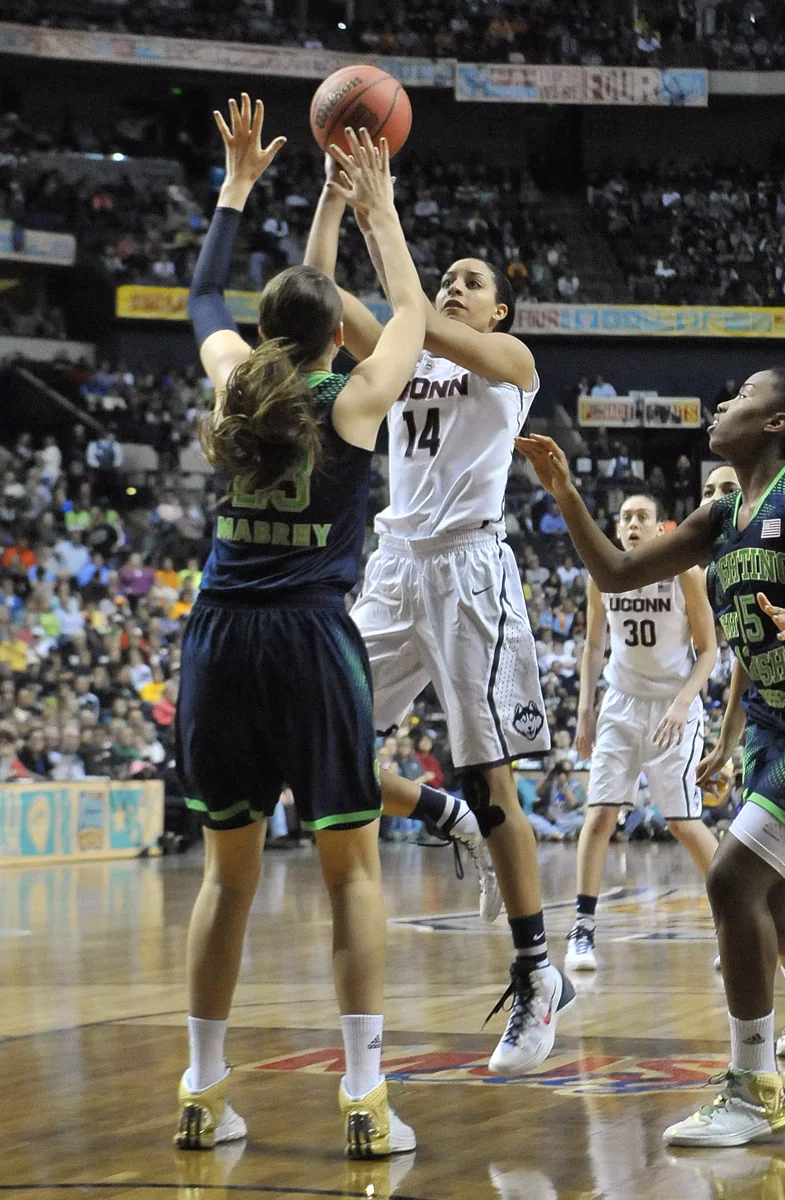
The 2014 NCAA women's basketball championship ended with UConn defeating Notre Dame 79-58 and completing a 40-0 season. The final paired two unbeaten teams in Nashville, then separated them through Connecticut's interior scoring, rebounding and second-half control. This retrospective follows both tournament routes, examines the official final statistics and explains the roster and historical context behind UConn's ninth national title.
The 2014 title game matched two unbeaten teams
UConn won the 2014 NCAA Division I women's basketball championship by beating Notre Dame 79-58 on April 8 in Nashville, Tennessee. The Huskies finished 40-0; the Fighting Irish finished 37-1. Those final records describe the season after the championship. Before the opening tip, Connecticut was 39-0 and Notre Dame was 37-0, giving the final its defining feature: both teams had reached the last game without losing.
The game took place at Bridgestone Arena, with Geno Auriemma coaching Connecticut and Muffet McGraw coaching Notre Dame. UConn's victory delivered its ninth national championship and fifth unbeaten season. The specific combination of forty victories and zero defeats was new for the Huskies, even though the program had already completed other perfect seasons. These details help distinguish the 2014 championship from the surrounding Connecticut titles rather than treating them as interchangeable entries in a winners list.
The Notre Dame championship preview explained why the matchup had remained unresolved throughout the season. The former Big East rivals had moved into separate conferences: Notre Dame joined the ACC, while Connecticut played in the American Athletic Conference. They did not meet during the regular season. A rivalry that ordinarily supplied repeated direct comparisons therefore reached the final with no current-season result between the teams.
That matters when interpreting the identical unbeaten labels. Each team had demonstrated consistency against its own schedule, but neither had established superiority over this particular opponent during that season. An unbeaten record narrows the range of plausible weaknesses; it does not remove differences in personnel, shot creation or defensive matchups. The championship supplied the comparison that the regular season had not provided.
For readers reconstructing the event, there are consequently two separate questions. Who had the better record entering the final? Both teams had perfect records, with different numbers of games played. Who won the actual championship matchup? Connecticut answered that with a twenty-one-point victory. The record comparison creates the historical setting; the game itself determines the champion.
The UConn championship report described the result as the first title game between undefeated teams. That achievement also makes Notre Dame's season important to the story. The Irish did not arrive as an incidental final opponent: their undefeated run created the unusual stakes. A retrospective should preserve that competitive context even while recognizing how decisively Connecticut won the last game.
How UConn and Notre Dame reached Nashville
The finalists occupied different regions and could meet only after surviving five tournament games. Connecticut entered the bracket at 34-0, while Notre Dame entered at 32-0. Those starting totals explain why their records remained different despite following the same six-game championship format. Both were No. 1 seeds, but the Final Four also included No. 2 Stanford and No. 4 Maryland.
UConn advanced through Lincoln and Stanford
UConn opened in Storrs with an 87-44 victory over Prairie View on March 23 and a 91-52 victory over Saint Joseph's on March 25. The next stage moved to the Lincoln regional, where the Huskies defeated BYU 70-51 on March 29 and Texas A&M 69-54 on March 31. Connecticut then beat Stanford 75-56 in the national semifinal on April 6 before defeating Notre Dame two days later.
The official completed 2014 NCAA women's bracket shows how that route developed. BYU, a No. 12 seed, reached the Sweet Sixteen after eliminating higher-seeded opponents. Texas A&M advanced from the other side of the Lincoln region. Reading only the original seed lines would therefore miss the actual teams Connecticut had to beat.
Its closest final score of the six-game run was the fifteen-point regional-final victory over Texas A&M. That provides a useful measure of the run's consistency, but a final margin is a limited description of a basketball game. It does not tell readers whether the lead grew steadily, whether a team recovered from an early deficit or whether late possessions changed the apparent separation.
The practical lesson is to read the route round by round. Two opening wins established progress; winning in Lincoln secured the Final Four; beating Stanford earned a place in the championship. None of those steps replaced the next. Even a team with substantial winning margins still needed to solve a new opponent in Nashville.
Notre Dame advanced through Baylor and Maryland
Notre Dame began with a 93-42 win over Robert Morris on March 22 and an 84-67 win over Arizona State on March 24. In its home regional, the Irish defeated Oklahoma State 89-72 on March 29 and Baylor 88-69 on March 31. Their national semifinal brought an 87-61 victory over Maryland on April 6, setting up the unbeaten championship matchup.
That five-game sequence contains a different pattern from Connecticut's. After a large opening victory, Notre Dame won consecutive games by seventeen, seventeen and nineteen points before separating from Maryland by twenty-six. The Irish had therefore demonstrated more than the ability to beat an opening-round opponent. They also advanced past multiple teams that had already survived the tournament's elimination rounds.
The two semifinal results are particularly helpful when reconstructing the final. Connecticut scored seventy-five against Stanford; Notre Dame scored eighty-seven against Maryland. Those results identified the finalists, but they were not predictions of the championship score. Opponent strength, lineup availability and defensive matchups changed when the two teams faced each other.
For historical searches, Lincoln is the Connecticut regional destination, Notre Dame is the other finalist's regional site, and Nashville is the national semifinal and championship location. Keeping those stages separate avoids conflating a regional championship with the national title. The complete bracket is the best starting point for checking any individual round, especially when a search result reduces the tournament to the last score.
UConn's interior production drove the 79-58 final
The championship was not a simple story of one team making more outside shots. Notre Dame made six three-pointers to Connecticut's four and received fourteen bench points to UConn's six. The Huskies won by controlling more valuable parts of the scoring and rebounding picture, especially around the basket. Their interior advantage became production rather than remaining an assumption based on the players' size.
Breanna Stewart scored twenty-one points on ten made field goals in fifteen attempts. Stefanie Dolson supplied seventeen points, sixteen rebounds and seven assists. Kaleena Mosqueda-Lewis added eighteen points, while Bria Hartley scored thirteen. These contributions spread the scoring across the starting lineup and gave Connecticut several ways to finish possessions.
Dolson's assists deserve attention alongside her scoring and rebounding. An interior player can affect an offense by attracting attention and finding a teammate as well as by taking a shot. The official statistics cannot identify the intention behind every pass, but seven credited assists establish that her contribution extended beyond her own baskets. Moriah Jefferson also recorded seven assists, connecting the backcourt and frontcourt in the final statistical picture.
The opening half still left a competitive game. Connecticut led 45-38 at halftime, a seven-point margin despite scoring forty-five. Notre Dame's ability to score in that period kept the championship unresolved. The second half changed the balance: UConn scored thirty-four while the Irish scored twenty. A fourteen-point advantage after halftime expanded the final margin to twenty-one.
The final box score separates size from actual production
The official UConn–Notre Dame championship box score records a 52-22 Connecticut advantage in points in the paint. UConn also led total rebounds 54-31 and offensive rebounds 22-9. Those numbers support an interior explanation with measurable outcomes, rather than relying on a general description of the Huskies as the bigger team.
Rebounding and scoring should nevertheless remain separate measures. Thirteen additional offensive rebounds did not automatically produce thirteen additional points. Connecticut's second-chance scoring advantage was 18-12, or six points. The offensive rebound column counts recovered possessions; the second-chance column records scoring from those opportunities. Confusing them would exaggerate what the box score actually demonstrates.
Another useful comparison comes from separating two-point baskets, three-point baskets and free throws. UConn made thirty two-point field goals, accounting for sixty points, then added twelve points from threes and seven at the line. Notre Dame scored thirty-two points on sixteen two-point baskets, eighteen from threes and eight from free throws. The Huskies' twenty-eight-point advantage on two-point baskets more than offset their combined seven-point disadvantage in the other two categories.
This calculation explains the final margin without requiring an invented possession model. It also shows why an outside-shooting summary would be misleading: the team that made more threes lost comfortably. Notre Dame's perimeter scoring helped, but it could not compensate for the much larger difference inside the arc.
Turnovers tell a similarly specific story. Connecticut committed fifteen to Notre Dame's thirteen, and both teams scored eight points off turnovers. A generic claim that UConn won every statistical category would therefore be wrong. The decisive strengths were substantial enough to overcome areas where the Irish matched or exceeded the Huskies. Reading those exceptions makes the explanation more precise.
For Notre Dame, Kayla McBride led with twenty-one points and Jewell Loyd added thirteen. Their combined thirty-four points account for a large share of the Irish total, but Connecticut held the team to twenty points after halftime. The final thus joined two developments: the Huskies kept generating enough offense to extend their lead, while the Irish's scoring slowed during the period when they needed to close it.
Natalie Achonwa's absence shaped Notre Dame's final roster
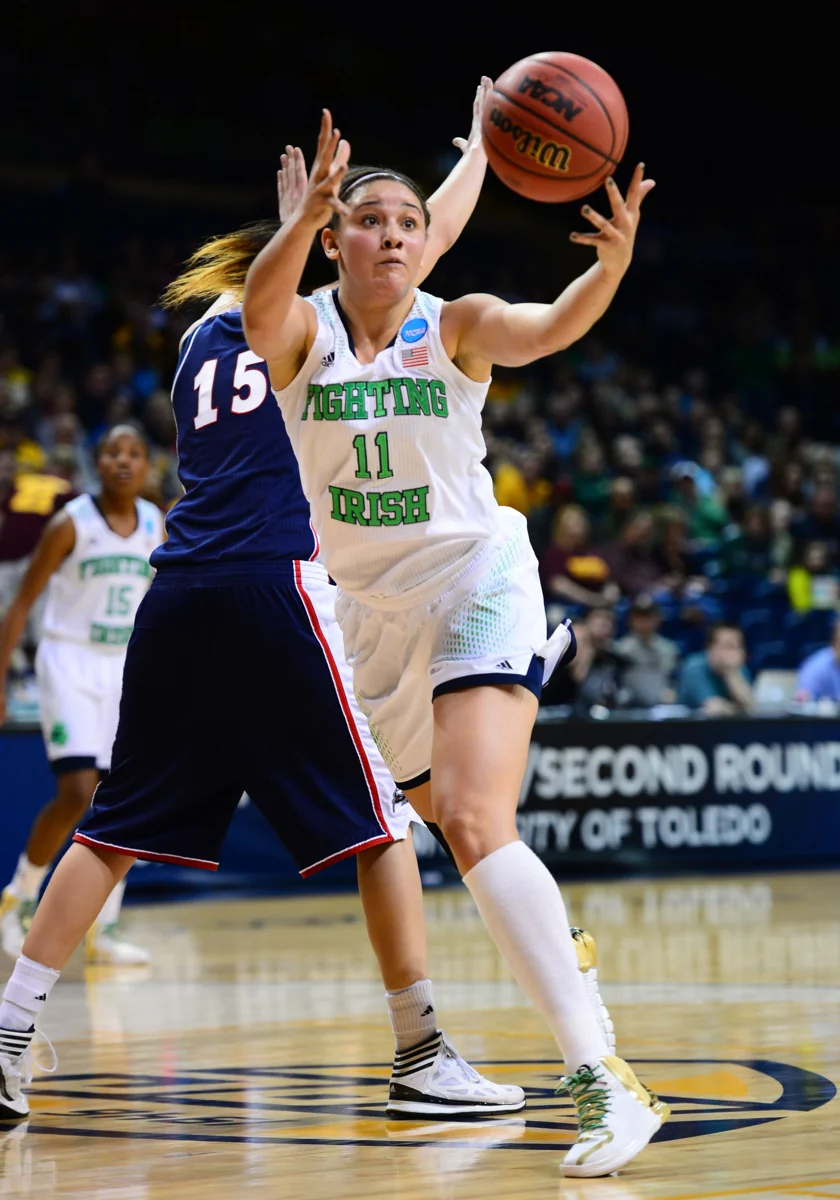
Notre Dame reached Nashville without senior forward Natalie Achonwa, who had injured her left knee during the March 31 regional-final victory over Baylor. The school's April 1 announcement confirmed a torn anterior cruciate ligament and said she would miss the remainder of the season. She did not play in either national semifinal or championship game.
The Notre Dame announcement of Achonwa's season-ending injury establishes the timing clearly. Her absence was already known before the Final Four. It was not an injury that occurred during the championship, and it should not be merged with a different player's availability in a later season.
Achonwa had averaged 14.9 points, 7.7 rebounds and 2.8 assists during her senior season. Her historical Notre Dame player biography records nineteen points and fifteen rebounds against Baylor in the game that sent the Irish to the Final Four. Those figures show the range of her contribution: she supplied scoring, possession recovery and passing from the frontcourt.
Replacing that range is more complicated than assigning her usual minutes to another player. A changed frontcourt can alter where passes go, who occupies space near the basket and which matchups the defense can accept. Those are basketball consequences of losing an established contributor. They explain why availability belongs in the championship account without requiring a prediction about an imaginary version of the game.
Freshman Taya Reimer started the final and played twenty-eight minutes, recording six points, four rebounds and three blocks. Her appearance should be understood as an actual part of Notre Dame's championship lineup rather than a statistical stand-in for Achonwa. The two players occupied different stages of their college careers, and one player's averages cannot simply be inserted into another player's box score.
Notre Dame nevertheless won its semifinal without Achonwa, so the injury did not prevent the Irish from reaching the championship. That result is essential context. It shows that the remaining roster could still defeat a Final Four opponent and keeps the account from reducing the team's entire final weekend to one absence.
The championship exposed a different set of problems against Connecticut. UConn's paint scoring and rebounding advantage were recorded outcomes against the players who actually participated. It is reasonable to recognize that Notre Dame was missing an important frontcourt contributor; it is impossible to determine from those statistics alone whether a healthy Achonwa would have reversed the result.
A careful retrospective therefore holds both conclusions together. Connecticut earned the championship by winning the game that was played. Notre Dame competed with a roster altered by a documented late-tournament injury. Keeping the actual result and the availability context distinct gives readers a fuller account without claiming certainty about an alternate final.
Why this championship mattered beyond one game
The 2014 championship moved Connecticut to nine national titles, breaking its tie with Tennessee's eight at that historical moment. That is the relevant comparison for understanding the achievement as it happened. A present-day championship total answers a different question and should not replace the number celebrated in Nashville.
UConn's announcement following the 2014 championships also documented the wider university setting. The men's team had beaten Kentucky 60-54 the previous night. Connecticut consequently won the men's and women's national basketball championships in the same season for the second time, following its first such achievement in 2004.
For the women's team, however, the forty-game perfect season remains an achievement with its own meaning. Winning the final determines the national champion. Going unbeaten across an entire season adds the requirement that no earlier opponent successfully interrupted the run. Those accomplishments overlap in 2014, but they measure different things: one is the outcome of the championship tournament, the other describes the complete season.
The matchup also preserved an unusual rivalry snapshot. Conference changes had separated the teams' regular-season paths, yet both arrived at the same national destination undefeated. Their final was therefore simultaneously a championship contest, a reunion of established rivals and a direct comparison that the season had otherwise withheld.
Stefanie Dolson and Bria Hartley finished their college careers
The title was the last college game for Connecticut seniors Stefanie Dolson and Bria Hartley. Dolson's seventeen points, sixteen rebounds and seven assists provided a substantial final contribution; Hartley scored thirteen. Their departure gives the game a different roster identity from the following year's championship, even though UConn and Notre Dame met again.
A recurring championship matchup can conceal these changes if the history is told only through school names. The players, roles and available combinations are specific to a season. Connecticut's 2014 senior endpoint belongs to Dolson and Hartley, while younger contributors remained part of the program's next chapter. A champion does not simply replay the same season with a new date.
Breanna Stewart's performance also illustrated that overlap between completion and continuity. She led the championship scoring while established seniors ended their college careers. The final combined a successful goodbye for one part of the roster with another major tournament performance from a player whose college career was still developing.
When comparing the 2014 championship with another season, start with the questions that are stable and verifiable: which players participated, which teams were defeated, what the final box score shows and what the season-ending record became. These details provide better distinctions than a broad claim that every Connecticut championship followed the same formula.
For this edition, the answers form a specific historical picture: two unbeaten finalists, a Nashville championship, a decisive advantage inside the arc, a documented injury affecting Notre Dame's lineup and a perfect Connecticut finish. Together they explain why the 79-58 result matters beyond its place in a chronological list of champions.
Join the conversation
Share a question or a thought about the women's game. Comments are reviewed before they appear. Keep it friendly, stay on topic and leave out personal information.
No comments yet. Start the conversation.
Sign in with Google to leave a comment. Your email address is not displayed with your comment.