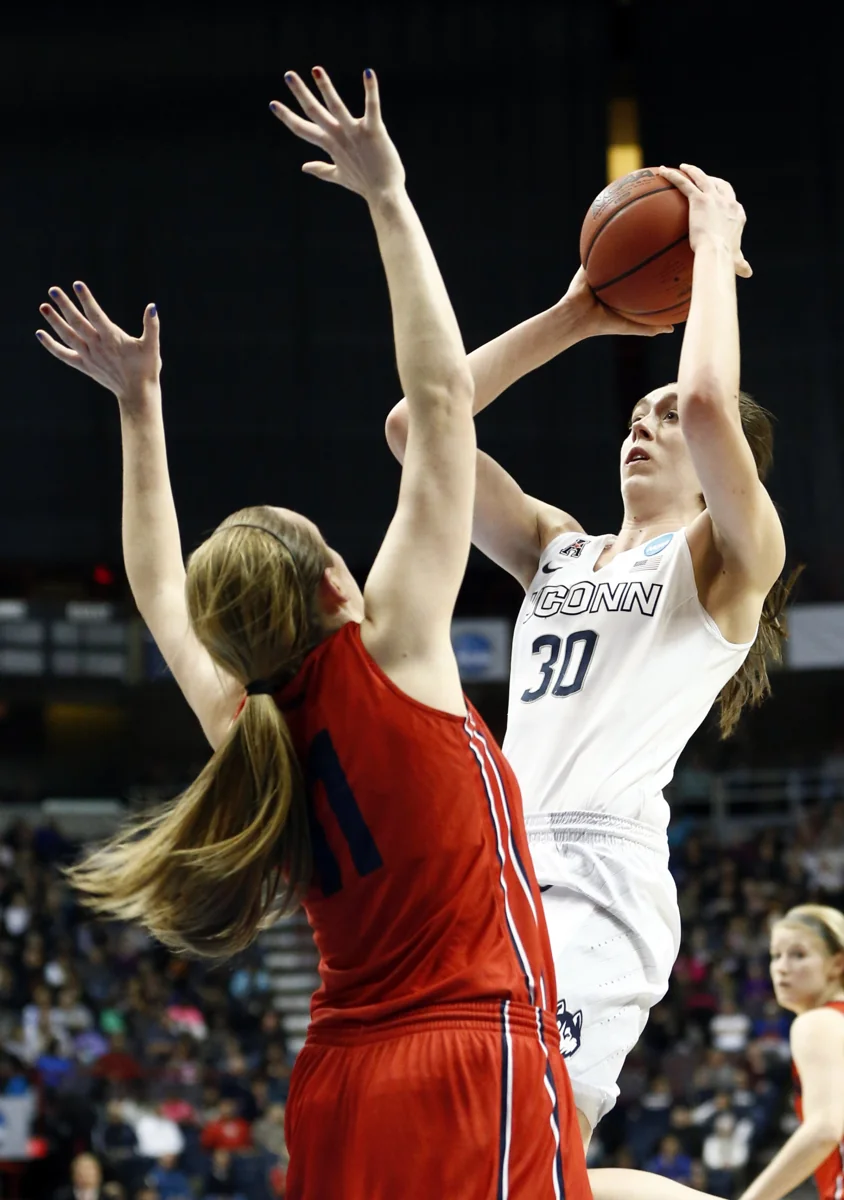
UConn won the 2015 NCAA women's basketball championship, beating Notre Dame 63-53 in Tampa on April 7. The Huskies finished 38-1 and captured their 10th title. This retrospective follows the bracket route, both semifinals, the final box score and the players who made the third consecutive championship possible.
UConn's 2015 championship route and the original bracket
UConn won the 2015 NCAA women's basketball championship by defeating Notre Dame 63-53 on April 7 at Amalie Arena in Tampa. The title completed a six-game national-tournament route and a 38-1 season. The official school schedule preserves the dates and results, while the NCAA's 2015 bracket places that route inside the full field.
| Date | Round | Opponent | UConn result |
|---|---|---|---|
| March 21 | First round | St. Francis Brooklyn | Won 89-33 |
| March 23 | Second round | Rutgers | Won 91-55 |
| March 28 | Sweet 16 | Texas | Won 105-54 |
| March 30 | Elite Eight | Dayton | Won 91-70 |
| April 5 | National semifinal | Maryland | Won 81-58 |
| April 7 | Championship | Notre Dame | Won 63-53 |
The 2015 field had 64 teams and no First Four. Its regional cities were Albany, Spokane, Oklahoma City and Greensboro, before the four regional winners met in Tampa. A modern bracket's opening games and regional arrangement should not be inserted into this older event. Historical tournament structure belongs to the year being discussed.
UConn's first two wins came in Storrs, followed by two in Albany. The opening three victories had final margins of 56, 36 and 51 points. That makes the favorite's strength clear, but it does not describe every stage of the run. The regional final changed the immediate task from maintaining a comfortable lead to overcoming a halftime deficit.
The Dayton regional final tested the favorite
Dayton led 44-43 at the break before UConn won 91-70. The published game report records the Huskies scoring the first nine points of the second half. The full half ended 48-26 in UConn's favor, a 22-point difference after a one-point deficit.
Kaleena Mosqueda-Lewis scored 27 points, while Breanna Stewart and Morgan Tuck added 23 each. Stewart also had 16 rebounds. Those separate contributions matter: UConn's response came from more than a single scorer having an isolated burst. The result established a Final Four place, but the halftime score preserves the resistance the Flyers had supplied.
For a historical reader, that distinction is more useful than describing the entire run as inevitable. A 21-point final margin and a one-point halftime deficit can coexist. The team had to produce the second-half separation; its top seed did not award it in advance. Dayton's opening performance remains part of the game even though UConn ultimately controlled the final result.
The path also distinguishes the national tournament from the full season. Six wins decided the NCAA trophy, while the 38-1 record describes all the qualifying season games. UConn's 2015 championship was part of a sustained title sequence, but it was not an unbeaten season. Understanding both facts gives the route a more accurate frame before the Tampa games are considered.
All four No. 1 seeds reached the Tampa Final Four
The 2015 Final Four contained UConn, Notre Dame, Maryland and South Carolina, all No. 1 seeds in their respective regions. The national semifinals were played on April 5 at Amalie Arena. Regional seeding had identified each as a leading contender, but the games still produced sharply different contests: a 23-point UConn win and a one-point Notre Dame win.
For the historical bracket, that matters more than simply calling the field strong. Each team had survived its own four-game route. Their arrival in Tampa did not mean those earlier routes had been identical, and it did not make the semifinal pairings interchangeable. The next opponent brought a different combination of size, scoring and personnel.
UConn separated from Maryland
UConn won 81-58 behind 25 points from Stewart and 24 from Tuck. The official semifinal box score adds eight rebounds for Stewart and nine for Tuck. Their combined 49 points represented a large share of UConn's offense, while Jefferson contributed 14 points and five assists.
The published game report describes Maryland keeping the game within six late in the opening half before Tuck scored the half's final five points. UConn entered the break ahead 44-33. The sequence explains part of the separation without treating the eventual margin as the score throughout the game.
The same box score records only four points from Mosqueda-Lewis but seven assists. That is a useful example of how a prominent scorer can contribute in another way on a particular night. One low scoring total does not erase a player's role in a win, just as a strong scoring night does not capture every teammate's work.
For Maryland, the result ended a successful route at the semifinal stage. For UConn, it created a title-game place and the opportunity to finish the third consecutive championship. The distinction is immediate: a semifinal win moves a team into the final, but it is not itself the final title.
Notre Dame survived South Carolina's late challenge
Notre Dame's 66-65 win depended on a late recovered possession. The school's historical Madison Cable account describes her gathering a missed Jewell Loyd shot and scoring from the right baseline with 19 seconds remaining. That basket gave the Irish the lead they retained.
The play illustrates why rebounding belongs inside a game's offensive story. A missed initial shot had not necessarily ended Notre Dame's chance to score. Securing the ball created another opportunity at the moment the team needed it. This is a specific recorded sequence, rather than a general assumption that every offensive rebound leads to a successful second chance.
The two semifinal results left UConn and Notre Dame in the championship, but their contrasting margins did not set the final's score in advance. UConn had separated from one opponent; Notre Dame had survived a close finish against another. The championship asked each to handle a new matchup, with the national title still undecided.
How UConn beat Notre Dame 63-53 in the championship game
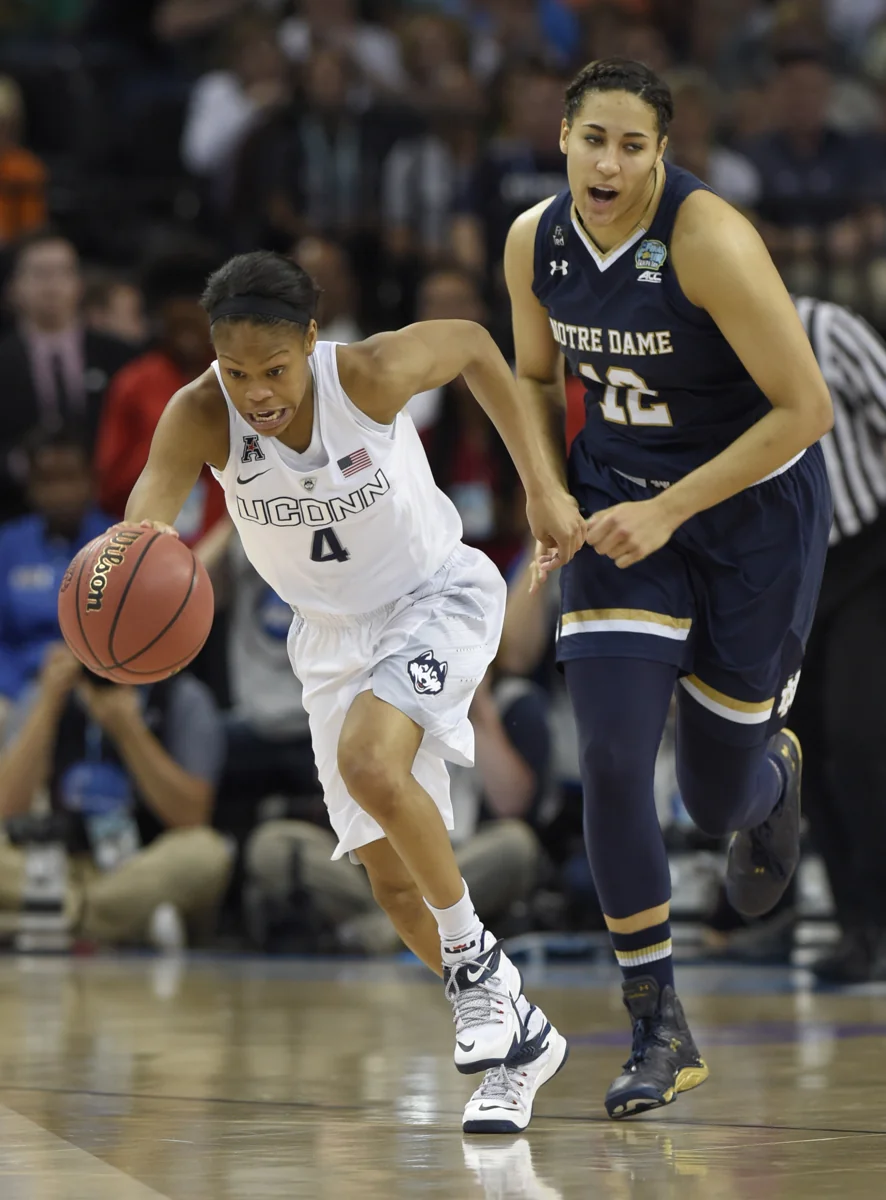
UConn led Notre Dame 31-23 at halftime and won 63-53. Mosqueda-Lewis and Jefferson scored 15 points each, while Stewart contributed eight points and 15 rebounds. The official final box score shows a game that requires a more careful explanation than a general claim that the winning team controlled every statistical category.
Notre Dame actually won the rebounding total 45-34, including 19 offensive rebounds to UConn's 11. Yet both teams recorded 10 second-chance points. The recovered misses did not translate into a scoring advantage in that category. This is a concrete example of why an offensive rebound is another opportunity, not automatically another successful basket.
UConn converted 25 of 61 field-goal attempts, or 41.0 percent. Notre Dame made 21 of 63, or 33.3 percent. The Irish had slightly more attempts but fewer makes. That difference establishes the importance of conversion in the recorded result, without allowing the box score alone to settle whether every miss came from a contested shot, an open shot or a particular defensive instruction.
The three-point difference was especially large in scoring terms. UConn made eight threes, producing 24 points, while Notre Dame made three, producing nine. The 15-point advantage from made threes exceeded the final 10-point margin. It was partly offset elsewhere: Notre Dame scored two more points from two-point field goals and three more from free throws. The arithmetic is 15 minus two minus three, equaling 10.
That calculation explains the scoreboard rather than inventing an extra performance statistic. UConn's 25 field goals included eight threes, leaving 17 two-point makes worth 34 points; its five free throws completed the 63. Notre Dame's 21 field goals included three threes, leaving 18 two-point makes worth 36; eight free throws completed the 53. Looking at the components makes the source of the difference visible.
Turnovers added another contrast. Notre Dame committed 17 against UConn's 12, and the Huskies recorded 15 points off turnovers against the Irish's six. These are related measurements, but they should not be added to the three-point difference as separate winning margins. A basket after a turnover can also be a three. The categories describe overlapping parts of the same possessions.
The individual lines reinforce the shared nature of the win. Jefferson had five assists and four steals as well as her 15 points. Tuck had 12 points and seven assists. Stewart's eight points came beside 15 rebounds and four blocks. Different players supplied scoring, creation and defensive contributions; the final did not need the same player to lead every category.
For Notre Dame, Brianna Turner finished with 14 points and 10 rebounds, while Loyd had 12 points on four-of-18 shooting. Their contrasting lines show why the Irish offense should not be reduced to a single collective shooting percentage. Individual production varied within the team even as the overall conversion rate trailed UConn's.
The published final report also records Notre Dame getting within six in the second half before a late Mosqueda-Lewis scoring stretch helped restore separation. The result was decisive, but the scoreboard still required an answer to that challenge. UConn's combination of made threes, better overall conversion and productive responses explains the title more accurately than attaching a broad label of dominance to every aspect of the game.
The players and historical significance of the 2015 title
The 2015 trophy was UConn's 10th NCAA championship and its third consecutive title. The program's championship history records a 38-1 season that ended with 37 consecutive victories. Those facts belong together: a long winning streak and a national championship do not make the complete season undefeated when an earlier loss remains in the record.
The distinction helps explain the shape of the achievement. UConn had to respond after losing, then maintain its performance through the rest of the schedule and six NCAA rounds. An unbeaten champion and a champion with one loss can each be exceptional, but they reached different statistical season outcomes. A retrospective should describe the one the team actually recorded.
The title also completed the college careers of seniors Mosqueda-Lewis and Stokes. UConn's historical account credits them with four Final Four trips and three national championships. Their senior endpoint is different from that of Stewart, Jefferson and Tuck, who continued into the following season. The 2015 team should therefore be understood through its actual mixture of experience rather than treated as an unchanged roster across every championship in the sequence.
Breanna Stewart's award and the team's shared production
Stewart received the Final Four's Most Outstanding Player award for the third time. Its scope is the Final Four, not simply a prize for the leading scorer in the championship game. Her 25-point semifinal and her eight-point, 15-rebound final belong to the same two-game event. The award and the final's scoring leaders can consequently identify different aspects of the team's success without contradicting one another.
The final season statistics show another layer. Stewart averaged 17.6 points and 7.8 rebounds and recorded 104 blocks. Those full-season figures describe a broader sample than the championship's two games. A player can have a final below her season scoring average while still making important contributions in other parts of that specific contest.
Mosqueda-Lewis averaged 14.9 points and made 121 threes on 248 attempts, a 48.8 percent conversion rate. The volume belongs beside the percentage. It was not a high percentage built from a handful of attempts; the record documents a substantial perimeter scoring contribution over the season. Her final-game shooting was one instance within that much larger body of work.
Jefferson averaged 12.4 points and finished with 191 assists and 100 steals. The April 6 Nancy Lieberman Award announcement recognized her point-guard play before the championship. Its statistics were an earlier snapshot; the completed season totals include the final. A historical source's date matters even when it concerns the same player and the same season.
Tuck's 14.4-point average and Nurse's 10.2-point average gave the team additional recorded scoring production. Their significance is not that five averages guarantee five double-digit scorers in every game. The final itself shows why that would be a mistaken assumption. They establish that UConn's season offense involved several players with sustained contributions, leaving different people able to lead on different nights.
Stokes recorded 147 blocks in 39 games while averaging 18.3 minutes, according to the completed statistics. That is another reminder that a team's value cannot be read entirely through starting status or points. Her documented shot-blocking contribution supplied a different kind of production from the guards' passing and perimeter shooting. A totals sheet cannot describe every defensive possession, but it can keep a role from disappearing merely because scoring is easier to summarize.
Put those records beside the tournament games and the team becomes more specific. Mosqueda-Lewis led the Dayton response, Stewart and Tuck led the Maryland scoring, and Jefferson and Mosqueda-Lewis shared the final's scoring lead. This sequence does not require a claim that every player performed identically throughout the run. It shows how several established contributions became useful at different stages.
UConn's April 12 celebration announcement places the national title after the American Athletic Conference regular-season and tournament titles. These were distinct achievements during the same season. The national trophy came last, after the team completed the route from Storrs through Albany to Tampa.
The champions-by-year guide provides the wider historical list. The particular value of 2015 lies in the games and people behind this entry: a challenged regional favorite, two contrasting semifinals and a final whose shooting and turnover advantages mattered more than winning every category. That fuller account gives the 10th title its own identity within the larger championship sequence.
Join the conversation
Share a question or a thought about the women's game. Comments are reviewed before they appear. Keep it friendly, stay on topic and leave out personal information.
No comments yet. Start the conversation.
Sign in with Google to leave a comment. Your email address is not displayed with your comment.