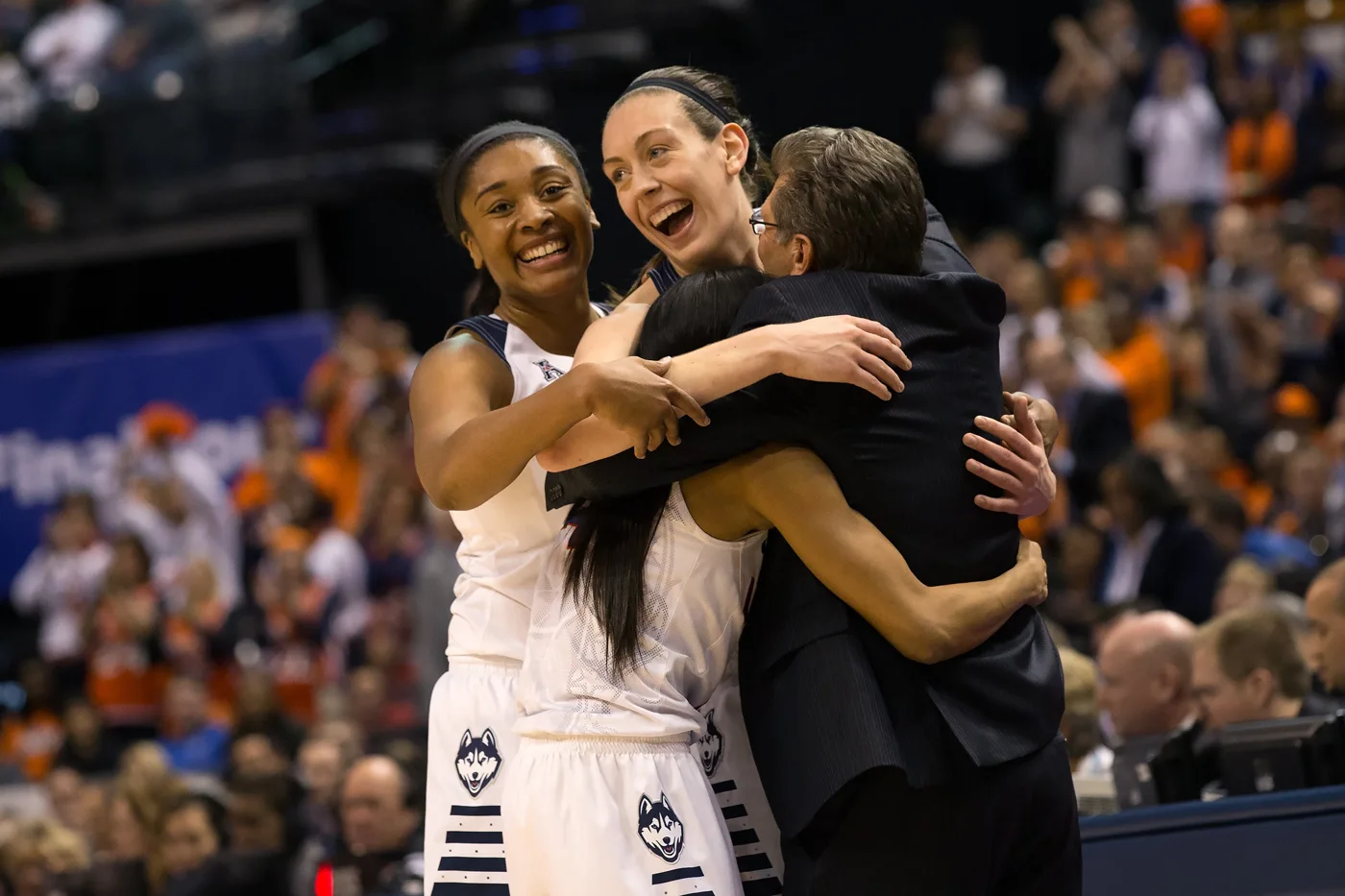
Cover: Morgan Tuck, Breanna Stewart and Moriah Jefferson celebrate their fourth championship with Geno Auriemma on April 5, 2016. Photograph: Stephen Slade ’89 (SFA) for UConn, via UConn Today.
UConn’s 2016 NCAA women’s basketball championship completed a fourth straight national title and an unbeaten season. This historical review follows the six victories that brought the Huskies to that result, the Syracuse run that created the final matchup, and the statistical story of an 82–51 championship game. It also separates the seniors’ four-year achievement from the record of one season, so the title’s different milestones remain clear. Every roster and result here belongs to the 2015–16 season, with archival sources checked October 14, 2026.
What UConn’s 2016 championship completed
UConn defeated Syracuse 82–51 on April 5, 2016, to win its fourth consecutive NCAA Division I women’s basketball championship. The final took place at Bankers Life Fieldhouse in Indianapolis. The Huskies finished the 2015–16 season 38–0 and earned the program’s eleventh national title. The fourth straight championship and the undefeated season were separate achievements, completed by the same final victory.
The dates matter in an archive. This championship game was played on a Tuesday, following the national semifinals on Sunday, April 3. It belongs to the 2015–16 season, not a modern tournament schedule whose final weekend follows a different calendar. Syracuse was the runner-up; Oregon State and Washington were the other semifinalists. A historical reader should keep that four-team field attached to the correct year.
Stewart, Jefferson and Tuck finished a four-title college run
Breanna Stewart, Moriah Jefferson and Morgan Tuck were the senior core associated with all four titles from 2013 through 2016. The NCAA’s career retrospective records Stewart’s 151–5 college record and the four consecutive championships. That is a four-year total, not the 2016 team’s season record. UConn could lose games during the wider college careers and still finish this particular season unbeaten.
The college run was extraordinary because the tournament’s elimination problem had to be solved repeatedly. Four six-game NCAA championship routes amount to 24 consecutive tournament victories. A loss in any one of those brackets would have ended that year’s championship attempt. The senior group’s achievement therefore required more than retaining a reputation for being the best program: the games had to keep confirming it every spring.
Stewart also received the Final Four’s Most Outstanding Player award in each of those four years. UConn’s contemporary university report identifies that distinction. It is a Final Four award, with a different scope from a regular-season player-of-the-year honor. Keeping the label intact explains why it is so closely connected to the championship sequence.
The seniors supplied continuity, but continuity itself did not score the next basket or secure the next rebound. Their significance becomes clearer through the games: Jefferson’s playmaking, Tuck’s scoring and Stewart’s wide statistical influence created different ways for opponents to be challenged. The championship final was their last college appearance together, making the conclusion both a team result and a career endpoint.
The school’s final report records the completed win. It should be read as an account from April 2016, with the streaks and title totals accurate to that moment. Later seasons changed UConn’s wider history. They did not change the four-title run this particular senior group finished in Indianapolis.
The Huskies’ six-game tournament route
The 2016 championship began in a 64-team bracket, so UConn needed six wins after entering the first round. Its official season schedule records two games in Storrs, two in Bridgeport and two in Indianapolis. The progression kept the early rounds in Connecticut before moving the remaining challenge to the national stage.
| Round | Date | UConn result |
|---|---|---|
| First round | March 19 | 101–49 vs. Robert Morris |
| Second round | March 21 | 97–51 vs. Duquesne |
| Sweet 16 | March 26 | 98–38 vs. Mississippi State |
| Elite Eight | March 28 | 86–65 vs. Texas |
| National semifinal | April 3 | 80–51 vs. Oregon State |
| Championship | April 5 | 82–51 vs. Syracuse |
The opening results were substantial, but Duquesne illustrates why the box score is more useful than the margin alone. Stewart scored 21, with Tuck and Jefferson contributing twenty each. UConn won the rebound comparison 51–31 and points in the paint 50–18, according to the second-round report. The scoring spread sat alongside control of interior opportunities.
Those categories describe different parts of the same result. Rebounding limits an opponent’s chances to extend a possession and can create further attempts for your own offense. Paint scoring records successful close-range production. Neither category alone explains every possession, but together they show why a reader should not attribute the 46-point win simply to the three seniors having recognizable names.
The 98–38 Sweet 16 victory against Mississippi State was the most lopsided result in the six-game route. The contemporary report identifies the sixty-point margin. It must remain attached to March 2016. Mississippi State’s later role in UConn’s history came in a different tournament with a different final result. An archive becomes misleading if the teams’ famous later meeting replaces the actual game being discussed.
Texas made the regional final more competitive, losing 86–65. Tuck scored 22 and Stewart had 21 points and thirteen rebounds, while Jefferson supplied eleven points and nine assists. The Texas report describes UConn answering a third-quarter run. The 21-point margin was the smallest of its tournament, yet still a decisive endpoint. It reflects both Texas’ ability to apply pressure and UConn’s ability to restore separation.
In the national semifinal, Tuck scored 21 and Stewart sixteen against Oregon State. The school’s report explains that Stewart’s first half was interrupted by foul trouble. A championship-caliber offense needed other production while its leading forward was constrained. Tuck’s scoring made those minutes useful rather than leaving UConn dependent on Stewart avoiding every possible problem.
All six wins came by at least 21 points. Their margins total 239 points, or approximately 39.8 per game when divided by six. That is the average for this NCAA run, not a season-long efficiency measure. It does not account for identical opponents or possessions, but it transparently describes how far ahead UConn finished these particular games.
The route supports the historical description of dominance while still leaving room for the games’ differences. Duquesne was decided with major interior production; Texas required an answer to a run; Oregon State presented early foul trouble for Stewart. A large average margin does not mean those were all the same contest. UConn made the final because it kept solving the next opponent’s actual challenge.
Syracuse reached its first final through the Sioux Falls bracket
Syracuse’s appearance in Indianapolis was a breakthrough on its own terms. The Orange entered as a No. 4 seed and won five times to reach the national championship game. Their contemporary championship notes record opening wins of 73–56 against Army West Point and 76–59 against Albany. That produced a trip to Sioux Falls, where two more wins transformed the program’s postseason history.
The Orange eliminated South Carolina and Tennessee
The 80–72 Sweet 16 victory against South Carolina required a recovery. Syracuse trailed 43–33 at halftime and 56–50 after three quarters. The Orange then scored thirty in the fourth, while South Carolina scored sixteen. Syracuse’s game report records Alexis Peterson with 26 points, Brianna Butler with eighteen and Brittney Sykes with seventeen.
The period scores explain why the win was more than an attractive eight-point margin. Syracuse had to erase a deficit and create separation in the same final quarter. Three productive guards gave the comeback several scoring contributors. The result removed the region’s No. 1 seed; it did not merely allow Syracuse to follow an already empty path through the bracket.
Two days later, Syracuse beat Tennessee 89–67 in the regional final. The school’s report confirms the first Final Four berth. Peterson scored 29, while Butler made six three-pointers. Syracuse made fourteen of thirty team attempts from beyond the arc, as the championship notes record. That supplied a different kind of successful scoring performance from the recovery against South Carolina.
The comparison matters because neither win should be reduced to an opponent’s historic name. South Carolina and Tennessee presented separate elimination games, with different trajectories and scoring demands. Syracuse earned the national semifinal by beating both. Its No. 4 seed was the starting placement; the five-game sequence would become the better description of what it accomplished.
A semifinal win that earned the UConn matchup
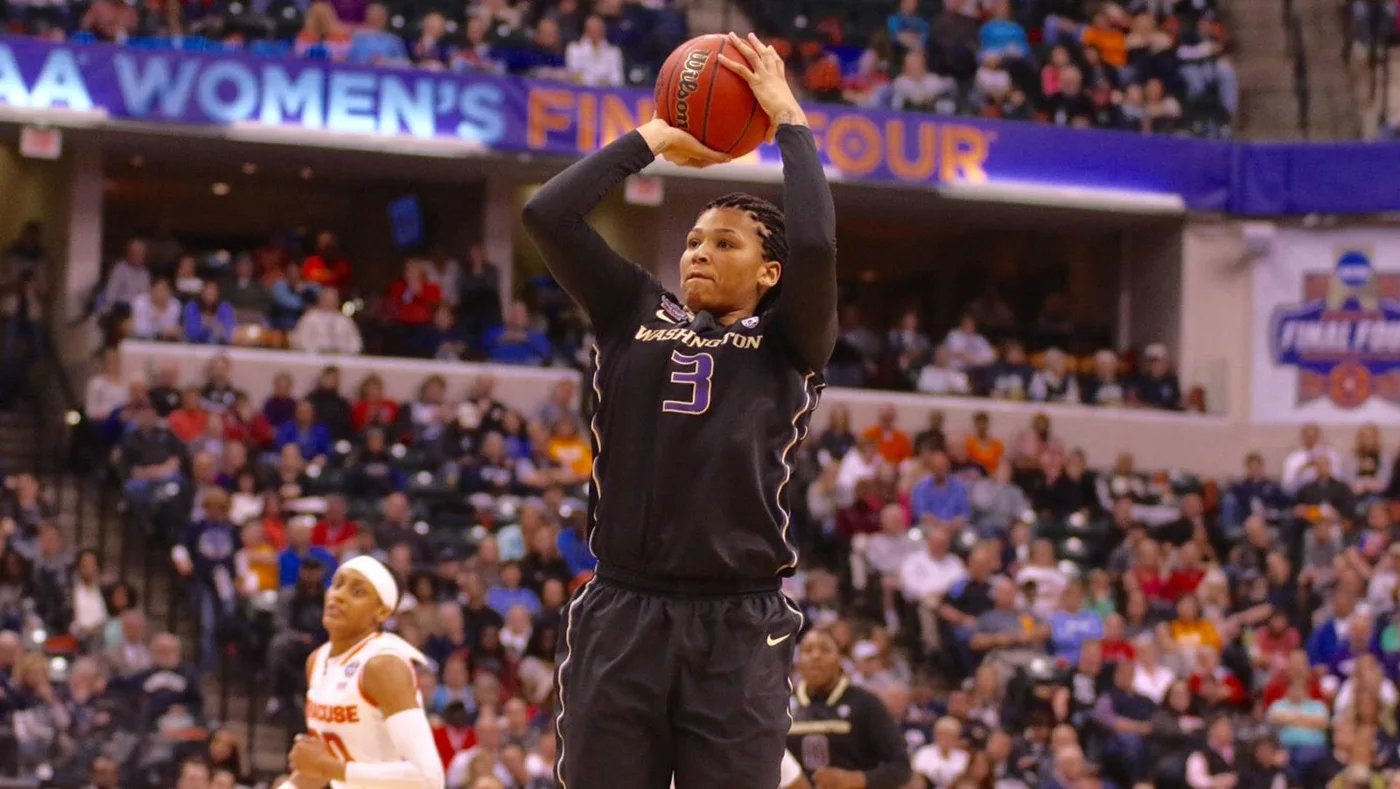
Syracuse defeated Washington 80–59 on April 3. Peterson had eighteen points and Sykes seventeen, according to Washington’s official account. When Washington reduced the gap to thirteen in the fourth quarter, Syracuse answered with consecutive three-pointers. The final score was substantial, but the answer to that late pressure still belonged to the winning performance.
Washington’s run ended in its first Final Four, just as Oregon State’s had earlier that evening. Syracuse, another first-time semifinalist, went one step further. The national weekend consequently paired a program pursuing a fourth straight title with three programs experiencing a new stage of NCAA success. UConn’s familiarity with Indianapolis did not make the achievements of the other three irrelevant.
For Syracuse, the final loss must sit beside those five victories. The Orange would finish 30–8 after falling to UConn, but their route had already established a first regional-final win, a first Final Four and a first championship appearance. A runner-up season has an ending short of the title; it can still represent the furthest a program has traveled.
That is the useful historical frame for the final matchup. Syracuse had demonstrated late-game recovery, guard scoring and successful outside shooting during the tournament. It now needed those tools to work against UConn. The matchup was earned by the Orange’s actual wins, even though the championship’s outcome would be much more one-sided than the Sweet 16 test that first changed their route.
How UConn turned the championship game into an 82–51 win
The championship was shaped early, but Syracuse still produced a substantial third-quarter response. UConn led 28–13 after one period and 50–23 at halftime. Syracuse won the third quarter 20–14, before UConn won the fourth 18–8. The official statistics preserve both the final margin and the period Syracuse successfully contested.
An early lead survived Syracuse’s third-quarter run
The Orange scored sixteen unanswered points to reduce the deficit to 60–43. Syracuse’s report records five forced turnovers and a stretch of five minutes without UConn scoring during the third quarter. That was a real defensive response, even though the gap remained seventeen points at the end of the run.
The size of the original lead explains why the run did not create a close final. Sixteen unanswered points can overturn a competitive game; against an advantage that large, they can leave the trailing team with considerable work still to do. UConn had already created a cushion through two productive quarters. Syracuse needed to sustain the recovery beyond that one burst to change the championship’s direction.
Instead, UConn entered the fourth ahead 64–43 and increased the margin by ten more points. The recovery had made the third quarter Syracuse’s strongest period, but it had not reversed the whole game. That is why the final 31-point margin and the sixteen-point Orange run can both describe the contest accurately. They refer to different scales of the same forty minutes.
Stewart’s all-around final and the team’s passing
Stewart finished with 24 points, ten rebounds and six assists. Tuck had nineteen points, seven rebounds and five assists; Jefferson had thirteen points and five assists. UConn recorded 22 assists on 28 made field goals. Dividing those totals gives approximately 78.6 percent of its made baskets associated with an assist. That is a calculation about successful field goals, not a measure of every pass or possession.
The passing totals help explain why Stewart’s influence was broader than a points total. Six credited assists meant successful baskets for teammates in addition to her own scoring. Tuck and Jefferson also connected individual production to team creation. The seniors were not three unrelated scorers taking turns; the official line shows several players helping convert opportunities for others.
There were errors as well. UConn committed seventeen turnovers, so the win should not be called flawless execution simply because the season record was flawless. An unbeaten season means no losses. It does not mean no bad passes, empty possessions or periods when the opponent played effectively. Syracuse’s third-quarter response is evidence of exactly that distinction.
The shooting and rebound comparisons still favored UConn decisively. The Huskies made 28 of 54 field-goal attempts and collected 43 rebounds, against Syracuse’s 22 of 62 and 27 rebounds. Those figures show a winner that converted shots more efficiently and completed more work on the glass. They do not identify every defensive coverage or establish how a particular matchup looked on film.
Why the senior farewell remains the central story
The university’s contemporary account places Stewart, Jefferson and Tuck together in the championship celebration. The final ended their college run with the same team achievement that had followed every previous spring. Four titles across four seasons made the senior farewell distinctive even within a program already familiar with national championships.
Syracuse’s players also reached a career endpoint within a historic season. The Orange’s report identifies thirty wins and the program’s first championship appearance. Those achievements should not disappear behind UConn’s record. The final established a clear winner, while the completed season established how far the runner-up had advanced.
The historical answer is UConn, 82–51, in Indianapolis on April 5, 2016. The explanation includes a powerful first half, an opponent’s genuine defensive run, passing shared across the senior core and a decisive closing period. Our champions-by-year guide supplies the wider timeline. This particular final is remembered because the team’s last win also completed one of the sport’s most remarkable college-career sequences.
Join the conversation
Share a question or a thought about the women's game. Comments are reviewed before they appear. Keep it friendly, stay on topic and leave out personal information.
No comments yet. Start the conversation.
Sign in with Google to leave a comment. Your email address is not displayed with your comment.