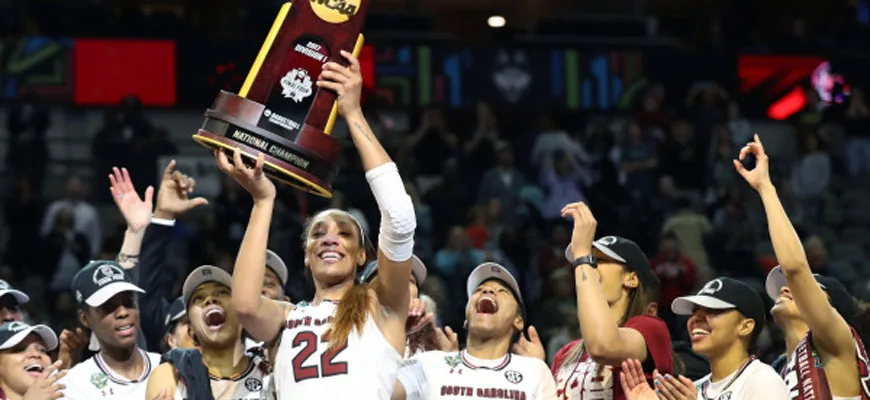
A’ja Wilson and South Carolina celebrate the 2017 championship. Photograph via the University of South Carolina.
South Carolina won the 2017 NCAA women’s basketball championship by beating Mississippi State 67–55 in Dallas. It was the Gamecocks’ first national title and Dawn Staley’s first as a head coach. The final followed two very different semifinals: Mississippi State ended UConn’s 111-game winning streak in overtime, while South Carolina recovered from a halftime deficit against Stanford. This retrospective follows the six-game title route, explains the championship box score and places the breakthrough within the program’s history.
The 2017 champion emerged from an all-SEC final
South Carolina won the 2017 NCAA Division I women’s basketball championship, defeating Mississippi State 67–55 on April 2 at American Airlines Center in Dallas. The Gamecocks finished 33–4 and secured their first national title. Mississippi State finished 34–5 as the national runner-up. The SEC’s title announcement and Mississippi State’s game report confirm the result.
The final involved two SEC programs, but the trophy was the NCAA national championship. Their conference relationship did not reduce it to another league tournament game. Each finalist had won a regional bracket, then a national semifinal, to earn a place in Dallas. The final victory completed South Carolina’s six-game NCAA run at the end of the 2016–17 college season.
Stanford and UConn were the other Final Four teams. The March 31 semifinals put South Carolina against Stanford and Mississippi State against the four-time defending champion. Those matchups created two distinct stories: the Gamecocks needed to recover from a halftime deficit, while the Bulldogs needed overtime and a winning shot at the buzzer to eliminate UConn.
Both finalists were making their first appearance in the national title game. South Carolina’s first championship consequently cannot be explained solely as the aftermath of somebody else ending UConn’s streak. The Gamecocks still had to win their own semifinal and beat the team that accomplished that upset. A dramatic elimination opens a possibility; it does not award the remaining trophy.
The university’s contemporary report identifies the championship as a program breakthrough. This retrospective keeps that achievement attached to the actual 2017 players, results and available lineup. Later South Carolina teams built their own records, but the first national title belonged to this team’s completed route through Dallas.
South Carolina’s six-win route continued without Alaina Coates
South Carolina played the NCAA tournament without senior center Alaina Coates, who was unavailable because of an ankle injury. The university’s account of her season confirms that absence. It is necessary context for the championship team’s available lineup. It does not erase her contribution to the season that brought the Gamecocks into the tournament.
An injury changes the players available to complete the next possession. It does not allow a retrospective writer to invent exactly how a healthy lineup would have performed. South Carolina’s accomplishment was winning the actual games with the players who could participate. Wilson, Allisha Gray and Kaela Davis provided different scoring resources within that available group.
| Round | Date | South Carolina result |
|---|---|---|
| First round | March 17 | 90–40 vs. UNC Asheville |
| Second round | March 19 | 71–68 vs. Arizona State |
| Sweet 16 | March 25 | 100–58 vs. Quinnipiac |
| Elite Eight | March 27 | 71–64 vs. Florida State |
| National semifinal | March 31 | 62–53 vs. Stanford |
| Championship | April 2 | 67–55 vs. Mississippi State |
The program’s subsequent official quick facts preserve those six results. The three-point second-round win against Arizona State is a useful corrective to remembering only the national final. A defeat there would have stopped the entire route before Stockton, regardless of how much championship potential remained in the roster.
The Stockton games tested more than one scorer
The 100–58 victory against Quinnipiac supplied a very different outcome. Quinnipiac’s report records Davis with 28 points, Wilson with 24 and Gray with nineteen. Davis made five of six three-point attempts, while Wilson made all ten of her free throws. The scoring came from outside shooting, successful field goals and the foul line, rather than a single productive area of the court.
That distribution matters when considering the loss of a center. Wilson remained a major scoring presence, but teammates supplied enough production to prevent the attack from being described as one player compensating alone. Three players combined for 71 points in that regional semifinal. A large total can obscure the detail; the individual lines show the different successful contributions inside it.
The regional final against Florida State ended 71–64, substantially closer than the Quinnipiac game. South Carolina still completed the two wins required in Stockton and returned to the Final Four. The final-margin comparison is useful as a description of the route’s different tests, not a claim that the Gamecocks necessarily played worse because they scored fewer points against another opponent.
The route consequently contained a close campus game, a high-scoring regional semifinal and a competitive regional final before Dallas. Coates’ absence was consistent across those stages; the opponents and scoring demands were not. The eventual champion kept finding enough production for the next game. That is the team accomplishment hidden by a simple list of scores or an account centered only on its best-known star.
The Final Four ended one streak and completed two first-time finalists
The March 31 semifinals changed the national championship field in two ways. Mississippi State beat UConn 66–64 in overtime, ending the Huskies’ 111-game winning streak. South Carolina beat Stanford 62–53 after trailing at halftime. Both winners earned a first national championship appearance, but the games required different forms of recovery and execution.
Mississippi State beat UConn at the overtime buzzer
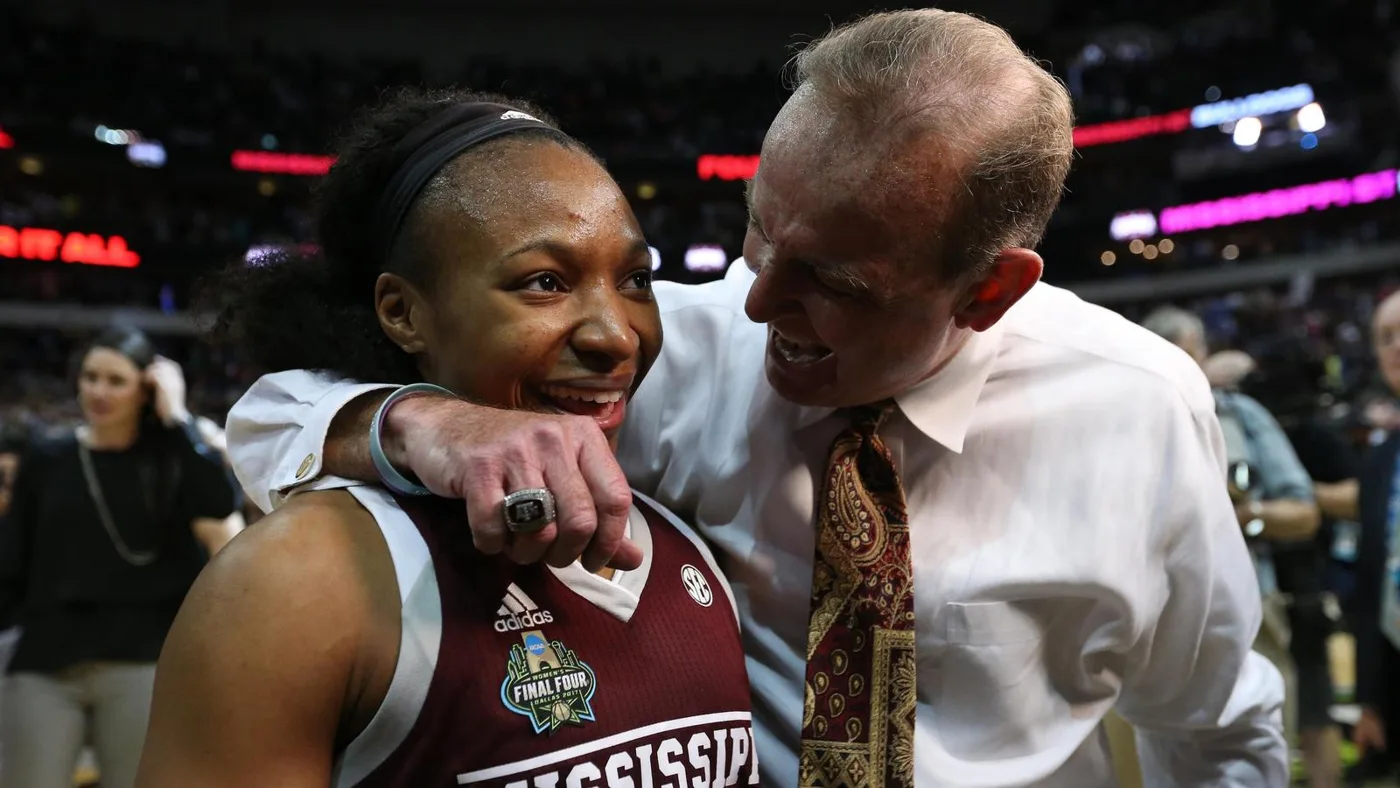
Morgan William’s jumper at the overtime buzzer decided the UConn game. Mississippi State’s report and UConn’s account confirm the finish. Regulation had ended 60–60. UConn’s Gabby Williams blocked an earlier William attempt, extending the game, but could not preserve the result in the extra period.
Those are two separate moments by players with similar names: Gabby Williams, the UConn forward, and Morgan William, the Mississippi State guard. The spelling matters when reading the historical play. One defensive effort helped force overtime; the eventual winning shot belonged to the opposing guard. Combining them into one loosely recalled buzzer sequence loses the actual order of the game.
The result ended UConn’s attempt to win a fifth consecutive championship. It did not erase the four titles already completed. The winning streak’s endpoint and the championship sequence’s endpoint occurred in the same semifinal, but they count different things: successive victories across games and successive national titles across seasons.
Mississippi State had lost 98–38 to UConn in the previous season’s Sweet 16. The two scores should remain separate. The 2017 overtime victory describes the performance of the team that played in Dallas, against that season’s UConn lineup. It does not prove that the 2016 teams would have produced a different outcome if their earlier game had been replayed.
South Carolina recovered against Stanford
Stanford led South Carolina 29–20 at halftime. The Gamecocks won the third quarter 21–8, leaving them ahead 41–37, then won the fourth 21–16. The official scoring record makes the turnaround explicit. A thirteen-point swing in the third period reversed a nine-point deficit and gave South Carolina an advantage it could build on.
Allisha Gray scored eighteen, while Wilson recorded thirteen points and nineteen rebounds. Stanford’s report and the SEC’s account confirm those contributions. Wilson’s lower scoring total did not make her irrelevant: the rebound total describes substantial work finishing or extending possessions while a teammate supplied the largest scoring line.
The comparison with Mississippi State’s game is instructive. The Bulldogs had to win beyond regulation; South Carolina had to reverse a difficult first half. Neither finalist reached Sunday simply by playing its preferred game without interruption. Each earned another opportunity by solving a problem within the semifinal it actually faced.
For the national final, the consequence was an all-SEC matchup with a new national champion guaranteed. UConn’s elimination drew exceptional attention, but South Carolina’s comeback was equally necessary to the final field. The Gamecocks were not waiting for a trophy after the streak ended. They still had forty minutes against the team that had just demonstrated its own ability to beat the reigning champion.
Why South Carolina beat Mississippi State 67–55
South Carolina won the championship without making a three-pointer. The Gamecocks finished zero for three from outside, but made 25 field goals overall and seventeen free throws. Mississippi State made nineteen field goals, including two threes, and fifteen free throws. The official box score makes the scoring comparison clear.
Wilson’s interior production and Gray’s double-double
Wilson scored 23 points and collected ten rebounds. Gray had eighteen points and ten rebounds. Their combined 41 points accounted for a substantial share of South Carolina’s 67, while both contributed to work on the glass. Two double-doubles gave the Gamecocks more than one major source of scoring and possession completion.
Wilson’s Final Four Most Outstanding Player award belongs beside that performance, but the game was not won by an award announcement. It was won through successful attempts and the work that made them possible. Gray’s contribution is especially useful in keeping the retrospective balanced: a reader concentrating only on Wilson would miss eighteen points and another ten rebounds from a teammate.
Mississippi State’s highest scorer was Victoria Vivians with twelve, followed by Dominique Dillingham with eleven. The Bulldogs’ leading lines were smaller than South Carolina’s two largest. That does not mean a team must have the highest individual scorer to win. Here, however, the more productive leading scorers accompanied the team that also finished ahead in the important overall comparisons.
The rebound and free-throw margins explain the score
South Carolina led the team rebound count 40–27. The total includes rebounds credited to the team rather than an individual player. Adding only the players’ rows produces a different South Carolina subtotal, so use the complete team comparison consistently. Rebounds matter because they help decide whether a miss ends a possession or creates another opportunity.
The free-throw line supplied seventeen South Carolina points against fifteen for Mississippi State. That two-point advantage was useful but smaller than the field-goal difference. Six additional made field goals supplied twelve points before allowing for the Bulldogs’ two extra points from three-point makes. Adding the two-point free-throw advantage restores the twelve-point final margin. This is a transparent scoring breakdown, not a claim that one category alone decided every possession.
Mississippi State still created pressure after trailing 36–26 at halftime. The Bulldogs reduced the deficit to four in the third quarter and again reached 54–50 with 6:52 remaining, according to their game report. South Carolina answered the later challenge with a 10–2 run. The final was not simply a lead that stayed at twelve throughout the evening.
The answer to that comeback separates the game from a highlights-only account of the previous semifinal. Mississippi State had shown it could beat UConn; on Sunday, it still needed enough successful offense to overcome South Carolina. The Gamecocks finished the more effective scoring performance in this matchup, even with an empty three-point column.
The result is a useful reminder that outside shooting is one route to a championship score, not the only route. South Carolina obtained every field-goal point from inside the arc and added a significant foul-line total. Those are the recorded facts. They explain how 67 was assembled without requiring an invented account of specific defensive coverages or a claim to have watched every possession on film.
What the first title meant for Staley and the Gamecocks
The 2017 championship changed South Carolina’s status from a program capable of reaching the national weekend to a program that had won its last game there. The distinction was concrete: a first final, followed by a first title. The university’s April 2017 account presents the victory as both a team milestone and a meaningful moment for Dawn Staley.
Staley had joined South Carolina in 2008 after coaching at Temple. As a Virginia player, she had reached three Final Fours without a national championship. Winning in Dallas was therefore her first NCAA title as a coach, with a different relationship to the game from her earlier playing achievements. The coach’s history helps explain the moment’s significance without implying that her players were simply completing somebody else’s personal story.
The players’ route remains the evidence of how the championship was earned. Coates contributed to the season before missing the NCAA tournament; the available lineup survived Arizona State, won the Stockton bracket, recovered against Stanford and answered Mississippi State’s final comeback. Wilson’s award and Gray’s double-double were parts of the completed team performance, not substitutes for that sequence.
A later university retrospective on Staley describes the broader program building and another national championship in 2022. That later result belongs to a different team and season. It makes the 2017 victory the first point in a longer championship history; it does not make the years that followed inevitable.
Mississippi State’s runner-up achievement also survives the final defeat. Thirty-four wins, a first Final Four and the overtime victory against UConn made it a historic season for the Bulldogs. South Carolina won the championship because it supplied the better final-game answer. Both programs’ completed achievements deserve their accurate labels in the archive.
For the wider timeline, the champions-by-year guide places 2017 beside earlier and later winners. The short answer is South Carolina, 67–55, on April 2 in Dallas. The fuller story is a team adapting to an absence, earning its own final berth and producing enough interior scoring and rebounding to finish the program’s first national title.
Join the conversation
Share a question or a thought about the women's game. Comments are reviewed before they appear. Keep it friendly, stay on topic and leave out personal information.
No comments yet. Start the conversation.
Sign in with Google to leave a comment. Your email address is not displayed with your comment.