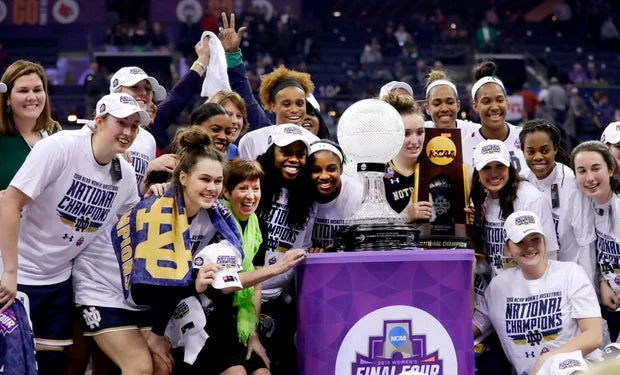
Notre Dame won the 2018 NCAA women's basketball championship with a 61–58 victory over Mississippi State. The famous final three-pointer was the last answer in a game that first required a 15-point comeback, and in a tournament run that included an overtime win over previously unbeaten UConn.
Cover: Notre Dame with the 2018 championship trophy. AP photograph via CBS News.
The result and the team behind the last shot
Notre Dame won the 2018 NCAA Division I women's basketball championship by beating Mississippi State 61–58 on April 1 at Nationwide Arena in Columbus, Ohio. Arike Ogunbowale's three-pointer left only one tenth of a second on the clock. The Fighting Irish finished 35–3, while the Bulldogs ended 37–2. It was Notre Dame's second national championship, following its 2001 victory, and both titles were coached by Muffet McGraw.
Those are the answers to the result search. Understanding the champion requires looking past the final shot. A championship game can be remembered through one player without having been won by one player. Jessica Shepard scored 19 points in the final, one more than Ogunbowale. Marina Mabrey and Jackie Young supplied the two baskets that erased a five-point deficit late in the fourth quarter. Without those contributions, a spectacular three at the end would have reduced a deficit rather than decided a title.
The Bulldogs' own championship report provides a useful counterweight to the winning highlight. Victoria Vivians scored 21 points, and Teaira McCowan collected 17 rebounds. Notre Dame had to overcome productive opponents with an established interior presence. Winning did not require making the opposing stars disappear; it required keeping the game within reach and making enough plays after a very poor offensive first half.
The familiar Irish lineup joined Ogunbowale, Mabrey, Young, Shepard and Kathryn Westbeld. Their names matter because they explain why the closing possession could involve several credible contributors. The inbounder, the scorer who had already sustained the comeback, and the guards who had just tied the game were all part of the same decision. Describing that collective responsibility is more accurate than treating everybody else as spectators to a star's moment.
Notre Dame also reached April with a reduced roster after multiple serious knee injuries during the wider season. That background gives the achievement weight, but it should not be used to invent details about fatigue or an individual player's medical condition in the final. The observable accomplishment is that the available group completed six tournament wins. Depth is partly a question of how many players are available; effectiveness is the separate question of what the players on court can actually produce.
For a reader following the championship through the bracket, the key distinction is between tournament seed and poll ranking. Both finalists were No. 1 seeds in their respective regions. A contemporary page calling Notre Dame fifth or Mississippi State fourth is referring to a ranking, not changing their positions in the NCAA bracket. The event was the conclusion of the 2017–18 college season, so its championship year is 2018 even though the team's schedule began in November 2017.
Six wins from South Bend to Columbus
A demanding regional route
Notre Dame's championship route began with a 99–81 victory over CSUN and a 98–72 victory over Villanova in South Bend. The Irish then beat Texas A&M 90–84 in the Sweet 16 and Oregon 84–74 in the regional final in Spokane. A six-point Sweet 16 win is a reminder that the champion's biggest danger did not necessarily arrive only after the bracket reached Columbus. Surviving the regional was a separate achievement with its own opponents and its own demands.
The official Oregon game report describes a stronger defensive second half as Notre Dame secured its Final Four place. The meaningful progression is from winning games in the nineties to finding a better defensive answer against a No. 2 seed. Scoring ability can carry an early round, but the later rounds ask whether a team can change the balance of a game when its opponent also has elite offensive personnel.
These results also show why an overall scoring average can hide the way a championship was earned. Notre Dame scored at least 84 in each of its first five tournament games, then needed only 61 to win the final. The same team won an overtime semifinal through sustained scoring and a championship through recovery in a much lower-scoring contest. There was no requirement that all six games resemble one ideal version of Irish basketball.
An overtime semifinal against unbeaten UConn
The March 30 semifinal finished 91–89 after overtime, ending UConn's unbeaten season at 36–1. Ogunbowale supplied the late jumper, but Jackie Young's 32 points and 11 rebounds are equally necessary to an account of how Notre Dame reached that final possession. In the official semifinal box score, Young made 10 of 15 field-goal attempts and 10 of 11 free throws. Ogunbowale added 27 points. A defense trying to solve one Irish guard still had another source of major scoring to confront.
Regulation ended 79–79. That distinction separates the semifinal winner from the final winner: the shot against UConn was a two-point jumper in overtime; the shot against Mississippi State was a three-pointer at the end of regulation. Combining them into a single vague buzzer-beater story loses the different circumstances of each game. Both shots were decisive, but the possessions that preceded them created different problems.
UConn made 38 field goals in the semifinal, including nine threes, yet finished with 89 points. That is a useful illustration of how the scoreboard gathers points from different places. Field-goal production is only part of the total; free throws can change the relationship between made baskets and the final result. The box score establishes what was produced, not whether an individual whistle was correct or which defensive instruction caused it. Notre Dame's advance rested on a complete night of production, followed by one final successful attempt.
How Notre Dame recovered against Mississippi State
Mississippi State led 30–17 at halftime. Notre Dame had scored only three points in the second quarter, all from one Shepard basket and the accompanying free throw. The deficit was therefore the consequence of an extended offensive breakdown, not simply a single bad possession before the break. A team cannot reliably plan to win a final after a three-point quarter; it can only respond to the game that remains.
The Bulldogs had reasons to believe their lead was sustainable. Vivians supplied scoring away from the basket, McCowan gave them an important interior target, and Notre Dame's offense had spent a long period producing almost nothing. The Irish comeback should not erase how well Mississippi State had established the original advantage. Doing so would make the eventual recovery seem easier than the score and sequence show it was.
The third quarter changed the final
Vivians hit a three with 6:41 left in the third quarter to put Mississippi State ahead 40–25. From that point, Notre Dame closed the quarter with a 16–1 run and entered the fourth tied 41–41. The larger quarter line was 24–11 in the Irish's favor: a 13-point gain that precisely removed the 13-point halftime deficit. That calculation makes the scale of the recovery visible without relying on a vague description of momentum.
The run needed stops as much as scoring. Even a productive stretch of offense cannot erase a large deficit if the opponent keeps answering. Notre Dame's final minutes of the third quarter reduced Mississippi State's scoring enough for its own baskets to accumulate into parity. This is a claim about the score sequence; it does not require asserting a specific defensive coverage that the available statistical record cannot demonstrate.
A tie after three quarters also changed the time pressure. When the Irish trailed by 15, every scoreless trip left fewer possessions for recovery. At 41–41, the remaining ten minutes could be played as a new contest on the scoreboard. Mississippi State still had the personnel to win it, and Notre Dame no longer needed to make up a large deficit merely to reach a competitive closing minute.
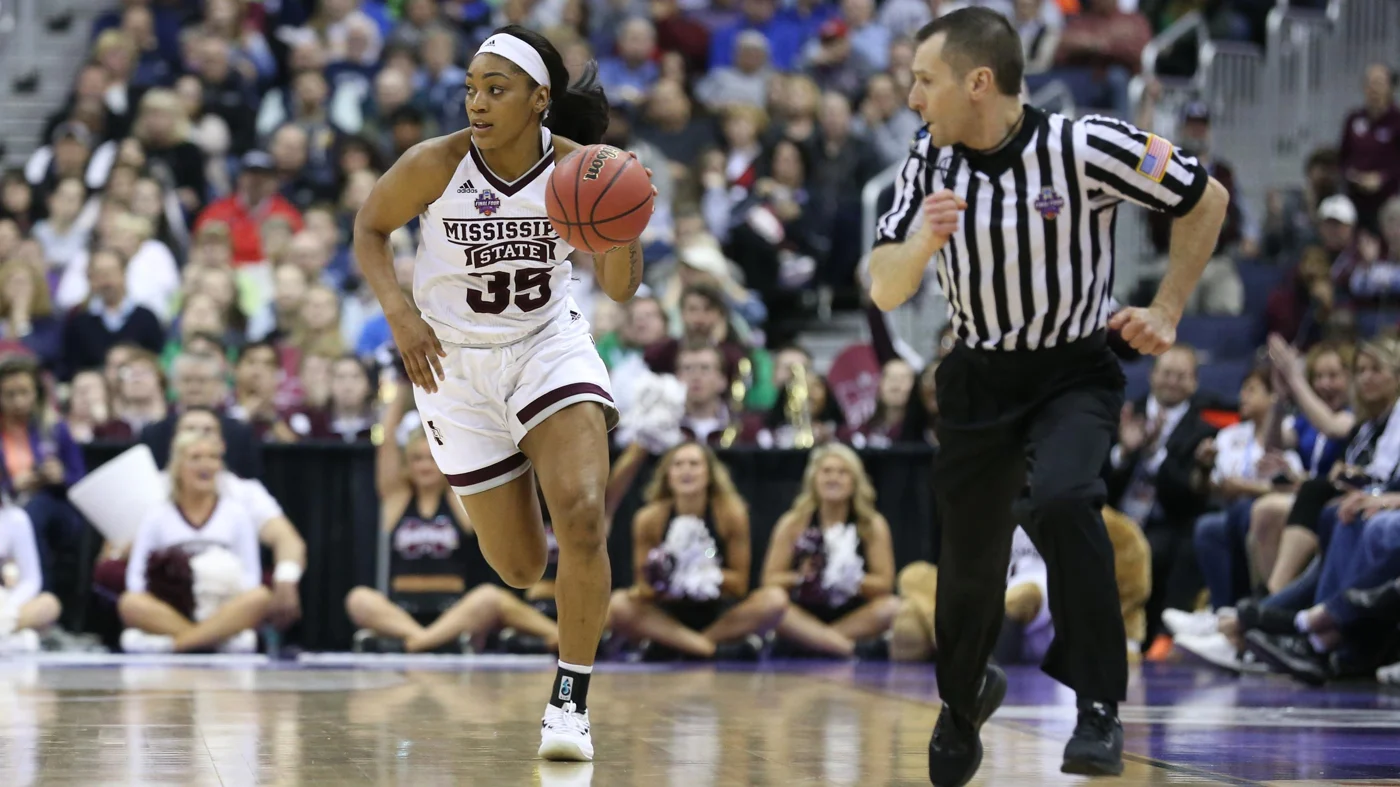
The Bulldogs did answer. Roshunda Johnson's three made it 58–53 with 1:58 remaining. Mabrey replied with a three, and Young tied the score on a jumper. In other words, the Irish completed two different recoveries: the large third-quarter rescue and the smaller, more urgent closing comeback. The second was essential because the first had only restored equality; it had not settled the championship.
Both teams then had unsuccessful possessions before Notre Dame inbounded with three seconds left. Young delivered the ball to Ogunbowale, who moved toward the corner and made the championship three. The Irish's contemporary account preserves that chain of stops, baskets and turnovers. The ending was remarkable because the opportunity was difficult, not because the preceding two minutes were irrelevant.
The final statistics give the comeback a second explanation. Both teams made 22 field goals. Mississippi State made four threes to Notre Dame's two, so the Bulldogs scored 48 points from the floor against the Irish's 46. At the foul line, Notre Dame went 15 of 17 and Mississippi State 10 of 17. The Irish's five-point advantage there overcame their two-point disadvantage in field-goal points, leaving the three-point winning margin. That is the scoreboard arithmetic behind 61–58.
Notre Dame also won despite losing the rebounding count 38–35 and committing 17 turnovers against Mississippi State's 15. Those numbers make this a recovery victory rather than a picture of comprehensive statistical control. The Bulldogs earned more shot attempts, but the Irish made the same number of baskets and converted more of their identical number of free-throw attempts. Efficiency on those available chances mattered as much as the more memorable difficulty of the final attempt.
What the 2018 championship changed
For Notre Dame, the result closed a 17-year gap between national titles. That does not mean the program had been absent from the championship conversation for 17 years. The Irish had returned to the final repeatedly. Winning again changed the conclusion of those seasons, rather than creating a successful program from nothing. The distinction matters when describing McGraw's work: building a team that can reach April and finishing the final game are related accomplishments, but they are not interchangeable.
The championship was also McGraw's 800th victory at Notre Dame, a milestone recognized in the school's contemporary report and in an April 2018 Congressional resolution. A single win could therefore serve as both a season's conclusion and a marker in a much longer coaching career. The final three points settled one tournament; the milestone behind that game reflected years of recruiting, development and successful seasons.
Ogunbowale's two closing shots give the championship an unusually compact identity. Fans can recall the entire weekend through a jumper and a three. Yet the best historical reading keeps two scales in view. The highlight explains why this championship remains so recognizable. The full six-game route explains why Notre Dame had the right to take those shots with its season still alive. One is the lasting image; the other is the competitive achievement.
Mississippi State's place in that history deserves equal precision. The Bulldogs were national runners-up for the second consecutive year, and their departing senior class had accumulated a school-record 126 victories. A final defeat does not remove the wins that brought them there. Nor does acknowledging their season make Notre Dame's championship less decisive. The Irish won the game, while the Bulldogs completed a sustained period of achievement that made the final a meeting of established contenders.
Mississippi State had earned its return with a 73–63 overtime win against Louisville. The school's semifinal account records McCowan's 21 points and 25 rebounds and Vivians's 25 points. Those were substantial performances before the final's disappointment. Remembering them prevents the losing finalist from becoming merely the team standing in the background of a famous celebration.
The two overtime semifinals also sharpen the meaning of the final. Both teams had already faced the immediate possibility of elimination in Columbus. Neither finalist arrived through a routine national semifinal in which the final minutes were inconsequential. That does not prove one was more tired than the other, or that overtime caused a particular missed shot on Sunday. It does establish that this national weekend required each team to solve an additional five minutes before it could even play for the championship.
There is a useful lesson for watching the final again: follow what the possession needs at that moment. During the third quarter, the Irish needed several successful trips and defensive stops to make the score manageable. With under two minutes left, they needed Mabrey and Young to restore parity. With three seconds left, they needed one player to create a makeable attempt quickly. Those are different basketball problems. The championship joined the answers into one completed result.
For the broader sequence of title winners, the champions-by-year guide places 2018 alongside earlier and later seasons. This particular title belongs to Notre Dame, 61–58, in Columbus. Its enduring quality is that the winning image can be understood immediately, while the comeback and the contributions beneath it reward a much closer look.
Join the conversation
Share a question or a thought about the women's game. Comments are reviewed before they appear. Keep it friendly, stay on topic and leave out personal information.
No comments yet. Start the conversation.
Sign in with Google to leave a comment. Your email address is not displayed with your comment.