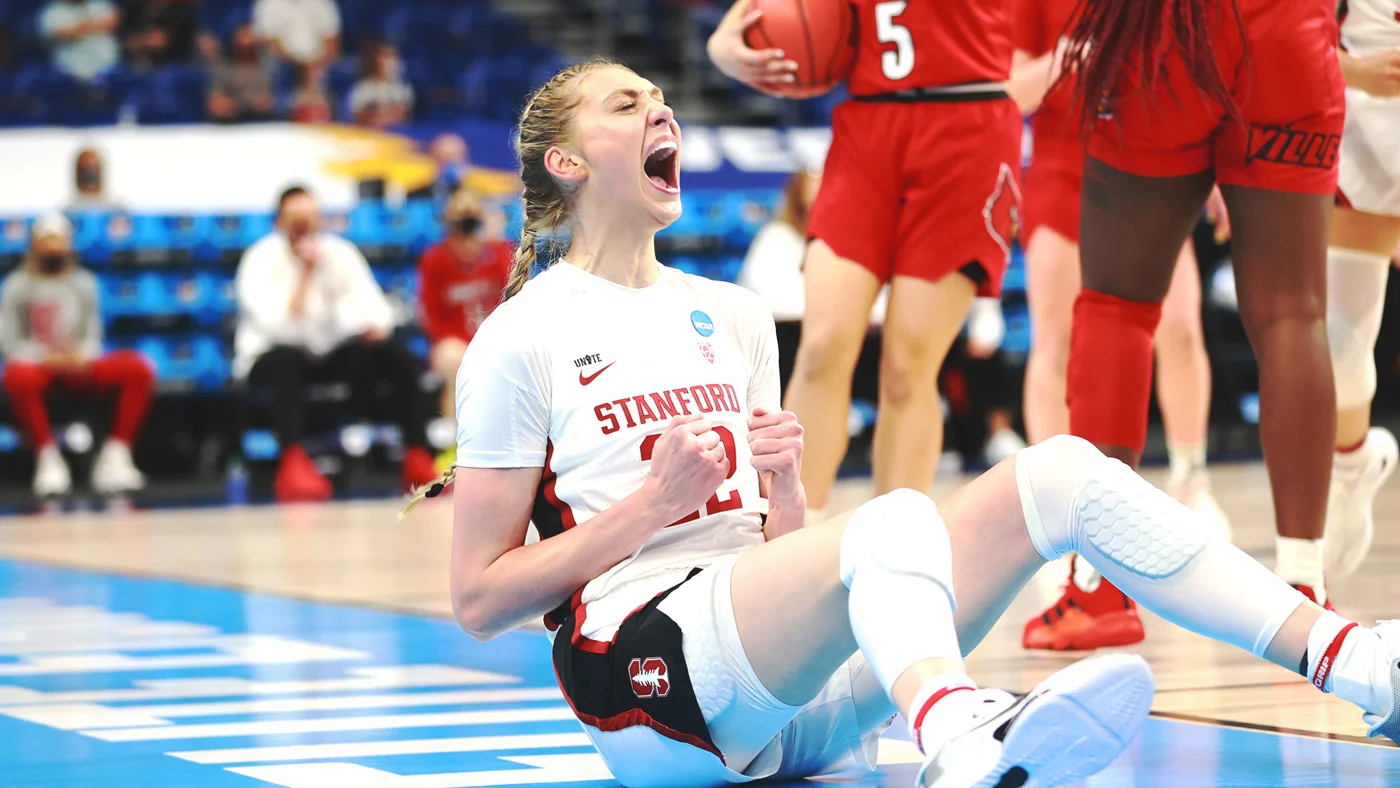
Stanford won the 2021 NCAA women's basketball championship by one point, defeating Arizona 54–53 in San Antonio. The final completed a season of disrupted travel and a tournament in which the Cardinal survived both national games on the opponent's last possession. Haley Jones supplied decisive scoring, while the roster's rebounding helped Stanford hold just enough of an advantage to finish its third national title.
Cover: Stanford during its 2021 regional final against Louisville. Photograph via Stanford Athletics.
Stanford’s 54–53 championship and its setting
Stanford won the 2021 NCAA Division I women's basketball championship, defeating Arizona 54–53 on April 4 at the Alamodome in San Antonio, Texas. The Cardinal finished the 2020–21 season 31–2, and the Wildcats finished 21–6. It was Stanford's third NCAA title and the first since 1992, following earlier championships in 1990 and 1992 under Tara VanDerveer.
The one-point result captures the tension of the final, but the setting explains why the season occupied an unusual place in college basketball history. The 2020 tournament had been canceled. The 2021 event brought the championship back in a centralized San Antonio-area arrangement during the COVID-19 pandemic. The trophy remained the reward for winning the national tournament, but the travel, preparation and daily surroundings differed markedly from a normal season.
Stanford had already spent much of its season adapting to restrictions that prevented its usual home routine. The university's year-in-review account places the championship within the disruptions experienced by its teams. For women's basketball, nominal home games and the actual location of practice and competition did not always match a familiar campus schedule. A game listed as home should therefore not automatically be imagined as a normal night at Maples Pavilion.
The contemporary final report describes the Cardinal being away for nearly ten weeks and spending 86 days in hotels over the season. Those are measures of disruption, rather than a claim that every hotel day belonged to one uninterrupted road trip. Their relevance is practical: recovery, preparation and living arrangements were repeatedly managed away from a normal home base. The team still had to convert that adaptability into better basketball than the opponent in front of it.
The national final brought together two Pac-12 teams. Stanford was a No. 1 seed, while Arizona had advanced as a No. 3 seed. Their conference familiarity did not make the championship outcome routine. A national tournament game is its own contest, and a one-point margin demonstrates how little protection earlier success can provide once the final minutes arrive. Stanford had to defend the last possession even after establishing leads earlier in the game.
That final possession ended with Aari McDonald's contested attempt missing at the buzzer. The Arizona-hosted championship report records both the outcome and the Wildcats' late recovery. The winning answer is Stanford, but the manner of victory was survival against a team that kept creating one more chance. The Cardinal's third title required six NCAA wins, including the ability to finish a game in which its own offense had stopped adding points.
The roster that made Stanford difficult to solve
Haley Jones was Stanford's leading scorer in the final with 17 points, and her eight rebounds added another part of the work. She made eight of 14 field-goal attempts. That production was especially valuable in a game in which the Cardinal did not build its total from a large volume of threes or frequent trips to the line. Jones supplied reliable baskets when the overall contest was becoming increasingly difficult to score in.
The official final box score shows Lexie Hull contributing ten points and ten rebounds. Double-digit rebounding from that position helped Stanford finish defensive possessions and recover some of its own misses. In a final decided by one point, a rebound's value is not limited to whether the player who collected it then scored. Securing possession can prevent an opponent from getting another attempt or give a teammate a new chance.
Interior scoring with perimeter support
Cameron Brink added ten points, six rebounds and three blocks in 20 minutes. Ashten Prechtel provided seven points and eight rebounds in 21 minutes off the bench. Their combined production matters because it gave Stanford meaningful minutes from more than one frontcourt player. A substitution did not necessarily mean conceding the glass or abandoning scoring around the basket. The final required contributions distributed across the rotation, rather than a single scorer carrying every lineup.
Kiana Williams and Anna Wilson each scored five points. Williams had three assists and played all 40 minutes; Wilson also had three assists. Those modest scoring totals should be read beside the jobs the guards performed and the conditions of the game. A team can need a guard's organization and passing while another player finishes more of the possessions. Conversely, handling the ball also brings responsibility for keeping it: Stanford's turnover total was a major reason Arizona stayed close.
The team rebounding count was 47–29 in Stanford's favor, an 18-rebound advantage. The turnover count ran in the opposite direction: Stanford committed 21, while Arizona committed six. These were competing forces within the same game. Stanford collected more missed shots, but Arizona avoided giving away possessions nearly as often. The rebounding margin helped the Cardinal survive; the turnover disparity kept the game from becoming the comfortable win that the rebound count alone might suggest.
Stanford made 24 of 57 shots, compared with Arizona's 17 of 59. The Wildcats nevertheless produced six three-pointers and 13 free throws, while Stanford had four threes and only two free throws. Those different scoring mixes explain how a seven-basket advantage could lead to a one-point result. Arizona recovered points from higher-value field goals and the foul line. Stanford's more successful overall shooting was necessary, but it did not remove the consequences of its lost possessions.
That is the most useful way to understand the roster in this particular final. Jones, Hull, Brink and Prechtel gave Stanford scoring and rebounding across several positions. The guards supplied distribution and perimeter baskets, yet the team still encountered Arizona's pressure and disruption. The championship lineup was strong enough to win without being flawless. Its strengths created a narrow reserve that its mistakes almost exhausted.
The six-game route and two one-point finishes
Stanford opened its NCAA run by beating Utah Valley 87–44, Oklahoma State 73–62 and Missouri State 89–62. Those results established a different early tournament rhythm from the final weekend. The Cardinal scored freely and advanced without the same last-possession uncertainty. Even so, each round had to be completed before the bracket could offer a chance at the national championship.
Louisville and the regional turnaround
The regional final was the first major rescue operation. Stanford trailed Louisville by 12 at halftime before winning 78–63. The final 15-point margin can hide how serious the danger had been: the Cardinal gained 27 points relative to Louisville across the second half. It was a substantial reversal, not simply the favorite gradually protecting an early advantage.
Prechtel scored all 16 of her points after halftime and made every one of her six field-goal attempts, including three threes. Lexie Hull scored 21. The official regional-final report makes the bench contribution central to the turnaround. A player who had not supplied the opening-half points changed the scoring possibilities after the break. That is the practical value of having an alternative frontcourt look when a game is going badly.
Prechtel's three-point shooting also illustrates why listing players simply as guards and posts can miss their actual effect. A frontcourt player who can score outside the arc presents a different set of scoring opportunities from one limited to finishing near the rim. Her perfect shooting did not establish that Stanford would always find that answer, but it gave this team a way back in this specific elimination game.
South Carolina and Arizona came down to the last possession
The April 2 semifinal ended Stanford 66, South Carolina 65. Jones scored 24 points on 11-of-14 shooting. Destanni Henderson had put the Gamecocks ahead with six consecutive late points, but Jones answered with a jumper with 32 seconds left. South Carolina then had the chance to win at the end, and Aliyah Boston's final putback did not fall. Stanford's semifinal account records a finish in which a made shot and a final defensive survival had to work together.
The title game followed two days later and again left the opponent holding the last chance. Stanford led Arizona 31–24 at halftime and 43–40 after three quarters. The Wildcats kept reducing the space between them. The final's pace and shooting struggles made a short run capable of changing the entire picture, and Stanford could not afford to treat its earlier lead as if it were an answer to the closing possessions.
McDonald's three cut the Stanford advantage to 51–50. Jones responded with a basket and a free throw with 2:24 remaining, establishing the Cardinal's final total of 54. Arizona then moved within one as McDonald converted three of four late free throws. Stanford's next possession ended without a shot before the shot clock expired, leaving Arizona 6.1 seconds and a chance to become champion.
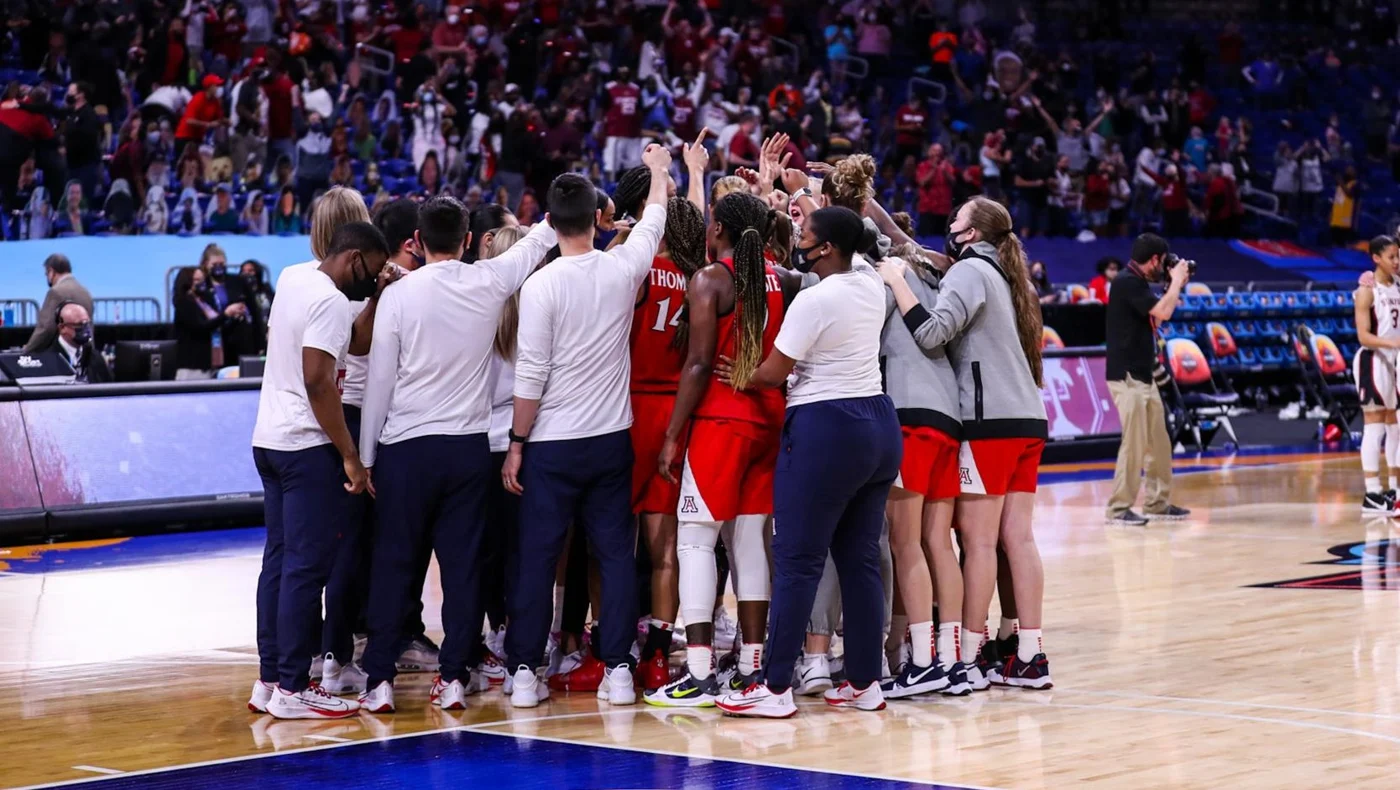
McDonald's final attempt missed. Stanford had survived the national semifinal and final by a combined two points, but those were two separate wins rather than one narrow aggregate contest. The Cardinal needed to prevail in each. No reserve of points from a convincing opening round could be carried into either final possession; the tournament required Stanford to hold its place anew.
The two endings also show the value of a useful lead before an offensive drought. Stanford did not score again after Jones's three-point play, yet it remained in front. Earlier baskets and defensive rebounds had created just enough protection. The championship was secured when the Wildcats' last attempt stayed out, but the score that it preserved had been built over the preceding 40 minutes.
Arizona’s breakthrough and the meaning of Stanford’s title
Arizona's first national championship game was an achievement that existed independently of the final shot. Adia Barnes's team had reached the NCAA tournament for the first time since 2005 and advanced all the way to the last game. That progression changed the program's competitive reference point. A successful season no longer had to be described only in terms of returning to the field; this team had demonstrated that it could beat opponents deep into the national bracket.
The Wildcats reached the final by beating UConn 69–59, with McDonald scoring 26 points. That semifinal was not a case of Arizona merely surviving until a favorite made a mistake in the final second. The Wildcats earned a ten-point win and placed the tournament's other finalist under pressure throughout the closing stage. McDonald's scoring was prominent, but the defensive result made the performance more than a one-player offensive story.
The building process had already produced a different postseason title. Arizona won the WNIT in 2019, defeating Northwestern 56–42 in Tucson. The original university report records a sold-out crowd of 14,644 at McKale Center, as well as McDonald's 19 points and Cate Reese's 13 points and nine rebounds. The WNIT championship and the NCAA runner-up finish were different honors, but they provide concrete markers of the program's growth.
That earlier crowd is relevant because the 2021 run did not create interest from an empty starting point. Fans in Tucson had already filled an arena for a postseason championship. The NCAA run carried that developing ambition onto a larger stage. The absence of a 2020 NCAA tournament interrupted the usual year-to-year sequence, making it especially important to distinguish what had actually been won from what a promising canceled season might have produced.
Stanford's story came from the other direction. The Cardinal did not need to demonstrate that the program could belong in major national games; it needed to finish another season as champion. Twenty-nine years separated the 1992 and 2021 titles. A long gap between trophies can contain excellent teams and deep tournament runs. The 2021 result therefore completed a new championship without requiring earlier Stanford teams to be dismissed as failures.
Jones received the Final Four's Most Outstanding Player honor. The award fits the decisive scoring she supplied in both national games, while the roster's rebounding and the defensive last possessions explain the team result around her. Championship basketball is capable of producing a deserving individual award and an equally convincing collective story. Stanford's win is a particularly clear example because a single lost rebound or one additional opponent basket could have changed its conclusion.
For readers comparing champions across years, the historical champions guide puts Stanford's return beside earlier and later winners. The 2021 entry is the Cardinal, with Arizona as runner-up. Its defining details are the unusual season, a regional comeback powered by a reserve, and two national games in which Stanford held on by a single point. Each detail explains a different part of how a highly accomplished program finally added its third championship.
Join the conversation
Share a question or a thought about the women's game. Comments are reviewed before they appear. Keep it friendly, stay on topic and leave out personal information.
No comments yet. Start the conversation.
Sign in with Google to leave a comment. Your email address is not displayed with your comment.