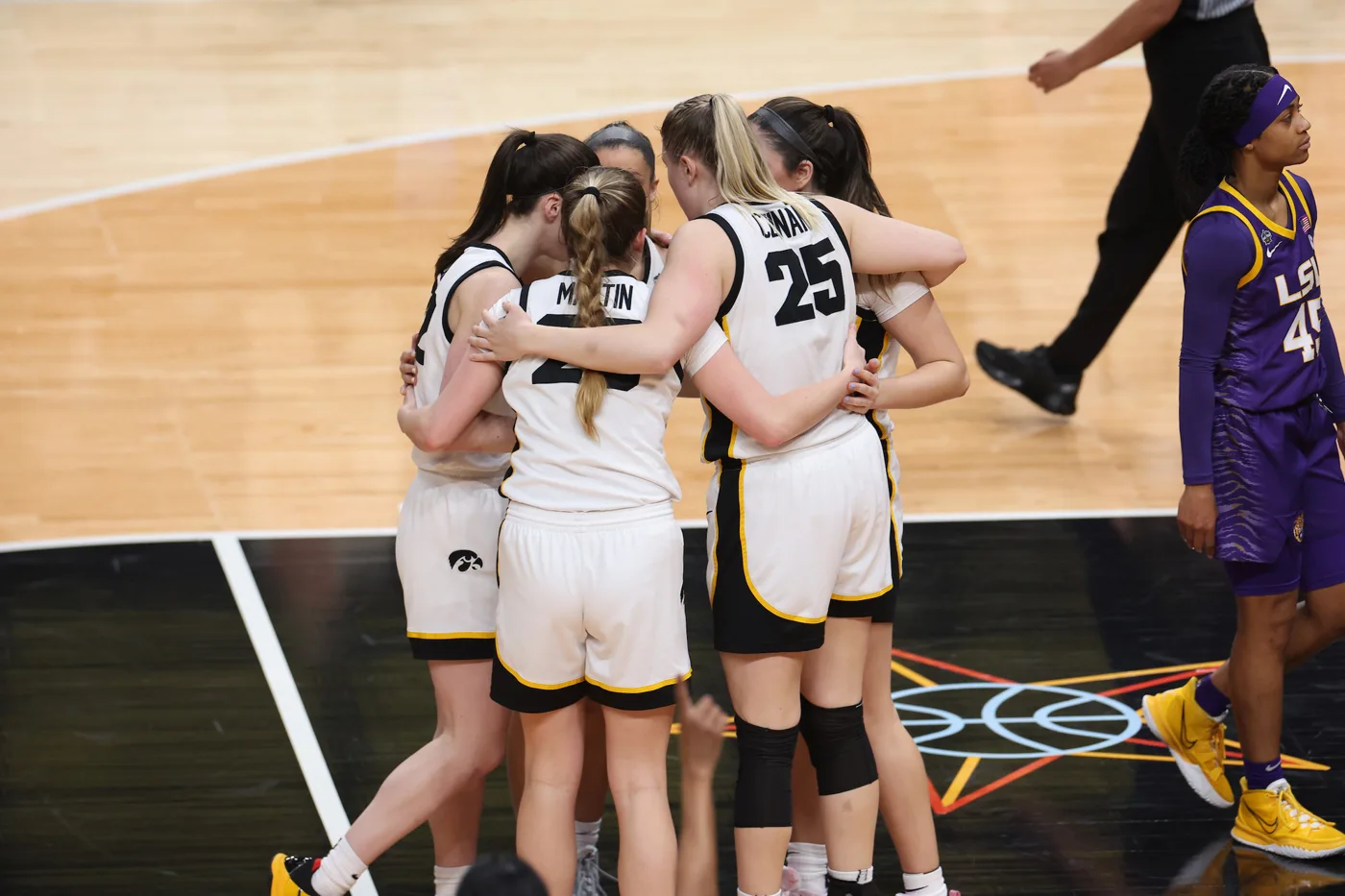
Cover: Iowa players gather together during the 2023 championship game against LSU, with an LSU player visible at right. Photograph via Iowa Athletics; the page does not identify an individual photographer.
The 2023 NCAA women’s basketball tournament delivered LSU’s first championship after two dramatic national semifinals. This historical guide covers the bracket’s route to Dallas, all six LSU results, Iowa’s win over unbeaten South Carolina and the bench scoring that shaped the final. It concerns the 2022–23 season; research checked October 14, 2026.
The 2023 bracket moved from campus courts to Dallas
LSU won the 2023 NCAA Division I women’s basketball championship, defeating Iowa 102–85 on April 2 at American Airlines Center in Dallas. It was the Tigers’ first national title. Iowa was the runner-up, while South Carolina and Virginia Tech lost the national semifinals. The tournament concluded the 2022–23 college season, with a champion whose route included both a 54–42 regional final win and a 102-point national final.
The 68-team event began with the First Four on March 15–16. First- and second-round games followed March 17–20; the regional rounds ran March 24–27. Dallas hosted the national semifinals March 31 and the championship April 2. The NCAA’s historical bracket remains the all-round reference. These dates describe completed basketball, not an upcoming ticket or television schedule.
Four regional winners across two host cities
The regional format changed in 2023. Instead of four separate host cities, Greenville and Seattle each accommodated eight Sweet 16 teams across two regions. The original committee announcement carried by Bon Secours Wellness Arena explains the arrangement. Each city held two regional finals, so each produced two teams for Dallas. The tournament still had four regional champions.
South Carolina won Greenville 1 and LSU won Greenville 2. Virginia Tech won Seattle 3 and Iowa won Seattle 4. LSU’s selection announcement identified the Tigers as a No. 3 seed. Iowa was a No. 2 seed, and South Carolina and Virginia Tech were No. 1 seeds. Half the final field therefore came from below the top seed line, while two top seeds still reached the national weekend.
The seed labels explain the starting bracket, not the final hierarchy. LSU did not need to be placed first to become champion. It needed to win the opponents its bracket actually presented, then solve two more national games. Likewise, an early exit by a highly seeded team opened a route for another program without transferring that eliminated team’s reputation to the eventual matchup.
Dallas also hosted championship games from the other NCAA divisions during the same weekend, as the NCAA’s event announcement explains. Those were separate competitions. Here, every result and player reference concerns Division I. Keeping the division, season and regional label attached to an archive prevents a shared city or championship weekend from becoming a misleading combined bracket.
LSU’s six wins required very different kinds of offense
LSU’s championship route began in Baton Rouge against Hawaii and Michigan, moved to Greenville for Utah and Miami, and ended in Dallas against Virginia Tech and Iowa. That progression matters because the Tigers did not reproduce one scoring formula through six games. The regional final demanded survival on a poor shooting night; the national final would bring an extraordinary shooting contribution from the bench.
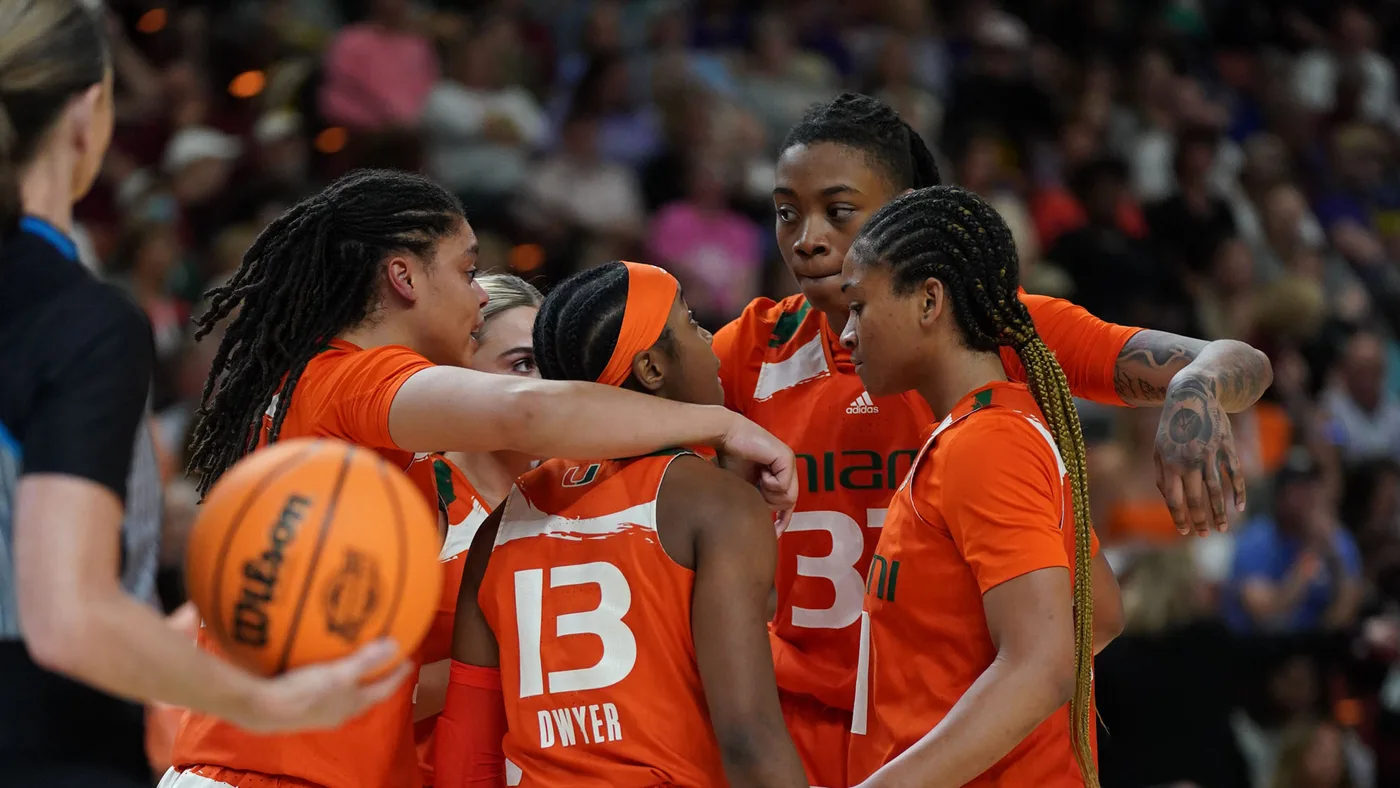
| Round | Date | LSU result |
|---|---|---|
| First round | March 17 | 73–50 vs. Hawaii |
| Second round | March 19 | 66–42 vs. Michigan |
| Sweet 16 | March 24 | 66–63 vs. Utah |
| Elite Eight | March 26 | 54–42 vs. Miami |
| National semifinal | March 31 | 79–72 vs. Virginia Tech |
| Championship | April 2 | 102–85 vs. Iowa |
Michigan supplied an early illustration of how rebounding could make LSU effective without exceptional accuracy. Angel Reese finished with 25 points and 24 rebounds, including 14 offensive boards. LSU shot 35.3 percent but won the rebound count 46–26, according to the school’s second-round report. The 24-point margin should not be mistaken for evidence that nearly every shot went in.
An offensive rebound keeps a missed attempt from becoming the end of the possession. A defensive rebound finishes the opponent’s chance to continue its own possession. Reese’s line contained both kinds of work, and her offensive total explains why poor initial shooting did not necessarily deny LSU further opportunities. It is a more useful reading than treating all rebounds as interchangeable decoration beside the scoring column.
Utah created a much tighter game, losing 66–63 in the Sweet 16. The Utes’ official report records a contest decided in its closing moments. LSU forward LaDazhia Williams scored 24 points, while Alexis Morris added 15. A three-point margin leaves a single successful outside shot as the difference between the completed result and a possible tie; it gives late free throws and the retention of possession particular significance.
That close result belongs in the championship story even though it did not come in Dallas. A team that loses in the regional semifinal never gets to display its later final form. Williams’ scoring and the guards’ work in the closing stretch supplied a route to the next game. The eventual 102-point performance cannot be used retroactively to make the Utah test look easy.
Miami then held LSU to 54 points and Reese to three made field goals in 15 attempts. The Hurricanes still lost 54–42. Miami’s report describes the defensive success against Reese and the completed result. Limiting an opponent’s best-known scorer can be an effective element of a game plan without being sufficient to win. The other end of the court still has to supply enough successful possessions.
From Utah to Miami, LSU scored twelve fewer points yet won by a larger margin. That comparison does not measure identical opposition or prove that the offense improved. It demonstrates why a tournament result is relational: points scored become meaningful beside points allowed. The regional winner was the team that found enough scoring for that particular game, however unattractive its shooting line looked.
The Tigers’ six results consequently tell a richer story than “a No. 3 seed caught fire.” Rebounding carried value before the shots did, a three-point game required late execution, and the regional final required winning with a modest total. LSU reached Dallas because it solved those problems in order. Its championship offense was the endpoint of the run, not a performance it needed to reproduce every night.
Two national semifinals changed the championship story
The March 31 games produced two first-time national finalists through very different performances. Iowa eliminated the unbeaten defending champion, South Carolina, 77–73. LSU defeated Virginia Tech 79–72 after entering the fourth quarter nine points behind. Both results rewarded a team that could answer the immediate problem in front of it, rather than a team relying on its seed or the expectations attached to its opponent.
Iowa ended South Carolina’s unbeaten season
Caitlin Clark scored 41 points, with eight assists and six rebounds, in Iowa’s semifinal victory. That made two successive 40-point NCAA tournament games. South Carolina’s completed season ended at 36–1. The lone defeat came at the exact stage where the Gamecocks needed another win to defend their championship.
Clark’s scoring is the immediate headline, but her assists matter alongside it. A defense facing a productive scorer also has to manage the teammates who receive her passes. An assist requires a made basket, so the eight are evidence of successful team creation as well as individual passing. They do not tell us every defensive choice South Carolina made, and the numbers alone should not be dressed up as a detailed film breakdown.
The official statistical sheet also records South Carolina advantages of 24–8 in second-chance points and 38–6 in bench points. Those advantages did not determine the winner on their own. Iowa found enough production elsewhere to finish four points ahead. A team can win significant statistical categories while losing the aggregate competition that decides the game.
Clark also had eight turnovers. That keeps the performance in proportion: it was a major scoring and creation night, not a mistake-free night. The challenge in evaluating a high-usage guard is to account for both successful opportunities and possessions lost. Iowa’s final total was sufficient despite those errors. Calling the game perfect would discard evidence that makes the victory more complete to understand.
South Carolina’s record deserves the same precision. The loss ended the unbeaten season; it did not retroactively remove the earlier wins. The team was an extraordinary opponent and still had to win the semifinal on its own terms. Iowa’s result established that its offense could supply the necessary answer on one of the tournament’s biggest nights. It did not guarantee a similar answer against whichever team won the other semifinal.
LSU overturned Virginia Tech’s nine-point lead
Virginia Tech led LSU 59–50 after three quarters. LSU won the last period 29–13, turning that nine-point deficit into a seven-point victory. The Hokies’ account describes the fourth-quarter reversal. The sixteen-point swing is directly visible in the period scores; no estimate of possessions is required to show its importance.
Alexis Morris finished with 27 points and Reese with 24 points and 12 rebounds, according to LSU’s semifinal report. The Tigers had to increase their scoring while also reducing Virginia Tech’s production. A comeback is a two-ended task: a productive offense alone cannot erase a deficit if the opponent keeps answering at the same rate.
The final quarter therefore did more than create a memorable run. It changed who would appear in the championship. LSU’s women had previously reached five consecutive Final Fours from 2004 through 2008 without advancing beyond the semifinal. This victory crossed that remaining threshold. Virginia Tech’s first Final Four ended one game before the title contest, despite a position that had looked favorable entering the last period.
Dallas now had LSU and Iowa, each seeking its first NCAA women’s title. Iowa carried a spectacular individual scoring performance; LSU carried a decisive team recovery. Those descriptions explain how they arrived, not which would win next. The final presented a fresh matchup, and the players who changed it would include someone who had played a much smaller part in the tournament’s earlier scoring headlines.
Why LSU scored 102 against Iowa in the final
LSU’s 102–85 win was a dramatically different scoring environment from its 54–42 regional final. The Tigers made 38 of 70 field-goal attempts and 11 of 17 three-pointers. Iowa shot 50 percent from the field and still lost by seventeen. The official championship statistics establish the central point: Iowa did not need a wholly unsuccessful offensive game for LSU’s offense to be decisive.
Carson’s bench scoring changed the first half
Jasmine Carson supplied 21 points before halftime and 22 for the game. Her first seven field-goal attempts went in, including five three-pointers. LSU’s championship report places that production alongside early foul trouble for Reese and Morris. The bench did not merely preserve the starters’ existing work; it produced a major part of the separation.
That changed the consequence of the foul problem. Taking a leading player out can reduce an offense’s available options. Here, Carson made the replacement minutes productive enough to extend the lead. Her performance was especially striking because she had scored only eleven points across the tournament before the final. Those earlier games were not a reliable ceiling on what she could contribute in this one.
LSU led 59–42 at halftime. The quarter scores and Iowa’s report confirm that seventeen-point advantage. An apparent 59–52 typographical error in one passage of LSU’s narrative is inconsistent with both the surrounding account and the official statistics. The actual score matters because it defines the size of Iowa’s task after the break; a seven-point deficit would describe a substantially different game.
The Tigers answered Iowa’s third-quarter comeback
Iowa recovered enough ground to make the game competitive again, outscoring LSU 22–16 in the third quarter. The Tigers still led 75–64 entering the fourth. Iowa’s account describes the scoring run that narrowed the gap. Winning that period reduced the deficit by six; it did not erase the first half.
LSU then scored 27 in the fourth quarter, with Morris contributing fifteen and making all six of her field-goal attempts in the period. The offensive responsibility had moved again: Carson’s first-half burst created the opening, while an established guard’s late scoring helped secure it. The Tigers did not need to rely on Carson continuing to make every attempt after halftime.
LaDazhia Williams supplied another twenty points across the game. That contribution kept the final from becoming a two-player account of Carson and Reese. Iowa had to handle scoring from the bench, a closing guard and a productive forward. Even a successful stretch against one of those threats did not automatically quiet the others.
A useful comparison is between accuracy and opportunity. Iowa’s 50 percent shooting means it made half its attempts; LSU’s larger field-goal total and efficient three-point production still created a much greater score. The percentages describe success within the attempts taken, while the final totals describe the points actually delivered. Treating a respectable percentage as proof a team should win skips the rest of the basketball.
Reese’s award and the program’s first championship
Reese finished with fifteen points and ten rebounds and received the Final Four’s Most Outstanding Player award. The championship was LSU’s first, with a final 34–2 record. Kim Mulkey secured her fourth NCAA title as a coach, after three at Baylor. The award, coaching milestone and program milestone describe different achievements within the same completed result.
Clark finished the final with thirty points and eight assists. Iowa’s report confirms 191 points and sixty assists across the NCAA tournament. Those totals remained extraordinary even though the final ended in defeat. Individual production and the team championship are related questions, but they are not identical ones: a player can set a tournament standard while the opponent supplies the stronger combined answer in the last game.
LSU’s route is consequently best remembered as a collection of solutions. Reese’s rebounding mattered against Michigan, multiple scorers helped survive Utah, defense made 54 sufficient against Miami, a fourth-quarter turnaround eliminated Virginia Tech, and the bench helped ignite 102 against Iowa. The historical champions guide records the destination. The completed 2023 bracket explains the work required to reach it.
Join the conversation
Share a question or a thought about the women's game. Comments are reviewed before they appear. Keep it friendly, stay on topic and leave out personal information.
No comments yet. Start the conversation.
Sign in with Google to leave a comment. Your email address is not displayed with your comment.