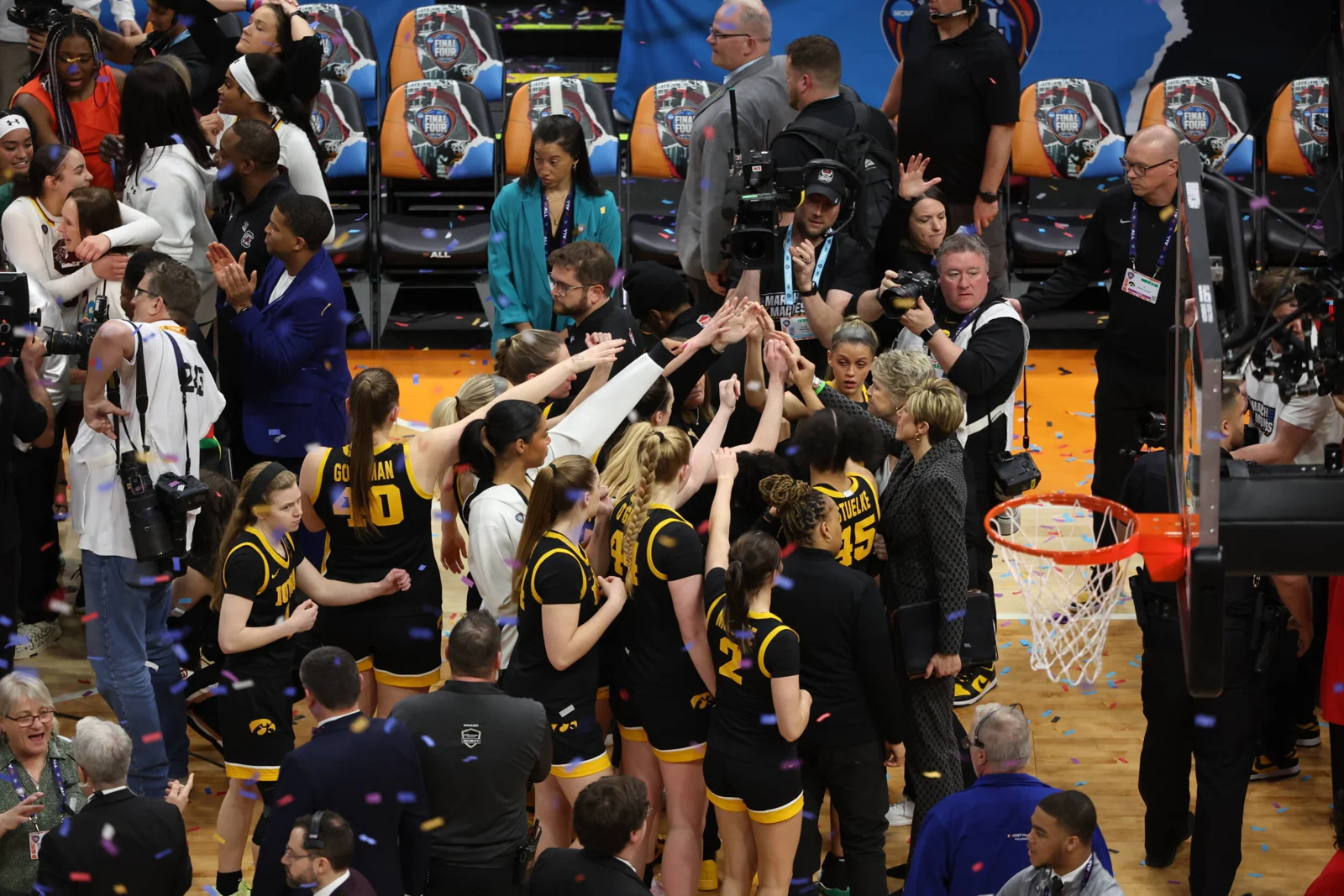
South Carolina won the 2024 NCAA women's basketball tournament, defeating Iowa 87-75 in Cleveland on April 7 and finishing 38-0. This historical guide sets out the round dates, official bracket, champion's six-game path, regional finals and the statistical differences that shaped the championship.
The 2024 tournament schedule and bracket structure
The 2024 NCAA Division I women's basketball tournament began with the First Four on March 20-21 and ended with South Carolina's 87-75 championship win over Iowa on April 7. The final was played at Rocket Mortgage FieldHouse in Cleveland. These dates belong to the completed 2023-24 season, rather than the next edition of March Madness.
| Round | 2024 dates | Setting |
|---|---|---|
| First Four | March 20-21 | Selected campus sites |
| First round | March 22-23 | Top-seeded host campuses |
| Second round | March 24-25 | Host campuses |
| Sweet 16 | March 29-30 | Albany and Portland |
| Elite Eight | March 31-April 1 | Albany and Portland |
| National semifinals | April 5 | Cleveland |
| National championship | April 7 | Cleveland |
The completed NCAA printable bracket preserves the game results and the round calendar together. It is the most useful starting point if you want every pairing, seed and score. This retrospective concentrates on the champion's path, the four regional finals and the games that determined the national title.
The field contained 68 teams. Four First Four games reduced it to the 64 teams entering the first round. Presbyterian, Holy Cross, Arizona and Vanderbilt won those opening games. A First Four appearance therefore created an additional step for those teams; it was not the same thing as a first-round loss or a separate championship tournament.
Regional labels require another distinction. Albany hosted two bracket regions, labeled Albany 1 and Albany 2, and Portland hosted Portland 3 and Portland 4. Four regional champions emerged from two host cities. The labels identified sections of the bracket, not four separate cities. Their winners then moved to Cleveland for the national semifinals.
That structure changes how to read a team's route. Winning a campus-site weekend meant reaching the Sweet 16, not reaching the Final Four. A team then needed two more victories in its regional bracket to reach Cleveland. An impressive second-round win could open a route, but it did not establish which opponent would survive the other half of the region.
Finally, keep this championship separate from other women's postseason events. A conference tournament, the WBIT and the NCAA national tournament award different titles through different fields. The archive here follows the NCAA Division I bracket only. For today's games, use the site's current scores page; for the historical 2024 story, the dates and results above fix the frame before the analysis begins.
South Carolina's six-game route to an unbeaten championship
South Carolina entered the NCAA tournament 32-0 and won six more games to finish 38-0. The school's historical schedule separates the national tournament from its earlier SEC tournament victories. That distinction keeps the championship route precise: the six opponents below were the NCAA path, not every postseason opponent South Carolina faced.
| Date | Round | Opponent | South Carolina result |
|---|---|---|---|
| March 22 | First round | Presbyterian | Won 91-39 |
| March 24 | Second round | North Carolina | Won 88-41 |
| March 29 | Sweet 16 | Indiana | Won 79-75 |
| March 31 | Elite Eight | Oregon State | Won 70-58 |
| April 5 | National semifinal | NC State | Won 78-59 |
| April 7 | Championship | Iowa | Won 87-75 |
The opening weekend produced wins by 52 and 47 points. Those margins established a commanding start, but the route soon changed from comfortable separation to late-game execution. An unbeaten season is an outcome maintained one game at a time. It does not mean the eventual champion encountered the same level or kind of resistance in every round.
Indiana provided the champion's closest tournament game
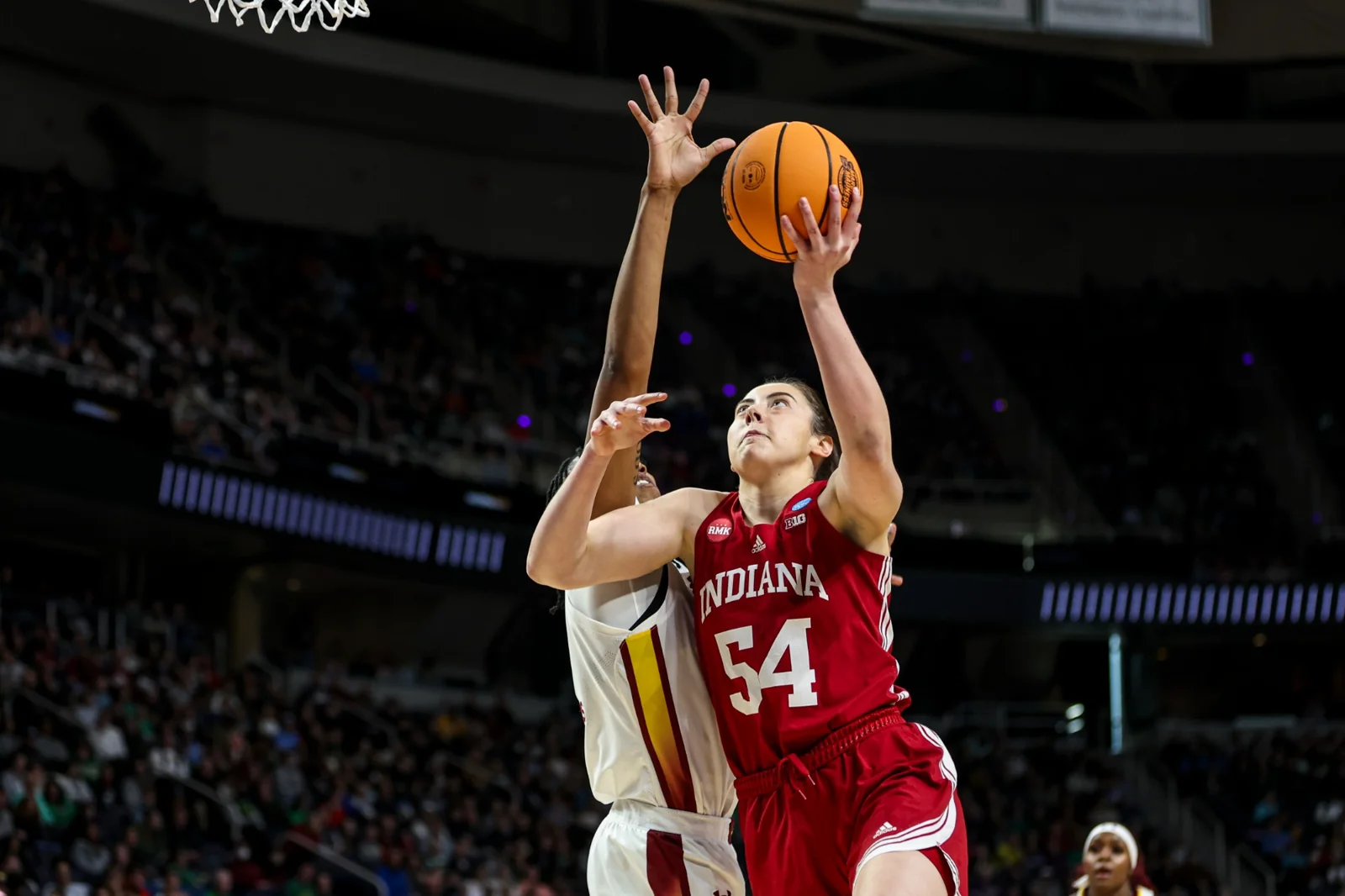
The four-point Sweet 16 win was South Carolina's smallest final margin of the six. Indiana's official report records a comeback from a 22-point deficit. South Carolina led 49-32 at halftime, yet a Mackenzie Holmes basket eventually brought the Hoosiers within two. Raven Johnson's three-pointer with 21 seconds remaining was a decisive late response.
That sequence explains why merely listing the final score would miss the tension. A large lead had not eliminated the need for another productive possession. Indiana had changed the game situation enough that South Carolina needed to answer rather than simply protect an early advantage by reputation.
Kamilla Cardoso finished with 22 points, seven rebounds, four assists and three blocks, as the SEC's game summary records. Her contribution and Johnson's late shot are different parts of the same win: sustained production helped create the position, and the final possessions determined whether it would hold.
Oregon State also kept the following round competitive. The Beavers' report records a 62-58 game late in the fourth quarter before South Carolina closed with eight unanswered points. The eventual 12-point margin therefore conceals another period when the next scoring run mattered.
The route is best understood as a sequence of different tests. South Carolina could dominate an opening weekend and still need composure in a close finish. Its championship did not require every game to look effortless; it required the team to keep solving the particular game in front of it.
Four regional finals determined who reached Cleveland
The regional finals produced two No. 1 seeds and two No. 3 seeds in the Final Four. South Carolina and Iowa won in Albany; NC State and UConn won in Portland. Those seed numbers describe each team's place in its region. They do not mean that every No. 3 seed was the third-ranked team in the country, or that a No. 1 seed had been guaranteed a place in Cleveland.
| Region | Date | Elite Eight result |
|---|---|---|
| Albany 1 | March 31 | South Carolina 70, Oregon State 58 |
| Albany 2 | April 1 | Iowa 94, LSU 87 |
| Portland 4 | March 31 | NC State 76, Texas 66 |
| Portland 3 | April 1 | UConn 80, USC 73 |
Albany sent South Carolina and Iowa to the Final Four
South Carolina's win over Oregon State illustrates the value of reading more than shooting percentage. The Beavers' official report records a 51-37 South Carolina rebounding advantage and six Gamecocks turnovers against Oregon State's 12. South Carolina won despite a lower overall field-goal percentage. The additional chances and fewer lost possessions help explain why conversion rate alone did not determine the result.
Iowa's 94-87 win over LSU was a different kind of regional final. The Hawkeyes' report records 41 points, 12 assists and seven rebounds for Caitlin Clark. Her contribution included both finishing possessions and creating scores for teammates. A points-only summary would omit an important part of the offense that reached Cleveland.
The LSU matchup also carried the history of the previous season's championship game. That gave the rematch context, but this game awarded a Final Four place rather than a national title. Iowa still needed to win a semifinal and a final afterward. Keeping the round clear prevents a meaningful revenge result from becoming a championship result in memory.
Portland sent NC State and UConn
NC State defeated Texas 76-66 behind Aziaha James' 27 points. Her seven made threes in nine attempts appear in the Wolfpack's official report. That shooting performance supplied a specific source of separation, helping the program reach its first Final Four since 1998.
UConn beat USC 80-73. The official box score records Paige Bueckers' 28 points, 10 rebounds and six assists. As with Clark's game in Albany, the star's influence extended beyond a scoring total. Both No. 3 seeds had beaten the No. 1 seed in their respective Portland regions.
These four games explain the Final Four field more precisely than a broad claim that favorites dominated or that the tournament was full of upsets. Two top seeds survived, two did not, and each result had its own statistical story. South Carolina would face NC State, while Iowa would face UConn, with all four regional champions beginning a new contest rather than carrying their previous margin onto the scoreboard.
The April 5 semifinals produced two different contests
South Carolina beat NC State 78-59, while Iowa defeated UConn 71-69 in the April 5 national semifinals. Both games were played in Cleveland, but they reached their outcomes through very different score patterns. One decisive quarter created substantial separation in the first game; the second remained a contest decided by the final possessions.
The South Carolina-NC State box score shows a 32-31 Gamecocks lead at halftime. South Carolina then outscored the Wolfpack 29-6 in the third quarter. A one-point lead became a 24-point lead entering the fourth. That is a directly calculable change from the period totals, rather than an impression drawn only from the final 19-point margin.
The third-quarter difference was large enough that NC State's better scoring fourth quarter did not restore a close game. This is why the semifinal deserves more than a final-score label. The opening half had been competitive; South Carolina created the decisive advantage afterward. A retrospective should preserve both parts of that sequence.
Iowa's semifinal had another central contributor besides Clark. The Hawkeyes' official report records 23 points from Hannah Stuelke, while Clark finished with 21 points, nine rebounds and seven assists. Clark had only four points at halftime. Stuelke's scoring is consequently an essential part of the game story, not a detail to remove because another player carried the larger national profile.
The finish included an offensive foul called on Aaliyah Edwards while setting a screen with 4.6 seconds remaining, as the report published by UConn records. The call was part of the actual ending. Reporting that event does not require declaring an unsupported verdict about its correctness, nor does it make all preceding possessions irrelevant.
The different semifinal margins also caution against projecting the championship from one result. South Carolina had won more comfortably that evening, while Iowa had navigated a close finish. The next game still began at zero. Regional and semifinal victories establish who advances; their margins provide context, not points credited in the final. The championship matchup was therefore both a meeting of two successful routes and a new test with a title still to be won.
Why South Carolina beat Iowa 87-75 in the championship
Iowa began the final with a 10-0 run and led 27-20 after the first quarter. Clark scored 18 points in that opening period, according to the Hawkeyes' game report. The opening established a real advantage, but the championship required sustaining it against a team with several different sources of production.
South Carolina led 49-46 at halftime and 68-59 after three quarters. Those period totals come from the official final box score. The change from a seven-point first-quarter deficit to a nine-point lead after three shows why the first burst and the final outcome must be considered separately. Iowa had created the early pace; South Carolina kept producing after that initial stretch.
Depth and rebounding changed the balance
The box score records a 37-0 advantage in bench points for South Carolina. Tessa Johnson led the Gamecocks with 19 points, making seven of 11 field-goal attempts, including three threes. A reserve became the team's leading scorer on championship day. That is a specific demonstration of depth, rather than a general claim that a strong bench must matter in every game.
Rebounding was another concrete difference. South Carolina finished with 51 rebounds to Iowa's 29, including 18 offensive rebounds against seven. Cardoso contributed 15 points and 17 rebounds. The Gamecocks also scored 30 second-chance points, compared with Iowa's 16. Those numbers connect recovered misses to recorded additional scoring opportunities without requiring a guessed possession count.
The two advantages should not be added together as though they were independent margins. A reserve can score after an offensive rebound, so bench production and second-chance points can overlap within the same basket. Their value here is explanatory: they identify different aspects of the team contribution that helped South Carolina keep scoring, not separate bonus points to place on the scoreboard.
Clark finished with 30 points, eight rebounds and five assists. That remained a significant individual performance. It did not cancel the other possessions, and it did not make the final a one-player contest. South Carolina's result was supported by contributions beyond its largest interior presence, while Iowa's scoring depended more heavily on its starters in this particular game.
The scoring components show the balance more precisely. South Carolina made 35 field goals, including eight threes, leaving 27 made two-point baskets. Iowa made 25 field goals, including nine threes, leaving 16 made two-point baskets. Multiplying those two-point makes by two gives 54 points for South Carolina and 32 for Iowa. That 22-point difference in two-point scoring was larger than the final winning margin.
Iowa recovered part of that difference in the other scoring categories. Its nine threes produced 27 points, three more than South Carolina's eight threes produced. Iowa also scored 16 points at the free-throw line against South Carolina's nine, another seven-point advantage. The full calculation is therefore 22 minus three minus seven, which equals the final 12-point difference. Each component comes from the same game's box score.
This does not prove that every two-point basket was a post move or that a particular defensive scheme caused the difference. Two-point field goals can arise through several kinds of possession. It does show why the final cannot be explained simply as one team making more threes or drawing more free throws. Iowa did both in terms of made shots, yet South Carolina's larger two-point production more than offset those advantages.
What the 2024 result means in its own historical context
South Carolina finished 38-0 and won its third NCAA championship, following its 2017 and 2022 titles. The distinction is both a tournament achievement and a complete-season achievement: six national-tournament victories produced the trophy, while the unbeaten record includes the games that preceded them.
Iowa finished 34-5 after reaching the championship game for a second consecutive year. The final loss does not remove the significance of that route through West Virginia, Colorado, LSU and UConn. It does establish that the 2024 national title belonged to South Carolina. Historical discussion becomes clearer when strong individual careers, deep tournament runs and championship winners retain their separate meanings.
The champions-by-year guide places this result in the longer title history. The completed bracket explains how it happened in this specific edition: different regional paths converged in Cleveland, and South Carolina combined depth, recovered possessions and sustained scoring to finish the last game as well as the last unbeaten season.
Join the conversation
Share a question or a thought about the women's game. Comments are reviewed before they appear. Keep it friendly, stay on topic and leave out personal information.
No comments yet. Start the conversation.
Sign in with Google to leave a comment. Your email address is not displayed with your comment.