
Kamilla Cardoso celebrates during the 2024 SEC semifinal against Tennessee. Photograph courtesy of South Carolina Athletics via the University of South Carolina.
South Carolina won the 2024 SEC women’s basketball tournament by defeating LSU 79–72 in Greenville on March 10. The fourteen-team event featured thirteen games, a Tennessee comeback that nearly eliminated the unbeaten Gamecocks and a championship scoring breakthrough by MiLaysia Fulwiley. This retrospective includes every result, explains the different routes through the bracket and separates the final’s basketball performance from its late ejections.
South Carolina won the 2024 SEC title in Greenville
South Carolina defeated LSU 79–72 in the 2024 SEC women’s basketball tournament championship on March 10 at Bon Secours Wellness Arena in Greenville, South Carolina. The Gamecocks entered as the number-one seed and beat the number-two seed in the final. The SEC’s championship report identifies the victory as the program’s eighth conference tournament title.
The tournament ran from March 6 through March 10. It was a five-day conference event, ending with one champion after a single-elimination bracket. Its dates matter because the tournament is sometimes confused with the national championship that came later in the same spring. Winning in Greenville decided the SEC tournament; it did not complete the NCAA tournament or award the national trophy.
Greenville also needs to be distinguished from Columbia, where South Carolina plays its home games. The final took place at the tournament’s common arena, rather than moving to a finalist’s campus. That setting brought the advancing teams into the same venue across successive days. For a historical results search, the correct answer is Bon Secours Wellness Arena, not the Gamecocks’ home court.
The numbers attached to the finalists require similar care. South Carolina’s first seed and LSU’s second seed describe their positions within this SEC bracket. A national poll number is a separate measure. Contemporary reports also identify South Carolina as the nation’s top-ranked team and LSU as eighth-ranked; those labels do not change the fact that the Tigers occupied the conference tournament’s second seed.
A conference regular-season championship and a conference tournament championship answer different questions. The former concerns performance across the league schedule. The latter requires surviving the postseason bracket. South Carolina’s top seed positioned it favorably, but the tournament trophy still depended on winning the games in front of it. A high seed created a shorter route through the early rounds; it did not provide protection once the Gamecocks began playing.
The final score alone leaves out the most distinctive parts of that route. South Carolina first had to survive a semifinal in which Tennessee recovered from a large deficit. Then a freshman’s scoring helped decide a championship game whose closing minutes included a lengthy interruption. Those are different basketball problems: preserving a lead against a comeback, generating enough offense against another finalist and completing a game after the available lineups changed.
The historical value of the 2024 event therefore extends beyond naming the champion. Its bracket shows which teams earned their opportunities, its semifinal explains how close South Carolina came to elimination, and its final separates the scoring performance from the disciplinary incident. Reading those pieces together produces a fuller account than treating the conference title as an automatic step on a season-long checklist.
The complete fourteen-team bracket and results
Fourteen teams contested the 2024 tournament, with thirteen games required to produce one champion. The results below follow the dated list and bracket in the SEC’s contemporary release. Winners appear first, so the table can be read without guessing whether the score follows a home-away listing.
| Date | Round | Result |
|---|---|---|
| March 6 | First | Kentucky 64, Georgia 50 |
| March 6 | First | Florida 66, Missouri 60 |
| March 7 | Second | Texas A&M 72, Mississippi State 56 |
| March 7 | Second | Tennessee 76, Kentucky 62 |
| March 7 | Second | Auburn 67, Arkansas 48 |
| March 7 | Second | Florida 62, Vanderbilt 59 |
| March 8 | Quarterfinal | South Carolina 79, Texas A&M 68 |
| March 8 | Quarterfinal | Tennessee 83, Alabama 61 |
| March 8 | Quarterfinal | LSU 78, Auburn 48 |
| March 8 | Quarterfinal | Ole Miss 84, Florida 74 |
| March 9 | Semifinal | South Carolina 74, Tennessee 73 |
| March 9 | Semifinal | LSU 75, Ole Miss 67 |
| March 10 | Championship | South Carolina 79, LSU 72 |
The second round did not simply confirm every higher seed. Texas A&M advanced past Mississippi State, and Florida eliminated Vanderbilt after already winning on the opening day. Those victories changed the quarterfinal opponents awaiting teams with byes. A seeded bracket defines where a winner goes next; it cannot be read as a prediction that every favored team will occupy the next space.
Tennessee’s quarterfinal victory over Alabama is another important connection. The Lady Vols entered the semifinal after winning twice, against Kentucky and Alabama. South Carolina entered after one win, against Texas A&M. The semifinal score belongs to that particular route through Greenville, rather than to a matchup between teams arriving at precisely the same stage of their tournament workload.
Byes changed the number of wins each seed needed
The first four seeds—South Carolina, LSU, Ole Miss and Alabama—began in the quarterfinals. Each could win the championship with three consecutive victories. Seeds five through ten began one round earlier and would need four wins. Seeds eleven through fourteen began on Wednesday and would need five wins across five successive tournament days.
That design rewarded regular-season positioning with fewer elimination games. It also created unequal paths without changing the final’s value. South Carolina and LSU each had to beat a quarterfinal opponent and a semifinal opponent before meeting on Sunday. Neither finalist had to appear in the first or second round, but both still needed a third win to claim the trophy.
Florida illustrates the difference between a successful opening stretch and a complete title run. Its two victories carried it from the first round into the quarterfinals. Those wins were real advancement, yet three more would still have been needed to finish the bracket. Counting only the final eight teams can hide the work an opening-day entrant has already completed.
The bracket also explains why the event contained thirteen games rather than fourteen. Every completed game eliminated one team; thirteen eliminations left one champion from fourteen entrants. Byes changed the round in which teams began, but did not introduce another champion or a second chance after defeat. This is the historical structure to use when reconstructing the 2024 results, regardless of how a later SEC tournament may be organized.
Cardoso’s semifinal three rescued an unbeaten season
South Carolina’s 74–73 semifinal victory over Tennessee was the narrowest result on its Greenville route. The Gamecocks led by twenty-three in the first half, yet needed Kamilla Cardoso’s banked three at the end to advance. Tennessee’s official report supplies the sequence behind a score that conceals the scale of the comeback.
The biggest deficit and the halftime deficit were different. South Carolina reached a 35–12 advantage, but Tennessee closed the half to 36–23. That recovery meant the Lady Vols began the third quarter thirteen points behind rather than twenty-three. A large part of their work had already happened before the break, even though South Carolina still appeared well positioned to reach the final.
The official box score then shows Tennessee winning the third quarter 25–24 and the fourth 25–14. The third period reduced the deficit by only one point. The fourth reduced it by eleven. The closing surge therefore did not erase the entire early margin at once; it completed a recovery that began in the first half and remained unfinished entering the last ten minutes.
Rickea Jackson scored twenty-two and Jewel Spear twenty-one. Their combined forty-three points represented more than half of Tennessee’s seventy-three. Spear also made all nine of her free throws. Those numbers describe sustained offensive contributions, not just an isolated late shot. They help explain why Tennessee could keep scoring while the game’s early imbalance gradually narrowed.
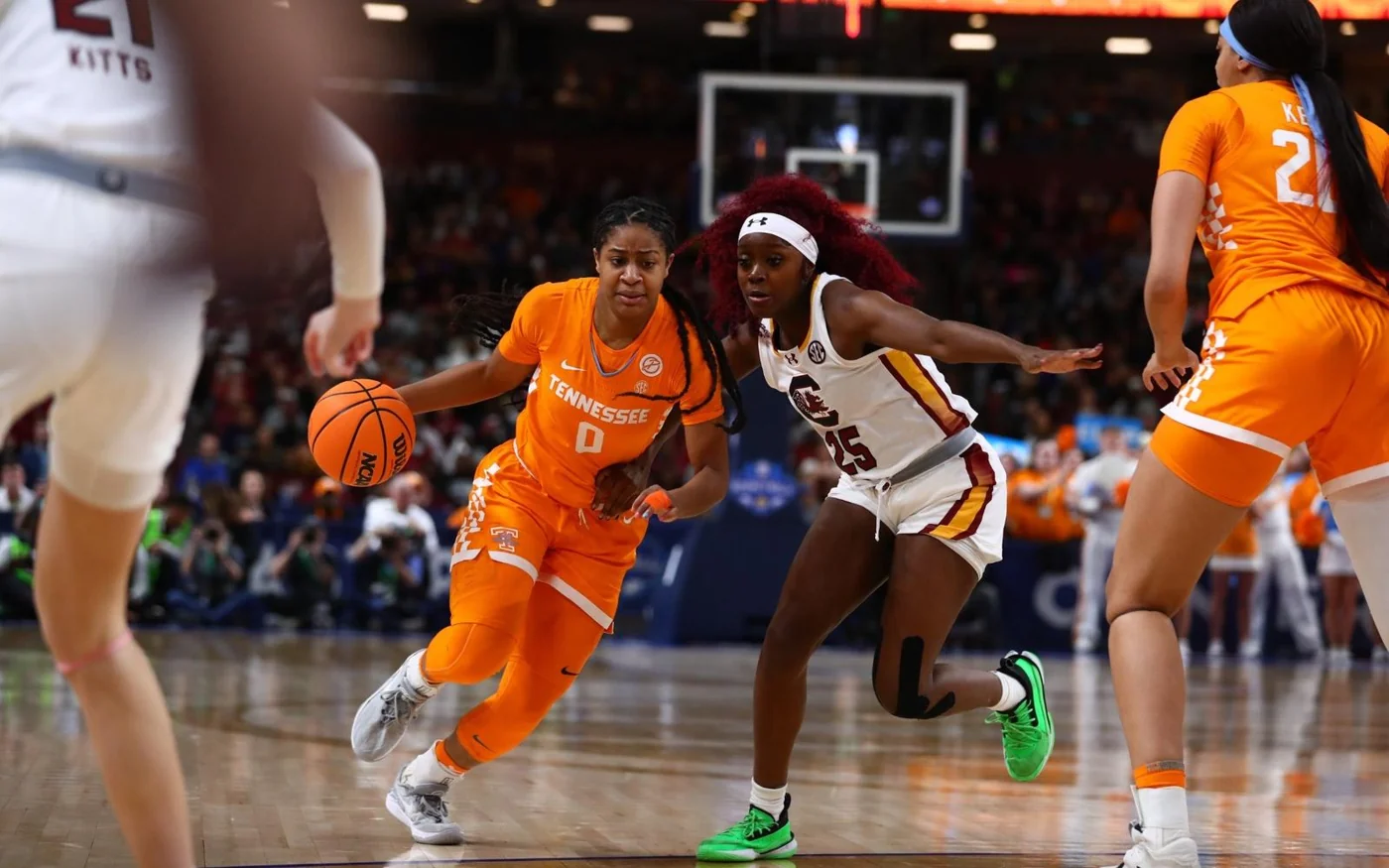
Jackson put Tennessee ahead 73–71 with twenty-four seconds remaining. South Carolina’s final sideline possession found Cardoso through a Raven Johnson inbound pass. Her shot from beyond the arc banked in before the finish, producing the one-point victory. The SEC’s account identifies it as Cardoso’s first collegiate three-pointer.
The value of the shot was mathematical as well as dramatic. With South Carolina down two, a successful two-point attempt would have tied the game. A three-point basket put the Gamecocks ahead. That extra point was the difference between needing further basketball and completing the semifinal with a win. It also explains why the final margin was one despite the magnitude of Tennessee’s earlier comeback.
The result preserved South Carolina’s unbeaten record at thirty-one victories. It did not establish that Cardoso had become a routine perimeter scorer, or that the team could safely depend on an identical escape in another game. One successful attempt in a particular late possession answers that possession’s problem. It cannot be stretched into a season-long scouting description.
For Tennessee, the defeat was an elimination after a substantial response to a poor opening stretch. For South Carolina, it was advancement after losing control of a large advantage. Those two truths can coexist. The winning shot deserves its place in the tournament’s history, while the preceding comeback explains why such a shot was necessary at all.
Fulwiley’s scoring and the disrupted championship finish
The championship final ended 79–72, with South Carolina receiving its largest scoring contribution from freshman MiLaysia Fulwiley. Her twenty-four points were a career high at the time. The SEC recognized her as the tournament’s most valuable player. That performance deserves attention alongside the late incident, because South Carolina had to create a winning position before it could protect one through the interrupted finish.
The final’s scoring came from more than the starters
Fulwiley made eight of twelve field-goal attempts, including four threes. Te-Hina Paopao added twelve points and five assists, while Bree Hall and Raven Johnson each scored nine. LSU’s contemporary recap records those totals, along with nineteen points for Aneesah Morrow, fifteen for Angel Reese, fourteen for Hailey Van Lith and thirteen for Flau’jae Johnson.
Fulwiley supplied nearly a third of South Carolina’s scoring. Her four threes accounted for twelve points; the other four field goals added eight more. That left four of her twenty-four points coming at the foul line. The arithmetic shows a scoring line assembled in more than one way. It also helps explain why a contribution from outside the starting group could materially alter a championship game.
LSU’s four double-figure scorers combined for sixty-one points. The Tigers therefore had substantial production from several players, yet still finished seven points behind. Individual scoring totals are useful evidence, but adding up the best lines does not establish that one team should have won. The complete team score includes everyone’s contribution and every possession that failed to produce a basket.
South Carolina led 36–32 at halftime and opened the third quarter with a 10–1 run. Later, a 9–0 LSU run in the fourth quarter cut the gap to one. South Carolina answered with six consecutive points before the interruption. This sequence matters: the Gamecocks had responded to a late challenge before play stopped. The eventual result cannot be explained solely by what happened during the review.
The late interruption changed the available lineups
The confrontation occurred with 2:08 remaining and South Carolina leading 73–66. Cardoso shoved Flau’jae Johnson during the escalating incident. Six players were ejected, four from South Carolina and two from LSU, according to the Associated Press’s contemporary account. Officials reviewed the sequence before the game resumed with reduced personnel available.
The postgame press conference adds the team’s own response. Staley acknowledged that the players had handled the situation poorly and accepted responsibility for South Carolina’s part. She also explained that leaving the bench carried consequences even for players who had not been central to the confrontation. Paopao described the need to stay composed and complete the remaining minutes.
Those comments clarify why the incident affected more than the two players most visible in its escalation. A bench player’s departure from the permitted area could remove another option from the coach’s rotation. The practical problem on resumption was therefore both emotional and personnel-related: regain concentration while finishing with a smaller set of available choices.
South Carolina made its final four free throws to close the game. The victory still counts as a conference championship, while the ejections remain part of its record. Neither fact erases the other. Fulwiley’s scoring, the response to LSU’s run and the disciplined completion of the remaining possessions explain the basketball result; the incident explains why the final minutes and celebration had an unusual context.
Paopao also described the difficulty of celebrating without teammates who had been ejected. That detail is a useful limit on a familiar championship image. A trophy ceremony can record a team’s achievement while failing to show everyone who helped produce it. Here, the official postgame account makes clear why the visible celebration did not simply resemble a routine full-team gathering.
What the SEC championship established before March Madness
When the Greenville tournament ended, South Carolina had completed three more wins and secured the SEC’s automatic NCAA tournament berth. The semifinal had taken the Gamecocks to 31–0, so the championship victory brought them to 32–0 before national tournament play. That was an accomplished record at a defined point in the season, rather than a promise about the games still ahead.
The NCAA field was announced one week later, on March 17. The conference’s selection announcement reported eight SEC teams in March Madness and identified South Carolina as the overall number-one seed. Three additional teams were selected for the WBIT. Those selections describe postseason opportunities beyond the conference championship, with a different bracket and a different trophy.
The distinction helps explain how an SEC tournament defeat and an NCAA tournament appearance can coexist. The conference champion receives an automatic place, but that is not the only route for a conference member into the national field. Elimination in Greenville ended a team’s pursuit of that SEC trophy. It did not, by itself, settle whether the team would be selected for the NCAA tournament.
South Carolina eventually beat Iowa 87–75 to win the national championship, the third in program history. The university’s May retrospective recounts both the Cardoso semifinal escape and the later national final. Knowing that later result gives the Greenville games added historical weight, but it should not make their outcomes appear inevitable.
The Tennessee semifinal is the clearest reason to resist that assumption. An unbeaten team needed an unusual three-point winner after conceding a large lead. The LSU final then required a response to a late scoring run and a composed finish after ejections. South Carolina’s eventual success included those difficult moments; it was not evidence that the moments had never presented a serious risk.
For someone revisiting this tournament, three records work together. The completed bracket answers who advanced. The contemporary game reports explain how the decisive scores developed. The later season account establishes what followed. Each record has its own time boundary, and preserving those boundaries avoids turning a historical recap into a prediction made after the outcome was already known.
The 2024 SEC tournament remains a useful study of South Carolina’s depth and survival under pressure. Fulwiley’s championship scoring and Cardoso’s semifinal shot belonged to different players in different games, yet both were necessary parts of the same conference title. That combination of a complete bracket, a near-elimination and a difficult final is what gives the Greenville championship its particular place in the season.
Join the conversation
Share a question or a thought about the women's game. Comments are reviewed before they appear. Keep it friendly, stay on topic and leave out personal information.
No comments yet. Start the conversation.
Sign in with Google to leave a comment. Your email address is not displayed with your comment.