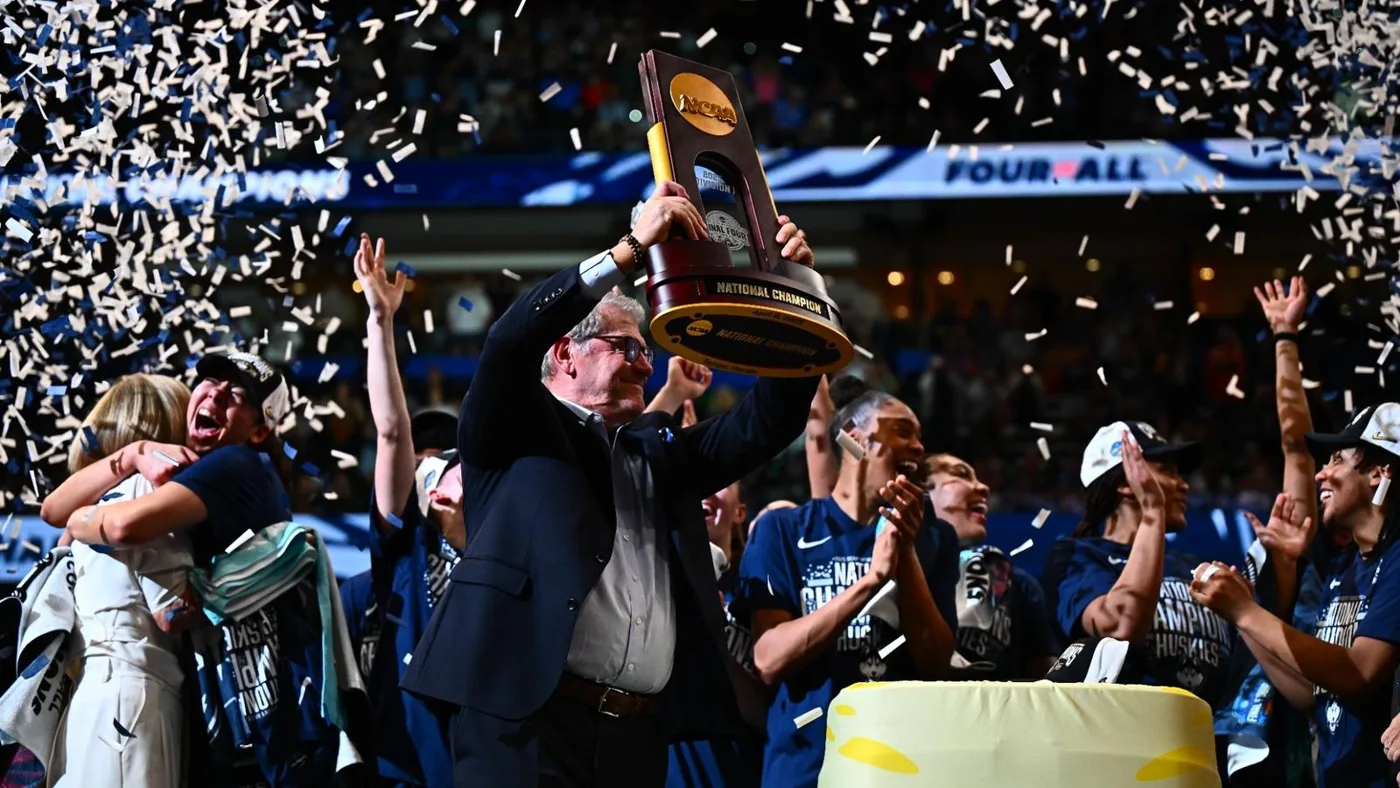
Cover: Geno Auriemma lifts the national trophy during UConn’s April 6, 2025 title celebration. Photograph: UConn Athletics, via UConn Athletics.
The 2025 NCAA women’s basketball tournament ended with UConn beating South Carolina for the national championship in Tampa. Follow the completed dates and regional results, all six games in the Huskies’ title run, and the scoring balance that decided the final. This is a historical review of the 2024–25 season, checked October 14, 2026, rather than a schedule for upcoming games.
The 2025 tournament calendar and the bracket that led to Tampa
UConn won the 2025 NCAA Division I women’s basketball championship, beating South Carolina 82–59 on April 6 in Tampa. The result completed a six-game NCAA tournament run and gave the Huskies their twelfth national title. UCLA and Texas were the other Final Four teams. Those four names identify the tournament’s endpoint; understanding the completed bracket requires following how the field narrowed to them.
The 2025 event concluded the 2024–25 college season. It should not be confused with the 2025–26 season or the next tournament’s schedule. The First Four took place March 19–20; first-round games followed March 21–22, second-round games March 23–24, the Sweet 16 March 28–29 and the Elite Eight March 30–31. Tampa hosted the national semifinals April 4 and the final April 6. The NCAA’s completed printable bracket preserves the historical matchups and scores.
The tournament began with 68 teams. The First Four reduced that field to 64, after which each complete round halved the number still playing. A team entering the main bracket needed six victories to win the championship. That structure gives the early games their proper weight: a comfortable opening win and a difficult regional final contribute equally to survival, even when they make very different demands on the eventual champion.
Two regional cities, four regional champions
The NCAA’s advance tournament arrangements placed the early rounds at top-16 host sites and the regional rounds in Birmingham and Spokane. Each regional city accommodated two separate brackets. Birmingham 2 and Birmingham 3 produced different champions; so did Spokane 1 and Spokane 4. Being in the same city did not mean all eight teams there were competing for only one Final Four place.
UCLA won Spokane 1, UConn won Spokane 4, South Carolina won Birmingham 2 and Texas won Birmingham 3. The Huskies’ selection announcement identifies them as a No. 2 seed. The other three regional winners were No. 1 seeds. The champion therefore came from just below its region’s top line, even though it delivered the tournament’s most convincing final weekend.
A seed describes the committee’s placement before the games; it does not become a permanent description of how a team played afterward. UConn still had to win its regional, then beat a different regional champion in the semifinal and another in the final. A completed bracket is valuable because it keeps those stages separate. It shows the opponent actually eliminated, rather than the opponent somebody expected to be waiting.
This retrospective concentrates on the regional winners, UConn’s complete route and the championship’s statistical turning point. The linked bracket supplies every game in the wider field. Read the dates as an archive, the results as completed evidence and the explanations as analysis of that evidence. That distinction avoids turning a historical score page into a misleading source for today’s games, tickets or broadcasts.
UConn’s six-game route to its twelfth national title
UConn’s completed 2024–25 schedule records a route from Storrs to Spokane to Tampa. The first two games allowed the Huskies to begin at home. The regional rounds required them to leave that setting and beat Oklahoma and USC. Tampa then presented UCLA and South Carolina, two more No. 1 seeds.
| Round | Date | UConn result |
|---|---|---|
| First round | March 22 | 103–34 vs. Arkansas State |
| Second round | March 24 | 91–57 vs. South Dakota State |
| Sweet 16 | March 29 | 82–59 vs. Oklahoma |
| Elite Eight | March 31 | 78–64 vs. USC |
| National semifinal | April 4 | 85–51 vs. UCLA |
| Championship | April 6 | 82–59 vs. South Carolina |
Bueckers carried the Spokane scoring load
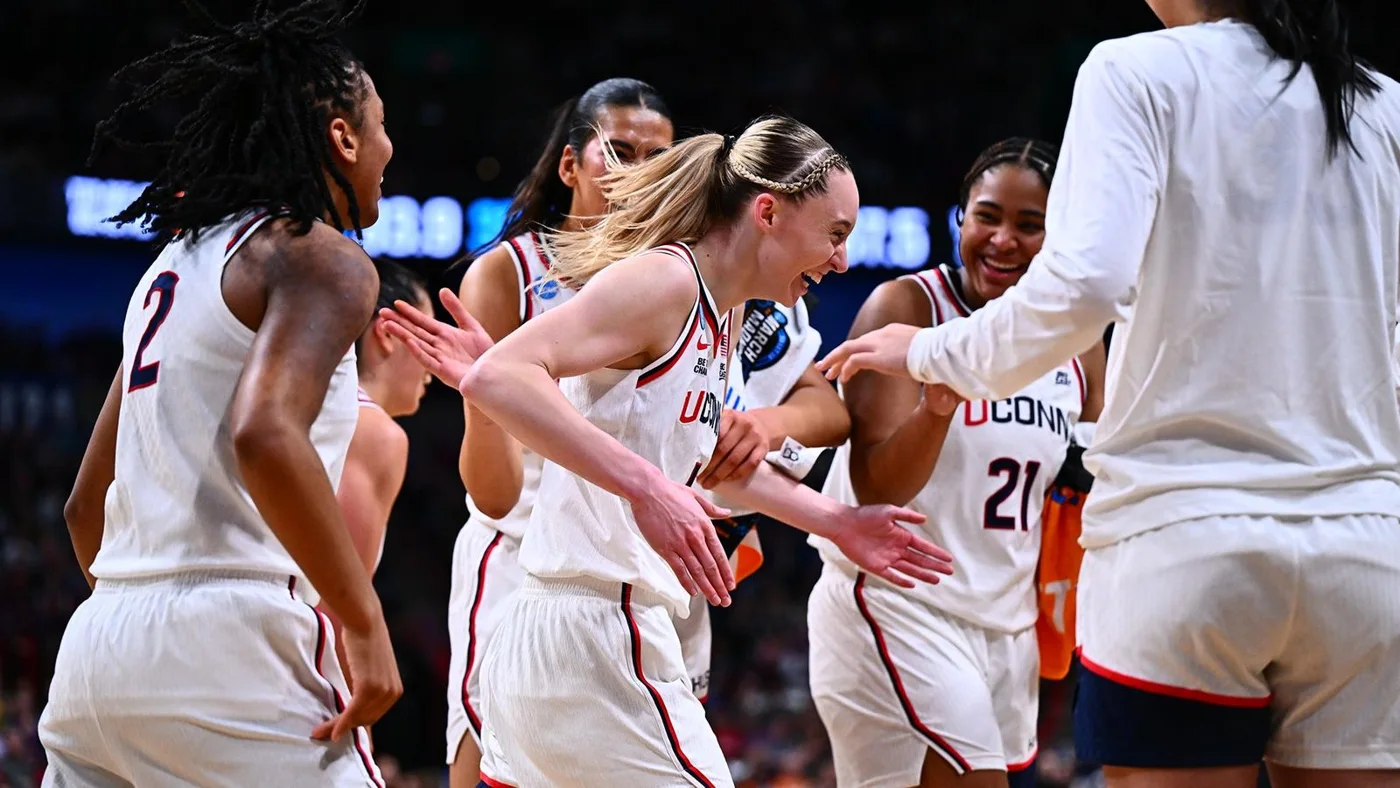
Paige Bueckers scored 34 against South Dakota State, 40 against Oklahoma and 31 against USC. Those three games total 105 points, an average of 35. Her second-round performance also ended her home playing career. A large margin did not diminish the importance of having an experienced scorer finish that stage decisively.
Oklahoma posed a different problem. UConn trailed 36–32 at halftime before Bueckers scored 29 of her 40 in the second half. The official recap records six made three-pointers and a final 82–59 score. The 23-point margin hides the first-half deficit. This was a game turned decisively after the break, rather than a lead UConn simply maintained for forty minutes.
Against USC, Bueckers’ 31 points shared the workload with Sarah Strong’s 22 points and 17 rebounds. The regional-final report describes a USC recovery that cut a 19-point deficit to 51–46 entering the fourth quarter. Bueckers scored 11 in the last period. Her production mattered as an answer to renewed pressure, not merely as another high number in a successful month.
USC’s season changed before the regional final
The Trojans reached that game without JuJu Watkins. USC’s March announcement confirms her season-ending injury during the second round. That absence is essential context for an anticipated matchup between two leading guards. It is not evidence that a healthy Watkins would necessarily have reversed the result.
USC still competed into the fourth quarter, which prevents the injury from becoming an excuse to disregard the basketball actually played. UConn had to respond when its advantage narrowed, and Strong’s rebounding accompanied the scoring needed to finish the game. The final 14-point margin identifies the winner; the changing lead explains why the Huskies needed more than an initial burst.
The route also shows why the eventual championship should not be reduced to Bueckers’ individual scoring peak. Her largest games came before Tampa. UConn reached the final weekend with several players able to supply different forms of production, and its last two victories would reveal how much that balance mattered. A tournament rewards the team that answers six consecutive problems, even when the most visible answer changes from one round to the next.
How the other regional champions reached the Final Four
South Carolina’s Birmingham regional final was a reminder that an elite team can need a difficult closing stretch simply to keep playing. The Gamecocks beat Duke 54–50, with the deciding change coming in a 16–8 fourth quarter. Duke’s official report records that period and Toby Fournier’s 18 points. Subtracting the fourth-quarter scoring from the final score shows Duke entered it leading 42–38.
That arithmetic matters. South Carolina did not merely hang on to an established advantage; it changed the outcome in the final ten minutes. The low total also gave each successful possession substantial value. Four points separated the teams at the end, leaving little room to treat any missed opportunity as inconsequential. A narrow regional win is still a complete qualification for the national semifinal.
Texas won Birmingham’s other regional by beating TCU 58–47. The Longhorns’ report records Madison Booker’s 18 points and the program’s first Final Four since 2003. The score describes a different offensive environment from UConn’s regional games: neither side reached 60. Texas earned its place by making a modest scoring total sufficient to eliminate an in-state opponent.
UCLA secured Spokane’s other berth with a 72–65 win against LSU. The LSU game report supplies the completed result, while the University of California’s account identifies UCLA’s first NCAA Final Four. The NCAA qualifier matters: the history of women’s college basketball includes competitions predating the NCAA championship. A milestone should describe the particular competition in which it occurred.
The regional winners arrived in Tampa having solved distinct elimination tests. South Carolina recovered late against Duke; Texas won a lower-scoring game against TCU; UCLA outlasted LSU; UConn answered USC’s third-quarter comeback. The regional margins cannot be used as a simple forecast of the semifinals. Opponents, offensive demands and the stage of each game changed when the teams moved to the national weekend.
On April 4, South Carolina beat Texas 74–57 and UConn beat UCLA 85–51. The two results produced a repeat of the schools involved in the 2022 championship game. They also ended UCLA’s breakthrough NCAA run and Texas’ return to the national semifinal. Both losing teams had earned their place through four victories; the heavy semifinal margins do not erase those earlier accomplishments.
UConn’s semifinal report records Azzi Fudd with 27 points, Strong with 22 and Bueckers with 16. The distribution had changed from Spokane’s largest Bueckers performances. UConn could advance comfortably without needing its senior guard to score 30 again. That was a consequential sign of balance before facing the defending national champion.
Tampa’s final thus brought together a team that had survived a close regional final and a team whose offense had just produced a 34-point semifinal win. Both were legitimate regional champions, and neither had to carry the previous round’s exact style into Sunday. The championship would be decided by what they produced against one another, not by averaging the four regional-final margins.
Why UConn beat South Carolina 82–59 in the championship
UConn’s 82–59 victory was decisive without being a simple three-point shooting exhibition. The teams each made four three-pointers. UConn made nine more total field goals and five more free throws. With equal three-point makes, the field-goal difference supplies 18 points and the free-throw difference supplies five: together they account for the 23-point final margin. The official box score provides the underlying totals.
A third quarter that doubled the lead
The Huskies led 36–26 at halftime and outscored South Carolina 26–16 in the third quarter. That changed a ten-point advantage into a twenty-point one, with UConn ahead 62–42 before the final period. South Carolina’s remaining task had become considerably larger: it needed to erase that margin in one quarter while also preventing the Huskies from adding to it.
This was the crucial change in the shape of the contest. A ten-point deficit still leaves room for a short scoring run to restore pressure. A twenty-point deficit asks for a sustained swing across many possessions. UConn did not need to reproduce its best quarter afterward; it needed to continue answering often enough that South Carolina could not create that swing. The fourth period increased the margin by three more points.
Fudd and Strong supplied more than a supporting act
The championship report records 24 points each for Azzi Fudd and Sarah Strong, with Bueckers adding 17. Fudd earned the Final Four’s Most Outstanding Player award. Bueckers’ scoring remained valuable, but the title did not require a repeat of her 40-point Oklahoma performance. Two teammates supplied 48 points between them.
Strong’s contribution extended beyond scoring: 15 rebounds, five assists and three blocks appear in the official statistics. These are different basketball jobs. Rebounding gathers missed shots, assists record successful creation for teammates and blocks interrupt shot attempts. Putting them beside her 24 points explains why describing her merely as a second scorer understates the breadth of her championship performance.
Fudd’s 24 also deserve their own reading. She scored on nine made field goals and five free throws, with only one made three-pointer. A reputation for outside shooting can make a reader expect the three-point column to tell the whole story. Here, it plainly does not. Her scoring came from a wider collection of successful attempts, giving South Carolina more to solve than one specialist stationed beyond the arc.
The three leading scorers combined for 65 of UConn’s 82 points. That is a transparent total, not a claim that the remaining players were unimportant. Basketball still requires ball movement, defensive work and the completion of possessions around the scorers. What the distribution does show is that South Carolina could not address the game simply by stopping one unusually productive guard.
Strong also finished the six-game tournament with 114 points, an NCAA freshman record confirmed in her UConn biography and a subsequent Big East announcement. Dividing 114 by six gives 19 points per game. The record describes total points across one NCAA tournament, not her whole freshman season and not a career scoring record. Her season total was 657, a much larger sample containing regular-season and conference-tournament games as well.
The distinction changes what the achievement tells us. A tournament total depends on both production and advancement: elimination removes the opportunity to play the next round. Strong supplied enough scoring to matter repeatedly and belonged to a team that created all six opportunities. That does not make the record less individual; it explains the competitive setting in which an individual total can grow. Her final was the strongest possible endpoint for that particular run, with 24 points helping secure the win that completed it.
Read the championship award and the freshman record together rather than asking which cancels out the other. Fudd’s Most Outstanding Player award recognized the Final Four; Strong’s record described scoring over the entire NCAA tournament. They have different scopes and can both be accurate. Bueckers’ largest scoring game, meanwhile, came in the Sweet 16. The team’s path becomes clearer when those accomplishments remain attached to the rounds and samples they actually measure.
What the 2025 title changed
UConn finished 37–3 and South Carolina 35–4. The SEC’s account confirms the Gamecocks’ final result and the end of their attempt to win consecutive national titles. UConn’s championship was its first since 2016. For Bueckers, it completed a college career with the team achievement that had remained missing.
The historical answer is therefore precise: UConn was the 2025 champion, South Carolina the runner-up, and Fudd the Final Four’s Most Outstanding Player. The fuller explanation includes the regional scoring surge, the changed USC matchup, the semifinal balance and a final won with substantially more successful field goals. Our champions-by-year guide places that result among other seasons; this completed tournament route explains how the twelfth title was earned.
Join the conversation
Share a question or a thought about the women's game. Comments are reviewed before they appear. Keep it friendly, stay on topic and leave out personal information.
No comments yet. Start the conversation.
Sign in with Google to leave a comment. Your email address is not displayed with your comment.