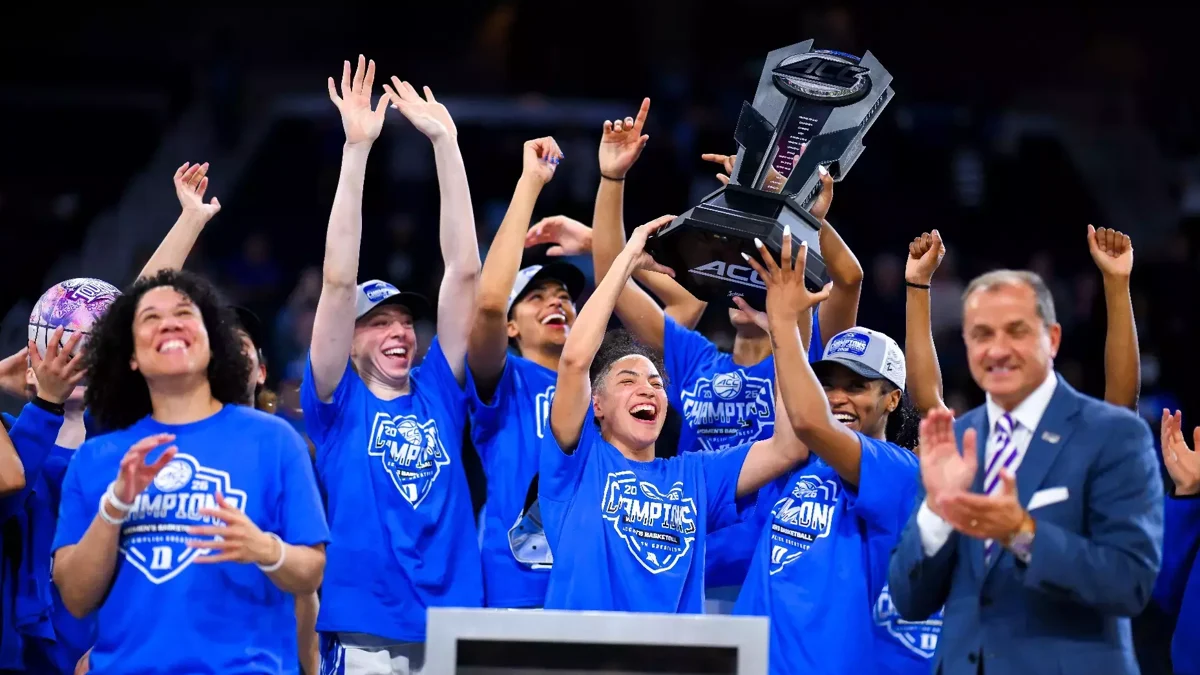
Duke won the 2026 ACC women's basketball tournament
Duke won the 2026 ACC women's basketball tournament with a 70-65 overtime victory over Louisville on March 8 at Gas South Arena in Duluth, Georgia. The No. 1-seeded Blue Devils defended their tournament championship, earned the program's tenth ACC tournament title and completed a sweep of the league's regular-season and tournament trophies.
The final was tied 60-60 after regulation. Delaney Thomas made the layup that forced overtime, and Riley Nelson supplied the late three-pointer that secured the result. Taina Mair, the tournament's most valuable player, finished with nineteen points and twelve rebounds. Thomas also scored nineteen. The ACC's championship report records those decisive contributions.
For Duke, the trophy completed a considerable recovery within the 2025-26 season. Kara Lawson's team began 3-6, then won 21 of its next 23 games to leave Duluth at 24-8. Its 16-2 ACC regular-season record had earned the top seed. That combination of improvement and late-game survival makes the championship more informative than a simple story of the favorite winning every round comfortably.
Louisville entered the final as the second seed after going 15-3 in conference play. The Cardinals left it 27-7 overall, having led for much of the championship game before Duke's late response. Their performance matters to the tournament account: this was a final between the top two seeds, but it was decided through a reversal in the closing minute and an additional five-minute period.
The results below cover the completed conference tournament. Duke's subsequent NCAA tournament games belong to a separate national bracket. For the league's current teams and season schedule, the ACC conference page provides that broader view. The Duluth championship is preserved here through its scores, the Blue Devils' route and the basketball that decided the final.
The complete 2026 ACC tournament results
The tournament ran from March 4 through March 8 at Gas South Arena. Fifteen teams played fourteen games, with the bracket distributing different starting rounds according to seed. Duke, Louisville, North Carolina and NC State entered in the quarterfinals. Seeds five through nine began in the second round, while seeds ten through fifteen opened on Wednesday.
The ACC's completed official bracket supplies all the results below. Numbers beside teams are tournament seeds. Each score is presented with the winning team first, and overtime is marked explicitly.
March 4-5: the opening rounds
| Date | Round | Winner | Loser | Score |
|---|---|---|---|---|
| March 4 | First | (12) Miami | (13) Stanford | 83-76 OT |
| March 4 | First | (10) California | (15) Wake Forest | 75-52 |
| March 4 | First | (11) Georgia Tech | (14) Florida State | 72-60 |
| March 5 | Second | (9) Clemson | (8) Virginia | 63-50 |
| March 5 | Second | (5) Notre Dame | (12) Miami | 69-54 |
| March 5 | Second | (7) Syracuse | (10) California | 70-59 |
| March 5 | Second | (6) Virginia Tech | (11) Georgia Tech | 62-54 |
Miami and Stanford supplied the opening day's overtime game. Miami led 65-52 after three quarters, but Stanford recovered to force a 70-70 tie at the end of regulation. The Hurricanes then won the extra period 13-6. The ACC's game report credits Miami with eight made free throws in ten overtime attempts, a decisive response after scoring only five points in the entire fourth quarter.
California separated from Wake Forest through a much stronger third quarter, winning that period 29-12. Sakima Walker contributed seventeen points and ten rebounds, while the Golden Bears finished with a 41-28 rebounding advantage. The conference report on California's win connects the final margin to that interior and rebounding production.
All three Wednesday winners were eliminated the following day. Miami lost to Notre Dame, California to Syracuse and Georgia Tech to Virginia Tech. The second round also produced Clemson's thirteen-point win over Virginia, allowing the ninth seed to advance into Duke's quarter of the bracket. It was the only second-round result in which the lower-seeded team won.
March 6-8: quarterfinals through the championship
| Date | Round | Winner | Loser | Score |
|---|---|---|---|---|
| March 6 | Quarterfinal | (1) Duke | (9) Clemson | 60-46 |
| March 6 | Quarterfinal | (5) Notre Dame | (4) NC State | 81-63 |
| March 6 | Quarterfinal | (2) Louisville | (7) Syracuse | 87-61 |
| March 6 | Quarterfinal | (3) North Carolina | (6) Virginia Tech | 85-68 |
| March 7 | Semifinal | (1) Duke | (5) Notre Dame | 65-63 |
| March 7 | Semifinal | (2) Louisville | (3) North Carolina | 65-57 |
| March 8 | Final | (1) Duke | (2) Louisville | 70-65 OT |
Notre Dame disrupted the top-four seed pattern with an eighteen-point victory over NC State. The Irish had already won the previous day, then removed a team entering after its double bye. Duke, Louisville and North Carolina won the other quarterfinals, leaving the first, second, third and fifth seeds in Saturday's field.
The margins narrowed sharply on Duke's side. The Blue Devils beat Clemson by fourteen, Notre Dame by two and Louisville by five after overtime. Louisville's route was more comfortable until the final: a 26-point quarterfinal win over Syracuse followed by an eight-point semifinal victory over North Carolina. Both finalists had earned their places through different scoring conditions before meeting in the tournament's second overtime game.
The full sequence also shows how the byes affected the eventual champion's workload. Duke played three games on consecutive days, beginning Friday. Notre Dame needed a fourth game to win the trophy after starting Thursday; Miami would have needed five after beginning Wednesday. In practice, the title was settled by the top two seeds, with the champion tested most severely in the final two rounds.
Duke's route from Clemson to another title
Duke's opening tournament performance was built on a decisive defensive second quarter against Clemson. The Blue Devils led 20-14 after the first period, then restricted the Tigers to five points in the next ten minutes. A 38-19 halftime lead gave Duke control, and it finished a 60-46 winner despite a less productive second half.
Fournier led Duke with seventeen points and ten rebounds. Thomas added fourteen points and six rebounds, and Mair supplied eleven points and eight boards. The Blue Devils' quarterfinal report also records 21 Clemson turnovers and eight Duke blocks. Those defensive outcomes explain the separation more clearly than the fourteen-point final margin alone.
During the second quarter, Clemson went 6:08 without scoring. Duke committed only one turnover in the period while forcing six. That combination reduced the Tigers' opportunities at one end and kept Duke's own offense from repeatedly surrendering the ball at the other. Fournier's double-double and the support from Thomas and Mair gave the team productive possessions when that defensive stretch created room to build a lead.
Notre Dame made the semifinal a two-point test
The semifinal required a different answer. Duke scored the opening ten points, but Notre Dame recovered and led 49-46 after three quarters. The Irish then extended their advantage to 51-46 early in the fourth. The Blue Devils had to win a closing contest after their early separation disappeared, rather than protect the kind of large halftime advantage they had enjoyed against Clemson.
Hannah Hidalgo scored 24 points for Notre Dame, with eight rebounds and four steals. Iyana Moore added fourteen and Vanessa de Jesus ten. The Irish game report describes Hidalgo's eleven-point second quarter and the third-quarter recovery that moved Notre Dame in front. Duke faced an opponent that had found sustained scoring after the difficult start.
Mair answered with sixteen points, eight rebounds, eight assists and three steals. Fournier added fourteen points, eight rebounds and four blocks. Duke also finished with a 47-32 rebounding advantage, an important source of recovery in a game where it committed twenty turnovers. The Blue Devils' ball security was imperfect; their work on the boards helped keep the game within reach.
The final minutes brought contributions from several players. Mair's three-pointer with 1:47 remaining made it 64-60. Hidalgo replied from three-point range with 1:10 left, cutting the margin to one. Nelson then made a free throw to establish the eventual 65-63 score. Notre Dame still had opportunities in the closing possession, but none produced the tying or winning basket.
Fournier blocked Moore's final attempt as time expired, the decisive defensive play identified in Duke's semifinal account. Her fourth block secured the result after Notre Dame had recovered offensive rebounds to extend its last chance. The sequence gave Duke a place in Sunday's final and ended the Irish's seven-game winning streak. It also showed why the championship roster needed more than one kind of contribution: Mair created and scored, Nelson added a late point, and Fournier finished the game with a stop.
The final turned in the last minute and overtime
Louisville began the final with the sharper shooting. The Cardinals made nine of fifteen first-quarter field-goal attempts and used a 13-0 run to build an eleven-point advantage. Duke reduced the deficit to seven at the first break, then recovered to trail only 32-30 at halftime. Louisville remained ahead 49-46 after three quarters.
| Team | First | Second | Third | Fourth | Overtime | Final |
|---|---|---|---|---|---|---|
| Louisville | 21 | 11 | 17 | 11 | 5 | 65 |
| Duke | 14 | 16 | 16 | 14 | 10 | 70 |
Thomas and Nelson rescued Duke in regulation
Duke briefly moved in front early in the fourth, but Louisville had a 57-53 lead in the final minute. Thomas scored on a putback and drew a foul. She missed the free throw, leaving the Blue Devils two points behind, before Nelson made a three-pointer with 27 seconds remaining to put Duke ahead 58-57.
Louisville responded rather than immediately surrendering the result. Randolph made a layup with 23 seconds left, and Berry added a free throw with fourteen seconds remaining for a 60-58 lead. Thomas then made the tying layup with four seconds left. Mair blocked Louisville's shot at the buzzer, preserving the tie and sending the championship into overtime.
The official Duke report documents that sequence. Thomas contributed twice around the basket at moments when the Blue Devils could not afford another empty trip. Nelson's outside shot forced Louisville to answer, and Mair's block ensured the tying basket actually earned another period. The comeback depended on consecutive contributions at both ends.
Laura Ziegler's overtime three put Louisville ahead 63-62, but Thomas answered with a layup at 3:20 to move Duke in front for good. Louisville then struggled to make another field goal until the final minute. Nelson's three with six seconds remaining established the five-point final margin. Duke outscored the Cardinals 10-5 in the extra period.
Rebounds and free throws explain the 70-65 result
Duke won despite making a smaller percentage of its field-goal attempts. The Blue Devils shot 22 of 57, or 38.6 percent, against Louisville's 26 of 62, or 41.9 percent. The official final box score identifies how Duke overcame those four fewer made baskets: eight three-pointers against seven, and eighteen made free throws against six.
The twelve-point advantage from free throws was substantial in a five-point game. Mair made all six of her attempts, while Thomas, Jackson and Fournier also contributed at the line. Duke did not convert every opportunity, finishing eighteen of 26, but the volume and makes gave its scoring a source beyond field goals. Louisville attempted only nine free throws across regulation and overtime.
Thomas's rebounding was another important part of the result. Seven of her nine rebounds were offensive, and she made eight of eleven field-goal attempts for her nineteen points. Duke finished with nineteen offensive rebounds and eighteen second-chance points, compared with fourteen and thirteen for Louisville. Thomas's documented late putback was one particularly visible example of that work becoming a scoring opportunity.
Mair added twelve rebounds to her nineteen points, giving Duke its largest individual total on the boards. The Blue Devils won the overall rebounding comparison 42-34. Those recoveries mattered when the offense missed shots, and they distributed possession work between a guard and the frontcourt. Duke also committed sixteen turnovers, exactly matching Louisville's total, so a large turnover advantage was not the explanation for the final result.
Louisville received an exceptional all-around performance from Randolph: seventeen points, eleven rebounds, six assists, four steals and no turnovers while playing all 45 minutes. Berry led the Cardinals with eighteen points; Roberts added twelve and Ziegler ten. The Cardinals' game report credits Randolph with a career-high assist total and identifies the overtime shooting drought that prevented Louisville from finishing the game.
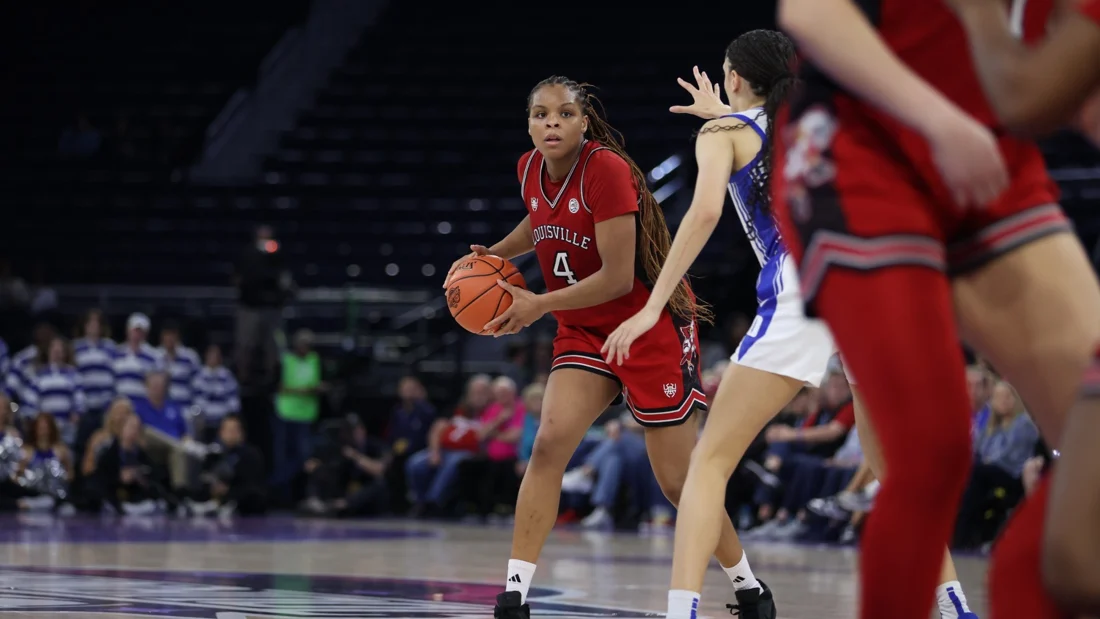
The two benches also contributed differently. Louisville scored twenty bench points, while Duke scored two; 68 of the Blue Devils' seventy came from their starters. Fournier fouled out after contributing seven points and six rebounds, and the other starters carried the largest scoring burden. Duke's win came through that core's late production, rebounding and foul-line points, while Louisville's useful reserve scoring was ultimately insufficient to protect its lead.
The all-tournament team and the championship's meaning
Mair's most valuable player award reflected a contribution sustained across Duke's three games. She scored eleven against Clemson, sixteen against Notre Dame and nineteen against Louisville, totaling 46 points. Her rebounds followed an eight, eight and twelve progression, totaling 28. The final's double-double completed a tournament in which she repeatedly combined guard scoring with significant work on the boards.
The conference's official all-tournament selections recognized five Duke players, three from Louisville and one each from Notre Dame and Syracuse. The distribution preserves the contributions of teams that did not reach the final as well as those of the two finalists.
| Honor | Player | Team |
|---|---|---|
| First team; MVP | Taina Mair | Duke |
| First team | Riley Nelson | Duke |
| First team | Imari Berry | Louisville |
| First team | Mackenly Randolph | Louisville |
| First team | Hannah Hidalgo | Notre Dame |
| Second team | Toby Fournier | Duke |
| Second team | Delaney Thomas | Duke |
| Second team | Ashlon Jackson | Duke |
| Second team | Laura Ziegler | Louisville |
| Second team | Uche Izoje | Syracuse |
Duke's five selections match the range of jobs visible during the weekend. Fournier's quarterfinal double-double and semifinal block helped establish and protect leads. Thomas supplied scoring, offensive rebounds and the final's tying layup. Jackson contributed perimeter shooting and distribution, while Nelson provided important late shots. Mair's award sits within that shared effort rather than replacing it.
Louisville's three honorees also had clearly documented contributions. Berry averaged seventeen points across the Cardinals' three games. Randolph finished the final with a double-double, six assists and no turnovers, while Ziegler made the overtime three that briefly restored Louisville's lead. Their inclusion records meaningful performances even though Duke won the last game.
The Blue Devils' postgame notes identify the tenth tournament title as tying Maryland's league record at the time. They also record Duke's eighth season winning both the regular-season and tournament championships. That combination ties the Duluth trophy to the team's work across conference play, while the final itself shows how close the second half of that sweep came to slipping away.
The ACC championship decided this conference event; it did not decide the national title. Duke and Louisville's later games appear in the separate 2026 NCAA tournament results. Duluth's completed answer remains Duke, 70-65 in overtime, after a semifinal stop, a last-minute recovery and a final lineup that kept producing when the game demanded another response.
Join the conversation
Share a question or a thought about the women's game. Comments are reviewed before they appear. Keep it friendly, stay on topic and leave out personal information.
No comments yet. Start the conversation.
Sign in with Google to leave a comment. Your email address is not displayed with your comment.