The 2026 tournament at a glance
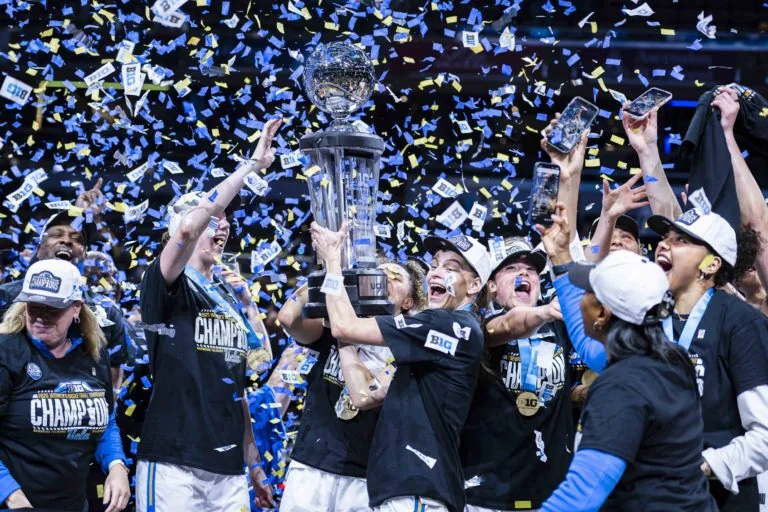
The 2026 Big Ten women's basketball tournament belonged to UCLA. The Bruins defeated Iowa 96-45 in the championship game on March 8, completing a three-win weekend and retaining the conference tournament trophy. The event ran March 4-8 at Gainbridge Fieldhouse in Indianapolis. These are results from the end of the 2025-26 season, rather than a schedule for the following winter.
That distinction matters when searching for this event months later. A conference regular-season championship rewards results accumulated over the league schedule; a conference tournament championship requires surviving the bracket. UCLA won both. The Big Ten's championship record lists the Bruins in both positions, but the accomplishments represent different competitions. Iowa reached the last game of the bracket without needing to finish above UCLA in the regular-season standings.
How the 15-team bracket rewarded the top seeds
Fifteen teams entered a single-elimination tournament, producing 14 games and one champion. Seeds 10 through 15 started Wednesday. Seeds five through nine entered Thursday, while the top four began in Friday's quarterfinals. UCLA was first, Iowa second, Michigan third and Minnesota fourth. A top-four seed therefore needed three wins on three consecutive days to take the trophy; a Wednesday starter would have needed five.
The benefit was more than an empty box on the bracket. Those extra games require preparation, recovery and repeated minutes from the same rotation. Illinois and Oregon each had to play twice before facing a top-four opponent. Their later exits should be read with that route in mind, although the bracket alone cannot prove fatigue caused a particular missed shot or turnover. Rest is an advantage; it is not a complete explanation for every result.
Numbers beside teams below identify Big Ten tournament seeds, not national poll positions or NCAA tournament seeds. That is especially useful when reading an eighth-seeded Washington win or an eleventh-seeded Oregon upset. The number describes each school's starting place in this specific competition. The official tournament central preserves the round-by-round route.
Every final score from Indianapolis
The bracket progressed through three Wednesday games, four Thursday games, four quarterfinals, two semifinals and the championship. The table puts the winner first in every matchup, so it can be read directly without decoding the visual bracket. Dates refer to Indianapolis. The scores match the conference's completed event schedule.
| Date | Round | Winner | Opponent | Score |
|---|---|---|---|---|
| March 4 | First | 13 Indiana | 12 Nebraska | 72-69 |
| March 4 | First | 10 Illinois | 15 Wisconsin | 82-70 |
| March 4 | First | 11 Oregon | 14 Purdue | 82-64 |
| March 5 | Second | 8 Washington | 9 USC | 76-64 |
| March 5 | Second | 5 Ohio State | 13 Indiana | 83-59 |
| March 5 | Second | 10 Illinois | 7 Michigan State | 71-69 |
| March 5 | Second | 11 Oregon | 6 Maryland | 73-68 |
| March 6 | Quarterfinal | 1 UCLA | 8 Washington | 78-60 |
| March 6 | Quarterfinal | 5 Ohio State | 4 Minnesota | 60-55 |
| March 6 | Quarterfinal | 2 Iowa | 10 Illinois | 64-58 |
| March 6 | Quarterfinal | 3 Michigan | 11 Oregon | 80-58 |
| March 7 | Semifinal | 1 UCLA | 5 Ohio State | 72-62 |
| March 7 | Semifinal | 2 Iowa | 3 Michigan | 59-42 |
| March 8 | Championship | 1 UCLA | 2 Iowa | 96-45 |
Two patterns are easy to lose in the final's enormous margin. First, the second round was genuinely hazardous for teams protected from Wednesday: Michigan State lost to Illinois by two, and Maryland lost to Oregon by five. A higher seed supplied a shorter route, but it did not stop a lower seed from carrying momentum into a fresh matchup. Second, Ohio State was the only team outside the top four to reach Saturday. The Buckeyes removed Minnesota before meeting UCLA.
Do not count an empty first-round slot as a victory when reconstructing a team's tournament record. Iowa finished 2-1 here, while UCLA finished 3-0. Illinois and Oregon both finished 2-1 despite leaving a round earlier than Iowa, because their opening games were Wednesday. That difference explains why raw tournament win totals can mislead when comparing how far teams advanced.
The table also separates close finishes from broad conclusions about team quality. Indiana's three-point opening win and Illinois' two-point second-round win were sufficient to advance, whatever the eventual champion did. A single-elimination competition only requires a positive final margin. For a historical bracket search, this complete trail is more useful than a prediction article that stops once the semifinals have been set.
How UCLA reached the championship game
UCLA's weekend was more varied than its final score suggests. Friday required a recovery against Washington; Saturday required protecting a lead against Ohio State. The Bruins advanced by 18 and 10 before winning the final by 51. Those different game shapes reveal a team capable of finding solutions without needing every part of its offense to work at once.
Washington made the Bruins recover
Washington held UCLA to six first-quarter points and led 15-6. Its advantage reached 22-12 in the second period before a 15-0 Bruins response changed the direction of the game. UCLA's quarterfinal report identifies the ten-point deficit as its largest comeback of that season to that point. A comfortable final margin therefore disguises an opening stretch in which the favorite had substantial work to do.
Lauren Betts provided 26 points and eight rebounds, while the Bruins scored 52 points in the paint. They made only one of ten three-point attempts. Those numbers are the clearest explanation of the recovery: the scoring did not depend on an outside-shooting correction. Two-thirds of UCLA's 78 points came in the paint, allowing it to keep producing while its three-point shots failed. That is a more specific lesson than treating every turnaround as a change in effort.
Washington still challenged after halftime. The Huskies' official scoreboard shows a 27-24 UCLA halftime lead, rather than an already decided contest. The Bruins eventually scored 51 second-half points. For a team entering after a double bye, the result was a reminder that its opponent had already played and won on that floor.
Ohio State kept the semifinal competitive
Ohio State reached Saturday by defeating Indiana and Minnesota, then lost 72-62 to UCLA. The quarter scores explain the contrast with Friday: UCLA led 32-21 at halftime and did not need another major early comeback. Ohio State nevertheless scored 22 in the fourth quarter, making the Bruins keep answering rather than drift through the finish. The Buckeyes' semifinal account records the ten-point result.
Five Bruins scored in double figures. Shared production mattered because a semifinal cannot be reduced to whether the leading post player had another huge scoring total. Multiple threats give an offense a way to continue accumulating points when a particular matchup becomes more difficult. That observation follows the scoring distribution; it does not require claiming an unverified defensive scheme. By Sunday, UCLA had already won through both a concentrated interior performance and a more evenly distributed attack.
Why UCLA's 96-45 win over Iowa stood out
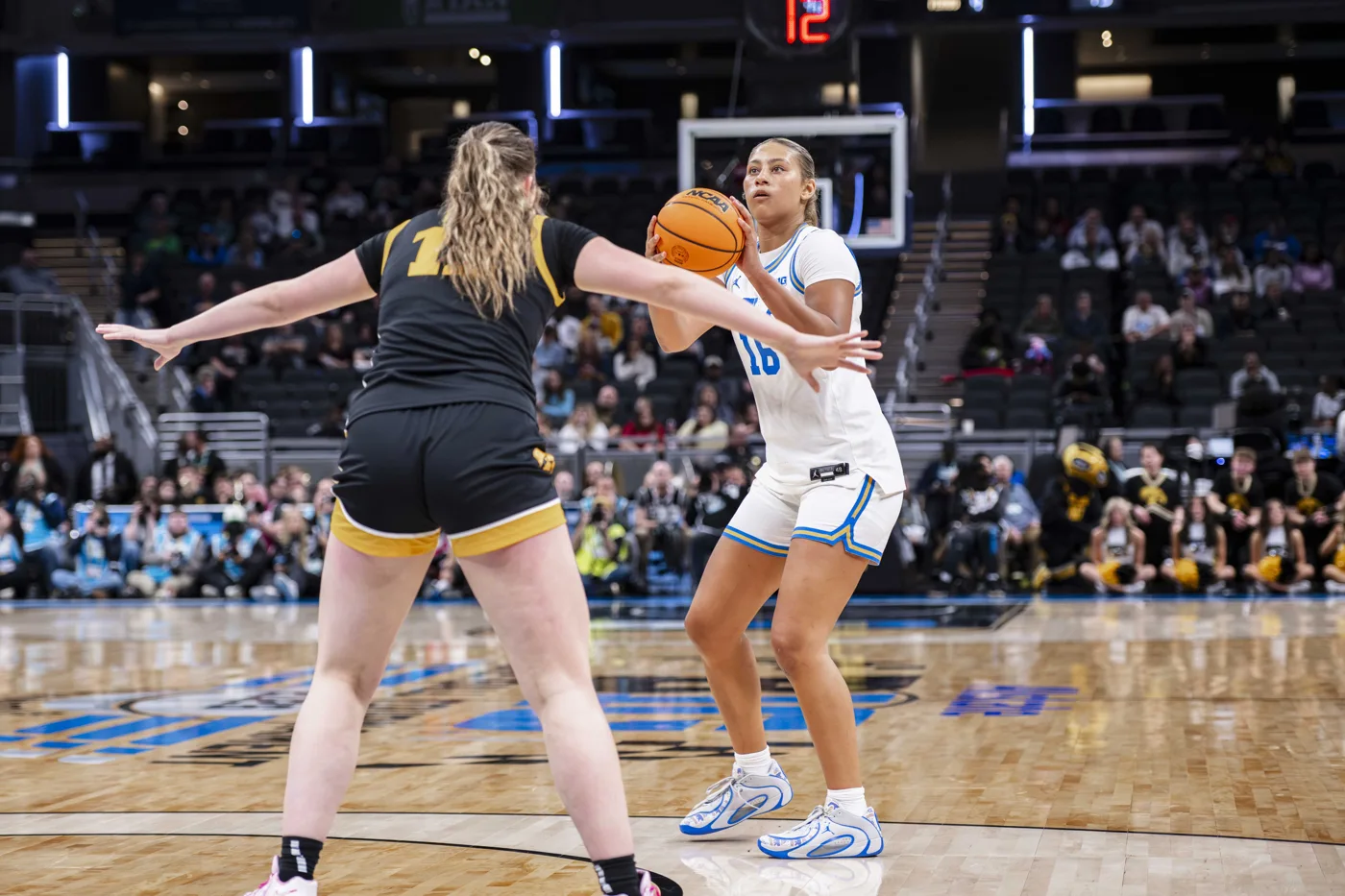
The final supplied the weekend's defining number: 51. UCLA's 96-45 victory established the largest winning margin in a Big Ten women's tournament championship game, surpassing Iowa's 33-point win over Ohio State in 2023. It was a striking reversal of the usual expectation that the last two teams standing will produce the tournament's tightest contest. Here, the No. 1 and No. 2 seeds met, and the favorite delivered its most decisive result.
The performance was broad enough that a single scoring line cannot describe it. Gianna Kneepkens scored 19, Kiki Rice supplied 15 points and eight assists, and all five starters reached double figures. Freshman Sienna Betts added 14 on seven-of-eight shooting off the bench, with seven rebounds and five assists. The Bruins' official championship report records six double-figure scorers overall. The bench contribution means this was not simply a starting lineup winning its own individual matchups.
UCLA made 40 of 63 field-goal attempts, a 63.5 percent conversion rate, and registered 34 assists. The school identified both the shooting percentage and assist total as Big Ten tournament single-game records. Thirty-four assists on 40 baskets means 85 percent of the made field goals were credited with an assist: 34 divided by 40. That is a transparent description of the recorded production, rather than a claim that every possession followed the same play.
A championship decided well before the final buzzer
UCLA led 22-5 after the opening quarter and 42-20 at halftime. Iowa had already conceded a 17-point deficit before the first ten minutes were complete. The rest of the afternoon therefore placed the Hawkeyes in a difficult sequence: improve their own scoring while also preventing an opponent with multiple contributors from extending its advantage. A 51-point final margin was the accumulation of that imbalance, not a late burst that transformed an otherwise even game.
Rice received the tournament's Most Outstanding Player award, with Lauren Betts joining her on the all-tournament team. The conference's title announcement confirms UCLA's second consecutive tournament championship. Rice's recognition fits a weekend in which organizing and distributing the offense mattered alongside finishing possessions. Her eight championship assists offer a concrete example of that influence.
The result deserves attention without becoming a universal explanation for Iowa's season. One final measures one matchup on one afternoon. UCLA's exceptional conversion and distribution are enough to explain why this particular championship was so lopsided; they do not establish that every opponent would have lost by a similar margin. The earlier Washington and Ohio State games provide the useful counterweight within the same weekend.
The other runs that shaped the bracket
A complete tournament account needs more than the champion's three games. Iowa's route to the final looked substantially different, and Wednesday's teams supplied some of the most dramatic moments before UCLA had entered the competition. Their results explain the opponent each higher seed eventually faced.
Iowa defended its way into Sunday
Iowa held Illinois to 58 in the quarterfinal and Michigan to 42 in the semifinal. The Hawkeyes did not need to approach UCLA's championship scoring total to earn their own final berth. Against Michigan, the crucial stretch arrived after three quarters: Iowa trailed 36-35, then won the fourth period 24-6. A one-point deficit became a 17-point victory in ten minutes.
The Hawkeyes' semifinal report credits Ava Heiden with 16 points. The broader story is the relationship between scoring and preventing scores. Michigan's six-point fourth quarter meant Iowa could take control without having to win an uninterrupted exchange of baskets. That makes the semifinal useful to revisit on its own terms, even though Sunday's very different matchup ended badly for the same team.
Nor should the semifinal be remembered as 40 minutes of uncontested control. Michigan had recovered from an early deficit to lead entering the final quarter. Preserving that sequence matters: Iowa had to respond to a genuine threat. The eventual winning margin describes the finish, while the fourth-quarter swing explains where the separation occurred.
Hannah Stuelke made that response tangible, scoring 11 of her 13 points in the fourth quarter and finishing with 10 rebounds. Iowa shot 60 percent from the field in the closing period. Taylor Stremlow added 11 points, six assists and six rebounds across the game, according to the same school report. Heiden led the scoring, but the final-quarter surge and the contributions around her explain why Iowa's semifinal was more than one productive center carrying an otherwise static offense.
Illinois, Oregon and Indiana made the early rounds matter
Illinois eliminated Wisconsin and then seventh-seeded Michigan State before losing to Iowa. Oregon defeated Purdue and sixth-seeded Maryland before Michigan stopped its run. Both started outside the protected top nine and still earned a quarterfinal appearance. For supporters following the opening sessions, these were consequential wins that changed the matchups waiting for the top seeds.
Indiana supplied the largest escape in that opening round. Its official comeback report says the Hoosiers erased a 20-point deficit against Nebraska, winning 72-69. Nebraska's account of the same game confirms the second-half reversal. Indiana outscored the Huskers 25-14 in the fourth quarter, converting a difficult position into another day in the tournament.
Those runs also show the limit of using a single result to predict the next day. Indiana then lost to Ohio State by 24. Oregon's win over Maryland was followed by a 22-point loss to Michigan. A comeback or upset solves the current elimination game; it does not erase the next opponent's strengths. That uncertainty is part of why the early rounds deserve attention beyond serving as a warm-up for the final.
What the Big Ten title meant after Indianapolis
The championship secured the Big Ten's automatic NCAA tournament berth for UCLA. That is a qualification mechanism, while an NCAA seed is a placement within a separate national bracket. Winning this event did not automatically make the Bruins the national No. 1 overall seed, nor did losing it prevent other conference teams from receiving at-large invitations.
In fact, 12 Big Ten programs entered the 2026 NCAA tournament, according to the conference's postseason record. That broader field makes the distinction practical. A team could leave Indianapolis on Thursday or Friday and still have more basketball ahead. The conference tournament was a championship opportunity and a final addition to the season's record, rather than an automatic end-of-season marker for every losing side.
With the benefit of completed results, UCLA's Indianapolis dominance also belongs within a larger championship season. The Bruins later defeated South Carolina 79-51 in the NCAA title game on April 5. That later achievement makes the Big Ten trophy one part of the season's story. It should not be retroactively treated as an inevitable outcome: UCLA still had to win each national-tournament game after leaving Gainbridge Fieldhouse.
For readers reconstructing March, the next useful step is the completed 2026 NCAA bracket. For readers planning the following winter, use the separate 2026-27 Big Ten schedule guide and the current game schedule. Keeping those timelines distinct preserves the value of both: this page explains what happened in Indianapolis, while the schedule helps identify the next game to watch.
Join the conversation
Share a question or a thought about the women's game. Comments are reviewed before they appear. Keep it friendly, stay on topic and leave out personal information.
No comments yet. Start the conversation.
Sign in with Google to leave a comment. Your email address is not displayed with your comment.