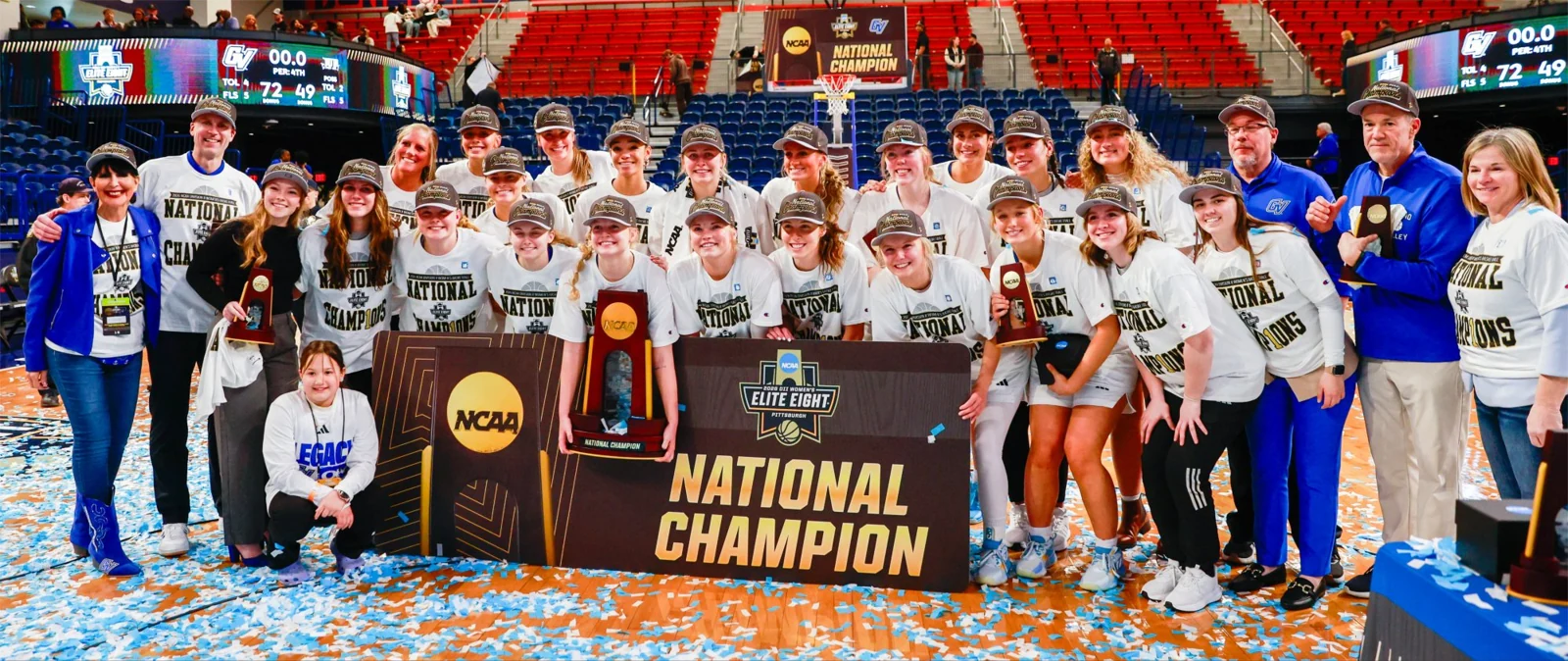
Cover: Grand Valley State celebrates its March 28, 2026 national championship at UPMC Cooper Fieldhouse. Photo: Emily Riddle / Grand Valley State University.
Grand Valley State repeated as the NCAA Division II women’s basketball champion in 2026. Follow the completed tournament through its regional finals, all seven national games and the statistics behind the championship victory over Indiana (PA).
Who won the 2026 NCAA Division II women’s basketball tournament?
Grand Valley State won the 2026 NCAA Division II women’s basketball championship, defeating Indiana University of Pennsylvania 72-49 on March 28 at UPMC Cooper Fieldhouse in Pittsburgh. The Lakers completed a 36-1 season, while IUP finished 31-4 as national runner-up. This was Grand Valley State’s third national title and its second consecutive championship. The previous winning seasons ended in 2006 and 2025, according to the university’s March 28 championship report.
2026 championship result: Grand Valley State 72, Indiana (PA) 49
The result belongs to the NCAA Division II women’s tournament that ended the 2025-26 college season. Regional play took place March 13, 14 and 16. The national quarterfinals, semifinals and final followed on March 24, 26 and 28.
IUP’s appearance also carried historical weight. Its official final-game recap identifies this as the program’s first national championship game. The Crimson Hawks reached a new stage even though the final afternoon belonged to the defending champion. A runner-up finish and a repeat title describe different achievements; both matter when assessing the completed bracket.
The tournament had two distinct phases. Eight regional brackets produced eight winners, who then entered a newly seeded national bracket. The tables below identify those regional champions and every national-round result, followed by an explanation of the final. For a particular team’s earlier games, the completed official bracket linked at the end remains the quickest way to trace its entire route. Reading the regional and national seed labels separately makes that route much easier to follow.
How to read the regional bracket and Elite Eight seeds
The starting field consisted of eight regional brackets with eight teams each. A team needed three regional victories to reach Pittsburgh, then three more national victories to win the championship. This structure explains why a regional final is an elimination game with its own champion, while the national quarterfinal begins a new set of matchups.
Regional seeds and national seeds answer different questions
A number beside a team in its regional bracket described its place within that eight-team region. The national numbers were assigned among the eight surviving regional champions. The NCAA prechampionship manual confirms that the committee seeded the advancing teams after regional play. Moving to Pittsburgh therefore changed the comparison group.
Holy Family illustrates the distinction. It began as the East Region’s fifth seed and reached the national bracket as No. 7. Its first national opponent was No. 2 Indiana (PA). Grand Valley State, meanwhile, was No. 1 in the Midwest and No. 1 nationally. The identical number in the Lakers’ case does not make the two seeding stages interchangeable. When describing an upset, identify which stage supplied the seed.
The national order was Grand Valley State, Indiana (PA), Colorado Mesa, Cal Poly Pomona, Alabama Huntsville, Minnesota Duluth, Holy Family and Carson-Newman. The quarterfinal pairings followed that new order: 1 against 8, 2 against 7, 3 against 6 and 4 against 5. A regional bracket line cannot be extended directly into Pittsburgh without accounting for this reset.
Where the tournament was played
Regional games were held at campus sites. The host institutions marked on the completed bracket were Indiana (PA), Minnesota State, Southern Connecticut State, Grand Valley State, Alabama Huntsville, Lincoln Memorial, Texas Woman’s and Central Washington. Hosting established the location; it did not guarantee advancement. Several regional champions defeated the host along the way.
| Stage | 2026 date | Location |
|---|---|---|
| Regional quarterfinals | March 13 | Eight campus sites |
| Regional semifinals | March 14 | Same regional sites |
| Regional finals | March 16 | Same regional sites |
| National quarterfinals | March 24 | UPMC Cooper Fieldhouse |
| National semifinals | March 26 | UPMC Cooper Fieldhouse |
| Championship | March 28 | UPMC Cooper Fieldhouse |
The regional round labels and dates are recorded in the NCAA’s 2026 regional information document. These are completed 2026 dates. A current championship landing page may already display another year’s event, so the year on an archive matters when checking a tournament location.
The eight regional champions and their final-round results
All eight regional finals were played March 16. The winners below became the Elite Eight field. The national seed column refers to the subsequent Pittsburgh bracket, while the result column records the regional final that secured qualification.
| Region | Champion | Regional final | National seed |
|---|---|---|---|
| Atlantic | Indiana (PA) | 65-64 over Winston-Salem State | 2 |
| Central | Minnesota Duluth | 94-87 over Concordia-St. Paul, 2OT | 6 |
| East | Holy Family | 78-62 over Daemen | 7 |
| Midwest | Grand Valley State | 69-59 over Northwood | 1 |
| South | Alabama Huntsville | 66-46 over Eckerd | 5 |
| South Central | Colorado Mesa | 65-64 over Texas Woman’s | 3 |
| Southeast | Carson-Newman | 72-53 over Lenoir-Rhyne | 8 |
| West | Cal Poly Pomona | 57-51 over Central Washington | 4 |
Minnesota Duluth’s route began at the bottom of its region’s seed list. The Bulldogs beat host Minnesota State 72-63, then Central Missouri 81-48 before winning a double-overtime final. The UMD final recap records 25 points and 13 rebounds for Maria Counts. A No. 8 regional seed had survived three games and become a national No. 6; calling the Bulldogs an eighth seed without a stage label would hide that progression.
Colorado Mesa advanced through a different kind of pressure. Olivia Reed Thyne finished with 23 points and 14 rebounds, and blocked Texas Woman’s final layup attempt with three seconds left. The official conference recap shows how a one-point win depended on the last defensive possession. A final margin describes the result; this detail explains how the winner preserved it.
Cal Poly Pomona also won on the host’s floor. Sydney Nelson contributed 29 points and 15 rebounds in the Broncos’ West title game. There is a score discrepancy in the NCAA archive PDF, which prints 55-51. This table uses the official school box score: 57-51. Its four quarter totals add to 57, and the school’s game recap records that same result.
Holy Family’s 16-point win had a clear statistical foundation. Daemen’s recap reports a 50-23 rebounding advantage for the Tigers, who also made 15 of 16 free throws. Grand Valley State’s regional final was closer than either of its earlier wins: the Lakers had beaten Maryville 83-50 and Wayne State 90-70 before Northwood held the gap to ten. The regional stage supplied both dramatic escapes and substantial wins, with every survivor starting again in the national bracket.
Elite Eight results: all four national quarterfinals
The national quarterfinals on March 24 produced wins for seeds 1, 2, 3 and 5. Grand Valley State and Colorado Mesa won by substantial margins. Indiana (PA) required overtime, and Alabama Huntsville overturned a halftime deficit. Each game reached the same destination through a different statistical pattern.
| National matchup | Final result |
|---|---|
| No. 1 Grand Valley State vs. No. 8 Carson-Newman | Grand Valley State 96-48 |
| No. 2 Indiana (PA) vs. No. 7 Holy Family | Indiana (PA) 57-52, OT |
| No. 3 Colorado Mesa vs. No. 6 Minnesota Duluth | Colorado Mesa 81-59 |
| No. 4 Cal Poly Pomona vs. No. 5 Alabama Huntsville | Alabama Huntsville 61-53 |
The top two seeds advanced
Grand Valley State doubled Carson-Newman’s total, but the useful detail is how it generated so many scoring opportunities. The official quarterfinal box score records 52 rebounds, including 24 offensive rebounds, with 21 assists and seven turnovers. Those figures show a team combining second chances with ball movement and relatively few lost possessions. The Lakers did not need exceptional three-point accuracy to reach 96: they made nine of 33 attempts from outside.
IUP’s 57 points reflect a much tighter game. The Crimson Hawks outscored Holy Family 9-4 in overtime after regulation ended at 48-48. Teresa Maggio supplied 20 points and nine steals, while IUP recorded 18 steals as a team. Its quarterfinal recap also records an 18-5 advantage in fast-break points. The win demonstrates why a low final score should not be read as an absence of decisive individual contributions.
Two lower seeds reached the semifinals
Below the two leading seeds, No. 3 Colorado Mesa and No. 5 Alabama Huntsville completed the semifinal field. Colorado Mesa was the higher seed in its own matchup; UAH supplied the round’s only victory by a lower-seeded opponent. That distinction matters when summarizing how far the bracket departed from the seed order.
Colorado Mesa turned a 22-19 first-quarter lead into a 51-29 halftime advantage by winning the second period 29-10. The Mavericks’ game report records 32 made free throws in 34 attempts and 35 points with 15 rebounds for Olivia Reed Thyne. The teams then scored the same number of points in each remaining quarter. The second-quarter separation, rather than a late scoring burst, explains the 22-point final margin.
UAH trailed Cal Poly Pomona 33-21 at halftime and 47-40 after three quarters. A 21-6 fourth quarter reversed the outcome. Lili Wilken finished with 19 points, eight rebounds and five assists in the official box score. The 61-53 result looks comfortable compared with the earlier deficit, but the quarter-by-quarter record preserves the comeback that made it possible.
Semifinal results and the championship matchup
Both national semifinals were played March 26. Indiana (PA) defeated Colorado Mesa 75-70, and Grand Valley State defeated Alabama Huntsville 61-39. The results sent national seeds No. 1 and No. 2 into the final. They also ended two memorable regional champions’ runs: Colorado Mesa finished 37-2, and UAH finished 32-6.
IUP opened its semifinal with a 12-0 lead. Nyshae’ Weaver scored seven of those opening points and finished with 21, while Teresa Maggio added 17. The Crimson Hawks led 36-29 at halftime and protected enough of that advantage to win by five. The official semifinal recap identifies the win as IUP’s breakthrough after two previous national semifinal appearances ended in defeat.
Colorado Mesa’s scoring was heavily concentrated. Olivia Reed Thyne and Mason Rowland combined for 61 of its 70 points, leaving nine from the rest of the team. That arithmetic helps explain the game’s offensive shape without diminishing either player’s contribution. Two scorers kept the Mavericks within reach, but the Crimson Hawks found enough baskets from several players to preserve their early advantage. A close margin at the finish does not erase the importance of the opening minutes.
Grand Valley State’s semifinal began much closer: the Lakers led only 14-13 after the first quarter. Their advantage expanded over the remaining periods, with UAH scoring six points in the fourth. The decisive team statistic was a 64-28 rebounding advantage. MacKenzie Bisballe supplied 13 points and 19 rebounds, while Paige VanStee scored 21. Those figures are recorded in Grand Valley State’s semifinal report.
The Lakers’ rebounding total offers a useful comparison with their quarterfinal. They scored 96 in the earlier game and 61 here, yet controlled the glass in both. Offensive output changed; their ability to secure possessions remained a central strength. IUP had advanced through an overtime quarterfinal and a five-point semifinal, whereas Grand Valley State reached the final through two large national-round margins. The championship paired those different paths in one game, with a returning champion facing a program making its first title-game appearance.
How Grand Valley State won the national championship
Grand Valley State’s championship performance joined efficient scoring with strong protection around the basket. The 23-point margin was built over the first three quarters. The final period finished even, leaving the advantage already established intact. Three leading scorers supplied most of the Lakers’ points, while their defensive totals show why IUP struggled to match them.
The final score and the game’s turning point
The Lakers started 8-0 and led 17-8 after one quarter. In the second period, an 11-0 run expanded a 26-17 advantage to 37-17. IUP reduced the gap before halftime, but Grand Valley State still led 41-24. These sequences appear in the Lakers’ championship recap.
That second-quarter run is a useful turning point because it transformed a single-digit gap into a twenty-point lead. The final was no longer close after one strong stretch of offense and defense. Grand Valley State then won the third quarter 17-11 to lead 58-35 entering the fourth. Both teams scored 14 in the last period. The quarter totals show that the Lakers did not build their winning margin after the competitive direction of the game had already been established.
The scoring sequence also answers a common question about a lopsided final: was it decided immediately or gradually? Grand Valley State had the early advantage, but the second period provided the largest quarter-by-quarter increase in the lead. Its eight-point edge in that quarter added to the nine-point first-quarter advantage, and the third added another six. The final 72-49 score reflects those accumulated gains.
The players and statistical advantages behind the title
Paige VanStee scored 25 points on nine-of-eleven shooting and collected nine rebounds. Nicole Kamin and MacKenzie Bisballe added 18 points each. Kamin had four assists, and Bisballe blocked five shots. Their combined 61 points left eleven from the remainder of the Lakers’ lineup. The official championship box score provides the complete individual and team totals.
Grand Valley State made 28 of 45 field-goal attempts, a 62.2% rate, while IUP made 19 of 61, or 31.1%. The Lakers also led 44-28 in paint points and blocked 13 shots. Taken together, those numbers explain a large part of the separation: Grand Valley State converted a much greater share of its attempts and made scoring around the basket difficult for its opponent.
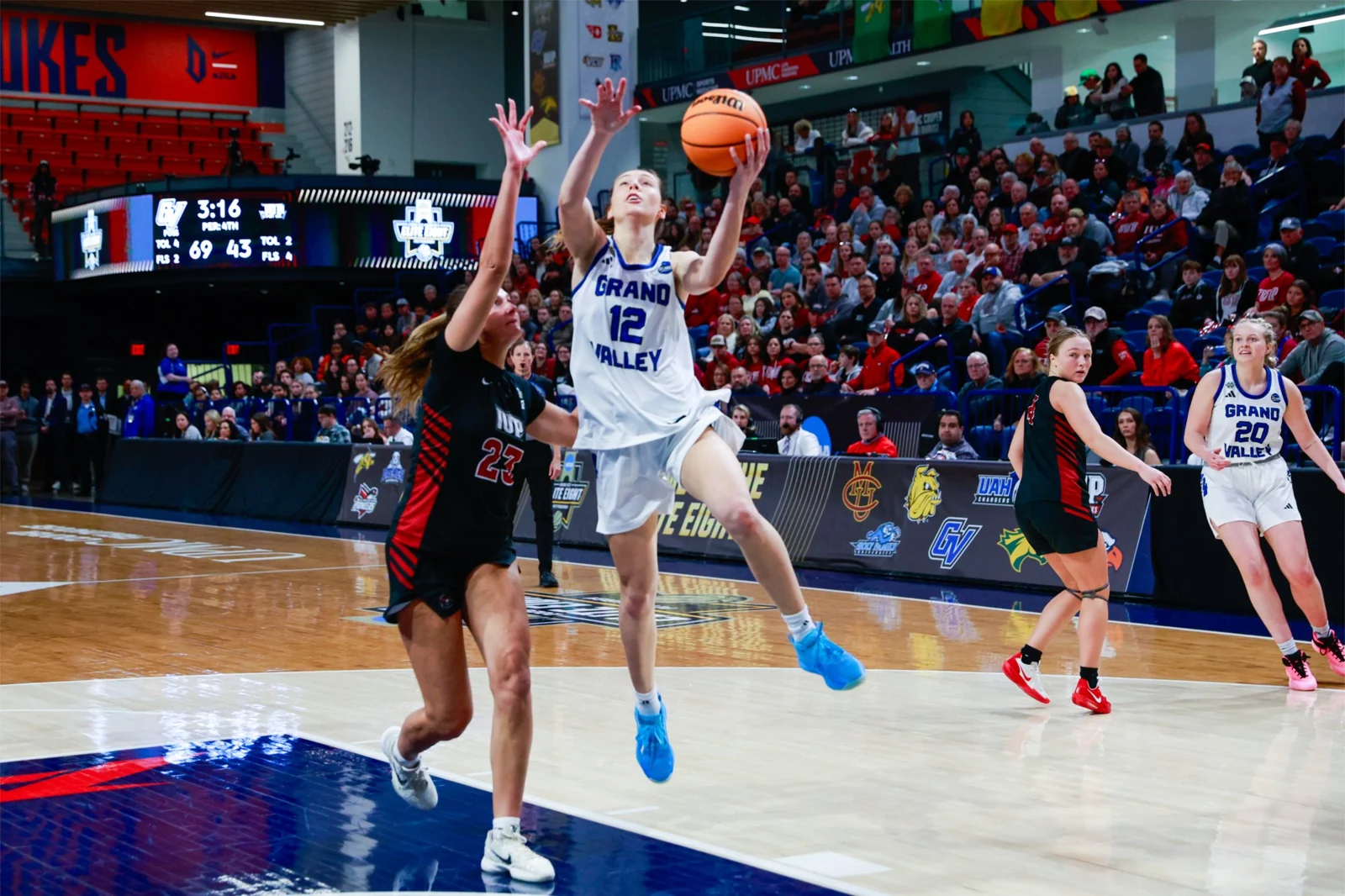
There was one clear weakness in the winning performance: Grand Valley State committed 19 turnovers to IUP’s 13. The Lakers therefore did not dominate every measure. They overcame the lost possessions through scoring efficiency and defensive resistance. This distinction makes the analysis more informative than describing the game as flawless. IUP’s Teresa Maggio still scored 20, but the team could not produce enough efficient offense around that contribution.
What the championship means in program history
Grand Valley State’s title years are now 2006, 2025 and 2026. The university’s championship announcement records the repeat and identifies Mike Williams’ second consecutive Division II national coach award from the WBCA. Nicole Kamin was the tournament’s Most Outstanding Player, according to the athletics recap.
The final closed a six-game NCAA run that included Maryville, Wayne State, Northwood, Carson-Newman, Alabama Huntsville and IUP. The Lakers allowed 48, 39 and 49 points in their three Pittsburgh games. Those results show why the final fits the wider national-round performance: Grand Valley State repeatedly restricted its opponents’ scoring while finding enough offense to advance. Winning the same championship in successive seasons required completing that entire path again. The 2026 bracket records the second successful journey, with a new runner-up and a new set of national-round opponents.
Finding the complete official bracket and individual box scores
For all 64 entrants and the earlier regional rounds, open the NCAA’s completed 2026 DII women’s bracket record. Its Attached Documents entry contains the final championship PDF. The direct official PDF download provides the printable version. It is a results archive, so it is useful for tracing a completed run or comparing regional paths.
To find a specific game’s statistics, use the participating school’s women’s basketball schedule and select the 2025-26 season. On IUP’s official schedule, the March 24, 26 and 28 rows lead to the national-round records. A box score answers questions the bracket cannot: minutes played, shooting attempts, rebounds, turnovers and the scoring sequence. A recap then adds the school’s account of the game.
Check the team name as carefully as the season. Minnesota Duluth and Minnesota State were different entrants in the Central Region. Indiana (PA) refers to Indiana University of Pennsylvania. Abbreviations in a compact bracket can conceal these distinctions, particularly when a search also returns another division or a men’s game. The Division II schools directory helps identify campuses and conferences when following a team beyond this tournament.
If you intended the Division I championship, use our separate 2026 women’s March Madness results guide. For this Division II event, the completed national sequence ends with Grand Valley State’s 72-49 victory in Pittsburgh. Keep the division, season and round attached to a result when saving or sharing it; those three details make an archived score much easier to recognize later.
Join the conversation
Share a question or a thought about the women's game. Comments are reviewed before they appear. Keep it friendly, stay on topic and leave out personal information.
No comments yet. Start the conversation.
Sign in with Google to leave a comment. Your email address is not displayed with your comment.