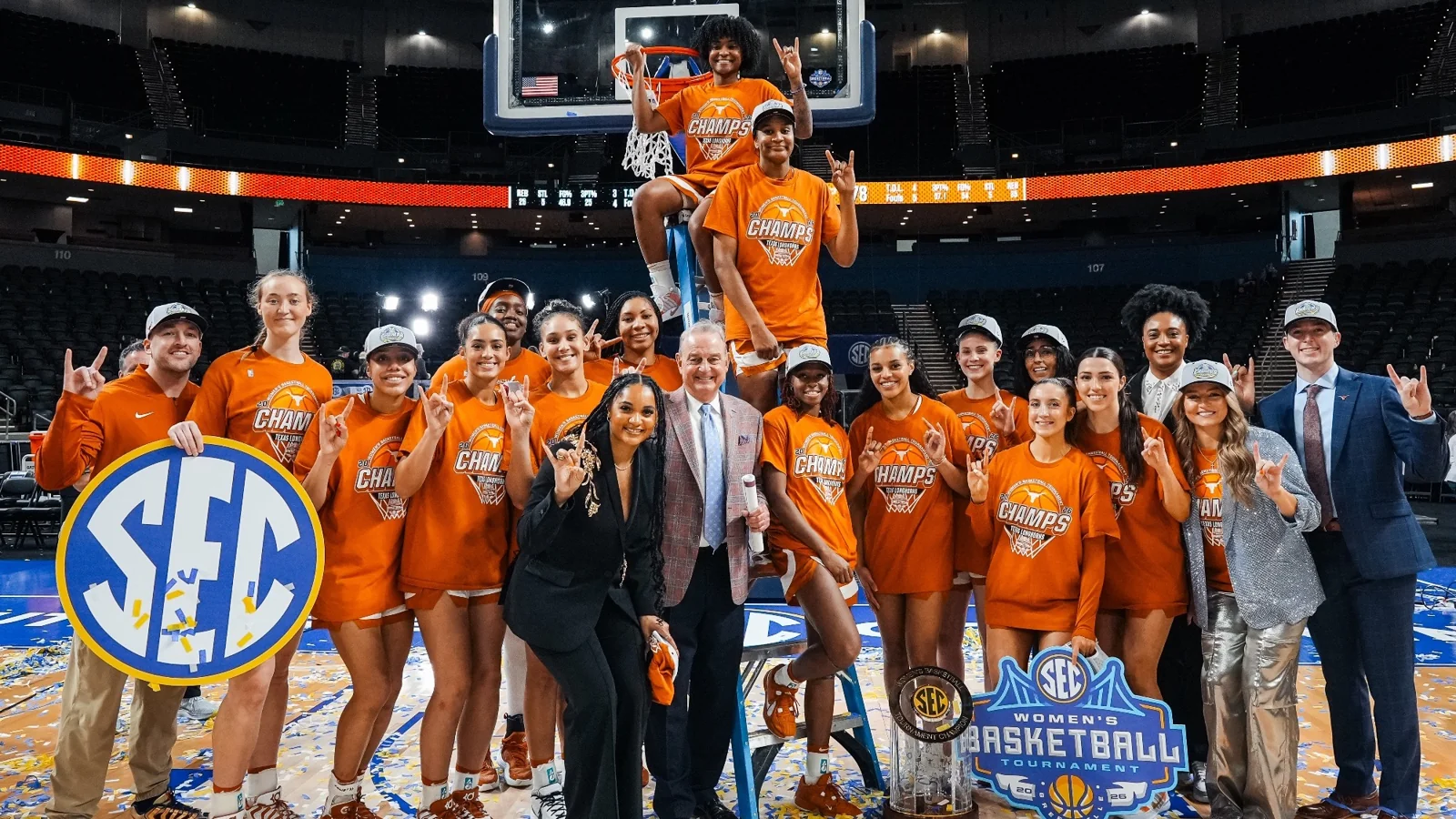
Texas defeated South Carolina 78-61 to win the 2026 SEC women's basketball tournament in Greenville. This completed-event guide lists all fifteen results, follows the finalists' routes and examines the early lead and official statistics behind the Longhorns' first SEC tournament title. It also explains Madison Booker's MVP performance and how the conference championship differed from the separate NCAA postseason.
Texas won the 2026 SEC tournament in Greenville
Texas won the 2026 SEC women's basketball tournament by defeating South Carolina 78-61 on March 8. The five-day tournament ran from March 4 through March 8 at Bon Secours Wellness Arena in Greenville, South Carolina. The Longhorns earned their first SEC tournament championship, completing a three-win route through Alabama, Ole Miss and the Gamecocks.
The Texas championship report records the seventeen-point final victory and the program milestone. Both finalists were 31-3 immediately after the game. Those are their records at the end of the SEC tournament, rather than their eventual totals after the separate NCAA postseason.
Texas was the No. 3 seed in this conference bracket, while South Carolina was the No. 1 seed. National rankings were different: the Texas report identified the Longhorns as No. 4 nationally and South Carolina as No. 3. A seed describes a team's placement in a particular tournament; a poll ranking describes its position in a national ranking. Keeping those systems separate resolves the apparently conflicting numbers readers may encounter in headlines.
The field contained sixteen teams, and the completed event required fifteen games to identify one champion. The four highest seeds entered in the quarterfinals, after receiving byes through the first two rounds. Seeds five through eight entered in the second round. Seeds nine through sixteen began on the opening day. The format consequently gave teams different workloads before they could reach the same final.
For Texas and South Carolina, a championship required three wins. A team beginning in the first round would have needed five. That distinction makes the daily results meaningful: they show both which opponents advanced and how many elimination games each team had already played. The top seeds' later entry provided an advantage, but it did not guarantee survival once they took the court.
The official completed SEC bracket is the clearest reference for the year-specific path. This retrospective covers that completed March event. A conference tournament hub may already advertise the following year's dates, while live scoreboards may display a different part of the season. Neither changes the dates or results of the 2026 championship.
South Carolina's top seed established the Gamecocks' starting position, not the final outcome. Texas converted its own protected entry into a title by winning each game it actually played. The results below show how that route developed and why the decisive championship performance should be understood alongside the entire bracket.
The completed bracket shows every round's results
The bracket contained four opening-round games, four second-round games, four quarterfinals, two semifinals and the championship. The tables list winners first and use tournament seeds, not national poll rankings. All scores follow the SEC's completed results bracket.
March 4 and 5 reduced the field to eight
| Date and round | Winner | Opponent | Score |
|---|---|---|---|
| March 4, first round | No. 9 Kentucky | No. 16 Arkansas | 94-64 |
| March 4, first round | No. 12 Florida | No. 13 Mississippi State | 86-68 |
| March 4, first round | No. 15 Auburn | No. 10 Texas A&M | 50-49 |
| March 4, first round | No. 11 Alabama | No. 14 Missouri | 65-48 |
| March 5, second round | No. 9 Kentucky | No. 8 Georgia | 76-61 |
| March 5, second round | No. 5 Oklahoma | No. 12 Florida | 82-64 |
| March 5, second round | No. 7 Ole Miss | No. 15 Auburn | 73-57 |
| March 5, second round | No. 11 Alabama | No. 6 Tennessee | 76-64 |
Auburn's one-point win over Texas A&M was the opening day's closest result. It was also a seed upset: the fifteenth seed advanced past the tenth. Kentucky, Florida and Alabama won the other first-round games. Those four survivors joined the four teams whose single byes had placed them directly into the second round.
The next day produced two more wins by teams seeded below their opponents. Kentucky defeated eighth-seeded Georgia, while Alabama eliminated sixth-seeded Tennessee. Both winners had already played on Wednesday. Their progress illustrates an important limit to the bye advantage: later entry reduces the number of games required, but the newly arriving team still has to defeat an opponent that has earned its place.
Alabama's route is particularly easy to miss in a championship-only account. The eleventh seed won twice before encountering Texas in the quarterfinals. Kentucky similarly won twice before facing South Carolina. Their eventual quarterfinal losses should not erase the earlier wins that changed the bracket and ended other teams' tournament runs.
After Thursday, the eight remaining teams were South Carolina, Vanderbilt, Texas, LSU, Oklahoma, Ole Miss, Kentucky and Alabama. This was the point where the top four seeds entered. It also meant that every quarterfinal paired teams that had taken different routes to Friday: some had not played, some had won once and others had won twice.
March 6 and 7 set up the championship
| Date and round | Winner | Opponent | Score |
|---|---|---|---|
| March 6, quarterfinal | No. 1 South Carolina | No. 9 Kentucky | 87-64 |
| March 6, quarterfinal | No. 4 LSU | No. 5 Oklahoma | 112-78 |
| March 6, quarterfinal | No. 7 Ole Miss | No. 2 Vanderbilt | 89-78 |
| March 6, quarterfinal | No. 3 Texas | No. 11 Alabama | 83-60 |
| March 7, semifinal | No. 1 South Carolina | No. 4 LSU | 83-77 |
| March 7, semifinal | No. 3 Texas | No. 7 Ole Miss | 85-68 |
Ole Miss supplied the quarterfinal seed upset by eliminating No. 2 Vanderbilt. That result changed the opponent Texas would face in its semifinal. A bracket projected from seeds alone would have anticipated Vanderbilt and Texas on that side; the actual games produced Ole Miss and Texas instead.
LSU's thirty-four-point quarterfinal victory was the largest winning margin of Friday's games. It did not carry over automatically to the semifinal, where South Carolina won by six. Results from consecutive rounds therefore answer separate questions. Friday established which teams advanced; Saturday determined which of those teams could win the next matchup.
Texas beat Alabama by twenty-three and Ole Miss by seventeen before meeting South Carolina. The Gamecocks defeated Kentucky by twenty-three, then survived the closer semifinal against LSU. Both finalists had won twice since entering the bracket, and both would play their third game in three days on Sunday.
The final completed the fifteen-game sequence: Texas defeated South Carolina 78-61 on March 8. Its seventeen-point margin matched Texas's semifinal separation from Ole Miss, but the championship had its own scoring pattern. The next section follows that pattern rather than assuming two identical margins describe identical games.
These results also show why a tournament summary should preserve the eliminated teams. The champion's path depended on outcomes elsewhere: Alabama's second-round win supplied Texas's quarterfinal opponent, and Ole Miss's Vanderbilt upset supplied its semifinal opponent. The entire bracket explains the route that a final score alone cannot.
Texas built the 78-61 final around an early lead
Texas established the championship's direction immediately, opening with a 14-0 run. Justice Carlton contributed six points during that start and finished the opening quarter with thirteen. By the first break, the Longhorns led 27-12.
The quarter scores show how much that beginning mattered. Texas won the second quarter 18-16, producing a 45-28 halftime lead. South Carolina won the third 16-12, narrowing the deficit to thirteen, before Texas won the fourth 21-17. The final margin returned to seventeen, exactly the separation at halftime.
The actual timeline contains both a South Carolina recovery and a Texas response. South Carolina made progress during the third quarter. Texas responded in the fourth. Across the entire second half, the teams scored thirty-three points each, so the Longhorns' early advantage remained decisive.
Booker led Texas with eighteen points, but the first-quarter burst was not built around her alone. Carlton finished with fifteen on six made shots in eight attempts, while Jordan Lee added twelve and made both of her three-point attempts. Their contributions gave the championship a broader scoring base than a summary focused exclusively on the tournament MVP.
The Texas final recap describes the opening surge and the Longhorns' response after halftime. Combined with the quarter scores, it explains how an early lead became a manageable advantage that Texas successfully defended through the closing period.
The championship box score explains the separation
The official championship box score records Texas making thirty-four of sixty-three field-goal attempts, compared with South Carolina's twenty-three of forty-nine. Texas combined better overall shooting with fourteen additional field-goal attempts. The raw attempts are useful evidence of opportunity, but they should not be mistaken for a complete possession count.
Texas also led rebounds 35-26, with an 11-6 advantage on the offensive glass, and committed nine turnovers to South Carolina's fourteen. These measures help explain how the Longhorns repeatedly reached scoring opportunities. Neither statistic alone describes every possession, and the same play can influence several columns, so their effects should not be added together as independent point totals.
The scoring categories supply a clearer arithmetic check. Texas made thirty two-point baskets for sixty points, four threes for twelve and six free throws. South Carolina made twenty two-point baskets for forty points, three threes for nine and twelve free throws. Texas's twenty-point advantage on two-point baskets and three-point advantage from threes outweighed its six-point disadvantage at the foul line, producing the seventeen-point final margin.
Inside scoring was important, but the more specific paint comparison was 40-32. Not every two-point basket is a paint basket, so those categories should remain distinct. Texas's overall two-point production included scoring beyond the area measured by the paint statistic.
Second-chance points were even closer: Texas led 11-10 despite recording five more offensive rebounds. That is a useful example of why recovered possessions and converted points are different. The Longhorns gained extra opportunities, but the scoring advantage directly credited to those chances was only one point.
South Carolina's bench outscored Texas's 25-17, and the Gamecocks made six more free throws. Those advantages did not close the gap created by Texas's field-goal production. The result was not a sweep of every statistical category; it was a combination of stronger scoring efficiency, sufficient opportunity and an opening lead that South Carolina never fully erased.
Joyce Edwards led South Carolina with thirteen points, while reserve Maddy McDaniel scored ten. Their contributions belong in the account of the actual game, even though Texas supplied the champion and the MVP. A complete final analysis explains both teams' production and identifies which differences were large enough to determine the result.
What the title changed for Texas and South Carolina
Texas's championship was its first SEC tournament title since joining the league. It also reversed the winner of the previous year's final: South Carolina had beaten Texas 64-45 in the 2025 championship. The same schools reached the 2026 title game, but the result and the way the game unfolded were different.
The SEC's 2025 championship account provides the direct historical comparison. That earlier score belongs to the previous event. Keeping the two finals distinct prevents a common search-result problem in which a familiar matchup leads readers to an account from the wrong season.
For South Carolina, the 2026 loss ended its tournament defense in the championship game. It did not erase the Gamecocks' wins over Kentucky and LSU, and it did not turn their No. 1 SEC seed into an incorrect pre-tournament designation. Seeding describes the bracket's starting order; winning the final establishes the tournament champion.
Madison Booker earned the tournament MVP award
Madison Booker was selected as the tournament MVP. Texas also placed Rori Harmon and Justice Carlton on the all-tournament team. The school's final report records Booker's three-game averages of twenty points and 8.3 rebounds, with 61.4 percent field-goal shooting. Those numbers describe her entire Greenville performance rather than just the championship.
The most striking individual game in that run came against Ole Miss. Booker scored a career-high thirty-one points, collected eleven rebounds and added five assists in the semifinal. The Texas semifinal report documents the performance that helped secure the team's place in Sunday's game.
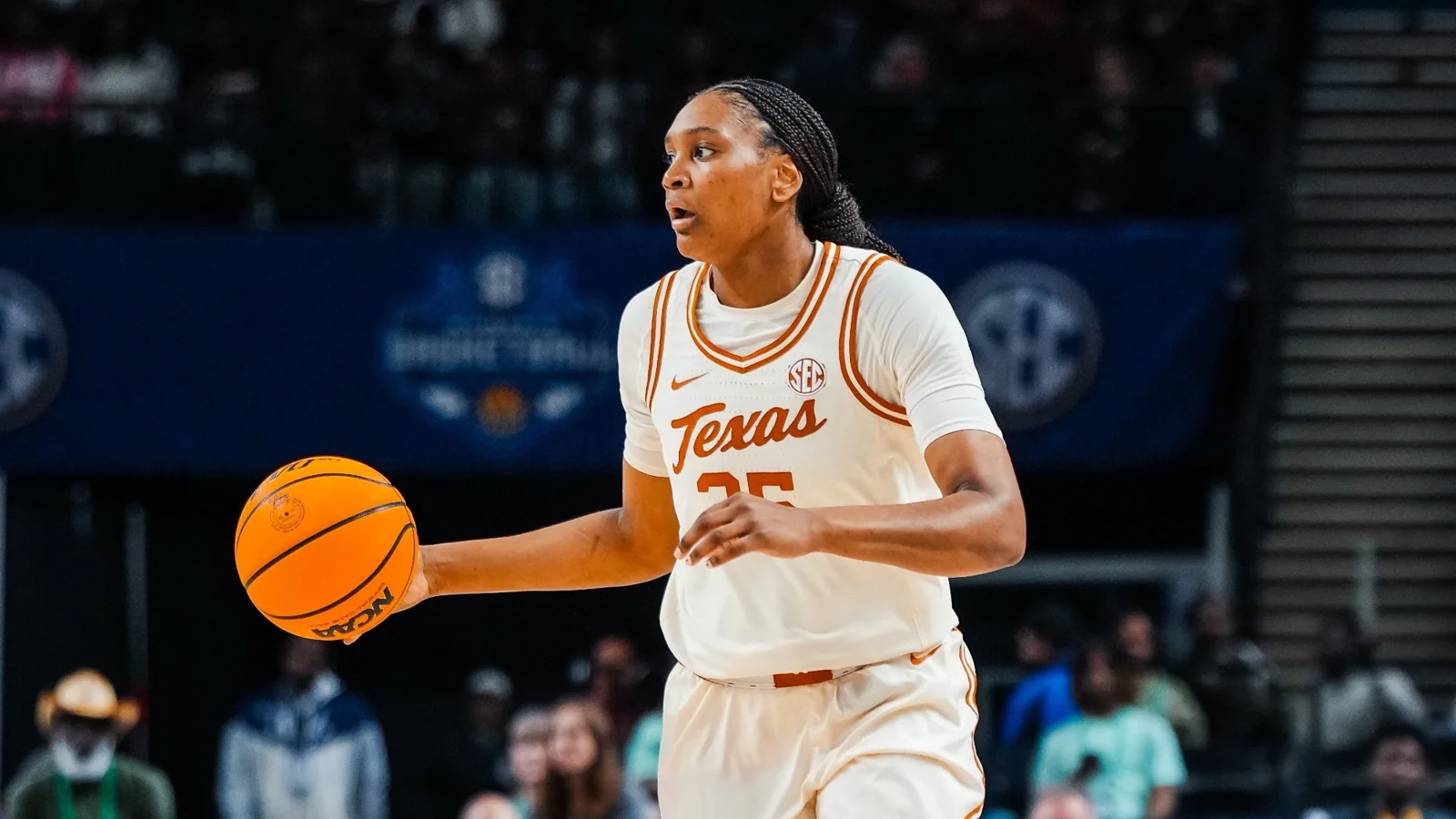
Her eighteen championship points were part of a different distribution, with Carlton and Lee also reaching double figures. That distinction is helpful when understanding the MVP honor. A tournament award reflects the event, while an individual final box score reflects one game. Booker's semifinal and final contributions fit together without requiring her to reproduce the same scoring total each night.
Harmon and Carlton's all-tournament recognition also keeps the account from becoming a single-player explanation. A championship run requires contributions across matchups and roles. The named awards acknowledge several parts of Texas's performance, while the official final statistics show how the team converted those contributions into the last victory.
The SEC trophy and NCAA tournament were separate achievements
The SEC tournament champion receives the league's automatic NCAA tournament bid, as the conference's championship information explains. Winning in Greenville therefore secured a conference postseason trophy and an automatic place in the national field. It did not award the NCAA national championship.
Texas subsequently earned a No. 1 seed in the NCAA tournament. Its NCAA selection announcement records that designation and the opening rounds in Austin. Texas could be the third seed in the SEC bracket and a first seed in an NCAA regional because those are different tournaments with different fields.
Losing a conference final does not, by itself, eliminate a team from the NCAA tournament. The national field includes automatic qualifiers and teams selected through the at-large process. The Greenville result settled which team won this SEC event; the national selection process addressed a broader set of teams and season accomplishments.
Readers looking for the 2026 SEC champion can therefore stop with Texas, the 78-61 final and the March 8 date. Readers looking for the national postseason need the separate NCAA bracket and results. That separation preserves what Texas achieved in Greenville while keeping the significance of the conference trophy accurate.
Join the conversation
Share a question or a thought about the women's game. Comments are reviewed before they appear. Keep it friendly, stay on topic and leave out personal information.
No comments yet. Start the conversation.
Sign in with Google to leave a comment. Your email address is not displayed with your comment.