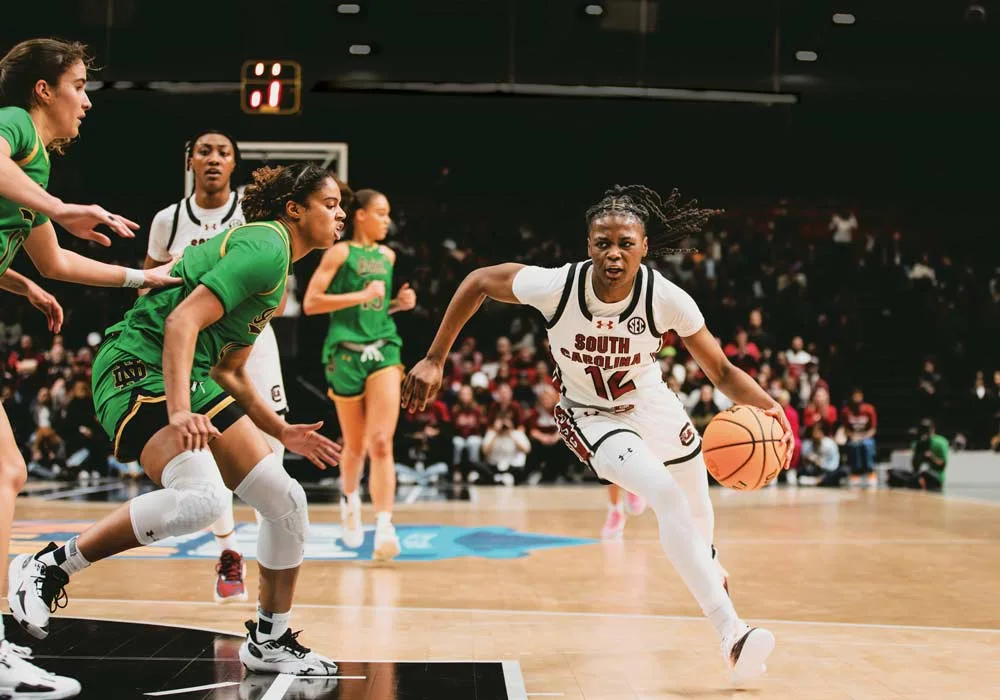
In NCAA women’s basketball in 2026–27, a team that begins a continuous backcourt count with 30 seconds on the shot clock can be called for a ten-second violation when the display reaches 19. Seeing 20 without a whistle is therefore consistent with the NCAA’s current interpretation. The team still has to establish frontcourt status; simply moving toward the center line does not finish that job.
The NCAA’s October 12 explanation is the starting point for this guide, current through October 30, 2026. It also makes an essential distinction: when the shot clock is turned off, officials use an exact 10.0 seconds on the game clock. Keep that exception in mind before applying the familiar 30-to-19 arithmetic to a late-quarter possession.
For fans, the useful question goes beyond which number appears on television. You need to know when the count began, whether an interruption preserved it, and when the ball actually gained frontcourt status. Those details explain why two sequences that look almost identical can produce different decisions.
Why 19 is the number to watch in 2026–27
The October 12 NCAA memorandum identifies this as an interpretation within the existing rules cycle. Its fresh-clock example places the violation at 19, provided the offense remains in continuous backcourt control. That is the official answer to the common “why didn’t they blow at 20?” question. It does not depend on whether the crowd has started counting or a commentator thinks the guard looks trapped.
The distinction matters because an integer display is an imperfect way to picture elapsed time. Fans often perform the subtraction 30 minus 20 and treat the visible result as a stopwatch measurement. The NCAA’s stated purpose is to ensure the offense receives its full ten seconds. Its shot-clock method deliberately uses the next displayed threshold. Think of 19 as the instruction for administering this particular count, rather than treating a television graphic as a laboratory timer.
That also explains why calling this an “eleven-second rule” creates confusion. It describes one piece of shot-clock arithmetic while concealing the continuing requirement to advance the ball and the separate game-clock procedure. A coach cannot simply tell every player to spend eleven seconds behind midcourt. The starting display can differ, an existing count can survive a stoppage, and the shot clock can be off altogether. Those conditions change what the viewer should calculate.
Imagine an ordinary possession after a made basket: the guard receives the inbound pass in the backcourt, the shot clock begins at 30, and there is no interruption. If the guard is still dribbling behind midcourt at 20, the current guidance explains the absence of a whistle. If continuous control remains there at 19, the ten-second decision has arrived. The example assumes the count and shot clock began together; that assumption needs checking in less ordinary sequences.
The practical adjustment for opening week is modest but useful. Stop treating the first appearance of 20 as proof of a missed call. Keep watching the ball, the dribbler’s feet and any intervening whistle. The 2026–27 preseason and opening-date guide provides the calendar context, while the interpretation explains what may look different once those games begin.
Crossing midcourt means establishing frontcourt status
The count ends when the ball obtains the required status, rather than when a player’s shoulders appear over the stripe. Rule 9 of the women’s rules book supplies the underlying location test. This is why a tight camera angle can make a routine call look controversial: the broadcast may show the upper body clearly while obscuring the foot or bounce that actually matters.
A dribbler needs both feet and the ball across
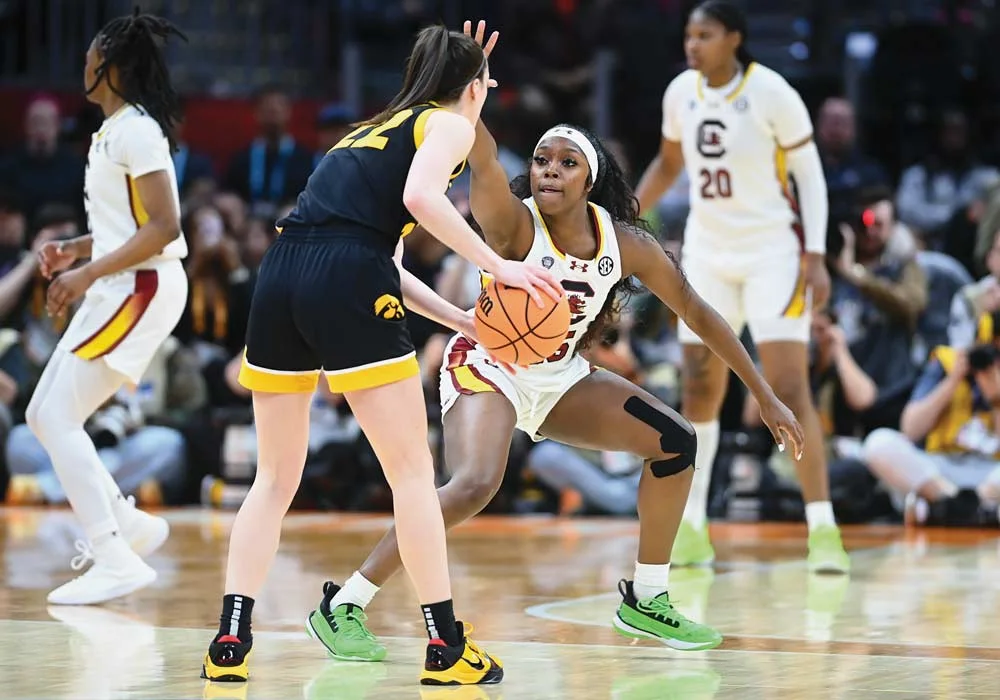
During a dribble from backcourt to frontcourt, both feet of the dribbler and the ball must touch the playing court entirely in the frontcourt. One foot beyond the line is insufficient. Nor does reaching the ball forward settle the issue if the rest of that required combination has not arrived. The line belongs to the backcourt for this purpose, so standing on it does not complete the advance.
Consider a guard moving diagonally along the sideline while a defender cuts off the direct route. The guard’s leading foot can cross before the trailing foot, with the next bounce still landing behind the stripe. From the main television angle the player may look safely over halfway. The official has a different question: has the full dribbling combination established frontcourt status before the count expires? The route and appearance of progress cannot replace that test.
For the offense, this creates a reason to advance decisively rather than relax as soon as the torso crosses. For the defense, it explains the value of delaying a clean crossing even without stealing the ball. That is a tactical implication of the location rule, not a claim that any particular team has changed its press for this season.
A pass must reach the frontcourt
An outlet pass is assessed differently from a dribble. The October 14 correction to A.R. 9-28 describes frontcourt contact as the relevant event on a pass. Releasing a pass from the backcourt is therefore not itself the finish line. A ball still flying over the center stripe has not automatically satisfied the rule merely because the passer let go in time.
That distinction rewards an early, available outlet. A teammate who comes into a useful receiving position can solve the pressure before the final instant; a hopeful late throw leaves another event to occur before the count ends. When reviewing a disputed sequence, locate the receiving touch or frontcourt floor contact rather than freezing the picture only at release. The same discipline prevents confusing a successful escape with a pass that was simply launched toward safety.
A whistle does not always buy another ten seconds
Two separate questions arise after a stoppage: what time belongs on the shot clock, and whether the backcourt count begins again. Treating those as the same question is a reliable way to misread a possession. A team can keep the ball without receiving a new opportunity to use a full backcourt count. Conversely, an interruption outside the listed exceptions can restart the count even when the possession looks like a continuation of the same attack.
The four interruptions that preserve the count
Rule 9-10 preserves the count when the opponent causes an out-of-bounds ball, the offense keeps possession after a held ball, an administrative technical is assessed to the team in control, or that team receives a timeout. These are specific exceptions. “There was a whistle” is not enough information to decide whether another ten seconds is available.
A timeout offers the clearest practical example. Picture a guard under pressure who asks the bench for help after spending several seconds in the backcourt. The break lets the coach organize an inbound play and place a receiver where the defense is vulnerable. It does not erase the time already used in that count. The offense needs a prompt advance when play resumes, rather than another leisurely attempt to organize behind the center line.
A defender tipping a pass out creates a similar viewing trap. The crowd sees another inbound play and may begin counting from the new touch, but the offense’s previous backcourt time still matters. Repeated deflections out of bounds can therefore create pressure without producing a steal. For a viewer, the relevant starting moment might be before the latest stoppage shown in a replay package.
Compare that with a defensive kicked-ball violation. A deliberate kick is a different event from a hand deflection out of bounds and falls outside the four exceptions. Do not identify the ruling merely from the ball finishing out of play; listen for the official’s actual decision. Otherwise the same-looking restart can be assigned the wrong timing history.
The corrected A.R. 9-37 makes the distinction especially concrete: an inadvertent whistle restarts the count because it is not among the four exceptions. That does not make every mistaken whistle harmless to either team. It establishes how the next live sequence is administered, which is why identifying the cause of the stoppage matters as much as noting that one occurred.
What happens when the shot clock does not start at 30
The number 19 is a worked example, not a permanent backcourt alarm. If a new count starts while the shot clock shows a smaller number, the decision belongs later in that existing shot-clock period. First identify the correct starting display. Subtracting eleven from 30 is useful only when 30 was actually showing as that count began.
The NCAA provides a particularly instructive example in the October correction to A.R. 9-37. A defender deflects a frontcourt pass into the offense’s backcourt, and an offensive player touches the ball there with 13 on the shot clock. The corrected case accepts a ten-second violation at 2.0 or 1.9; a whistle at 2.1 is treated as inadvertent. The calculation is 13 minus eleven, rather than an attempt to wait for 19 on a clock that has already passed it.
For a fan watching pressure after a deflection, the important part is the new backcourt touch. A possession can have included several seconds of ordinary frontcourt offense before that touch occurs. Counting from the original inbound would combine two different phases of play and produce the wrong answer. The case also shows why a low shot-clock display does not by itself mean the ten-second question has disappeared.
Another corrected example, A.R. 9-28, separates the start of the two clocks. On an inbound pass, a defender’s initial touch starts the shot clock, but a later touch in the backcourt starts the backcourt count in the case’s first scenario. The displayed shot-clock value at that later touch is 12. Remember the distinction rather than assuming the first movement of either clock always establishes both starting points.
That is also why shot-clock resets require their own analysis. Whether an operator should show 20, 30 or the previous time after a foul concerns the time available for the possession. Whether the offense has a new backcourt count concerns its obligation to advance. A broadcast replay that begins after the inbound may omit exactly the touch needed to distinguish those questions. When that happens, leave the conclusion open until the earlier sequence is available instead of reconstructing it from the final number alone.
With the shot clock off, use exactly 10.0 seconds
A team can have no shot-clock obligation for the remainder of a period and still have a backcourt obligation. Those are different restrictions. The October 12 guidance says to use the game clock when the shot clock is off, with a violation after exactly 10.0 seconds if continuous backcourt control remains. Do not transfer the eleven-display-second shot-clock method into that situation.
The worked example in A.R. 9-33 begins with 12.4 seconds remaining. The offense inbounds into its backcourt and stays there; the corrected ruling identifies 2.4 as the point at which the violation should have been called. A requested timeout at 1.6 comes after that point. The arithmetic is 12.4 minus 10.0, which makes this example especially useful when explaining the distinction to someone watching a late possession.
The difference between a missed violation and a late whistle
The same case distinguishes two administrative outcomes. In its missed-violation scenario, the officials recognize the error at the subsequent stoppage before the ball becomes live again and restore the clock to the required moment. The case also specifies exceptions for flagrant and technical fouls when describing what subsequent activity is canceled. It is not a license to erase every event that followed without considering its nature.
A note then addresses a different situation: an official blows late for the violation itself, and that whistle makes the ball dead. The note says there is no game-clock adjustment in that situation. For a viewer, this is a reason to identify the sequence of decisions before declaring that a clock correction was either mandatory or forbidden. A timeout revealing an earlier missed violation and the delayed violation whistle are not the same sequence.
There is a wording inconsistency worth acknowledging when reading the documents directly. A general passage in corrected A.R. 9-28 refers broadly to an eleventh second and mentions the game clock. The explicit October 12 instruction and A.R. 9-33’s detailed 12.4-to-2.4 example instead agree on 10.0 for the shot-clock-off situation. This guide follows those specific instructions; treating the generic sentence as permission to wait eleven game-clock seconds would contradict the worked case.
How to judge the next disputed backcourt sequence
Start with the beginning of the count, not the moment that attracted the crowd’s attention. Was this an ordinary inbound, a rebound, or a return to the backcourt after a defensive deflection? Find the relevant touch or control before calculating elapsed time. A replay that starts with the guard already trapped might be exciting television while leaving the essential evidence outside the frame.
Next, follow every interruption. An offensive timeout or a defensive tip out can preserve an earlier count; a different stoppage can begin another one. Write down the cause of the whistle rather than assuming that possession, the shot clock and the ten-second count all restarted together. In the basic 30-second example, the appearance of 19 answers the timing question only after those conditions are established.
Then look for frontcourt status. With a dribbler, watch both feet and the ball. With a pass, look for the relevant frontcourt contact. A broadcaster describing the player as “across” may be speaking conversationally about body position rather than applying that legal test. Neither the announcer’s first reaction nor the crowd’s count is a substitute for the full sequence.
Finally, separate a disagreement about judgment from a claim that a clock was operated incorrectly. Rule 11 treats replay categories and clock-operation mistakes specifically. A complaint that the shot clock started too early is a different proposition from saying the guard’s last foot crossed in time. The existence of replay equipment does not make every objection an automatic monitor review, and a replay being shown on television does not establish what officials are authorized to decide from it.
This approach also makes the basketball more interesting. Watch how quickly the receiver presents an outlet, whether the dribbler retreats into pressure, and whether a deflection actually steals time from the offense. Those observations can explain a possession’s difficulty without pretending that the scoreboard alone proves a rules error. Use the women’s college basketball TV schedule to choose the next game, then keep the three decisive details in view: the count’s start, any preserved time, and the ball’s frontcourt status.
Join the conversation
Share a question or a thought about the women's game. Comments are reviewed before they appear. Keep it friendly, stay on topic and leave out personal information.
No comments yet. Start the conversation.
Sign in with Google to leave a comment. Your email address is not displayed with your comment.