The Division I steals record belongs to Chastadie Barrs, while Natalie White leads the career average list. Their achievements, the next historical leaders and Hannah Hidalgo's newer records tell different parts of the same defensive story.
Who holds the Division I career steals record?
Chastadie Barrs of Lamar holds the NCAA Division I women's basketball career steals record with 648 steals in 122 games, according to the current NCAA Division I record book. She played from 2015-16 through 2018-19. Natalie White of Florida A&M owns the career steals-per-game record: 624 in 113 games, an average of 5.52. Those answers were checked on October 20, 2026, and they describe different achievements.
There is a small but meaningful discrepancy in published accounts of Barrs' career. Some lists give her 649 steals. The current NCAA career table and Lamar's own season biography both give 648, the figure used here. That one-steal difference does not change the identity of the leader or White's separate average record. It does change the number somebody chasing the official career mark needs to pass.
Career totals and career averages answer different questions
A career total asks how many possessions a player took away across all her games. An average asks how frequently she did it per appearance. Games played therefore belong beside the steals number. White accumulated fewer steals than Barrs but did so in nine fewer games. Dividing 624 by 113 produces about 5.52; dividing 648 by 122 produces about 5.31. The calculations explain the apparent contradiction without having to declare either player a lesser defender.
The average record also has a qualification rule. The NCAA career steals-average table requires at least 200 steals. A player who collects six steals in one appearance does not become its leader. Minimums protect a comparison from extremely small samples, although they cannot make every qualifying career identical. Availability, role, minutes and the length of a team's season still influence what a player can accumulate.
Consider an illustrative comparison, not an actual player record: a guard averaging four steals over 30 games finishes with 120, while another averaging three over 40 games also finishes with 120. Their totals match, but the first produced steals more frequently per game and the second sustained her contribution across a longer schedule. Neither total tells us how many points their teams allowed or how often their pressure failed. The record is a clear answer to a defined question; defensive evaluation asks additional questions.
What the NCAA record actually covers
This is a Division I college record, rather than a combined NCAA, NAIA, junior-college or professional basketball list. The NCAA records directory separates Division I, Division II, Division III and association-wide records. It also separates full-season and career statistics from NCAA championship records. A steal in a conference game can count toward a player's career while having no place in her NCAA tournament total.
There is also a historical boundary. Steals became an official NCAA women's statistical category in 1987-88. Earlier schools sometimes kept their own defensive totals, but incomplete national coverage prevents treating every earlier career as if it entered the same record system. A missing early player does not prove she rarely won the ball. It can mean the national category did not yet exist during her college years.
The season labels need similar care. An NCAA table listing Barrs as 2016-19 identifies seasons by their ending years; it does not mean she arrived in the autumn of 2016. Reading the labels as 2015-16 through 2018-19 avoids losing an entire freshman season. This guide uses the official scope and identifies completed records separately from active careers, so fans can compare accomplishments without confusing eligibility years, calendar years and tournament appearances.
The players who built the career steals leaderboard
The leading names reach across different conferences, decades and styles of team. The selected leaders below follow the current NCAA career table, including completed 2025-26 results. They provide a more useful starting point than a list restricted to famous championship programs. A national record remains national whether its holder played on a heavily televised team or in a conference that rarely received that attention.
| Player | College | Games | Steals |
|---|---|---|---|
| Chastadie Barrs | Lamar | 122 | 648 |
| Natalie White | Florida A&M | 113 | 624 |
| Ticha Penicheiro | Old Dominion | 133 | 591 |
| Heidi Caruso | Lafayette | 113 | 532 |
| Cierra Hooks | Ohio | 149 | 497 |
| Shakyla Hill | Grambling | 130 | 493 |
| Angel McCoughtry | Louisville | 139 | 481 |
| Hannah Hidalgo | Notre Dame, active | 103 | 481 |
Chastadie Barrs and Natalie White
Barrs makes the strongest case for sustained accumulation. Across four seasons she repeatedly created chances to finish possessions before an opponent could shoot. One particularly useful snapshot comes from Lamar's January 18, 2018 report: she collected 12 steals in a 77-54 victory over Incarnate Word while becoming the Southland Conference career leader. A dozen steals in one game is extraordinary, but the career distinction required repeating productive defensive work long after that evening.
Her role also extended beyond finishing defensive possessions. Lamar's biography credits her with 711 career assists and four consecutive conference defensive-player-of-the-year awards. That combination matters when picturing the player behind the record. She could take possession away at one end and organize a teammate's chance at the other; describing her only as a specialist leaves out a substantial part of her responsibility.
White's claim is different and equally clear. Florida A&M's historical account records a 143-steal freshman season and three national steals titles, in 1992, 1994 and 1995. Her career did not depend on a late statistical surge. She established an exceptional rate immediately and kept returning to it. White's total therefore provides a warning against assuming the player with fewer career games had less sustained influence.
Ticha Penicheiro and Heidi Caruso
Penicheiro's 591 steals sit alongside an equally revealing college identity: the point guard who could deliver a pass as readily as she could intercept one. Old Dominion's archived media guide records her career steals and the program's defensive history. In a player like Penicheiro, awareness links the two ends. Recognizing where a pass is going helps a defender disrupt it; recognizing where teammates will move helps a ball-handler create it. That is an explanation of the relationship between those skills, not a claim that every steal in her career occurred in the same way.
Caruso supplies another route to the top of the table. Lafayette's Hall of Fame profile credits her with 532 career steals and notes that she once held national game and season records as well. She was also an accomplished college soccer player. Her place in this basketball comparison rests on the steals she actually recorded, rather than an assumption that being good at another sport automatically creates an elite defender.
The contrast between these two guards is useful for a fan learning the history. They shared an ability to win possessions, but their programs and national exposure differed. A career list recovers that breadth. It can introduce a reader who already knows Old Dominion's Final Four history to a Lafayette player whose achievement is just as concrete on the relevant statistical measure.
Why the next names still matter
Hooks, Hill, McCoughtry and Hidalgo show why cutting the history down to the record holder alone misses so much. Their game counts vary considerably. Hooks' 497 steals came in 149 games; Hidalgo reached 481 in 103 through 2025-26. That is a comparison of recorded opportunity and production, not a verdict that one faced an easier schedule or defended better teammates. Those larger claims need separate evidence.
Hill also appears in the sport's unusual quadruple-double history, while McCoughtry brought her ball-winning production to a Louisville team that reached the 2009 national championship game. The point is not to convert a steals table into a universal player ranking. It is to recognize how the same defensive event can become part of very different careers: an all-around statistical performance, a long program career, or a championship run. Each deserves its proper context.
Hannah Hidalgo and the records a career list can hide
Hannah Hidalgo finished 2025-26 with 481 career steals, still short of Barrs' career total. Yet she had already changed three other major steals records. Notre Dame's April 1, 2026 award announcement confirms her 202 steals in a season, 29 in one NCAA tournament and 16 in one game. A search that answers only "Who leads the career list?" would miss that remarkable concentration of production.
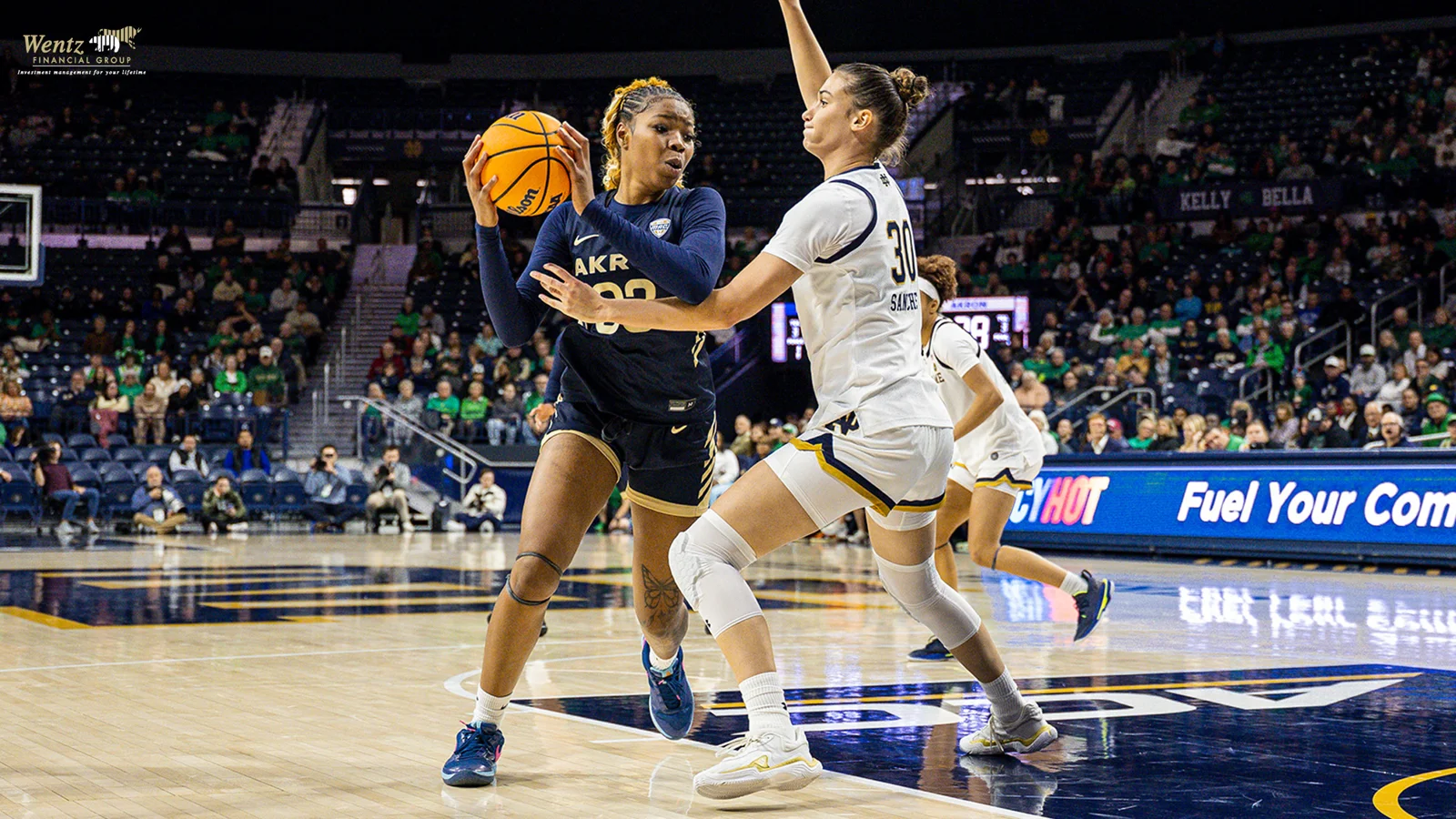
The single-game record came against Akron on November 12, 2025, when Hidalgo also scored 44 points. The date belongs to the 2025-26 college season; the game did not take place in November 2026. Akron's contemporary report identifies the 85-58 result. It is a useful reminder that a season ending in 2026 includes games played in the previous calendar year.
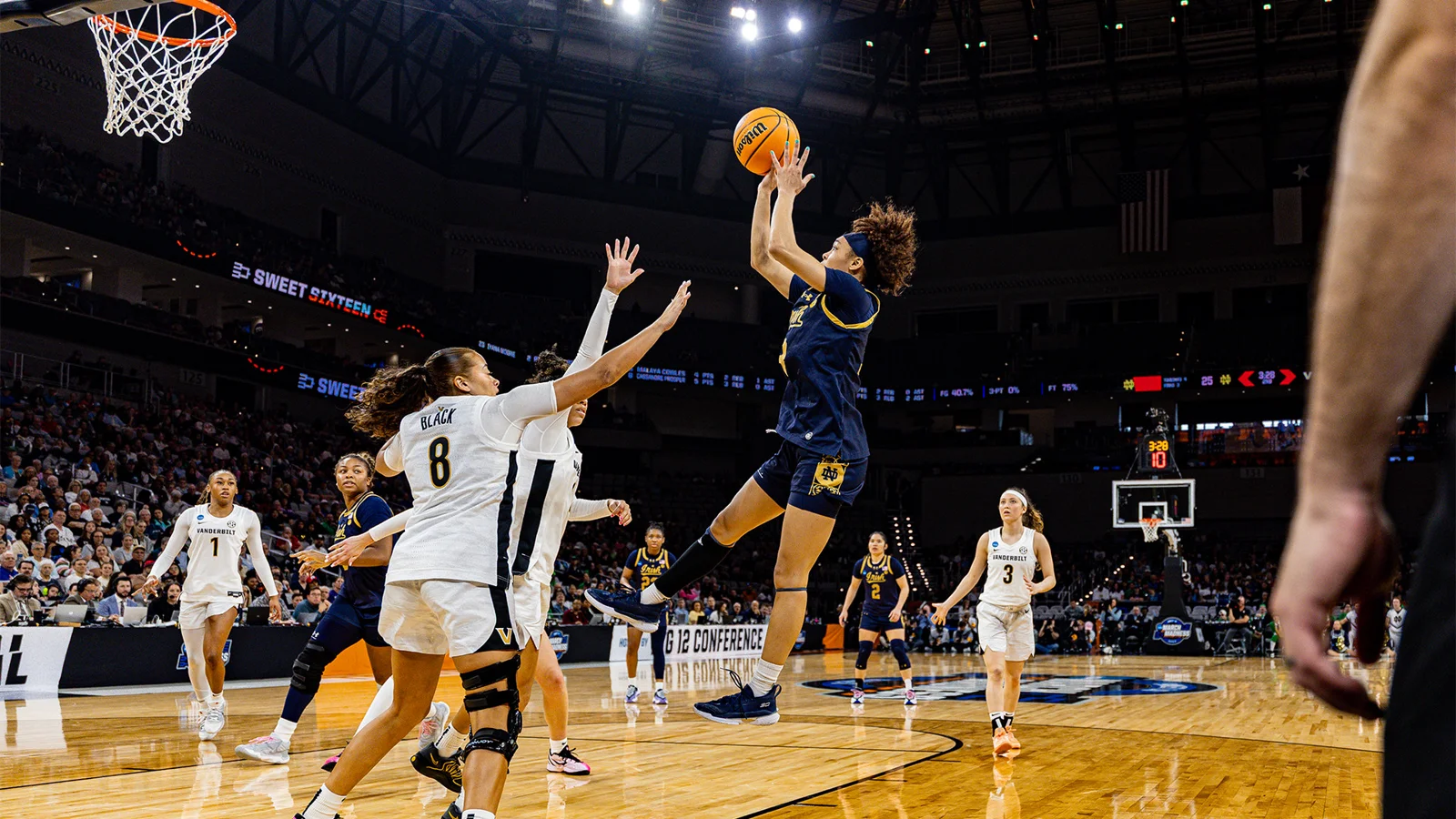
The record-setting season also reached beyond an early nonconference matchup. In the March 27, 2026 Sweet Sixteen, Hidalgo produced 31 points, 11 rebounds, 10 steals and seven assists as Notre Dame beat Vanderbilt 67-64. The official box score gives the numerical foundation for that performance. Her steals total after that game was 199 for the season; three more against UConn took the final number to 202.
Those changing totals explain why two accurate reports can appear to disagree. A story written immediately after the Sweet Sixteen should use 199. A completed-season record should use 202. Likewise, the tournament progression was eight against Fairfield, eight against Ohio State, 10 against Vanderbilt and three against UConn. The arithmetic, 8 + 8 + 10 + 3 = 29, is more informative than treating each article's publication date as its statistical cutoff.
The Vanderbilt game also illustrates why a defender's value does not end when she takes possession. Hidalgo's seven assists included the late pass that allowed Cassandre Prosper to put Notre Dame ahead, as described in the school's game report. Winning the ball and making the next decision were both part of the performance. Reducing the game to the triple-double label conceals how many different responsibilities she carried.
As of this guide's check, her 481 career steals left a gap of 167 to equal the current official record and 168 to exceed it. That is simple subtraction, not a projection of her next season. Availability, games played, opponents and defensive responsibilities can change. The completed achievement is already substantial: by the end of her junior season she had paired a place near the career leaders with national records at shorter time scales. Fans can appreciate those facts without promising a future career record.
How to judge a great ball-winning defender
A steals record measures a real, valuable event: an opponent has lost possession through a defender's action. It is still only one part of defending. A player can prevent a pass from being attempted, funnel a drive toward help or hold her assignment away from the ball without recording a steal. Appreciating a record becomes more interesting when those quieter actions stay in the picture.
Read the possession after the steal
When watching a current game, follow the entire sequence. Did the defender win the ball cleanly and keep it in bounds? Did she find a teammate ahead of the defense or protect possession until support arrived? Was the ensuing shot a good opportunity? A live-ball steal can create a fast break, but a steal does not automatically become two points. A rushed pass can give possession straight back. The record credits the original defensive event; the next decision determines how much the team can make of it.
The action before the steal matters as well. A teammate might stop a drive, another might deny the obvious outlet, and the eventual steal recipient might anticipate the remaining pass. Credit still belongs to the player who earns it under the scoring rules. Understanding the group work simply stops an individual statistic from being mistaken for a complete map of responsibility. The same principle applies when a defender's gamble leaves a teammate covering two attackers.
That distinction was central to the setting in which Barrs played. A Northwestern State preview from February 2019 described Lamar forcing 25.3 turnovers per game and Northwestern State forcing 25.0. Those are team turnover figures, not Barrs' individual steals. They establish the importance of possession pressure in that matchup without pretending every opponent error belonged to one defender.
Compare opportunities before comparing players
Start with the simplest denominators: games and minutes. Then ask how the team plays. A guard in a pressure defense may be encouraged to attack passing lanes; another may be required to stay connected to a dangerous scorer. Neither assignment removes the need for skill. They do alter the kinds of plays available. Without a reliable possession count and comparable role information, turning the career table into a precise estimate of defensive efficiency goes beyond what the numbers establish.
Schedule length also changes the horizon of a record chase. Conference tournaments, national tournaments and other postseason appearances can add games. Extra eligibility seasons can add a larger set of opportunities. An average partly addresses the number of appearances, but it does not adjust automatically for pace, opponents, minutes or teammates. There is no honest single calculation that makes every era and every program identical.
For fans following today's players, the best approach is to keep three notes together: the verified running total, the number of games behind it and the season being compared. Use the women's college basketball schedule to choose a game, then watch how the defender creates and uses possessions. The career leaders give that viewing a historical reference point. Barrs supplies the official total to chase, White supplies the unmatched career rate, and players such as Hidalgo show how a season can redraw other parts of the record book before a career is finished.
Join the conversation
Share a question or a thought about the women's game. Comments are reviewed before they appear. Keep it friendly, stay on topic and leave out personal information.
No comments yet. Start the conversation.
Sign in with Google to leave a comment. Your email address is not displayed with your comment.