
NCAA women's basketball ticket prices depend on the school, seat and package. Published 2026-27 season examples start at $65 for Illinois general admission and $80 at Florida, while individual-game availability follows each school's release schedule. This guide focuses on regular-season buying and helps you compare the whole cost of attending.
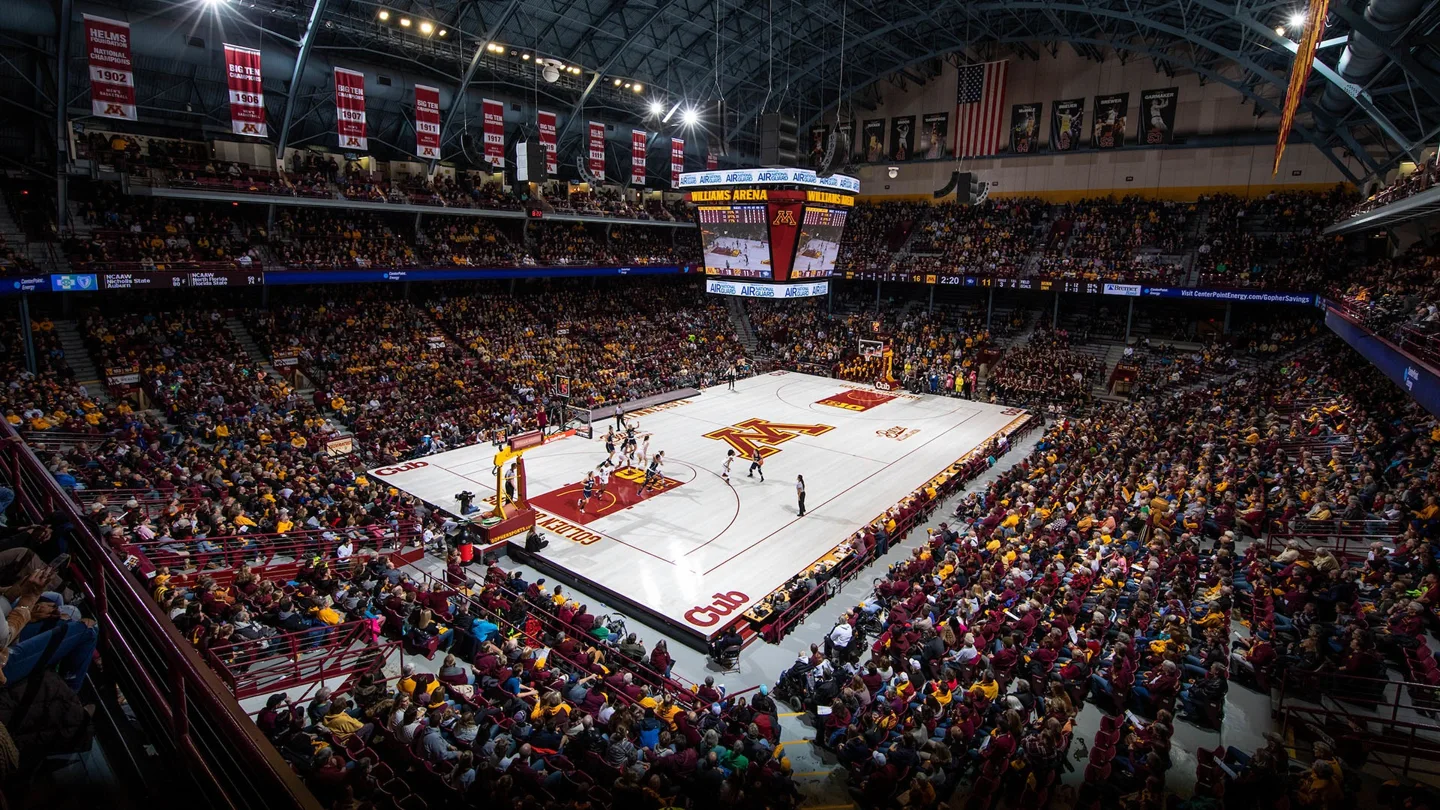
Cover: archival Williams Arena exterior, University of Minnesota Athletics; capture date not stated. Not a 2026-27 event photograph.
How much do NCAA women's basketball tickets cost?
There is no single NCAA price for attending a regular-season women's basketball game. Start with the home university's ticket office, select the women's team, and compare the exact seat category and package. As of September 9, 2026, several schools have published affordable full-season options, while some individual-game prices remain unannounced. A season-ticket advertisement can therefore appear before there is a reliable price for the one Saturday you want.
Published 2026-27 season-ticket examples
The following examples are published school prices for the upcoming season. They illustrate different choices; they are not a survey of every Division I program or live resale quotes. Availability, checkout charges and the precise benefits attached to a seat must be checked with the seller.
| School | Published season-ticket examples | What to compare |
|---|---|---|
| Illinois | $65 general admission; $109 public reserved; $199 public courtside | Assigned seating versus general admission |
| Florida | From $80 general admission; $175 loge; $275 courtside | Entry category and upgraded locations |
| App State | $99 reserved; $150 courtside | Seat category and separate parking |
| Minnesota | From $169 per seat | The section available at the starting price |
These figures come from the Illinois ticket page, Florida's July announcement, App State's August announcement and the Minnesota ticket page. A $65 general-admission package and a $275 courtside package answer different questions. The higher amount buys a different viewing position at a different school; it does not establish what a typical fan must spend.
Why there is no useful national average
An average becomes misleading when it combines one-game tickets, season packages, student admission and premium seats. Resale listings introduce another distinction: an asking price is what a seller hopes to receive, not necessarily a completed sale. Taking the cheapest listing for each school would also ignore how many seats are actually available together. Four scattered singles cannot substitute for a family block of four.
For a practical comparison, keep the game, quantity, seating type and delivery method constant. Compare the same event on the school-linked sales platform and any resale platform you are considering. Record the final payable total for the whole party, then divide by the number of people. That gives you an actionable per-person cost. Do not divide a family order by the number of games unless the order really includes those games.
There is also a difference between an affordable game and your preferred game. A local nonconference afternoon may fit a tight budget and an early bedtime; a rivalry matchup might be the reason you want tickets in the first place. Decide which experience you are purchasing before chasing the smallest number. The cheapest available basketball ticket has little value if it does not match the team, date or seat arrangement your group needs.
Single games, mini-plans or the whole season?
Buy a single game when the date matters more than long-term access. It lets a first-time visitor learn the arena, test the sightline and discover whether an evening game works for the family. A season ticket becomes more attractive when you want a regular place in the building and can use enough dates. A mini-plan can bridge those needs, provided its games and seat restrictions actually fit your calendar.
Do not assume a mini-plan exists because the ticket website has a tab for it. Minnesota's 2026-27 page still describes mini-plans as forthcoming at this check. Buying a season package today and hoping to exchange it later for a smaller plan is an expensive way to resolve an unanswered question. Ask the ticket office when the product you need will be offered.
Calculate the cost of the games you will attend
Use your realistic attendance count rather than the full home schedule. In a hypothetical comparison, a $120 season ticket costs $10 per attended game if you attend twelve times, $20 if you attend six times and $40 if you attend three times. If comparable individual tickets cost $15 each, eight visits would equal the $120 package before additional costs. That is arithmetic for a made-up example, not a quoted school offer.
The calculation becomes more useful when you write down the actual dates. Mark definite visits, possible visits and definite conflicts. Count the definite visits first. Add possible dates only if you would comfortably accept paying for them even when your plans fall through. A package can still be worth buying for convenience or a preferred seat, but those are benefits you are choosing to pay for, separate from savings.
Check what happens to unused tickets. Duquesne's published 2026-27 benefits include exchanging tickets for up to two other games, with exclusions possible. That is a specific school benefit. It does not mean every university lets you roll missed games forward, and an exchange may not preserve the original location or admit an extra person to a sold-out date.
Keep postseason access separate as well. Priority to purchase a future tournament ticket is a purchasing opportunity; it is not the tournament ticket itself. A buyer interested mainly in March should not count an uncertain future game as an included regular-season visit. Read the itemized package description and ask which exhibitions, neutral-site games and postseason events fall outside it.
Finally, price flexibility honestly. If your work schedule changes weekly, a smaller commitment may be the stronger choice even when the theoretical season average looks lower. If you attend almost every home game and value sitting beside the same friends, stable seating may be worth a premium. The best package is the one you can use comfortably, with benefits you understand before payment.
Read the full price before comparing seats
A useful ticket budget has two totals: the amount needed to secure admission and the amount needed to enjoy the trip. Keep the first precise and the second realistic. A school can offer an inexpensive seat while parking, a long drive and meals make a particular outing costly. Conversely, a slightly more expensive nearby game can be the easier family purchase.
Seat location and required contributions
Read the seating map alongside the price list. General admission describes how a place is allocated, while courtside, sideline and upper level describe location. Do not infer an assigned row from a colorful section on a map. If a ticket promises access to a general-admission area, ask whether arriving earlier matters for your group to sit together and whether every open section is included.
For watching basketball, a higher sideline position can make spacing easier to follow: you can see a guard use a screen, the weak-side defender help and the next pass reach the corner. A lower seat gives a stronger sense of speed and contact, but a basket support or a row of people can affect what an individual spectator sees. Those are reasons to inspect the actual section, not a claim that one premium label always delivers the best view.
Ask whether a required contribution is per seat, per account or attached only to optional hospitality. Also ask what the contribution buys. Club access, food, parking and admission are separate benefits unless the package explicitly combines them. A premium-area photograph is useful for understanding the furniture and angle, but it cannot confirm the exact seat inventory or what is included in today's offer.
Parking, children and accessible seating
Parking can materially change the season calculation. App State's 2026-27 announcement lists a separate $125 deck parking pass available to eligible season-ticket holders and Yosef Club members, covering men's and women's home games. Someone attending both sports may value it differently from a women's basketball fan walking from campus. Do not add the entire parking pass to one sport without considering how you will use it.
For children, confirm the venue's age threshold, lap-child conditions and whether the event has an exception. A youth rate and free infant admission are different products. Ask whether an infant still needs a no-cost credential, whether a stroller can enter and whether your chosen section makes repeated concourse trips manageable. The right answer comes from that game's host rather than another university's otherwise similar ticket page.
Accessible seating deserves the same early attention as price. Describe the actual need to the ticket office: wheelchair space, step-free access, a nearby companion seat, limited walking distance or a place that avoids steep stairs. Do not buy an unsuitable cheap seat on the assumption that a same-day exchange will be available. Confirm the route from parking or drop-off through the entrance to the seat, and keep the office's instructions with your booking.
Before payment, compare the full order totals for the same number of people. Then add your planned transport and meal budget. This is a more dependable way to control spending than choosing the lowest displayed seat amount and discovering the rest at the arena.
Where and when to buy regular-season tickets
Start at the university athletics website and follow its women's basketball ticket link. That route identifies the school's chosen primary seller and any resale partner it actually endorses. A familiar ticketing brand in a search result does not by itself tell you whether the offer is a primary sale, a fan's resale listing or the correct event. Verify the opponent, venue, women's designation and year before comparing prices.
There is no nationwide release day for ordinary home games. Illinois's May 26, 2026 announcement points to mid-October for single-game sales. Other schools use broader fall windows or have not posted a date. A page with no selectable seats in September may reflect inventory that has not been released, rather than a sold-out game. Check the dated announcement before paying a reseller's early asking price.
For an away game, locate the host school's ticket information. Your team's schedule helps identify where it will play, but the visiting school's season package should not be assumed to cover an opponent's arena. Neutral-site events need another check: the promoter or venue may sell a multi-game session, and a university's familiar home seating categories may not apply. Read the event title and inclusions closely.
Resale can be useful when a preferred section is unavailable or your plans change late. Compare its final total with any remaining primary inventory and read the delivery deadline and buyer-support terms. A seller's high asking price does not show that tickets have traded at that amount, and waiting does not guarantee a discount. If sitting together is essential, inspect all seat numbers in the order rather than accepting a quantity alone.
Prepare the digital tickets before traveling. For tickets using its moving-barcode system, Ticketmaster says screenshots will not work for entry; use the supported app or wallet process. Other schools may use a different provider, so follow the instructions attached to your actual order. A confirmation email, a payment receipt and an admission credential have different purposes.
If friends arrive separately, complete any permitted transfer ahead of time. Ticketmaster's transfer guidance explains that acceptance issues a new barcode to the recipient and invalidates the sender's version. Verify acceptance rather than assuming a forwarded message finished the process. Keep your phone charged and know where the venue handles ticket problems.
Recheck the game time before leaving and read the order's change and refund conditions when purchasing. To organize dates before selecting a package, use our women's basketball calendar. The schedule helps plan attendance; the seller's final event details determine what your ticket admits you to.
Lower-cost options for students, families and groups
Ask about the offer that matches your party before choosing ordinary public tickets. A university may have a student arrangement, a youth price, an employee benefit or a group program, and each can operate differently. A discount that requires advance coordination is useful only if you can meet that requirement. It is better to learn the rules before collecting money from a team of parents than to discover them at the box office.
Duquesne's 2026-27 ticket page lists $13 advance general admission and $8 youth general admission. Two adults and two qualifying youths would therefore total $42 at those listed rates before any additional charges. Its group offer is $8 per ticket for at least ten people, purchased at least 48 hours ahead. Check eligibility and the actual event's availability before treating either example as a completed quote.
A group organizer should confirm the final count, how tickets will be distributed and whether the seats or general-admission area fit the party. Ask separately about any on-court activity. A discounted game ticket does not automatically reserve a halftime appearance, and an advertised experience may have a different minimum purchase or age limit. Put the arrival time and meeting place in the message you send to attendees.
Use the eligibility rules, not just the headline discount
Student admission belongs to the eligible student, not automatically to every visitor accompanying that person. Florida's announcement specifies current UF students who pay the athletic fee and take at least one credit hour. A student from another college, an alumnus or a visiting parent should not assume that the same offer applies.
Minnesota advertises free student entry and encourages early arrival; its group discounts apply to parties of twenty or more at selected games. These details matter more than the word “free” or “discount.” They tell you who can use the offer, whether a popular date is included and how early your party needs to organize.
For a first family visit, choose the date and seating arrangement before upgrading the experience. A comfortable start time, a manageable walk and seats together may be more valuable than a hospitality add-on. Leave room in the budget for the parts of the trip your family actually enjoys, and decide those limits before reaching the concession stand. Nobody needs to buy every available extra to make a college game memorable.
Finish with a simple sequence: choose the game, check the school offer, confirm eligibility, compare the complete price, and prepare admission on the device or credential the host requires. Use our team directory to begin with the right program. A good ticket purchase puts your group in suitable seats on a date you can attend, at a total you understood before paying.
Join the conversation
Share a question or a thought about the women's game. Comments are reviewed before they appear. Keep it friendly, stay on topic and leave out personal information.
No comments yet. Start the conversation.
Sign in with Google to leave a comment. Your email address is not displayed with your comment.