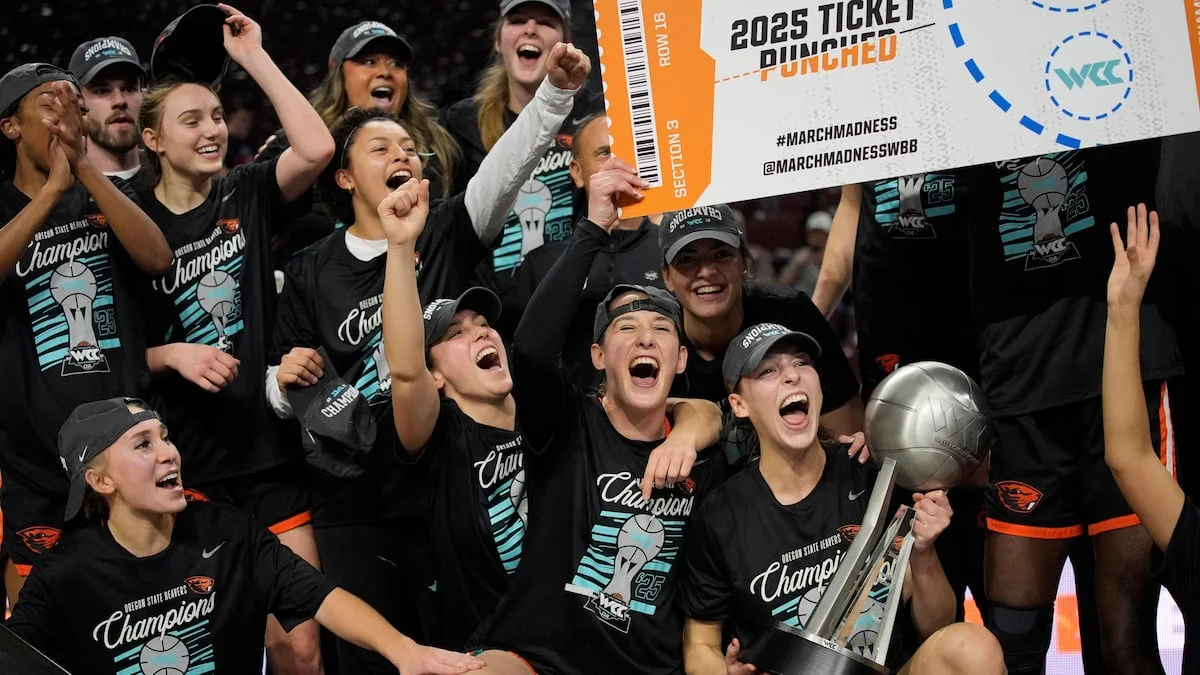
Cover: Oregon State celebrates the WCC tournament final in Las Vegas, March 11, 2025. Archive basketball photograph, not a union-recognition celebration. Photo: John Locher/AP, via OPB.
As checked October 1, 2026, Oregon State women's basketball players are seeking union recognition; the public case remains assigned to an administrative law judge with objections pending. Their goals include compensation, continuing medical protection and a collective voice. Here is what they are requesting, why the university disputes the employee claim and what the Oregon process can decide.
Oregon State's players are seeking recognition, not celebrating a final ruling
Oregon State women's basketball players are asking to be represented as public employees through the United College Athletes Association, or UCAA. Their petition is not a completed collective bargaining agreement. As checked on October 1, 2026, the Oregon Employment Relations Board's public case listing records RC-016-26 with objections to the petition and assignment to an administrative law judge. This review did not establish a final recognition ruling.
The original July 31 petition describes the proposed unit as Oregon State women's basketball athletes receiving wages, stipends or other compensation. It asks for certification through the card-check process. That is a specific representation request concerning a particular team and employer, not an order unionizing every Oregon State athlete or every NCAA women's basketball team.
The filing listed a proposed unit of 14 at that time. Later reporting describes the team with a different headcount. Numbers from different dates and definitions should not be combined into one supposedly current roster. Likewise, the UCAA's July 31 announcement says more than 100 women's basketball players nationally had signed authorization cards. It does not say that Oregon State had 100 petitioners or that those cards created one already certified nationwide bargaining unit.
The school disputes whether these players are public employees for this purpose. That disagreement is why legal status, player goals and the eventual bargaining process need separate treatment. The petition shows what the organization is asking for; it does not prove that every underlying employment argument has been accepted.
For fans, the case offers a direct view of issues that sit behind a college season. Players are raising questions about compensation, continuing medical protection and their role in decisions affecting participation. Understanding those goals is useful even while the board's answer remains unresolved.
What the players want to negotiate
The players' case is about the conditions of participation as well as the money attached to it. The UCAA's launch announcement identifies compensation, health, safety, education and a collective voice as priorities. Those are the organization's goals. None is a negotiated contract term simply because the petition has been filed.
Compensation is about more than a star's endorsement deal
Individual NIL opportunities and collective compensation questions are different. One player's commercial following can support an endorsement business without establishing a floor for her teammates. A reserve who prepares for practice, travels with the team and contributes to its work may have little individual marketing demand. The existence of a highly visible star does not answer how that reserve's participation should be valued.
In OPB's August report, former Beaver and UCAA co-founder Mikayla Pivec describes an interest in minimum compensation for players beyond the top of the market. That explains the organizing objective; it does not establish that a particular minimum has been agreed or that every player currently receives the same institutional payment.
A collective floor and an individual endorsement can coexist as separate ideas. The former asks what protections or compensation attach to being part of the unit; the latter concerns a particular commercial agreement. Fans should avoid reading the campaign as a request that every player have the same brand value. Equally, a successful individual deal does not remove the athlete's interest in medical protection, academic flexibility or an enforceable process for disputes.
Medical protection can extend beyond the final college game
Continuing care is a concrete concern. OPB's September hearing report describes Mackenzie Shivers discussing earlier knee injuries and her desire for future surgery-related coverage. The account provides her stated concern, not a diagnosis made by this article and not proof that a particular future treatment has been denied.
The distinction between treatment while on the roster and treatment after college helps explain why the issue matters. A hypothetical player can finish her final season yet still need follow-up care associated with an earlier sports injury. The relevant questions then concern the duration and scope of coverage, who pays an uncovered expense and how she contacts the responsible institution after moving away. A season's final box score cannot answer those questions.
Negotiating stronger protection would require understanding benefits already available and identifying the remaining concern. Asking for continuing coverage does not establish that there is no existing medical support. It also does not guarantee unlimited coverage after recognition. The practical value would lie in clearly stated eligibility, responsibilities and a usable process, rather than an assurance whose meaning a player discovers only when she needs care.
A voice in the demands placed on the team
OPB also reports Jenna Villa seeking fair treatment, health benefits and influence over what happens to the players. Her participation is reflected in the UCAA's published leadership, which includes her on its interim executive committee. That is a specific player's role in the effort, rather than a claim about what every Beaver or every college athlete believes.
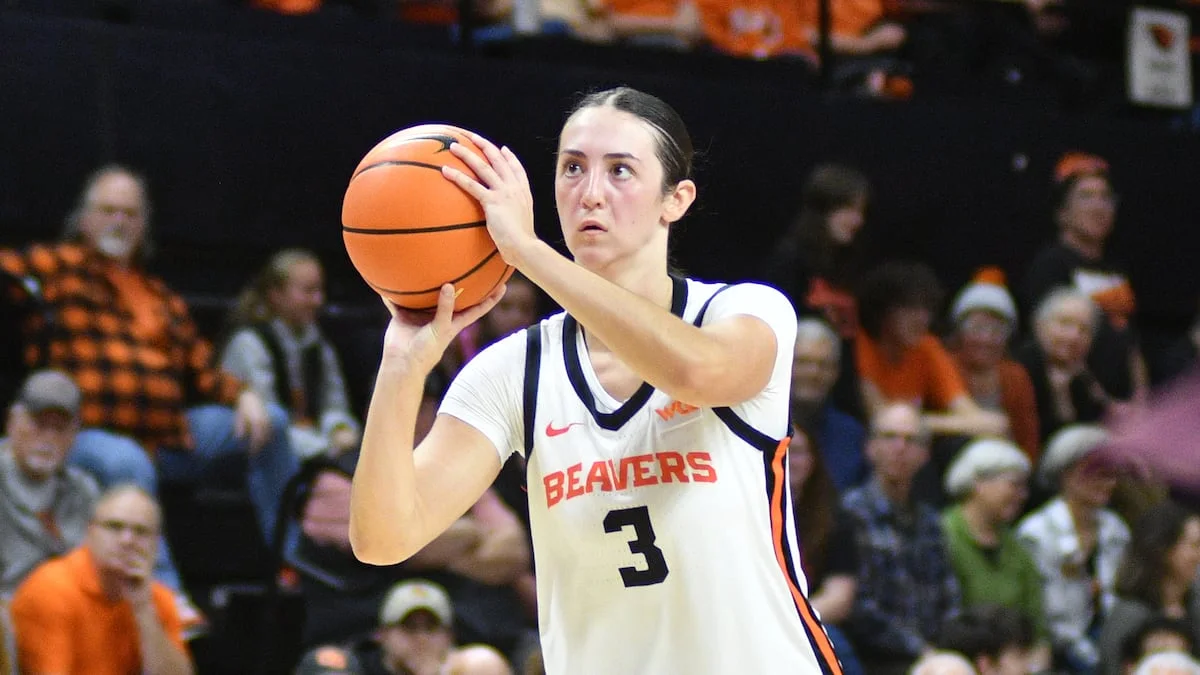
A voice can mean more than an opportunity to complain after a decision. The organizing proposal seeks a mechanism for addressing participation terms together. Travel, required activities and academic commitments can interact: a player might need to understand which obligations are mandatory and how a conflict is resolved. Collective representation is proposed as a way to address such issues, not a promise that the players would take over tactical decisions or choose their own minutes.
The Oregon Labor Federation's supporting statement emphasizes an organized role in decisions affecting athletes. It is a labor organization's position, not the board's finding. The useful question for a future agreement would be which decisions the players can influence and how that influence works when the institution disagrees.
Why Oregon State disputes the employee claim
Oregon State objects to treating the proposed unit as employees. The university's position is a substantive dispute over the legal relationship, not an indication that the players failed to submit a petition. OPB reported its formal objection in August, alongside a university spokesperson's praise for the athletes' leadership. Those two messages can coexist: supporting the team does not amount to accepting its proposed employment classification.
Education and employment are the contested relationship
The September hearing report describes provost Roy Haggerty presenting varsity participation as part of the university's educational mission rather than ordinary work for wages. The players' petition, in contrast, proposes a unit of team members receiving compensation and argues that their relationship belongs within Oregon's public-sector bargaining system. The board must assess the relevant facts and law; counting endorsements or repeating the phrase student-athlete does not by itself resolve that assessment.
Oregon's public-employee labor statute supplies the framework. ORS 243.650 defines public employee by reference to employment with a public employer and lists exclusions; ORS 243.662 gives public employees the right to organize for collective bargaining. Those provisions establish why classification matters. They do not name this roster and announce that its members have already met the test.
Being a student and performing activities that benefit a university are observable facts, but readers should not turn either into an automatic conclusion. A scholarship can support education; required athletic participation can also involve substantial institutional demands. The dispute concerns how the relationship is legally understood on this record. A player's education would remain relevant even if employment were recognized, while a payment described as compensation still needs to be considered within the applicable legal analysis.
The hearing coverage also records concerns raised by the school's lawyer about consequences involving benefits and international athletes. Such concerns are issues presented in the dispute, not confirmed outcomes for a named player. This article cannot infer a changed immigration status, new insurance entitlement or lost scholarship from the filing of the petition.
For fans following the case, the most useful comparison is between what each side asks the board to find. The players seek recognition of a covered employment relationship and a bargaining unit. Oregon State disputes that threshold. A future decision should be read for its reasoning and scope, including which facts it relied on, before treating it as a statement about every college athlete or every form of athlete compensation.
How the Oregon labor process works
The Oregon Employment Relations Board is the agency handling RC-016-26. Understanding the forum and the stage of the case helps avoid two common mistakes: importing the outcome of a private-college organizing effort directly into Oregon, and assuming that submitting signed cards produces an immediate employment contract.
A public university follows a different route from a private college
Oregon State is a public university, and the petition seeks recognition under Oregon's public-employee bargaining framework. The National Labor Relations Board's jurisdiction explanation says the federal National Labor Relations Act generally covers private-sector employers, including private universities, while excluding federal, state and local governments. That jurisdictional difference is why a headline about organizing at a private college does not answer the Oregon case.
The distinction identifies the applicable route; it does not guarantee the players a favorable result. The Oregon board still has to address the disputed relationship and the proposed unit under its own framework. Similarly, a private university's inclusion in the federal board's general employer coverage does not automatically establish that all its athletes qualify as employees. Employer jurisdiction and an individual group's classification are separate questions.
For someone following several teams, the practical first step is to identify the institution and the agency on the actual filing. Two campaigns can have similar compensation goals and different procedural routes. The Oregon case may offer useful reasoning for other disputes, but a different state's rules or a federal proceeding still require their own analysis.
A petition, a ruling and a negotiated agreement are different milestones
The original July petition selects certification by card check rather than asking for an election as its chosen route. That detail matters when interpreting reports about player signatures. Authorization cards establish support for representation; they do not independently settle the school's legal objection or specify the terms of a future deal.
| Milestone | What it would establish |
|---|---|
| Representation petition | A request for recognition of the described unit, with supporting information. |
| Board determination and certification, if granted | The legal and representation questions addressed in the order; read its exact scope. |
| Negotiated agreement, if reached | The compensation, protections and procedures the parties actually agree to include. |
Oregon's representation-hearing rule provides different procedures depending on the dispute, including standard and expedited hearings. The September reporting describes an expected administrative-law-judge recommendation followed by board consideration. That reported expectation should not be presented as the only possible sequence: the rule also provides for the board to issue a final order without a recommended order in expedited matters.
Assignment to an administrative law judge therefore means the dispute is being processed, not that the school's objection has already been rejected. A report anticipating a decision later in the year is an estimate, not a guaranteed date. The reliable update is the actual filing, notice or order, together with what it says about the next step.
Recognition would also leave work to do. Oregon's bargaining provisions distinguish a representative's role from the terms produced through negotiations. A favorable classification decision would not itself set every player's pay or turn the medical goals described above into an agreed benefits schedule.
What could be negotiated also has a defined scope. ORS 243.650 includes monetary benefits, hours, leave and grievance procedures in its explanation of employment relations. It also distinguishes matters that are not mandatory bargaining subjects, including some questions involving management authority. The statute therefore supports a more precise question than whether players would control the program: which proposed participation conditions fall within the applicable bargaining framework?
For example, an organizer's request for a usable grievance procedure concerns how a disagreement would be raised and resolved. It does not tell readers whether a coach's choice of a starting lineup would become a negotiated subject. That latter conclusion would require its own legal and factual basis. A future contract should be read for the procedures it actually establishes, including who can invoke them, rather than treating collective voice as authority over every basketball decision.
What a decision could mean for women's college basketball
This campaign puts women's basketball players at the center of an employment debate often discussed through football revenue or men's basketball stars. The practical issues identified by the organizers include the situation of an ordinary roster member: compensation attached to participation, care after an injury and a way to influence institutional demands. Those issues can matter to a player whose individual endorsement opportunities are limited, without assuming that every athlete wants the same arrangement.
The UCAA's July announcement reported authorization-card support from more than 100 women's college basketball players nationally. That is evidence of the organizers' stated reach and ambition. It is not a declaration by a labor board that those athletes already belong to a single certified bargaining unit. The Oregon filing describes one proposed team unit at one university.
If the board recognizes the relationship sought by the petition, other athletes and institutions would have a decision to examine rather than only competing public statements. They could study the facts, the reasoning and the limits of the finding. A different school would still need to consider its own relationship with athletes and the rules of its jurisdiction. A ruling against recognition would likewise need to be read for its stated grounds before being described as ending every possible college-athlete organizing effort.
The case also sits beside a changing federal policy discussion. The Protect College Sports Act passed the Senate on September 28, 2026; Senate passage is a legislative milestone rather than proof that the proposal has become law. That debate and the Oregon representation proceeding should be tracked through their own documents. A proposed national framework does not justify replacing the current Oregon case status with an assumed future outcome.
The next meaningful update will identify what happened procedurally. Did the agency issue an order, and what did it actually decide? Which athletes and which unit did it address? Is the decision being challenged, or are the parties moving toward negotiations? Only an actual agreement could tell readers whether a requested medical protection or compensation provision became a negotiated term.
For supporters of the Beavers, following the team and following the labor case remain different activities. A strong performance cannot establish employee status, and disagreement over classification does not erase the athletes' stated concerns. The useful connection is that the same people seen competing in Corvallis are seeking a formal role in the conditions surrounding that competition. The current record explains why they are asking and why the school objects; the pending proceeding will determine what recognition, if any, follows.
Join the conversation
Share a question or a thought about the women's game. Comments are reviewed before they appear. Keep it friendly, stay on topic and leave out personal information.
No comments yet. Start the conversation.
Sign in with Google to leave a comment. Your email address is not displayed with your comment.