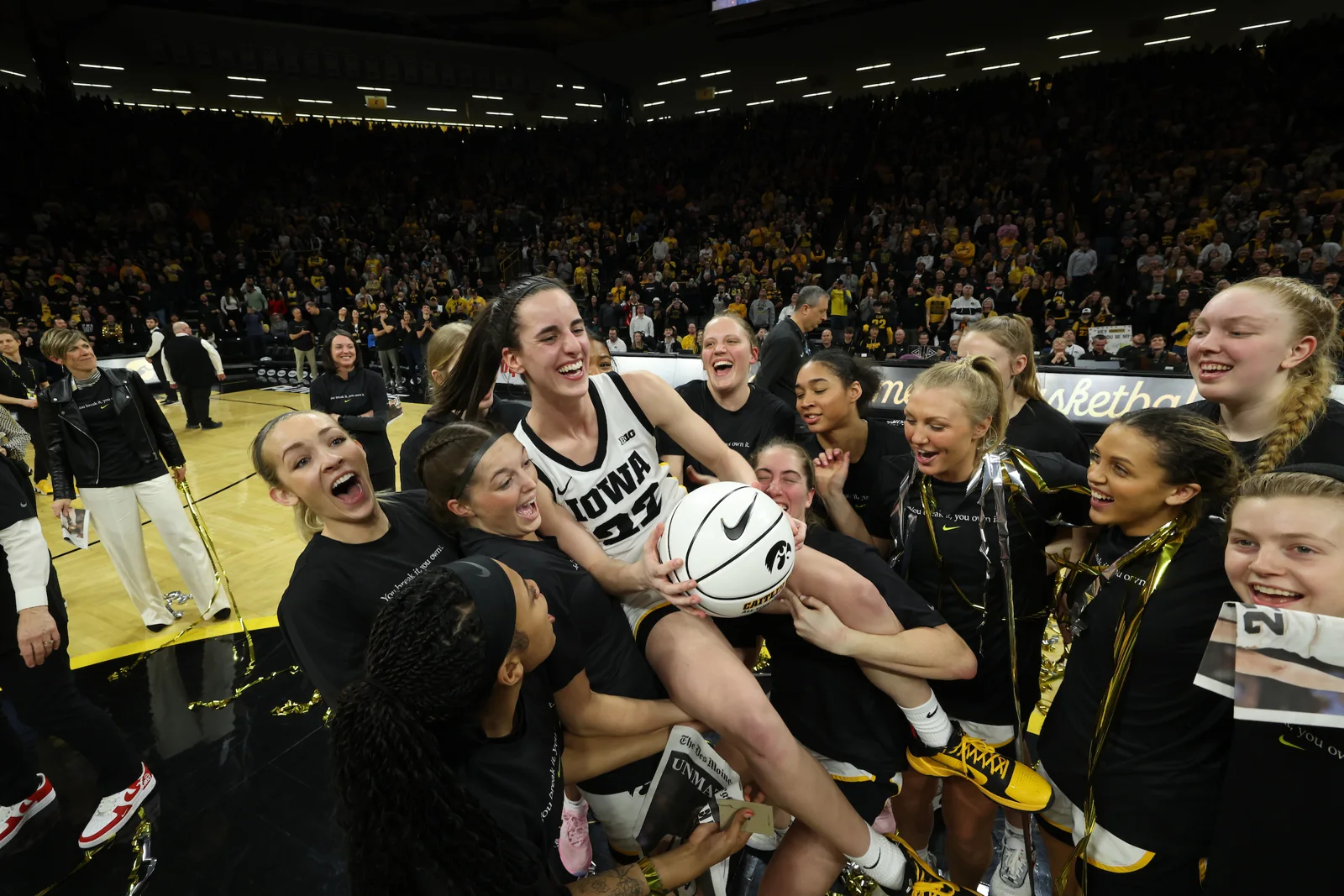
Cover: Caitlin Clark celebrates with Iowa teammates after the Michigan game, February 15, 2024. Archive photograph, not a statement about the PCSA. Source: Iowa Athletics.
The Protect College Sports Act passed the Senate on September 28, 2026. As checked October 1, it remains a legislative proposal: this review did not establish House passage or enactment. For women's basketball, the Senate text connects NIL, transfers and eligibility with athlete protections and institutional enforcement powers. Here is what it proposes and why those distinctions matter.
The Protect College Sports Act has passed the Senate, not become law
The most useful answer for a women's basketball player or fan is also the easiest detail to lose in a headline: Senate passage is not enactment. The Senate Commerce Committee announced that S. 4668, the Protect College Sports Act of 2026, passed the Senate 77–22 on September 28. Its announcement says the bill moves to the House of Representatives. This article's October 1 status check did not establish House passage or a presidential signature.
That distinction changes how every provision below should be read. The proposal would authorize or require certain actions if enacted; it does not already give a school a new federal power over its point guard's transfer. A player deciding whether to sign an endorsement agreement still needs to understand the rules and agreements that actually apply now. A proposed safeguard is similarly different from a benefit she can already claim.
The analysis uses the official Senate-engrossed bill text, rather than treating the committee's September 17 draft as the final Senate version. An engrossed bill records the legislation passed by that chamber. The formal wording “An Act” on its cover does not mean that the proposal has completed the legislative process. Versions, amendments and effective dates matter more than the label on a downloaded document.
For women's college basketball, this is a proposal about the framework around the game: money, eligibility, health protections and the authority to enforce rules. It is not a change to the shot clock or a newly announced tournament bracket. Its practical effects would depend on the enacted language, subsequent rulemaking and the situation of the athlete or institution involved.
Keep two questions separate while reading: what does the Senate's text propose, and what has actually changed for a player today? Answering the first can explain the debate. Answering the second requires current rules and confirmed implementation, which a Senate vote alone does not provide.
What the proposal would change about athlete compensation
The compensation debate becomes clearer when “athlete pay” is separated into its actual parts. An endorsement using a player's identity, an institutional payment and a scholarship are not interchangeable. The Senate text addresses multiple categories, with protections and restrictions that need to be read together rather than reduced to the claim that it either ends NIL or makes all payments unrestricted.
NIL endorsements and school payments are different questions
Section 101 of the Senate-engrossed text would protect an athlete's ability to market and earn compensation for her name, image and likeness, subject to the title's exceptions. It would also protect eligibility and financial aid from restrictions based simply on that NIL activity. The text preserves room for restrictions involving generally applicable student conduct rules and unauthorized use of institutional facilities, uniforms or protected marks.
For a women's basketball player promoting a local business, her personal identity and her school's logo therefore remain separate assets. A deal involving her own name is not automatically permission to sell a product bearing the university's marks. That distinction is useful even without a prediction about the size of any player's market.
Section 114 concerns institutional compensation and arrangements that would circumvent the school revenue-share cap. It also imposes business-purpose and comparable-compensation conditions on specified agreements. Those provisions should not be described as one identical ceiling on every athlete's outside earnings. Who supplies the money, which entity arranged the agreement and which exception applies all matter. The bill's institutional retention provisions likewise describe permitted school spending under conditions, rather than a guaranteed payment to every returning women's basketball player.
Reporting and enforcement could affect everyday deals
The proposed reporting rules are not limited to superstar endorsements. Section 101 would require covered Division I athletes to report agreements exceeding $600, including payments or benefits from the same entity exceeding that total over a 12-month period. It specifies a five-day agreement-reporting deadline and, for compensation not previously reported under that rule, a 30-day deadline after receipt. These are proposed federal provisions, not new deadlines created by the Senate vote itself.
Consider a hypothetical player receiving three $250 benefits from the same business across a year. The total is $750. Looking at each payment alone would miss the aggregation described in the proposal. The example explains why records and accessible guidance could matter for a rotation player with modest opportunities as well as a nationally recognized scorer. It does not identify an actual athlete's contract.
Section 104 would also require anonymized institutional reporting, including compensation information by sports program, and treats men's and women's programs separately. That could give readers a more useful picture than one department-wide number that conceals how women's basketball compares. Reporting would still need careful interpretation: an average payment does not reveal every player's individual agreement, and anonymized reporting is not permission to publish a named player's private contract.
Why transfers and eligibility matter to women's basketball
A transfer changes more than a roster graphic. It can change a player's role, degree path, coaching relationship and opportunity to compete. Section 112 of the Senate text would protect one transfer between four-year institutions without losing or delaying athletic eligibility. A second transfer would normally carry a loss of competition eligibility during the first academic year afterward, subject to the listed exceptions.
Those exceptions include discontinuation of the athlete's sport, departure of her head coach, sexual assault or harassment by someone associated with the institution, and pursuing a graduate degree. Describing the provision simply as “only one transfer allowed” misses the distinction between changing schools and remaining immediately eligible to play. It also obscures the exceptions written into the bill.
A uniform rule can still produce unequal choices
Imagine a guard who has already transferred once and later finds that her academic program or playing role is a poor fit. Compare her situation with a teammate whose head coach has departed. The proposal's listed exceptions can make those cases different, even though both players might have persuasive reasons to move. This is a hypothetical comparison explaining the text, not a finding about a particular player.
For a coach, additional continuity could make recruiting and development easier to plan. For a player, a year without competition can consume a meaningful part of a short college career. Those are competing interests to evaluate, rather than proof that all transfers are motivated by money or that every restriction will improve the sport. A useful policy debate asks how the rule treats a difficult ordinary case, not only the high-profile move fans disliked.
Eligibility is a separate clock. Section 113 describes a maximum five-calendar-year period for Division I and II competition, beginning at the earlier of initial full-time enrollment or the academic year following the athlete's nineteenth birthday. It lists pregnancy, religious mission and active-duty military absences, with room for additional uniformly adopted absence exceptions. Five calendar years should not be casually translated into a promise of five completed seasons regardless of circumstances.
The basketball-specific youth-competition language and the football-specific coaching provisions also need their own boundaries. A rule about an FBS head coach moving midseason is not a women's basketball coaching rule. Reading the actual section prevents a general college-sports explainer from importing another sport's conditions into a player's case.
The protections promised to athletes and women's teams
The proposal contains substantive protections alongside restrictions. Evaluating it only through transfer freedom would miss provisions about education, medical expenses and the treatment of women's programs. Evaluating it only through those benefits would miss the conditions attached to them. The important question is what each protection would actually cover.
A benefit has value only if the athlete can actually use it
Section 105 of the Senate text would prohibit reducing or revoking athletic aid because of performance, a physical or mental medical condition, or roster-management decisions. It retains exceptions involving transfer and specified good-standing requirements. For a player losing minutes or recovering from injury, the distinction between losing her rotation place and losing educational support can be substantial. This is not a promise that every scholarship continues under every circumstance.
Section 106 describes covered Division I medical expenses related to participation, an independent second opinion and an examination at the end of the college career. Its post-competition provision concerns covered sport-related expenses for five years after the last competition, for an athlete enrolled at the institution during her final eligibility year. That is more specific than saying the bill gives every former player unlimited lifetime health care.
The practical questions would include who handles a claim, how the relationship to sports participation is documented and how a former player accesses the coverage after leaving campus. A benefit written into a statute can matter greatly, but a player must be able to find the responsible office and understand its scope. Those implementation questions are not answered merely by a favorable headline.
Sections 107 and 108 would also protect independent medical return-to-play decisions and establish a student-athlete ombudsman offering independent advice at no cost, with confidentiality and anti-retaliation provisions. A coach's desire to have a starting center available and a clinician's medical decision would not be equivalent authority under the proposed language. This explains a decision-making safeguard; it does not offer medical advice about any current injury.
Protecting opportunities is not a guarantee of equal spending
Section 109 would require comparable championship standards across similarly situated men's and women's programs for items including medical care, lodging, meals, transport, publicity and facilities. That addresses how competitions are supported. It is different from prescribing identical individual endorsement income or the same operating budget for every team.
Section 125 contains opportunity protections tied to institutional revenue categories and a 2024–25 baseline. For covered larger institutions, its total scholarship and roster-opportunity requirement has a nine-year horizon; for covered mid-sized institutions, four years. Waivers and exemptions remain. the text expressly allows changes to which sports are sponsored or to individual sport allocations while applicable total requirements are maintained. An aggregate floor is not an unconditional guarantee that a particular women's team keeps every existing roster place.
The Title IX savings clause in section 127 also preserves that law's applicability. It should not be turned into a claim that the PCSA itself settles every dispute about distributing institutional athlete payments. Fans assessing whether women's basketball is protected should examine access, opportunities and actual allocations separately, rather than allowing one department-wide total to answer all three questions.
The dispute over who gets to set the rules
The central disagreement is about authority as well as money. Supporters want a stable national framework for enforcing eligibility, compensation and recruiting rules. Critics question whether institutions should receive additional protection for restrictions on athletes without a stronger negotiating role for the players themselves. A reader can recognize the value of medical protections while still examining how the proposal distributes power.
Section 118 of the Senate-engrossed bill would shield specified compliance and enforcement activities from antitrust liability. That is narrower than immunity for everything an athletic institution does. Section 119 separately provides routes to challenge violations of listed protections, with conditions and limitations. A statutory right and an antitrust challenge are different routes; retaining some remedies does not mean every existing type of challenge remains available in the same way.
The proposal also includes athlete representation. Section 111 requires at least one-third of the membership and voting power of covered governing boards and committees to come from current athletes or qualifying recent former athletes. Restrictions on who counts and conflict-of-interest voting apply. That is a meaningful governance requirement to inspect, but one-third representation is not majority control or an athlete veto.
Employee status and collective bargaining remain separate issues
Section 122 explicitly says the title is neutral about employee or non-employee status and does not alter it. The PCSA therefore should not be described as directly declaring all women's basketball players employees, or as simply prohibiting all player unions. Section 116 also asks a proposed commission to study compensation alternatives, including the implications of employment and collective bargaining. A study requirement is different from a final classification decision.
The neutral-status language does not end the political argument. In a September 18 advocacy essay, CLASP's Christian Collins acknowledges neutrality on the face of the proposal but argues that prescribing participation terms would constrain the space for athletes to negotiate. That is an organization's critique, written before final Senate passage, rather than a court ruling about the final text.
For women's basketball, the important comparison is between being represented within a governing body and bargaining with an institution over participation terms. Those mechanisms are not identical. Fans should ask who chooses athlete representatives, what decisions they can influence and which protections remain enforceable if the institution disagrees. Neither a blanket “players have no voice” claim nor a blanket “the bill resolves player rights” claim adequately describes the provisions and the dispute.
What fans and players should watch next
The next meaningful developments are actions and implementation details, not another headline recycling the Senate vote. The official roll-call record confirms passage of the amended bill. Follow subsequent legislation by bill number and version so a discussion of an earlier draft does not silently become a description of a later text.
- Track the legislative step. House consideration, agreement on the same text and presidential action are different events. An endorsement by a conference or coach is not one of those events.
- Read the provision that affects the question. A transfer case belongs with the transfer and eligibility sections; a medical-expense question belongs with the coverage section. General claims about protecting women's sports cannot substitute for either.
- Check the time and scope. Look for the covered division, institution, athlete and implementation deadline. A protection for specified former Division I athletes is not automatically the same protection for every former college player.
- Look for actual implementation. If legislation is enacted, watch for the responsible institution's published guidance, procedures and athlete contacts rather than assuming every benefit begins on the vote date.
The Senate text itself uses different clocks. For example, its health-and-safety standards provision specifies 270 days after enactment, while institutional reporting and commission reports follow other schedules. A future announcement should explain which requirement it implements. That specificity matters when a player needs help with an expense or a team needs to understand a roster decision.
For ordinary game planning, continue using the current team directory and the school's confirmed announcements. The proposal does not tell you who will start next week or which player will transfer next spring. Its significance is longer term: the conditions under which athletes can earn, move, compete and challenge decisions. A careful assessment should keep those individual consequences visible alongside the institutional goal of a more predictable system.
Join the conversation
Share a question or a thought about the women's game. Comments are reviewed before they appear. Keep it friendly, stay on topic and leave out personal information.
No comments yet. Start the conversation.
Sign in with Google to leave a comment. Your email address is not displayed with your comment.