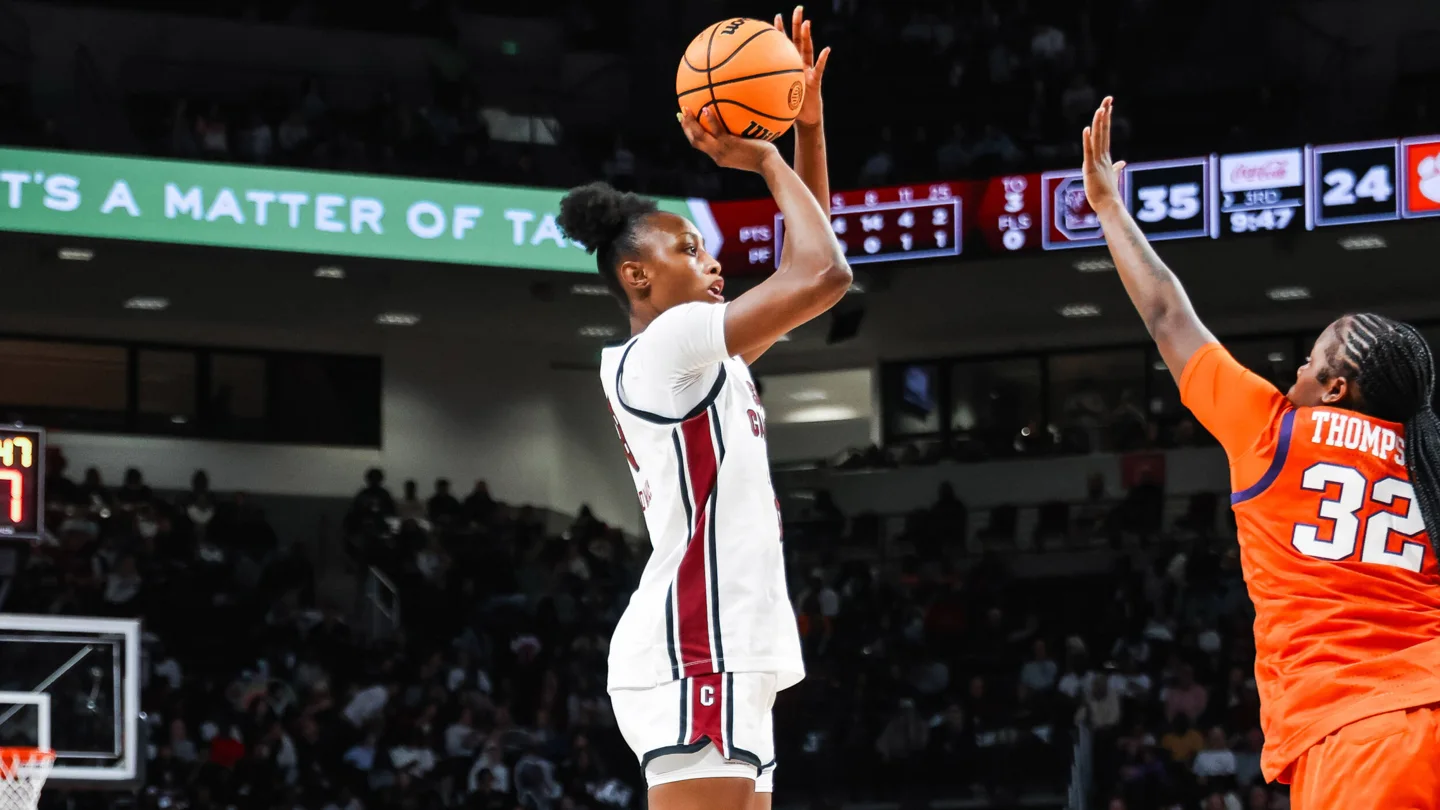
Cover: Joyce Edwards shoots against Clemson in a 2025-26 archive photograph published by South Carolina Athletics in November 2025.
South Carolina's women's basketball roster for 2026-27 lists 15 players as of September 9, 2026: returning scorer Joyce Edwards, veteran guard Tessa Johnson, transfers Jordan Lee and Brooke Quarles-Daniels, and five freshmen among them. The main questions concern backcourt responsibilities, the available frontcourt combinations and how the newcomers fit alongside established tournament contributors.
This is the University of South Carolina Gamecocks roster coached by Dawn Staley. The table follows the school's current player listings; the role discussion distinguishes completed-season evidence from possibilities that still need to be tested in games.
South Carolina's confirmed 2026-27 roster
Dawn Staley's South Carolina roster has fifteen players on the university's September 9, 2026 listing. The table below follows the official Gamecocks roster, including its positions and class labels. This is the University of South Carolina in Columbia, not Southern California, South Carolina State, USC Aiken or USC Upstate.
| No. | Player | Position | Height | Class |
|---|---|---|---|---|
| 0 | Oliviyah Edwards | F | 6-3 | Freshman |
| 2 | Ashlyn Watkins | F | 6-3 | Fifth Year |
| 3 | Kaeli Wynn | F | 6-2 | Freshman |
| 5 | Tessa Johnson | G | 6-0 | Senior |
| 6 | Brooke Quarles-Daniels | G | 5-7 | Fifth Year |
| 7 | Jordan Lee | G | 6-0 | Junior |
| 8 | Joyce Edwards | F | 6-3 | Junior |
| 9 | Jerzy Robinson | G | 6-0 | Freshman |
| 15 | Adhel Tac | F | 6-5 | Junior |
| 21 | Chloe Kitts | F | 6-2 | Fifth Year |
| 23 | Kelsi Andrews | F | 6-3 | Freshman |
| 24 | Ayla McDowell | G | 6-1 | Sophomore |
| 31 | Alicia Tournebize | F | 6-7 | Sophomore |
| 32 | Justine Loubens | G | 6-2 | Freshman |
| 44 | Agot Makeer | G | 6-1 | Sophomore |
A roster answers who belongs to the team. It does not answer who starts, who closes a tight game or who is medically available for a particular night. Those distinctions are especially important when veterans return after time away and several newcomers compete for overlapping roles. Treat the class column as the school's designation, not a calculation of remaining eligibility or a promise of another season.
The useful basketball question is how these players fit together. Guards need to advance the ball, organize the first action and create an advantage without exhausting the shot clock. Forwards need to provide usable spacing, rebounding and defensive coverage as well as scoring. Several players can share those tasks, so the roster's simple guard-forward labels should not be mistaken for a complete tactical map.
Readers comparing this list with an April or May projection should use the current names rather than combine both lists. Offseason previews describe a moment in an evolving process. A projected returner is not automatically part of the September roster, and a late arrival can change the balance of the team without changing its headline stars. The dated official listing is the starting point for the analysis that follows.
All lineup possibilities discussed below are editorial assessments of roles, not a starting-five announcement from Staley. The distinction lets fans ask better questions during the opening games: which combinations create good shots, which protect the defensive glass and which can execute after an opponent takes away the first option. Those answers will matter more than the order in which names appear on a preseason depth chart.
The backcourt must replace more than points
The useful question for this backcourt is who creates a good possession when the first action fails. A guard can score efficiently while another teammate organizes the offense; moving to a different lineup changes that division of labor. South Carolina has several credible perimeter options, but their previous scoring averages do not automatically identify the player who should bring the ball up against pressure or control the final possession of a close quarter.
Tessa Johnson and Jordan Lee on the perimeter
Tessa Johnson supplies a substantial returning shooting foundation. Her official Gamecocks biography records 12.8 points per game and 90 made three-pointers at 44.8 percent in 2025-26, along with Final Four All-Tournament recognition. Those are completed-season figures, not a forecast for her senior year. They explain why her place in the discussion extends beyond being an experienced name on a long roster.
For the new lineup, the implication is spacing. A defense that respects Johnson away from the ball has a harder choice about sending her defender toward an Edwards post touch. The benefit depends on where the other four players stand and whether the pass arrives before the defense recovers. Watch the quality of the opportunities she receives, as well as her final shooting percentage: a contested attempt late in the clock asks more of the shooter than an open catch after the ball changes sides.
Jordan Lee brings another experienced scoring and handling option. South Carolina's April signing announcement lists 13.2 points and 2.5 assists per game in her sophomore Texas season, plus 59 steals and 20 blocks across 39 games. Dawn Staley emphasized her ability to create for herself and teammates and defend different positions. The statistics describe her previous role; the coach's assessment supplies the reason to consider her more than a replacement scorer.
Johnson and Lee could share creation responsibilities without either taking every point-guard possession. That is an editorial possibility, not an announced arrangement. The revealing moments will be the second decision after a screen: attack an available lane, find the roller, or move the ball to Johnson before a closeout arrives. Simply adding two scoring averages cannot describe whether those decisions fit together.
Brooke Quarles-Daniels and the point-guard question
Brooke Quarles-Daniels gives the discussion a different statistical shape. Michigan's 2025-26 biography lists 35 appearances, 31 starts and averages of 5.9 points, 5.4 rebounds, 2.8 assists and 2.5 steals. She earned Big Ten All-Defensive Team recognition. Against NC State in the NCAA tournament on March 22, she contributed six points, six rebounds, five assists and five steals.
That example makes the roster fit easier to understand: a guard can help win a tournament game without leading the scoring column. Defensive rebounds can start transition; a steal can create an advantage before the opposing defense is organized. Neither outcome guarantees that the same role will transfer unchanged to South Carolina. Her early possessions should show whether she can release the ball quickly to the team's finishers while keeping turnovers under control.
The roster does not resolve which combination will close games. A lineup needing another shooting threat may differ from one protecting a lead or trying to contain a quick opposing guard. Treat the point-guard question as a distribution of responsibilities to be tested in games, rather than a vacancy that a transfer announcement has already settled.
Joyce Edwards anchors a frontcourt with several possible looks
Joyce Edwards enters her junior season with the strongest recent offensive evidence in this frontcourt. Her official South Carolina biography lists 19.2 points and 6.8 rebounds per game on 57.1 percent shooting in 2025-26. She scored a school-record 768 points over 40 games. Her 24 points and 12 rebounds against TCU in the regional final provide a specific example of that production carrying into a high-pressure tournament matchup.
The roster-building question is how to make her opportunities efficient again while changing the players around her. Putting another forward near the basket can create offensive-rebounding chances, but it also gives the opposing help defender a shorter journey to Edwards. Putting more guards outside can widen the floor, but those guards must contribute when the opponent sends size to the offensive glass. There is a tradeoff to assess on possessions, rather than a single ideal lineup implied by the roster's height column.
For fans, one useful detail is when Edwards receives the ball. An early catch gives her more time to attack, recognize a second defender and find an open teammate. A late catch with the clock expiring leaves fewer choices. A higher point total does not necessarily mean an easier offensive job; the location and timing of the touches can explain why one lineup helps her more than another. This is a framework for watching the coming season, not a claim that South Carolina has announced a particular offense.
Adhel Tac is another returning frontcourt option whose previous contribution deserves attention. Her official biography records 23 appearances and three starts in 2025-26, with 11.2 minutes per game, before she missed the final 15 games with a lower-leg injury. At Oklahoma on January 22, she collected six rebounds, five on offense. That example identifies a useful possible contribution beyond scoring: extending a possession when the first shot misses. Her current workload still needs to be established through team updates and games; a junior class label does not answer the availability question.
Chloe Kitts and Ashlyn Watkins require an availability check
Chloe Kitts and Ashlyn Watkins appear on the current roster, but their most recent full season of basketball cannot be treated as last season. Kitts' official biography says she missed 2025-26 after surgery in mid-October to repair a torn right ACL. Watkins' biography records her January 2025 knee injury and subsequent year away. These are historical availability facts; neither entry establishes an unrestricted workload for a future game.
There is also a distinction between returning to the program and returning to a previous competitive role. The State reported Watkins' return in May 2026. That announcement settled whether she was back with the team. It did not specify the number of minutes she would play in November. Use current team updates and the actual game roster for that later question, rather than interpreting a workout clip as a medical statement.
Watkins' previous production illustrates why her progress matters: the school records 7.4 rebounds and 2.4 blocks per game in 2023-24. A shot-blocking forward can change which driving lanes an opponent is willing to test. The rest of the lineup still has work to do after the shot: a challenge at the rim helps most when a teammate secures the rebound. The relevant evaluation is the complete defensive possession, not simply a running count of blocks.
Kitts and Watkins also bring experience that a large incoming class cannot reproduce immediately. Experience, however, is only useful within the role a player can perform that night. South Carolina can consider combinations with an additional post player or another perimeter option, then judge the effect on ball movement, spacing and defensive coverage. Keep the distinction clear between those available roster choices and a prediction that every veteran will immediately resume her old workload.
Five freshmen create competition across the lineup
The five-player freshman class reaches both the perimeter and the frontcourt. That breadth gives South Carolina several development paths, but it should not be interpreted as five immediate additions to a settled game rotation. Previous competition, positional responsibilities and availability differ across the group. A useful preview identifies those differences before deciding which newcomer might play the most.
Jerzy Robinson and Oliviyah Edwards
Jerzy Robinson is listed as a 6-foot guard from Sierra Canyon, while Oliviyah Edwards is a 6-foot-3 forward from Lincoln High School in Tacoma. The State's April signing report placed Edwards at No. 3 and Robinson at No. 6 in ESPN's class rankings at that time. Those rankings explain the interest in the pair; they do not supply an SEC depth chart.
The different positions matter more for the immediate roster question. Robinson enters a guard group with established college experience in Johnson, Lee and Quarles-Daniels. Oliviyah Edwards joins a frontcourt led by Joyce Edwards with multiple other veterans and young forwards. Their routes to contributing therefore need not look alike. A productive short stint can involve defending the correct assignment and moving the ball on time, even when it produces no eye-catching scoring total.
Keep the two Edwards players separate when reading a box score or a projected lineup: Joyce is the returning junior, and Oliviyah is the freshman newcomer. A preview that says only “Edwards” can accidentally assign Joyce's college achievements to Oliviyah. The incoming forward deserves evaluation on her own college possessions, rather than a comparison built around their shared surname.
Kaeli Wynn, Kelsi Andrews and Justine Loubens
Kaeli Wynn and Kelsi Andrews add further forward options, with health history relevant to any early rotation prediction. The Student's January 2026 reporting described Wynn's recovery after December knee surgery. Gamecock Central reported Andrews' knee surgery in October 2025. Neither historical article provides an opening-night 2026-27 availability decision.
Andrews' basketball background includes a concrete high-level performance. The school's signing announcement highlights 12 points and 13 rebounds in IMG Academy's 2025 high-school championship victory over Montverde. Staley also described scoring range extending beyond the paint. That combination explains a potential fit alongside another interior scorer, while leaving the practical questions of availability and college shooting results open.
Justine Loubens brings a different background to the freshman label. The school announcement reproduced by SportsTalkSC records experience with La Roche Vendée and French youth national teams, including teams shared with Alicia Tournebize. Her current South Carolina roster entry lists a 6-foot-2 guard. “Freshman” describes her college classification; it does not mean that all five newcomers arrive with identical experience of organized basketball.
The returning sophomores still matter
Agot Makeer has already supplied meaningful tournament production. Her official biography records 14.0 points per game on 55.0 percent shooting in the 2026 NCAA tournament, including 14 points against UConn in the semifinal. That evidence should keep her central to a roster discussion dominated by transfer and recruiting announcements. A player who has produced in that setting is competing from a different starting point than an incoming freshman.
Ayla McDowell also offers an existing college shooting example: her team biography lists 16 points with five three-pointers against NC Central on December 7, 2025. Tournebize, meanwhile, arrived for the spring 2026 semester, according to the original signing announcement. She is a returning sophomore on this roster, not a sixth new freshman. Those distinctions help explain why the rotation involves both continued development and new arrivals.
How to judge the rotation once games begin
Start with availability, then examine the first substitutions and the closing possessions of competitive games. Those observations answer different questions. A starting assignment shows the opening plan. An early substitute may indicate a matchup adjustment, a planned workload or foul trouble. The players trusted with a late lead reveal another part of the coach's decision. None of those details should be reduced to a permanent ranking after a single game.
A completed game offers a useful illustration of complementary responsibilities. In South Carolina's 79-72 win at LSU on February 14, 2026, Tessa Johnson scored 21 points, Raven Johnson added 19, and Madina Okot supplied 12 points with 17 rebounds. Eight Gamecocks scored. South Carolina finished with six straight points after holding a 73-72 lead. The result depended on more than selecting the five highest scoring averages from a roster page.
The new roster must create its own version of that balance. When watching a close finish, identify the player receiving the inbound pass, the teammate occupying the weak-side shooting spot and the forward responsible for securing a defensive rebound. A possession can fail before a shot goes up if the ball cannot advance through pressure. It can also fail after a good defensive contest if nobody finishes the rebound. Looking at these responsibilities makes changes in the lineup easier to interpret.
The official 2026-27 schedule provides early opportunities to compare combinations: Maryland in Paris on November 2, North Carolina in Charlotte on November 8, UConn in Uncasville on November 24 and a December 3 visit to Duke. These are different settings and opponents, so a changed rotation need not mean the previous arrangement has been discarded. Several listed tipoff times remain to be announced; check the current listing when making viewing plans.
A useful personal game note can be short: who handled pressure, which combinations created open shots, and whether the team finished defensive possessions. Add availability and foul context before drawing a conclusion about anyone's minutes. Across several competitive games, those observations will become more informative than preseason labels. Use our women's college basketball TV schedule to follow the games and the scores page to track results as South Carolina turns this September roster into an actual season rotation.
Join the conversation
Share a question or a thought about the women's game. Comments are reviewed before they appear. Keep it friendly, stay on topic and leave out personal information.
No comments yet. Start the conversation.
Sign in with Google to leave a comment. Your email address is not displayed with your comment.