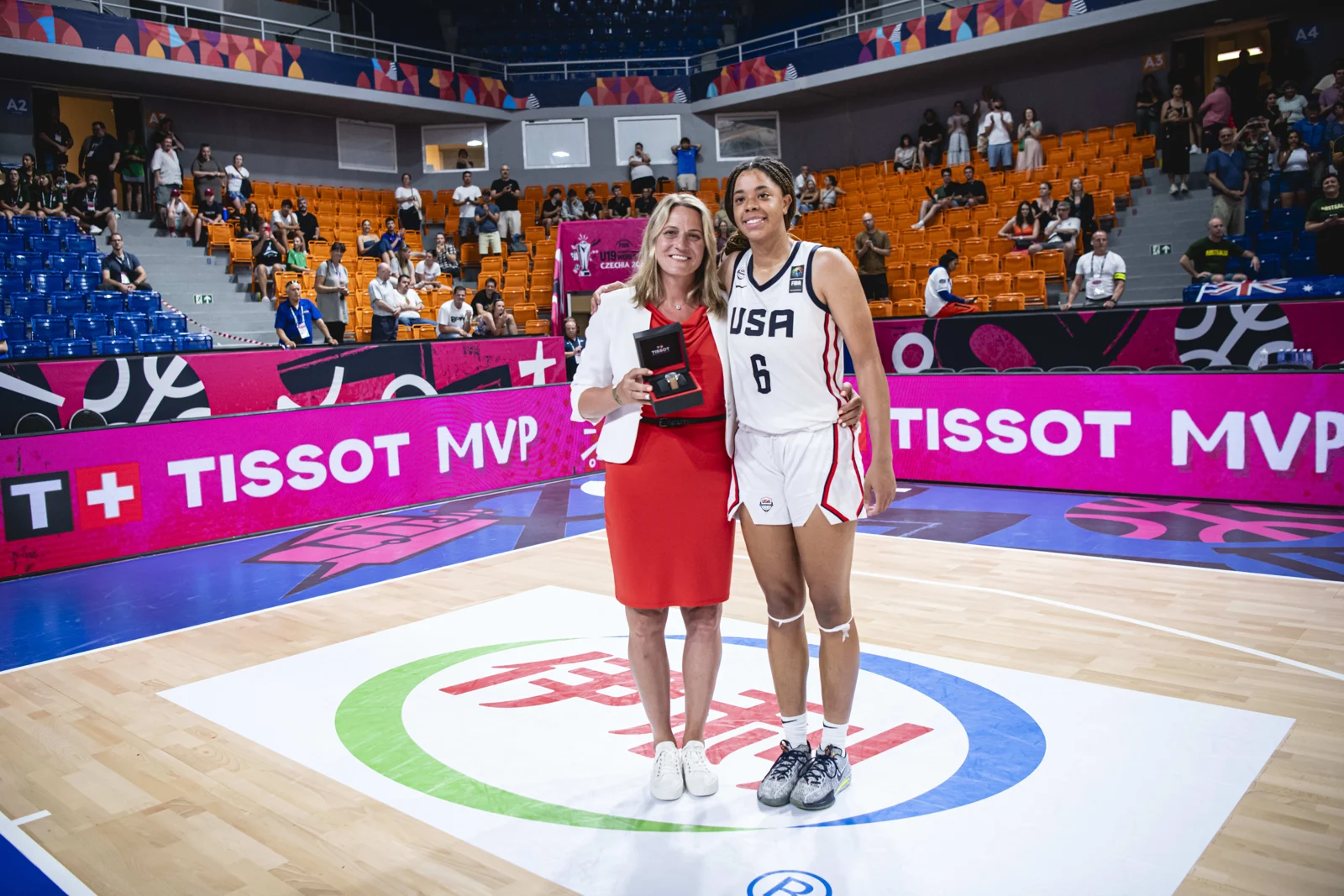
Cover photograph: Saniyah Hall at the 2025 U19 World Cup MVP presentation in Brno, July 20, 2025. Archive image: FIBA.
What the class of 2026 ranking actually tells you
Saniyah Hall, Kate Harpring and Jerzy Robinson lead the ten-player watchlist below, drawn from the August 17, 2026 Rivals Industry recruiting order. The article follows the high-school class of 2026 toward its first college season in 2026-27. It explains destinations and the basketball questions worth watching, with information checked September 9, 2026.
The dated Rivals Industry list supplies a consistent selection method. Its first ten are Hall, Harpring, Robinson, Olivia Vukosa, Oliviyah Edwards, McKenna Woliczko, Trinity Jones, Brihanna Crittendon, Maddyn Greenway and Savvy Swords. This is not a claim that every evaluator puts them in that order. Nor is it a ranking of the best players already competing in the NCAA.
A recruit's number answers a narrower question than fans sometimes give it: how a particular evaluation places her within that incoming cohort. College impact also depends on opportunity, responsibilities and the opponents she faces. A highly rated scorer may initially help through defense and simple ball movement. Another freshman may handle more possessions immediately because her team's rotation asks for a different contribution.
Keep dates attached to destinations, too. The official March all-star roster is a useful record of that moment, but a commitment listed in spring is not by itself proof of an autumn college roster place. The school confirmations discussed below provide the next step.
Read the freshman outlooks as questions to test once games begin. They are not promises of starting jobs, predicted scoring averages or claims that a teenager has already mastered a college system. A useful preseason guide tells you who to follow and what to notice; the season supplies the answers. That approach leaves room for both immediate stars and players whose most valuable contributions arrive gradually.
Hall, Harpring and Robinson bring three different perimeter questions
The first three players in the chosen recruiting order are headed to USC, North Carolina and South Carolina. Their current school pages confirm those destinations. Each brings evidence of scoring against strong competition, but the most interesting college question is how that scoring combines with the work a possession demands before and after the shot.
Saniyah Hall at USC
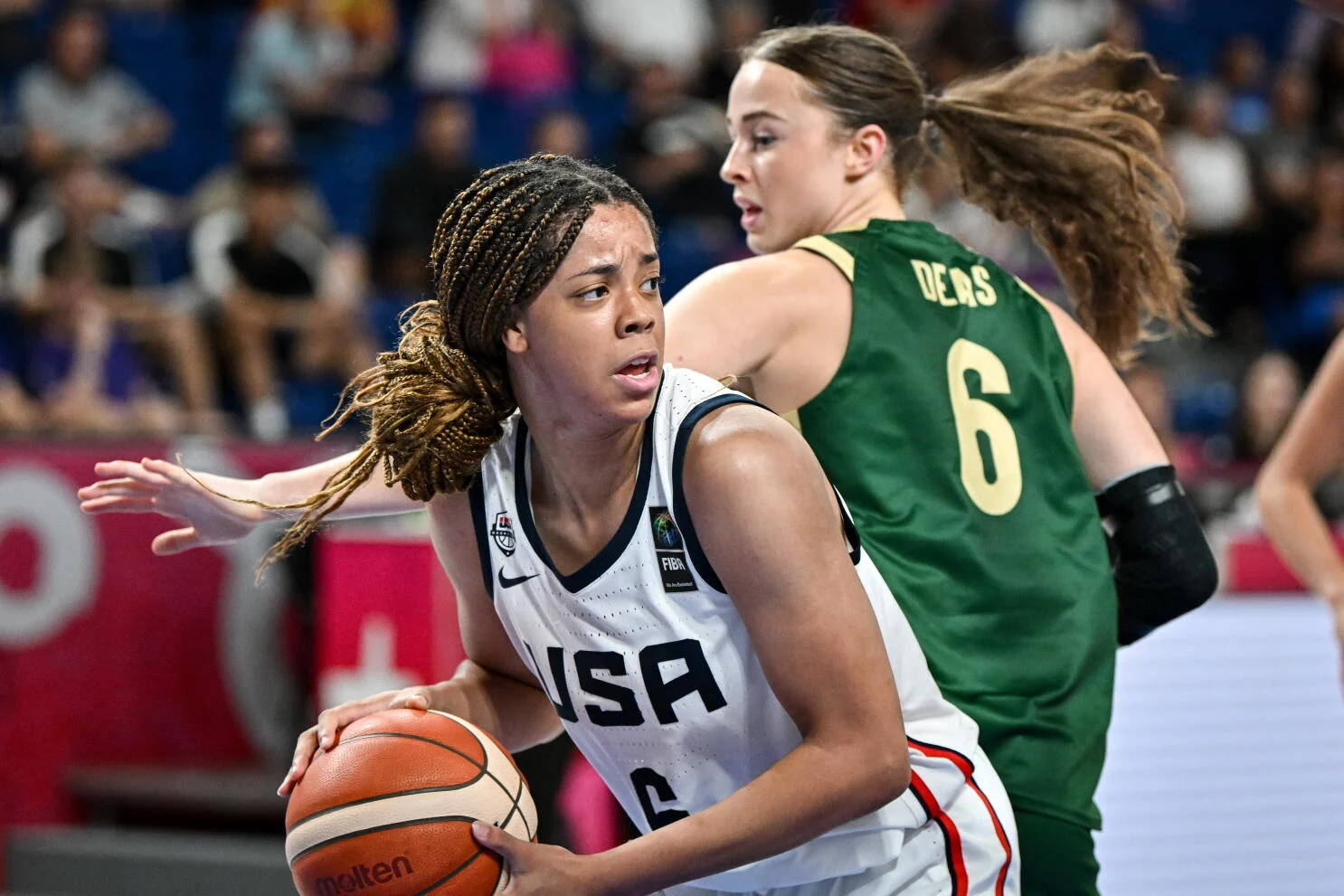
USC lists Hall as a freshman guard/forward. Her international record provides a concrete reason for the attention: FIBA named her the 2025 U19 World Cup MVP. In the championship game against Australia, she produced 25 points, nine rebounds and seven assists as the United States won 88-76, according to FIBA's tournament report.
The seven assists matter alongside the points. They establish that this particular high-level performance involved creating for others, not simply finishing possessions. They do not prove every college defense will give her the same options. Watch whether Hall can recognize help early, move the ball before a driving lane closes and remain involved when another Trojan starts the action.
USC's roster also lists Jazzy Davidson as a sophomore. That gives fans a specific pairing to follow without declaring a starting lineup: how do two perimeter talents divide initiation and finishing? Hall can have a productive first season even when she is not the team's leading scorer. A possession on which she draws attention and releases the ball at the right moment can improve the next shot without increasing her own total.
Kate Harpring at North Carolina
Harpring appears on North Carolina's 2026-27 roster as a freshman guard, with the 2026 Naismith Girls' High School Player of the Year award among her honors. Her college destination is therefore more than an old recruiting projection.
North Carolina's signing announcement supplies two different samples: 32 points and 10 rebounds per game at Marist in 2024-25, then 8.3 points, 3.7 rebounds and 2.4 assists across seven games for the gold-medal U.S. U19 team in 2025. Those are different competitions and responsibilities, so averaging them together would obscure their meaning.
For her freshman season, the useful question is how scoring ambition and possession management interact. Can she turn an initial advantage into a good team shot when the defense sends help? Can she contribute to a successful stretch without forcing her high-school volume into a smaller opportunity? Her contrasting precollege samples make that a more informative question than demanding an immediate return to 32 points a night.
Jerzy Robinson at South Carolina
South Carolina announced Robinson's signing on April 15, 2026, and its current player page identifies her as a freshman guard. The announcement records 32 points and 12 rebounds in Sierra Canyon's CIF Southern Section Open Division title game, plus senior-season averages of 21.3 points, 8.3 rebounds and 3.8 assists.
That combination directs attention beyond jump shooting. Watch whether Robinson can finish possessions with a rebound, create a useful passing angle after a drive and keep the offense connected when the ball moves elsewhere. These are evaluation questions, not claims about a college game she has already played. South Carolina fans can appreciate the scoring background while letting her actual responsibilities, rather than a recruiting number, define the early standard.
Vukosa and Edwards make frontcourt fit worth watching
Olivia Vukosa and Oliviyah Edwards occupy the next two places in the selected recruiting order. Their names are similar enough to reward careful reading, but their college destinations and basketball profiles are separate. Vukosa is UConn's freshman center; Edwards is a South Carolina freshman forward.
Olivia Vukosa's UConn transition
UConn's official biography lists Vukosa at 6-foot-5 and records senior-year averages of 17.8 points, 18.1 rebounds, 5.5 assists and 4.4 blocks at Christ the King. It also documents her Croatia experience, including 24.9 points and 14.3 rebounds per game at the 2026 U18 EuroBasket. Those samples establish a substantial precollege workload on the glass.
For a college viewer, the assists add another useful question: what happens after she receives the ball in traffic? A center can help an offense by recognizing a cutter or moving the ball away from a double-team, even when she does not shoot. High-school assists do not guarantee the same decisions against college rotations, but they give fans a reason to watch the quality of the next pass.
On defense, separate the attempt to block a shot from completion of the possession. Watch whether Vukosa can contest under control, recover her position and help secure the rebound. A spectacular rejection followed by an opponent's second chance is different from a quiet sequence that ends with UConn in possession. The freshman evaluation should include both, rather than treating the block column as the entire defensive story.
Oliviyah Edwards and the importance of a current destination
Edwards provides the clearest warning against relying on a spring commitment list. The March 2026 all-star roster listed Tennessee beside her name. South Carolina's current player page lists the 6-foot-3 forward as a freshman wearing No. 0. For following the coming college season, South Carolina is the relevant destination.
That change affects which teammates, opponents and coaching decisions frame her first year. It does not create a set of Tennessee college statistics to compare with South Carolina statistics. She belongs to this incoming freshman watchlist, and her college contribution still needs to be established through actual games.
Start with where she receives the ball and which opponents she is asked to defend. Does her role place her near the basket, in space on the perimeter or in different locations with different combinations? Then watch whether she finishes the possession she helps create: securing the rebound, making the next pass or converting the available chance. These specific questions make the forward label useful without assuming a complete tactical role from height alone.
Vukosa and Edwards also illustrate why comparing freshman point totals can be misleading. A center's passing and defensive responsibilities may differ from a forward's assignments in another lineup. Let the game reveal those responsibilities before deciding that a lower scoring night means one recruit is falling behind another.
Woliczko and Jones offer two more routes to early influence
McKenna Woliczko and Trinity Jones take this watchlist into two Big Ten programs. Iowa and Maryland provide different team contexts, even though both players arrive with national recruiting recognition. Following their first seasons means identifying what each lineup needs, then looking for evidence that the freshman can supply it consistently.
McKenna Woliczko at Iowa
Iowa lists Woliczko as a 6-foot-2 freshman forward wearing No. 20. Her biography records a 2024 U17 World Cup gold medal and averages of 12.4 points, 9.6 rebounds and 2.4 assists over seven games. That gives fans a defined international sample with contributions in several categories.
The rebounds are particularly useful when thinking about possessions that do not begin with a play called for her. A forward can create extra chances on the offensive glass or complete defensive work by securing a miss. Watch which of those opportunities Woliczko gets within Iowa's combinations, and whether the effort remains effective when opponents are stronger or better positioned.
Her November 2025 signing announcement notes that injury ended her junior high-school season after ten games. That is historical context, not a current medical assessment. It would be wrong to use that old report either to promise unrestricted minutes now or to presume a present limitation. The current school roster establishes her place in the team; game participation and new official information will establish the rest.
Trinity Jones at Maryland
Jones is another player whose destination needs a current check. Although older recruiting material connects her with Clemson, Maryland's 2026-27 roster lists her as a freshman guard wearing No. 10. She should be followed through the Terrapins' schedule for the coming season.
Maryland's August team overview places Jones in a freshman group with Jordyn Jackson, Mimi Thiero and Eva-Grace Yebila. It also identifies returning All-Big Ten honorees Bri McDaniel, Oluchi Okananwa and Addi Mack. That combination makes her integration with experienced teammates a more concrete subject than assuming a newcomer must immediately carry the offense.
Watch the purpose of her minutes. Is she asked to pressure the ball, provide another perimeter target, help initiate offense or solve a particular matchup? Those assignments can change across games. A modest scoring total in a useful role may tell more about progress than a large total accumulated after the competitive portion of a game is over.
The Iowa and Maryland examples also show why a watchlist should remain open to different forms of success. Woliczko's documented rebounding background and Jones's arrival alongside experienced guards suggest different starting questions. Neither question requires a fixed prediction about freshman awards, and both can be tested by following actual possessions and rotation decisions.
Crittendon, Greenway and Swords round out the ten-player watchlist
The final three players in this selection bring a Colorado scoring record, a Minnesota guard's international passing sample and a Canadian forward's established school connection to another incoming teammate. Those details help separate three recruits who can otherwise disappear behind similar five-star labels.
Brihanna Crittendon at Texas
Texas's current biography lists Crittendon as a 6-foot-3 freshman and credits her with Colorado's high-school career scoring record for either boys or girls: 3,073 points. The same biography supplies a more focused championship example, with 22 points and 16 rebounds in Riverdale Ridge's 2024 state title game.
The career total and that final answer different questions. The record establishes sustained high-school scoring; the final shows a particular title-game contribution that combined scoring with work on the glass. Neither requires inventing a shot chart. For Texas fans, the combination makes Crittendon interesting as a player whose offensive influence need not be limited to one kind of possession.
Her No. 3 jersey is a useful practical detail when learning a changed roster. Follow how often her touches arrive against an already shifting defense and how often she must manufacture the initial advantage. Those situations demand different decisions, so the location and timing of her chances will add meaning to the eventual scoring average.
Maddyn Greenway at Kentucky
Kentucky's freshman guard Greenway wears No. 30. Her November signing profile records a 32-0 Providence Academy season in 2024-25, when she averaged 32.8 points and 8.7 assists. It also records a much smaller scoring role with the 2025 U.S. U19 team: 3.3 points but 4.5 assists per game across six appearances, in fewer than 15 minutes a game.
That international line is a useful example of production surviving a change in responsibility. She was not scoring at her school rate, yet the passing output remained substantial within limited minutes. As Kentucky's account makes clear, these were separate competitive settings. Her college season will introduce another one.
For the Wildcats, watch how she controls pace after the first attacking opportunity is gone. Pushing quickly and restarting patiently are both parts of guard play. Her background gives fans specific reasons to be interested in the balance, beyond simply asking whether she can repeat a high-school scoring average.
Savvy Swords at Kentucky
Swords is Kentucky's 6-foot-2 freshman forward wearing No. 21, from Sudbury, Ontario. Kentucky's signing coverage identifies a connection that Greenway does not share: Swords and fellow incoming Wildcat Emily McDonald played together at Long Island Lutheran.
That shared experience gives the freshman group an existing relationship to build on. It does not mean a college lineup is already settled, but the Swords-McDonald pairing is a concrete combination to follow as Kentucky introduces its newcomers. The school's account also documents Swords's Kia Nurse Elite background and invitations to Canadian senior national-team training camps in 2024 and 2025.
Her junior high-school statistics in that announcement came from only five games before injury. A short burst can introduce a player's range of contributions, but projecting a full college shooting season from five games would give the sample too much weight. Her more useful early story is how a forward with several development environments and a familiar teammate adapts to Kentucky's new combinations.
How to judge freshman impact once college games begin
Several announced early fixtures could put multiple members of this watchlist in the same game. Maryland's season opener against South Carolina is scheduled for November 2, 2026, in Paris, with the announcement listing noon Eastern Time. That offers an early team context for Jones, Robinson and Edwards, subject to their actual availability and rotation roles.
North Carolina's schedule lists Oklahoma in Paris on November 2 and South Carolina at Charlotte's Spectrum Center on November 8. Harpring therefore has more than one early matchup worth following. Use the live event listings for final coverage and start-time details; an announced game does not establish which individual freshmen will play or how much.
Keep exhibitions separate. North Carolina labels its October 18 meeting with Davidson as an exhibition, which makes it useful for an initial look but a different category from the regular-season opener. Do not add exhibition totals to a freshman's official season line when comparing her with another player.
Once regular games begin, read the scoring total alongside minutes and attempts. In a purely hypothetical example, eight points on three made field goals from five attempts describes a different shooting night from eight points on three makes from twelve attempts. Add the actual free throws, turnovers and game circumstances before judging the contribution. The purpose is to explain the line, not to create a verdict from one column.
Then compare similar stretches of competition. A freshman's first week, a demanding neutral-site event and the opening conference games may reveal different strengths and problems. Note whether her role expands against competitive opponents, whether mistakes recur and whether the coaching staff uses her in meaningful late-game possessions. Those observations become more persuasive when they repeat across games.
Choose a few players whose stories interest you and follow their teams through the women's college basketball calendar. The most rewarding part of a recruiting class is watching its members acquire distinct college identities. Their destinations are established; the shape of their freshman seasons is still to be played.
Join the conversation
Share a question or a thought about the women's game. Comments are reviewed before they appear. Keep it friendly, stay on topic and leave out personal information.
No comments yet. Start the conversation.
Sign in with Google to leave a comment. Your email address is not displayed with your comment.