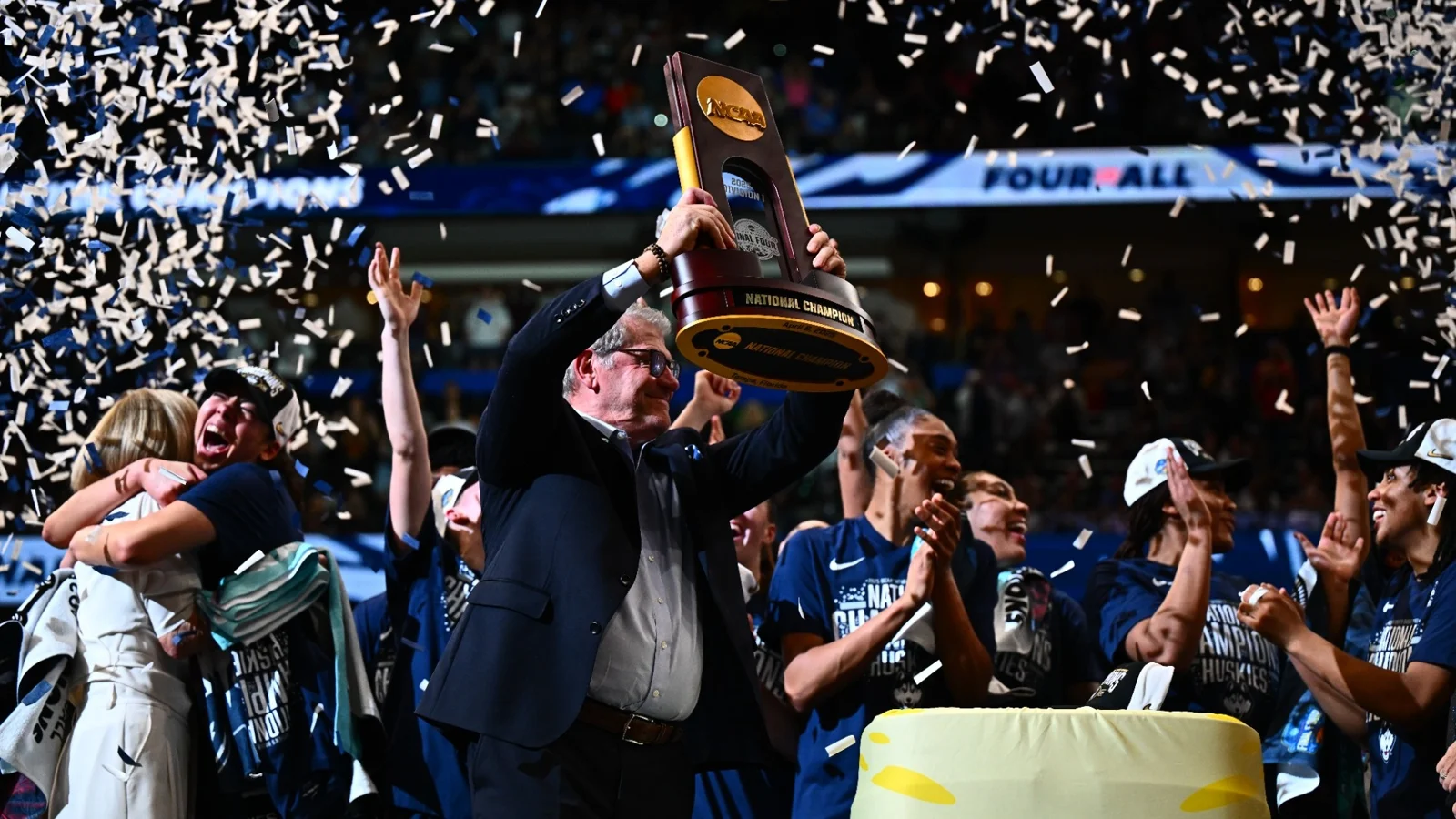
Cover: Geno Auriemma raises the championship trophy during UConn's 2025 celebration. Photo: UConn Athletics.
Geno Auriemma leads women's college basketball coaches with 12 NCAA championships, followed by Pat Summitt with eight. This guide counts NCAA Division I women's titles won as a head coach through the completed 2026 tournament. The years, programs and championship games below explain how the leading coaches built their records.
The coaches with multiple NCAA women's titles
Geno Auriemma leads NCAA Division I women's basketball head coaches with 12 national championships, followed by Pat Summitt with eight and Kim Mulkey with four. Seven head coaches have won at least twice. The table counts NCAA titles through the completed 2026 tournament; it excludes AIAW championships, other divisions and championships earned as a player or assistant coach.
| Head coach | NCAA titles | Championship programs and years |
|---|---|---|
| Geno Auriemma | 12 | UConn: 1995, 2000, 2002, 2003, 2004, 2009, 2010, 2013, 2014, 2015, 2016, 2025 |
| Pat Summitt | 8 | Tennessee: 1987, 1989, 1991, 1996, 1997, 1998, 2007, 2008 |
| Kim Mulkey | 4 | Baylor: 2005, 2012, 2019; LSU: 2023 |
| Tara VanDerveer | 3 | Stanford: 1990, 1992, 2021 |
| Dawn Staley | 3 | South Carolina: 2017, 2022, 2024 |
| Linda Sharp | 2 | USC: 1983, 1984 |
| Muffet McGraw | 2 | Notre Dame: 2001, 2018 |
The NCAA's coaching record book supplies the historical totals. The WBCA's championship-coach list adds Cori Close and UCLA for 2026. Close's first NCAA title expands the group of champions without changing this list of coaches with multiple wins.
The program column explains a difference that a school ranking can conceal. Mulkey's championships belong to two institutions, while the other six coaches here earned theirs at one. A school keeps its banner when a coach leaves; the coach's career record follows the person. Neither count is wrong, but they answer different questions.
The years are also more revealing than the totals alone. Sharp won in consecutive seasons. McGraw's victories were separated by 17 years. Both have two titles, yet one sequence describes immediate repeat success and the other a return with a different generation. Reading those paths alongside the numbers gives a much better picture of how these coaches reached the top.
Geno Auriemma and Pat Summitt set the championship standard
Auriemma and Summitt account for 20 championships between them. Their careers explain why the top of this list is so difficult to approach: each kept winning after the players associated with an earlier championship had moved on. A great recruiting class can establish a peak. Sustaining a title-winning program requires finding the next group capable of reaching it.
Auriemma's 12 titles span several UConn generations
UConn's biography of Auriemma places his arrival before the 1985-86 season and his first championship in 1995, when the Huskies finished 35-0. That ten-season build matters. The program's eventual reputation for expecting championships should not erase the years it took to establish a national contender.
The 2013-16 stretch represents the other extreme: four championships in four seasons. UConn's championship history records a 151-5 four-year mark for the teams led by Breanna Stewart, Moriah Jefferson and Morgan Tuck. Maintaining a core across successive tournament runs creates an opportunity to build on shared experience, but it also brings the challenge of meeting the same expectation every spring.
Then came a different kind of achievement in 2025. The AP game report carried by UConn records an 82-59 win over South Carolina, its first title since 2016. Azzi Fudd and Sarah Strong scored 24 points each, Strong added 15 rebounds, and Paige Bueckers scored 17. The ninth year after the previous title brought a championship built around a new trio.
That is why Auriemma's total contains more than one story of dominance. The unbeaten breakthrough, the four-year sweep and the later return each tested something different. Twelve titles are the record; the changing routes to them explain its scale.
Summitt's eight championships combined repeat titles with reinvention
Tennessee's account of Summitt's career records the first NCAA women's three-peat in 1996, 1997 and 1998. The last two seasons show how different championship teams can be: the Lady Vols finished 29-10 in 1997, then went 39-0 in 1998, closing with a 93-75 title-game victory over Louisiana Tech.
The ten-loss champion is an important counterweight to the perfect season. A championship count gives both one title because both solved the tournament, even though their regular-season records suggest very different journeys. It rewards the final achievement rather than requiring every champion to have looked unbeatable throughout the winter.
Summitt returned to consecutive titles in 2007 and 2008 with Candace Parker. Tennessee's biography highlights 25 Stanford turnovers in the 64-48 final of 2008. That concrete defensive result helps explain how the eighth championship was secured: the opponent repeatedly lost chances to finish possessions, rather than merely being outscored by a famous star.
Her title years stretched from 1987 to 2008 within a 38-season Tennessee career. The gaps between those championships were part of that career too. They make the return to consecutive titles more meaningful and show why counting only the seasons ending in a trophy understates the work required to keep a program in contention.
Kim Mulkey's four titles came at two programs
Mulkey's place immediately behind Auriemma and Summitt comes from three Baylor championships and one at LSU. Her 2023 victory made her the first women's head coach to win NCAA titles at two schools. That distinction adds a different dimension to the ranking: she reached the same endpoint after changing the institution, roster and setting around her.
The Baylor peak of 2012 was a perfect 40-0 season. The school's championship page records Brittney Griner's 26 points, 13 rebounds and five blocks in an 80-61 final against Notre Dame, with Odyssey Sims adding 19 points. Those numbers show how much influence Griner exerted at both ends: scoring, securing the ball and denying opposing shots all contributed to the same victory.
LSU's 2023 final provides a different example. The school's report of the 102-85 win over Iowa describes a roster with nine freshmen and transfers in Mulkey's second season. Jasmine Carson scored 22 points as LSU made 11 of 17 three-pointers. Her contribution became especially valuable while Angel Reese and Alexis Morris dealt with early foul trouble.
That final is a useful reminder that a championship coach needs more than a plan for the most recognizable players. Foul trouble can change who must finish a possession or carry the scoring. LSU had a player outside its usual star pairing provide a decisive lift, illustrating why the supporting roster belongs in any explanation of Mulkey's fourth title.
Separate her head-coaching titles from her Louisiana Tech years
Mulkey's longer championship biography begins before Baylor. LSU's account of her Louisiana Tech career identifies the 1981 AIAW championship and 1982 NCAA championship as a player, followed by the 1988 NCAA title as an assistant to Leon Barmore. Those achievements belong in her career story, but none adds to her four NCAA championships as a head coach.
Her responsibilities during the Louisiana Tech staff years included recruiting and working with guards. That experience helps explain why her professional path should not be reduced to the date of her first head-coaching title. At the same time, preserving the distinction lets readers compare her fairly with coaches whose published totals also count only seasons in charge.
When a biography uses a larger number of national championships, check both the governing body and the role attached to each season. Mulkey is an especially clear example of how a broader achievement total and a narrower head-coaching total can both be accurate.
Three titles can describe very different careers
VanDerveer and Staley share the next total, but the timing of their championships gives each career a different shape. Stanford's titles stretch from 1990 to 2021. South Carolina's three came in 2017, 2022 and 2024. One record includes an exceptionally long return to the summit; the other shows a program converting its first breakthrough into repeated recent success.
Tara VanDerveer's Stanford championships stretched across three decades
Stanford's 2024 retirement announcement credits VanDerveer with three championships and 14 Final Fours at the school, following earlier head-coaching jobs at Idaho and Ohio State. The third title came 29 years after the second. That interval spans far more than the replacement of one graduating class.
The 2021 championship game was a 54-53 win over Arizona. Its official box score shows Haley Jones with 17 points and eight rebounds. Stanford won the rebounding comparison 47-29 but committed 21 turnovers to Arizona's six. Arizona made 17 of 60 field-goal attempts.
Those figures resist a tidy story of a flawless final. Stanford had a major possession problem with turnovers, yet rebounding and the opponent's missed shots helped it survive. The record therefore supports a more useful observation than simply calling the Cardinal dominant: a championship team sometimes has to win while one important part of its performance is going badly.
VanDerveer's three titles should also be read alongside those 14 Final Four appearances. The long gap was not an absence from national contention. It was a reminder that reaching the last weekend and winning its final game are separate achievements, even for a coach who repeatedly builds teams capable of getting there.
Dawn Staley built South Carolina into a repeat champion
South Carolina's coaching history traces Staley's path from Temple, where she coached from 2000 to 2008, to the Gamecocks in 2008. Her first NCAA championship followed in 2017. The titles of 2022 and 2024 turned that initial success into a sustained place among the sport's leading programs.
The 2024 championship report records an 87-75 win over Iowa and a 38-0 finish after all five starters from the previous season had departed. Kamilla Cardoso contributed 15 points and 17 rebounds, while South Carolina's reserves outscored Iowa's 37-0.
The bench comparison matters to the coaching story because the team had to distribute responsibility across a changed lineup. Replacing starters is not only about identifying five names for introductions. It requires defining useful roles for the rest of the rotation, so that substitutions preserve or improve the team's ability to compete.
South Carolina reached the championship game again in 2025 and 2026, but both seasons ended as runner-up. Staley consequently remains on three titles through 2026. Keeping that distinction intact recognizes the depth of the recent run without converting championship-game appearances into championships she has not won.
Linda Sharp and Muffet McGraw reached two titles by different routes
The two-title tier contains the NCAA women's tournament's first repeat champion and a coach whose second victory came 17 years after her first. That contrast makes Sharp and McGraw particularly useful examples for understanding a championship ranking. The shared number preserves the result while leaving room to examine the very different careers behind it.
USC's consecutive championships under Sharp
Sharp led Southern California to the 1983 and 1984 championships. The school's historical tournament accounts describe an 11-point halftime deficit against Louisiana Tech in the 1983 final. Sharp used a full-court press, with Cynthia Cooper's steals contributing to the comeback in a 69-67 victory.
The 1984 final also required a response to a deficit. USC beat Tennessee 72-61, with the school's account emphasizing Cooper's penetration against the Lady Vols' zone. These are specific examples of the coach's influence within a game: altering the defensive approach in one final and using a player's ability to attack a defensive structure in the other.
Cheryl Miller's later interview with USC also points to the leadership of Pam and Paula McGee. Remembering that supporting leadership keeps the title story from becoming only a biography of its most famous player. Sharp coached a group with several important contributors, and its consecutive championships established the tournament's first successful title defense.
Notre Dame's long return under McGraw
McGraw's Notre Dame championships were decided by small margins and memorable late plays. The university's retirement account recalls Ruth Riley's late free throws in 2001 and Arike Ogunbowale's decisive shooting in 2018. The career biography gives the results: 68-66 over Purdue and 61-58 over Mississippi State, with the second championship ending on Ogunbowale's buzzer-beater.
A late shot can decide the trophy without explaining all the work that made the opportunity possible. McGraw took Notre Dame to nine Final Fours, including every tournament from 2011 through 2015. Her second title therefore followed repeated returns to the last weekend, rather than one sudden successful season after years away from contention.
She retired in 2020 after 33 seasons at Notre Dame. The two championship years are the easiest dates to remember, but the intervening appearances supply context for the coaching achievement. Sharp's consecutive victories and McGraw's long return belong beside each other in the count precisely because the count measures championships, not one prescribed way of building a career.
What the championship count leaves out
A table of multiple champions does not contain every coach who has won the tournament. It also cannot settle every argument about coaching quality. A first championship, a sustained run of Final Fours and the rebuilding of a program are different accomplishments. Comparing them requires more than sorting one column, even when that column answers a clear historical question.
The governing body matters as well. UCLA's account of Billie Moore's career identifies her 1978 championship as an AIAW title. It is part of the school's women's basketball history, but it is outside an NCAA championship count. The same care applies when separating a coach's playing career, assistant-coaching work and head-coaching record.
Cori Close joined the NCAA champions in 2026
Close supplied the latest addition to the championship coaching roll. UCLA beat South Carolina 79-51 on April 5, 2026, completing a 37-1 season in her 15th year leading the Bruins. The university's championship report explicitly distinguishes the program's first NCAA women's title from its earlier AIAW championship.
That result gives Close one NCAA title as a head coach. She consequently belongs in the full history of championship coaches while remaining outside the seven-coach table of multiple winners. It also means that a list ending with UConn's 2025 championship is no longer a complete account of the tournament through 2026.
For fans comparing these careers, start with the count and then ask how each coach reached it. Did the championships come together with a returning core, across generations at one school, or after a move to another program? Which final required a defensive adjustment, a contribution from the bench or one late possession? Those questions connect the historical ranking to the basketball that produced it. They leave the numbers intact while making the achievements behind them easier to understand.
Join the conversation
Share a question or a thought about the women's game. Comments are reviewed before they appear. Keep it friendly, stay on topic and leave out personal information.
No comments yet. Start the conversation.
Sign in with Google to leave a comment. Your email address is not displayed with your comment.