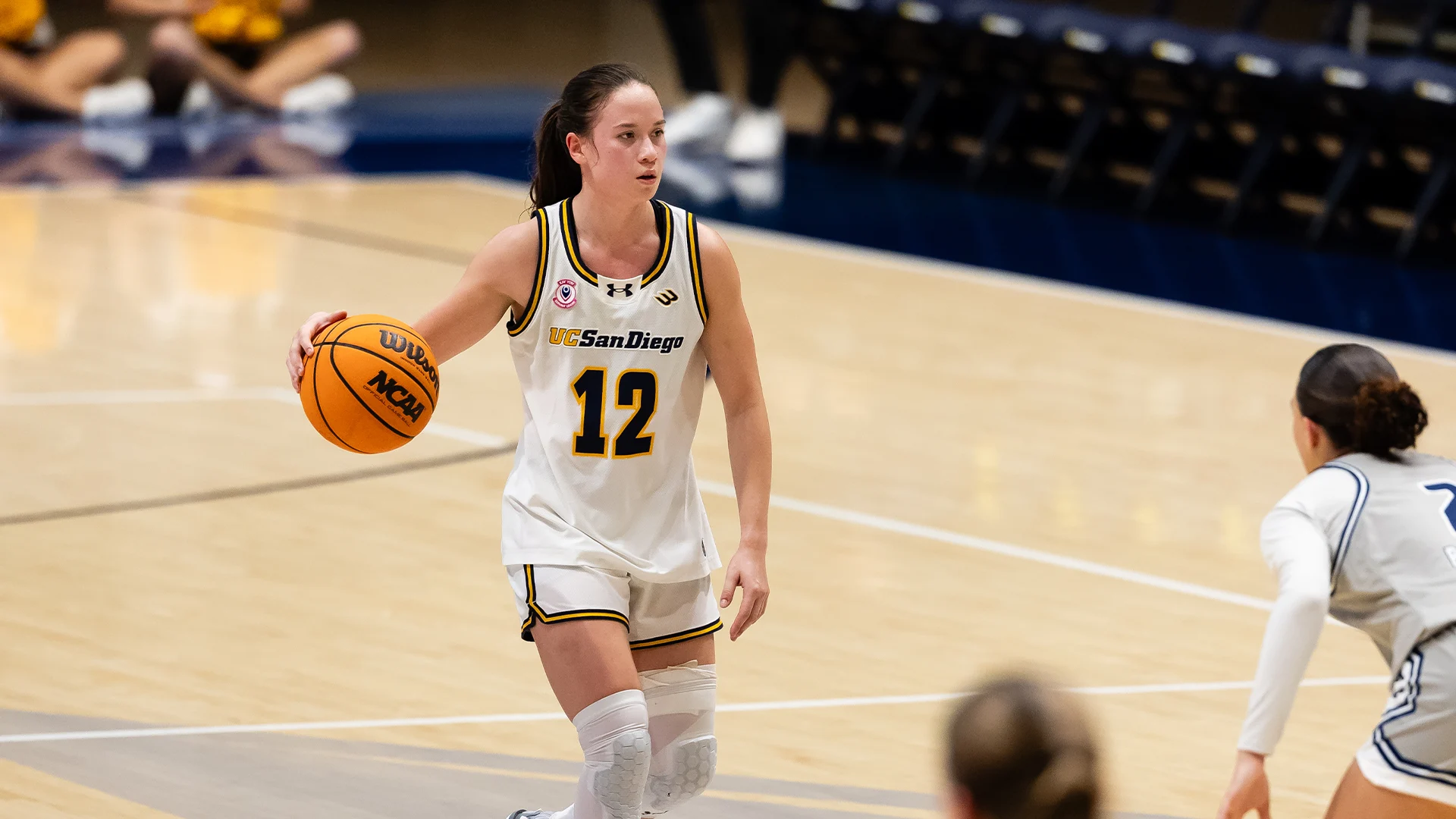
The Women's Mid-Major Top 25 is CollegeInsider.com's coaches' poll for a defined group of Division I women's basketball conferences. It ranks teams across that eligible field. A No. 5 position means fifth in this specialist poll, rather than fifth among every Division I team or fifth in a team's own conference.
Cover: Rosa Smith against UC Davis during the 2025-26 season. Photo: Derrick Tuskan/UC San Diego, via the Tritons' preseason poll announcement.
What the Women's Mid-Major Top 25 actually ranks
The publisher matters because several lists use similar language. CollegeInsider maintains separate men's and women's polls, while other publications and fan communities produce their own mid-major rankings. Their eligible teams, voters and order can differ. A reference to the Women's Mid-Major Top 25 should therefore identify CollegeInsider and the release date before comparing one team's position with another.
The publisher's women's poll page displays a dated ranking, records, total points, previous positions, conference labels and teams receiving votes. It also names the voting panel and the conferences included. Those details make it possible to understand both the order and the boundaries of the competition being compared.
School announcements describe the 2026-27 poll as a vote by 31 Division I coaches. CollegeInsider identifies James Madison head coach Sean O'Regan as the panel's chairman for the season. That makes this a coaches' assessment, with the strengths and limitations of human judgment. Coaches can evaluate the same results differently; a poll position is a collective opinion rather than the output of a published efficiency formula.
UC San Diego's October 30 preseason announcement offers a useful example. The Tritons were fifth and received one first-place vote. The school also discusses its Big West championship history and returning players. Those facts help explain why voters might value the team, while the fifth-place position describes where the ballots placed it within the poll's eligible group.
This gives fans a national comparison that a conference standing cannot provide. A league table compares results within one competition; the mid-major poll can place an Ivy League team beside a Horizon League team before they have played each other. It helps identify strong programs and possible nonconference matchups beyond the schools that usually dominate the overall national rankings.
The examples below use the November 10, 2026 release, checked on November 12. They illustrate how to read the poll and why particular teams moved. Later games and later ballots can change the order, so the date belongs with every position quoted here. The permanent value of the page is the explanation; the current order belongs to the publisher's latest dated release.
Which conferences are included in the 2026-27 poll
CollegeInsider's published conference note is the starting point for eligibility. On the page checked November 12, 2026, it lists the following 23 conference labels. These are the publisher's listed scope for this poll, rather than an NCAA definition of which institutions deserve the description “mid-major.”
| Included conference labels, as published | Included conference labels, continued |
|---|---|
| America East | Missouri Valley |
| Atlantic Sun | Northeast |
| Big Sky | Ohio Valley |
| Big South | Patriot |
| Big West | Southern |
| Coastal Athletic | Southland |
| Conference USA | Southwestern |
| Horizon | Summit |
| Ivy | Sun Belt |
| Metro | United Athletic |
| Mid-American | West Coast |
| Mid-Eastern |
The labels help resolve ambiguous team names. Miami appears in the November 10 table with the Mid-American conference label, identifying the Ohio program in this context. Fairfield appears under Metro, Princeton under Ivy League and Green Bay under Horizon. Reading the conference column prevents a familiar name from being assigned to the wrong institution or compared within the wrong league.
UC San Diego provides a clear example of a school inside the pool. Its own preseason announcement identifies its Big West championship history and its fifth-place CollegeInsider ranking. Those two descriptions concern different competitions: the league accomplishment explains part of the program's recent record, while the poll compares that program with eligible teams across numerous conferences.
Why a familiar team may be absent
A missing team can reflect eligibility or the ballots. The American, Atlantic 10, Mountain West and Pac-12 do not appear in the publisher's currently listed conference scope. A team belonging to a conference outside that list should not be treated as a voting snub merely because a fan commonly thinks of it as a mid-major. The first question is whether that team belongs to the poll's comparison group.
Inside the listed conferences, eligibility still does not guarantee a position. A school can be eligible and outside the Top 25, eligible and receiving a few points, or eligible without appearing in the published receiving-votes line. Those are different situations. The conference list answers who can be considered; the released ballots determine which teams appear and in what order.
Nor should this scope be turned into a financial ranking. The conference note does not provide a revenue cutoff, an attendance threshold or a minimum arena size. It therefore cannot establish which two programs have comparable resources. Its value is more straightforward: it tells readers which basketball teams the publisher has chosen to compare in this particular national poll.
Conference membership and conference names can change, so an old season's eligibility list is a poor substitute for the current note. For following the teams themselves, use the women's college basketball conference directory. Use CollegeInsider's own published scope when deciding whether a ranking or an omission belongs in a discussion of this poll.
How to read votes, points and movement
A ranking row contains several different measurements. Its position, first-place support, ballot points, record and previous position should not be collapsed into a single number. Read together, they can show whether a team leads clearly, sits in a close group or has recently attracted substantially more support.
First-place votes and total points answer different questions
The number in parentheses after a team name identifies first-place votes. Fairfield's conference announcement explicitly describes its two preseason first-place votes. UC San Diego's announcement likewise identifies one while placing the Tritons fifth. Receiving a first-place vote means at least one voter preferred that team; it does not mean the collective poll placed the team first.
The points column is the aggregate ballot score used to order the list. It is separate from both first-place votes and points scored in games. In the November 10 release, Green Bay had 721 poll points and Fairfield 719. Their two-point separation belongs to the ballots. It is neither a prediction that Green Bay would win a matchup by two nor a measure of the schools' season scoring totals.
First-place support can help describe the top of the poll without replacing total points. Princeton had 24 first-place votes, Green Bay four, Fairfield two and Columbia one. Adding those figures gives 31 first-place selections. A team with fewer first-place selections can still collect broad support elsewhere on ballots, so the complete ordering requires the aggregate points column.
Close totals also call for proportionate conclusions. Green Bay's second place and Fairfield's third are real positions in that release, but a two-point ballot gap offers little basis for declaring an enormous difference in quality. The rank gives an order. The nearby totals show that the collective assessment at those positions was much closer than a dramatic “second versus third” argument might imply.
Records, previous positions and receiving votes
The record belongs to the release's snapshot. A school may play again before a reader opens the poll, so its current schedule can already show a different record. The previous column refers to the preceding poll position. It lets readers identify movement between releases, without implying that the most recent game alone caused every voter to change an assessment.
“NR” means that a team was not ranked in the previous Top 25. Idaho's previous entry in this release is “NR (40).” That is not a previous rank of No. 40, and it should not be used to calculate a 19-place climb to No. 21. The reliable conclusion from the position labels is that Idaho entered the ranked group.
Below the list, “others receiving votes” identifies teams with ballot points outside the published Top 25. South Dakota had 64 and UC Irvine 54 in the example release. Calling them officially No. 26 and No. 27 would add positions that the publisher has not printed. The line is useful evidence of support near the boundary, while the Top 25 remains the actual ranked list.
What the November 10, 2026 rankings show
The November 10 release supplies useful examples of a new leader, substantial movement and the boundary of the ranked group. The selected rows below retain the records and positions printed in that release. They are a dated illustration, rather than a live table updated with every subsequent game.
| Team | Rank | Record | Poll points | Previous |
|---|---|---|---|---|
| Princeton | 1 | 3-0 | 759 | 2 |
| Green Bay | 2 | 1-1 | 721 | 1 |
| Fairfield | 3 | 2-0 | 719 | 4 |
| UC San Diego | 5 | 1-1 | 591 | 5 |
| Miami | 6 | 3-0 | 521 | 16 |
| High Point | 7 | 3-0 | 493 | 21 |
| Howard | 25 | 1-1 | 89 | 25 |
Princeton passed Green Bay despite both staying near the top
Princeton moved from second to first after opening with victories over Belmont, Richmond and Murray State. Green Bay moved from first to second after a loss to Duke and a win over Loyola Chicago. Those results show why a poll cannot be read as a simple ordering of winning percentages. The quality and context of opponents remain part of the basketball being judged.
The Tigers' 65-57 victory at Richmond provides a concrete reason to look beyond the final record. Princeton trailed by nine with fewer than six minutes left, then closed with a 14-0 run. Fadima Tall finished with 27 points and 10 rebounds, including 14 points in the fourth quarter. Winning required a strong finish against a team that had controlled a substantial part of the closing period.
That does not reveal how each coach filled out a ballot. It does supply a basketball achievement behind the rise: a road comeback, an identifiable leading performance and another completed win. Green Bay's 1-1 record, meanwhile, included a 76-60 loss to Duke before an 82-48 victory over Loyola Chicago. A difficult opener and a comfortable response contain more information than the fraction .500 alone.
High Point and Miami made the biggest jumps
Among teams already ranked in the previous release, High Point climbed 14 places, from No. 21 to No. 7, and Miami climbed 10, from No. 16 to No. 6. Howard's report of the poll points to Miami's win over James Madison and High Point's win at Ball State as important results. Both rising teams were 3-0 in the release.
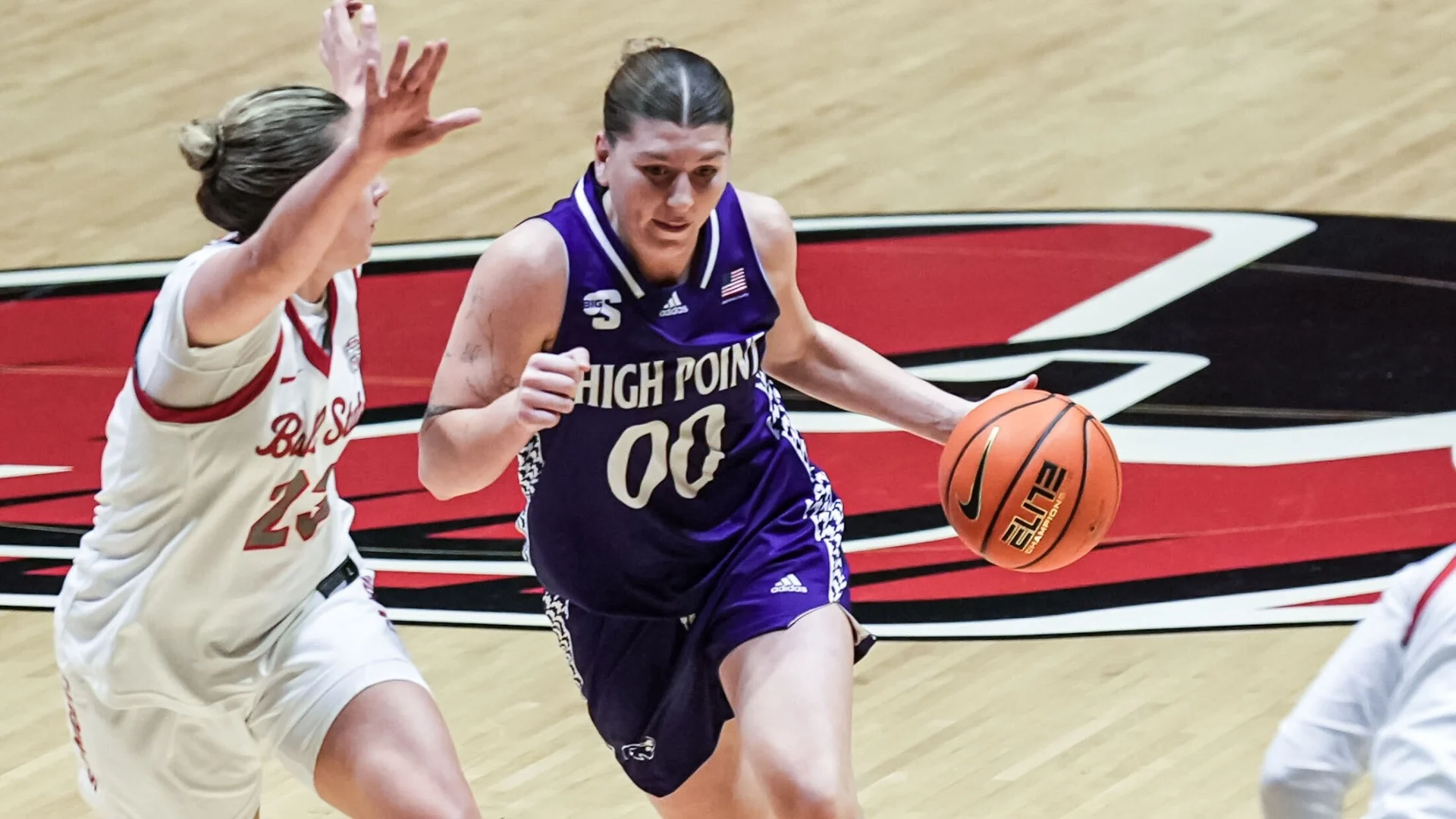
High Point's 78-71 road victory had specific contributions behind it. Taylor Feldman scored 21, and Juliann Woodard had 20 points and 13 rebounds while making four of six three-point attempts. The Panthers did more than acquire another win in a record column: they beat a fellow ranked program away from home with production from several players.
Early-season records still require attention to the schedule. High Point's other victories came against Wingate and Lees-McRae. Listing the three wins together does not make every opponent the same competitive test. For understanding the poll movement, the Ball State game gives fans a particularly relevant comparison within the ranked mid-major field.
Howard and the teams just outside the list
Howard remained No. 25 with 89 points and a 1-1 record in the release. Its school announcement describes a 91-88 overtime loss at Missouri followed by a 76-69 victory over Elon. Those results help a reader understand the early record: the loss was a close game that required an extra period, rather than a result that the record alone can fully describe.
South Dakota and UC Irvine were below the ranked boundary with 64 and 54 points. The distinction between those teams and Howard is the published Top 25 cutoff, rather than a claim that a vast competitive gap separates them. Their continued results could interest fans following the next release, even though neither carried an official numbered position in this one.
The strongest reading combines the poll with those actual games. A rise suggests that support has increased; the game report can explain what the team accomplished. Neither should replace the other. The ranking adds a national comparison, while the performances give that comparison its basketball substance.
How the poll fits beside AP rankings, NET and March
CollegeInsider, the AP poll and the NCAA Evaluation Tool can give the same team very different positions without contradicting one another. They compare different fields or use different methods. The useful question is which one answers the particular question a fan is asking.
A national poll and a selection tool have wider jobs
The AP women's Top 25 is a national media poll covering Division I programs across the sport. Its field is wider than CollegeInsider's listed conferences. The Associated Press describes its national media panel in its poll reporting. CollegeInsider's specialist coaches' poll and that overall media poll have different voters as well as different comparison groups.
NET has a different purpose again. The NCAA's explanation describes a tool based on results and adjusted efficiency, with the women's model using women's game data. It does not incorporate preseason rankings or prior-season results. The NCAA first releases NET in December, so a November preseason or early-season poll should not be confused with a current NET table.
Neither No. 1 in CollegeInsider nor any other specialist poll position awards an NCAA tournament berth. The women's selection procedures distinguish conference-tournament automatic qualifiers from at-large selections made by the committee. An at-large discussion considers the wider season's evidence. The committee does not simply invite the highest teams from this mid-major list or convert its positions into NCAA seeds.
For that reason, a team can be highly regarded within the eligible mid-major field while still needing a stronger overall tournament case. A specialist ranking measures standing within one pool. NCAA selection compares candidates across the full eligible national field. The separate women's NET guide explains that evaluation in more detail.
Use the rankings to find games worth watching
The poll is especially useful for discovering matchups. A meeting between teams from different eligible conferences can test an assessment built on separate schedules. High Point's trip to Ball State is a good example: an actual road result added a meaningful comparison between two programs already in the ranked group.
Start with the opponent and venue, then look at the players behind the result. Woodard's rebounding and shooting, Feldman's scoring and Tall's fourth-quarter production provide specific things to follow in their next games. That turns a list of school names into a reason to watch how a team handles pressure, finishes possessions and sustains its offense against a different opponent.
Use the current women's basketball schedule to find the next matchup and the TV and streaming listings to confirm where it is available. Broadcast arrangements belong to individual games and platforms. A poll identifies teams to follow; the schedule and viewing information complete the plan.
Join the conversation
Share a question or a thought about the women's game. Comments are reviewed before they appear. Keep it friendly, stay on topic and leave out personal information.
No comments yet. Start the conversation.
Sign in with Google to leave a comment. Your email address is not displayed with your comment.