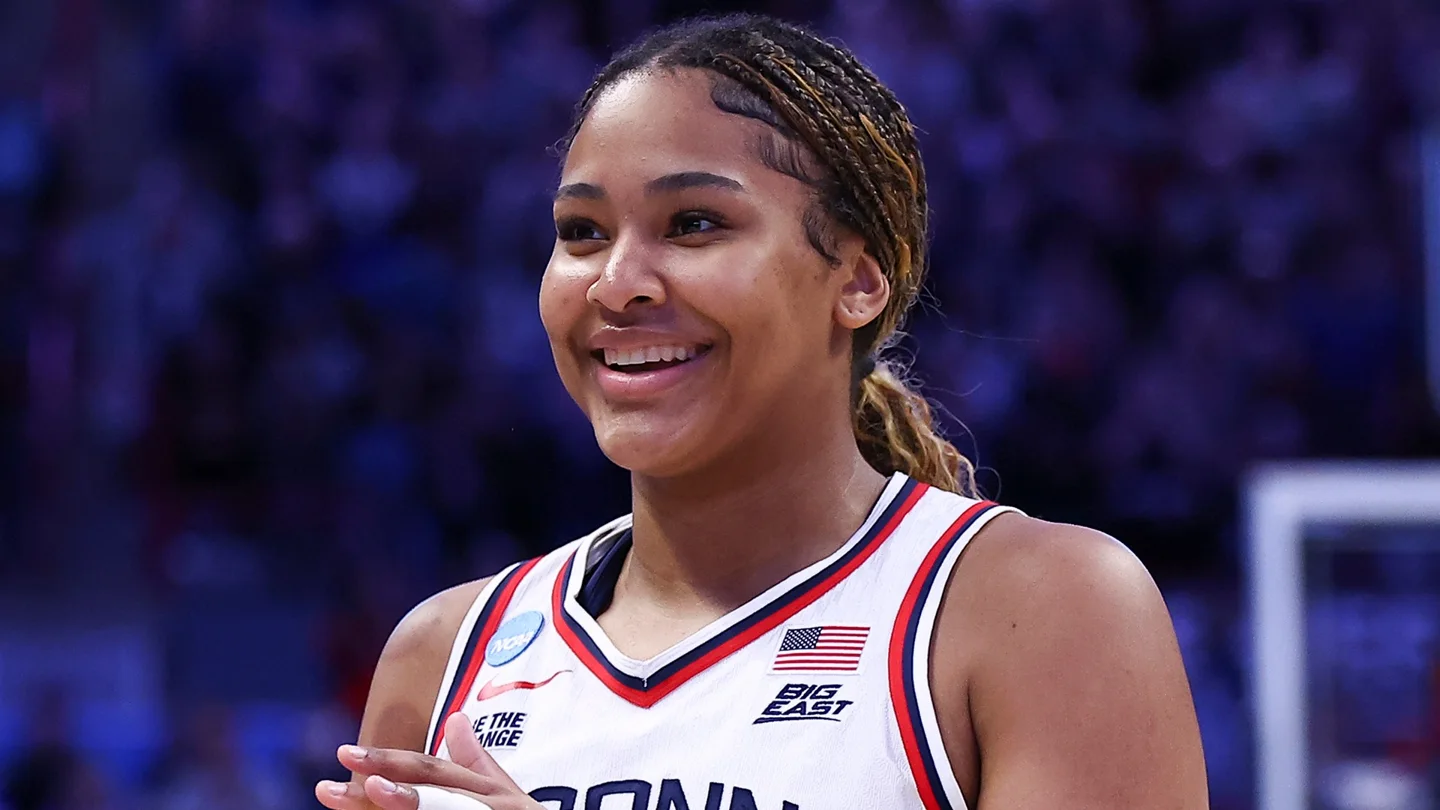
Cover: Sarah Strong during her 2025-26 UConn season, in an archive photo accompanying UConn Athletics' April 2026 award announcement. The source does not identify the photograph's exact game date.
Sarah Strong is the answer to the main 2026 women's college basketball player-of-the-year question: the UConn sophomore collected the Naismith, AP, Wooden, Wade and USBWA national honors. Lauren Betts' Final Four award and Hannah Hidalgo's defensive award recognize different achievements. Here is what each result means for the completed 2025-26 season.
Who won women's college basketball player of the year in 2026?
Sarah Strong of UConn won the 2026 Naismith Trophy, Associated Press Player of the Year, John R. Wooden Award, Wade Trophy and USBWA Ann Meyers Drysdale National Player of the Year honor. The awards recognize her sophomore season in 2025-26. UConn's Wooden Award announcement confirms that collection of national honors.
| 2026 honor | Winner | School |
|---|---|---|
| Naismith Trophy, women's college player | Sarah Strong | UConn |
| AP women's Player of the Year | Sarah Strong | UConn |
| Women's Wooden Award | Sarah Strong | UConn |
| Wade Trophy | Sarah Strong | UConn |
| USBWA Ann Meyers Drysdale national award | Sarah Strong | UConn |
| NCAA Women's Final Four Most Outstanding Player | Lauren Betts | UCLA |
| Naismith Women's Defensive Player of the Year | Hannah Hidalgo | Notre Dame |
The first five rows address the broad season-level player question. The final two answer narrower questions about the Final Four and defensive performance. The Naismith announcement names Strong and Hidalgo in separate categories, while UCLA confirms Betts' Final Four award. Those results belong alongside one another without being interchangeable.
There is no need to choose one headline and declare the others wrong. A season award considers a different body of work from an honor attached to a particular championship weekend. A defensive award also asks voters to emphasize a different part of the game. The precise award name is therefore part of the answer, rather than an optional detail beneath the player's name.
This guide covers the Division I women's college season ending in spring 2026. It does not identify the men's winner, the best high-school recruit in the graduating class of 2026 or the WNBA's most valuable player. Those searches can share names, sponsors and calendar dates, which makes an unqualified “basketball player of the year” result misleading.
For a clean comparison, read every award claim as four pieces of information: player, organization, category and season. That approach is particularly useful for Strong, whose multiple national trophies sit beside conference and position-specific honors, and for Betts, whose championship achievements generated a different set of award announcements after the tournament.
Why Sarah Strong collected the major national honors
Strong's case was broader than a scoring title. She could contribute to the same possession in different ways: finishing a play, drawing defensive attention or helping a teammate get a better opportunity. At the other end, rebounds, steals and blocks supplied additional measurable value. The awards are judgments by their selectors, but the basketball evidence helps explain why so many organizations converged on the same player.
Production on both ends of the court
UConn's April 11 season summary lists 18.4 points, 7.7 rebounds, 3.4 steals and 1.6 blocks per game in 27.4 minutes. Her shooting percentages were 58.2 from the field, 40.4 from three-point range and 83.3 at the foul line. These are three separate measures, not percentages that should be added together.
The combination creates several problems for an opponent. A forward capable of scoring inside and making an outside shot cannot be defended simply by conceding one area of the floor. Helping toward that player can free a teammate; staying attached can reduce the help available elsewhere. That is the practical significance of the shooting profile, although a season percentage alone cannot tell us which defensive coverage a particular opponent used.
The tournament supplied specific evidence beyond an award announcement. In the 63-42 Sweet 16 win over North Carolina, Strong had 21 points, 10 rebounds, five steals and two blocks. The Tar Heels committed 24 turnovers. Her personal defensive totals were part of a team effort, so they should not be presented as proof that she created every lost possession.
That distinction improves the analysis rather than diminishing her contribution. A steal ends an opponent's possession directly, while a block may still leave the ball with the attacking team. A defensive rebound completes the stop. Combining those categories into a single invented “defensive points” total would hide the different things they describe. Strong's appeal was that she affected several parts of the possession without needing each category to be reduced to one number.
Read the date beside the statistics
Award stories can publish slightly different averages without either being incorrect. The USBWA's March 25 announcement described a 36-0 UConn team and listed Strong at 18.4 points, 7.5 rebounds and 60.0 percent field-goal shooting. It appeared before the regional weekend. That is a dated snapshot of her season, not the final statistical line.
The AP's April 2 report listed 18.6 points, 7.6 rebounds and 59.4 percent shooting with UConn at 38-0. UConn's later summary, quoted above, reflects the completed season. The additional games explain why a comparison must retain the reporting date.
This matters when assessing an argument about the award. A final-season statistic can describe the year in retrospect, while a voting story may describe the evidence available earlier. Before comparing two players, match their dates and samples: all games against all games, or tournament games against tournament games. Otherwise, a small numerical difference can come from the cutoff rather than from a meaningful difference in performance.
How the major player-of-the-year awards are selected
The awards have separate administrators and selection processes. The Atlanta Tipoff Club presents the Naismith Trophy; the Associated Press organizes its media award; the Los Angeles Athletic Club's Wooden Award program has its own ballot and qualifications. The WBCA and USBWA also make their own selections. Calling all of these an “NCAA vote” erases differences that help explain both the result and its timing.
For the 2026 Naismith awards, the official winner announcement states that fan voting accounted for five percent of the overall vote. That makes public participation part of the process, without making the award a simple popularity contest decided entirely by online ballots. A large fan campaign and the final overall result are different pieces of evidence.
The AP vote was also specific: Strong received 25 votes, Mikayla Blakes four and Lauren Betts two. Voting was completed before the NCAA tournament. A later tournament performance therefore could not alter that already-completed ballot.
That cutoff is essential when discussing whether the champion's best player should have won. A fan looking backward from the final can reasonably emphasize the championship run. The AP selectors were making their decision earlier. Comparing those judgments without acknowledging the timing makes them appear to answer the same question with the same evidence when they did not.
Similar winners do not make the awards identical
The 2026 Wooden national-ballot announcement listed 15 candidates chosen by the program's advisory board. Universities certified that candidates met its qualifications, including academic progress and a cumulative GPA of at least 2.0. The criteria also address team contribution, offense, defense and character. Its announced All-America voting window ran March 16-28, with the trophy winner announced in April.
The WBCA's Wade Trophy rules describe a different route: selection from the ten-member Division I Coaches' All-America team. The eligibility and criteria include academic eligibility, on-court excellence and sportsmanship. Being on a preseason watch list is therefore one stage of the discussion, not evidence that the player has won or even reached every later stage.
For readers following awards throughout a season, distinguish watch lists, semifinalists, finalists and the final recipient. An early announcement explains who is being considered at that moment. A later announcement can narrow the field without changing anything about a previously completed game. Counting every appearance on those lists as a separate trophy would exaggerate an athlete's honors.
Strong's collection means multiple award programs reached the same broad conclusion about her season. It does not mean the programs used one combined ballot, applied identical requirements or published on the same day. When discussing the achievement, naming the trophies is more informative than inventing a universal award formula from scoring averages or social-media attention.
Why Lauren Betts won the Final Four's top honor
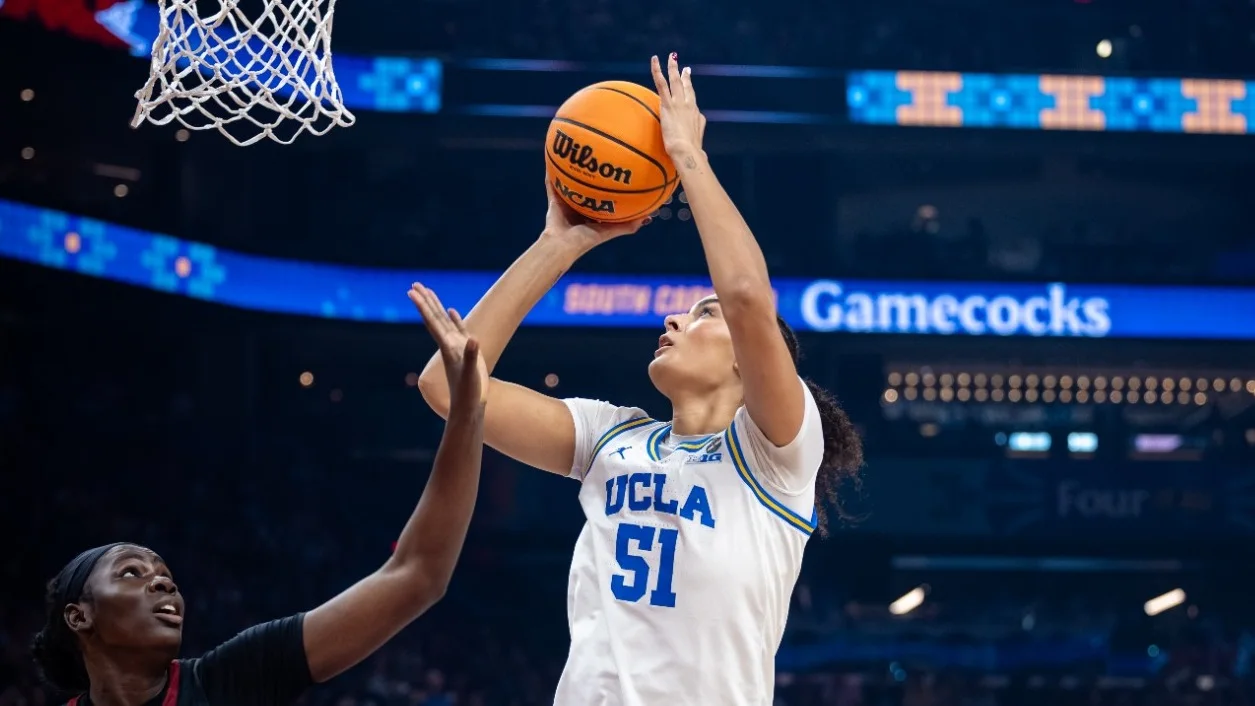
Lauren Betts was the 2026 NCAA Women's Final Four Most Outstanding Player after helping UCLA win its first NCAA women's basketball championship. That honor belongs to the championship event. It does not replace Strong in the Naismith, AP or Wooden records, and it does not require Betts to have led every individual statistical category in the final.
The semifinal showed why her defensive role mattered. In UCLA's 51-44 win over Texas on April 3, Betts finished with 16 points, 11 rebounds and three blocks, shooting 7-for-10. With UCLA ahead 47-44, she blocked a shot with fewer than 21 seconds left. Kiki Rice subsequently made the four late free throws that completed the scoring.
That sequence illustrates why a valuable defensive play can carry more meaning than its single entry in a box score. The score and clock made the possession consequential: UCLA needed to prevent Texas from reducing a one-possession deficit. Betts' block was followed by teammates completing the remaining work. Describing that chain is more useful than presenting the block as a solitary act that won the entire game.
In the 79-51 championship win over South Carolina on April 5, Betts had 14 points and 11 rebounds; Gabriela Jaquez led UCLA with 21 points. The school report identifies a third-quarter sequence in which Betts blocked a shot, Rice collected the rebound and Jaquez finished a fast break to make it 48-26. UCLA's first NCAA title followed its separate AIAW championship in 1978.
The roles in that play explain how an interior defender can contribute to a teammate's scoring opportunity. A blocked shot by itself does not guarantee possession, and a rebound does not automatically become a transition basket. Betts, Rice and Jaquez performed connected tasks. The award can recognize Betts' importance to that structure while the game report still properly credits Jaquez as the leading scorer.
Betts also received the 2026 Honda Sport Award for basketball. In July, she won the broader Honda Cup as Collegiate Woman Athlete of the Year. The latter selection spans women's college sports: sport-award winners feed a Top Three selection, with the CWSA board choosing the Cup recipient.
These are separate achievements with distinct scopes. An April article naming Betts a Honda Cup finalist was accurate when published, but it is incomplete as a September account of her honors. The completed 2026 record includes her national championship, Final Four recognition, basketball-specific Honda award and later multisport Honda Cup.
Defensive, positional and conference awards answer different questions
The national player-of-the-year trophies are only one part of the honors landscape. Other awards identify excellence in a particular role, position or conference. Keeping those boundaries visible lets fans appreciate a wider range of players without turning every award announcement into a dispute over the same supposed number-one ranking.
Hannah Hidalgo and the defensive award
Notre Dame's Hannah Hidalgo won the 2026 Naismith Women's Defensive Player of the Year. The awarding organization highlighted her NCAA single-season record of 202 steals and average of 5.6 steals per game. Her recognition shows that a guard's disruption of possessions can stand alongside a center's rim protection in a national defensive discussion.
Those roles should be evaluated with an understanding of what the player is asked to do. A guard defending the ball may affect the point at which an opponent can begin its offense. An interior defender may change whether the resulting drive produces a clean attempt. Neither task is fully described by the other position's signature statistic. The steals record is important evidence of Hidalgo's season, but the award is not a rule that automatically assigns the trophy to the national steals leader.
For a fan revisiting games, watch what happens around the recorded defensive event. Did the pressure force a rushed pass? Did the recovery lead to a controlled transition opportunity? Did teammates cover the space behind the defender? Those questions help explain the basketball value without assuming that every gamble succeeds or that the same defensive approach suits every lineup.
Position awards and conference honors
The Basketball Hall of Fame's 2026 women's Starting Five awards recognized Hidalgo at point guard with the Nancy Lieberman Award, Mikayla Blakes at shooting guard with the Ann Meyers Drysdale Award, Madison Booker at small forward with the Cheryl Miller Award, Strong at power forward with the Katrina McClain Award and Betts at center with the Lisa Leslie Award.
The Ann Meyers Drysdale name creates an especially easy misunderstanding. Blakes won the Hall of Fame's shooting-guard award, while Strong won the USBWA's national player award bearing the same name. They are different honors from different organizations. A search result that omits the organization or the positional description can make two correct winner announcements look contradictory.
Conference honors have their own scope too. The BIG EAST named Strong its Player of the Year and Defensive Player of the Year. Its head coaches selected the league awards and could not vote for their own players. That result coexists with Hidalgo's national Naismith defensive honor because the eligible fields and selectors differ.
Awards are useful starting points for deciding which players and skills to study. They are less useful when their names are stripped away and all winners are placed into an invented combined ranking. For 2026, retain the specific achievement: Strong's major national season honors, Betts' championship and Honda recognition, Hidalgo's defensive distinction and the separate position winners. That gives each result its proper meaning and makes the next award headline much easier to interpret.
Join the conversation
Share a question or a thought about the women's game. Comments are reviewed before they appear. Keep it friendly, stay on topic and leave out personal information.
No comments yet. Start the conversation.
Sign in with Google to leave a comment. Your email address is not displayed with your comment.