South Carolina opens our 2026-27 women’s college basketball preseason Top 25 at No. 1, followed by UConn, Duke and USC. This is a September 15 editorial snapshot—not an official AP poll—and the most useful part is not a one-place gap. It is the reason each team can rise or fall.
Below is the complete 1-25 board, a transparent contender hierarchy and the roster variables that matter most: Sarah Strong’s two-way control, JuJu Watkins’ return, Michigan’s continuity, UCLA’s championship rebuild and Oklahoma State’s transfer-fueled upside.
The 2026-27 Top 25 at a glance
This is an editorial ranking dated September 15, 2026, not the official AP preseason poll. It weighs five things: proven returning production, incoming talent, lineup fit, coaching continuity and the range of realistic outcomes created by health. The date matters because an April “way-too-early” board and a September roster-informed board are different snapshots.
| Rank | Team | Rank | Team | Rank | Team |
|---|---|---|---|---|---|
| 1 | South Carolina | 10 | LSU | 19 | Kentucky |
| 2 | UConn | 11 | UCLA | 20 | Ohio State |
| 3 | Duke | 12 | North Carolina | 21 | Maryland |
| 4 | USC | 13 | Oklahoma State | 22 | Illinois |
| 5 | Michigan | 14 | TCU | 23 | Arizona State |
| 6 | Texas | 15 | Notre Dame | 24 | Nebraska |
| 7 | Louisville | 16 | Ole Miss | 25 | Rice |
| 8 | Vanderbilt | 17 | Washington | ||
| 9 | Iowa | 18 | Minnesota |
The order deliberately favors evidence over title-defense etiquette. South Carolina and UConn have the most convincing blend of a proven centerpiece and program infrastructure. Duke has a rare continuity advantage. USC's ceiling is enormous, but it depends on how JuJu Watkins looks after a redshirt injury season. Reigning champion UCLA begins at No. 11 because the players who produced its 2026 title are not the same group that must defend it.
Reasonable boards can differ. HoopsHQ's September ranking also starts South Carolina-UConn-Duke-USC, while Major Movez's July board puts Michigan second, Vanderbilt third and UConn eighth. That spread is a warning against false precision. Nos. 1-4 form the championship tier; Nos. 5-10 have credible Final Four paths; Nos. 11-25 carry at least one larger projection or roster question.
How to read the list
One-place differences are not meaningful in September. Tiers are. A healthy return, an emerging point guard or a difficult nonconference win can move a team several spots without proving the original evaluation was careless.
The four teams with the clearest championship cases
A championship case needs more than a famous coach or one brilliant scorer. The top four all have a player who can solve late-clock possessions, enough defensive personnel to survive a cold shooting night and a plausible lineup that does not depend on several freshmen becoming stars immediately.
No. 1 South Carolina: the deepest proven contender
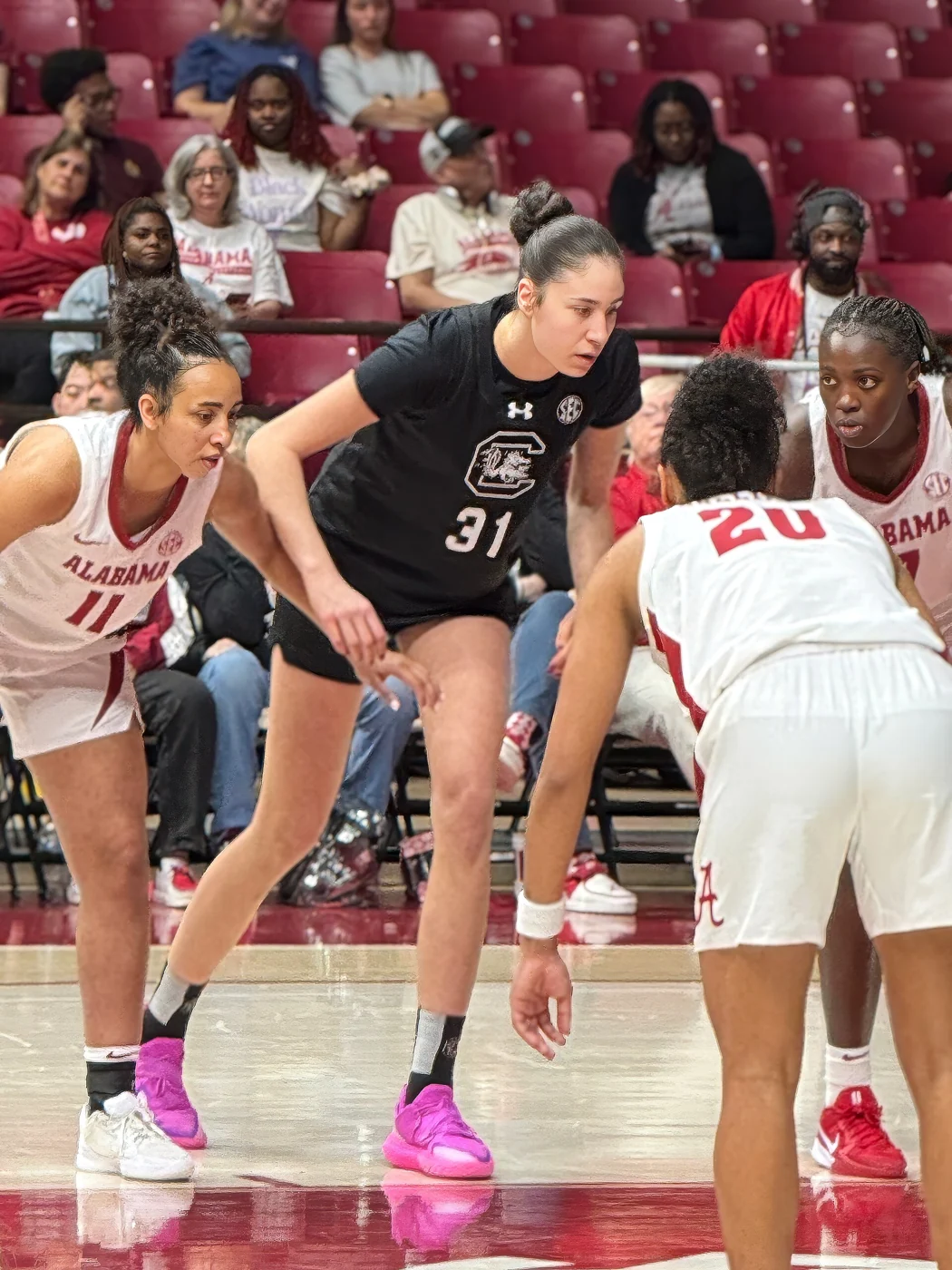
South Carolina's ugly final loss should not erase the route that preceded it. The Gamecocks reached a sixth consecutive Final Four and beat previously unbeaten UConn before UCLA controlled the championship game, 79-51. That finish exposes an offensive ceiling to solve; it also confirms that Dawn Staley's program can reach the last weekend through defense, rebounding and lineup depth.
The official 2026-27 roster is why the Gamecocks start first. Joyce Edwards is the primary scorer, while Tessa Johnson, Ashlyn Watkins, Chloe Kitts, Brooke Quarles-Daniels, Jordan Lee, Agot Makeer and 6-foot-7 Alicia Tournebize supply different sizes and roles. Edwards averaged 19.2 points, 6.8 rebounds and 2.4 assists last season, according to HoopsHQ. The question is not whether South Carolina has options; it is whether its guards consistently create efficient offense when a title opponent shrinks the paint.
No. 2 UConn: Sarah Strong raises the floor
UConn lost Azzi Fudd and ended a 38-0 start with a 62-48 semifinal defeat to South Carolina. Those are not small deductions. The Huskies stay second because Sarah Strong is already both an elite offensive hub and a disruptive defender. UConn's award release lists 18.6 points, 7.6 rebounds, 3.4 steals and 1.6 blocks per game, with a .594 field-goal percentage and .404 three-point percentage.
That efficiency lets Geno Auriemma build several kinds of offense around one player. Strong can punish a switch, pass over help and finish possessions defensively. Ten returning Huskies give the staff internal candidates for larger roles, but the key uncertainty is perimeter hierarchy: someone must replace Fudd's shot-making when Strong draws two defenders. UConn's floor is Final Four contention; its claim to No. 1 depends on that answer.
No. 3 Duke: continuity plus a harder ceiling
Duke has the cleanest continuity argument below the top two. The Blue Devils went 27-9, won both ACC titles and reached the Elite Eight. Their August schedule announcement says three starters and nine players return. Toby Fournier, Jadyn Donovan, Delaney Thomas and a now-experienced interior rotation already understand Kara Lawson's defensive demands.
Texas transfer Aaliyah Crump adds a 6-foot-1 guard who averaged 7.9 points as a freshman—not a guaranteed savior, but another credible connector and scorer. Duke's harder question appears late in close games: can this roster generate a great shot against the length of South Carolina or UConn when transition chances disappear? A December date with reigning champion UCLA in Phoenix will test that ceiling early.
No. 4 USC: the highest-variance title bet
USC could look under-ranked by January or overly ambitious by November. The difference is JuJu Watkins. Her official roster bio says she redshirted 2025-26 because of injury; in 2024-25 she produced 23.9 points, 3.4 assists, 2.18 steals and 1.76 blocks per game. That two-way workload is championship-level when healthy, but a projection cannot assume the same minutes and explosiveness on opening night.
USC also has a team beyond Watkins. Jazzy Davidson led the 2025-26 Trojans in points, rebounds, assists, steals and blocks, and USC added top recruit Saniyah Hall plus transfers Pania Davis and Ryan Bennett. If Watkins can share creation with Davidson instead of carrying every difficult possession, the Trojans have No. 1 upside. Until competitive games confirm her availability and the new hierarchy, fourth is the honest balance between ceiling and risk.
The next six blend Final Four upside with real questions
Nos. 5-10 are not consolation prizes. Each team has enough creation to beat a top-four opponent, but each needs either a new role, a transfer fit or a young player to translate quickly. Their order should be more responsive to November evidence than the order above them.
Michigan and Texas have backcourts built for March
No. 5 Michigan offers the safest continuity bet in this tier. The Wolverines return all five leading scorers from a 28-7 Elite Eight team: Olivia Olson (18.9 points per game), Syla Swords (14.6), Mila Holloway (12.3), Te'Yala Delfosse (8.7) and Ashley Sofilkanich (7.7). Those figures come from Michigan's June roster outlook. Familiar ball-handlers should make its early offense cleaner than that of most reconstructed contenders. The next step is half-court efficiency when opponents can switch across Olson and Swords.
No. 6 Texas has the tier's best proven March closer in Madison Booker. She led the Longhorns to a second straight Final Four and became the first Texas player with 1,900 career points, 600 rebounds and 400 assists. Booker can score, initiate and defend size, but Rori Harmon's departure leaves more organization to replace. Freshman guards may be talented; asking them to direct a title offense immediately is a different claim. Texas belongs near the top, yet its non-Booker possessions will decide whether sixth is too low or too high.
Louisville and Vanderbilt can turn roster quality into a leap
No. 7 Louisville added a lead guard with conference experience. Zamareya Jones arrived from NC State after averaging 14.9 points, 3.8 assists and 3.3 rebounds. Jeff Walz now has more ways to create off the bounce around a roster that went 29-8. The concern is familiar to transfer-heavy teams: good names must become a five-player defense, and that cohesion cannot be awarded in September.
No. 8 Vanderbilt could make the largest jump. Mikayla Blakes won SEC Player of the Year after averaging 27.1 points, 4.6 assists and 2.9 steals, while Aubrey Galvan won the league's freshman honor. Vanderbilt returns seven players from a Sweet 16 team and adds five newcomers. That is a stronger base than the program's reputation might suggest. To justify an even higher placement, the Commodores must show that the frontcourt can protect the glass without forcing Blakes and Galvan to win every high-level game from the perimeter.
Iowa and LSU own top-10 talent but thinner margins
No. 9 Iowa acquired production and upside at once. Georgia transfer Dani Carnegie averaged 17.8 points, 5.2 rebounds and 3.2 assists, and five-star freshman McKenna Woliczko supplies a physical 6-foot-2 forward. Carnegie's three-level scoring should prevent the offense from depending on one action. Woliczko's résumé is excellent, but college defenses have not tested her yet. Iowa's top-10 case assumes the veteran makes the rookie's transition easier, not that a recruiting grade guarantees it.
No. 10 LSU has eight McDonald's All-Americans by the school's count and a backcourt crowded with creators. Jada Williams joins after averaging 15.3 points and 7.7 assists at Iowa State, alongside Mikaylah Williams and MiLaysia Fulwiley. LSU lost 87-85 to Duke in the Elite Eight, so the ceiling is visible. The margin is thinner because touches must be allocated cleanly and the frontcourt changed. If the new point guard turns star power into easier shots instead of another competition for possession, the Tigers can move well above tenth.
Nos. 11-25 are where the ranking gets volatile
The lower 15 contain a national champion, an All-American transfer, proven conference stars and several reconstructed rotations. That sounds contradictory only if a ranking is treated as a résumé award. This board estimates what each 2026-27 team will become; it does not redistribute medals from last April.
UCLA starts at No. 11 because a title defense is also a rebuild
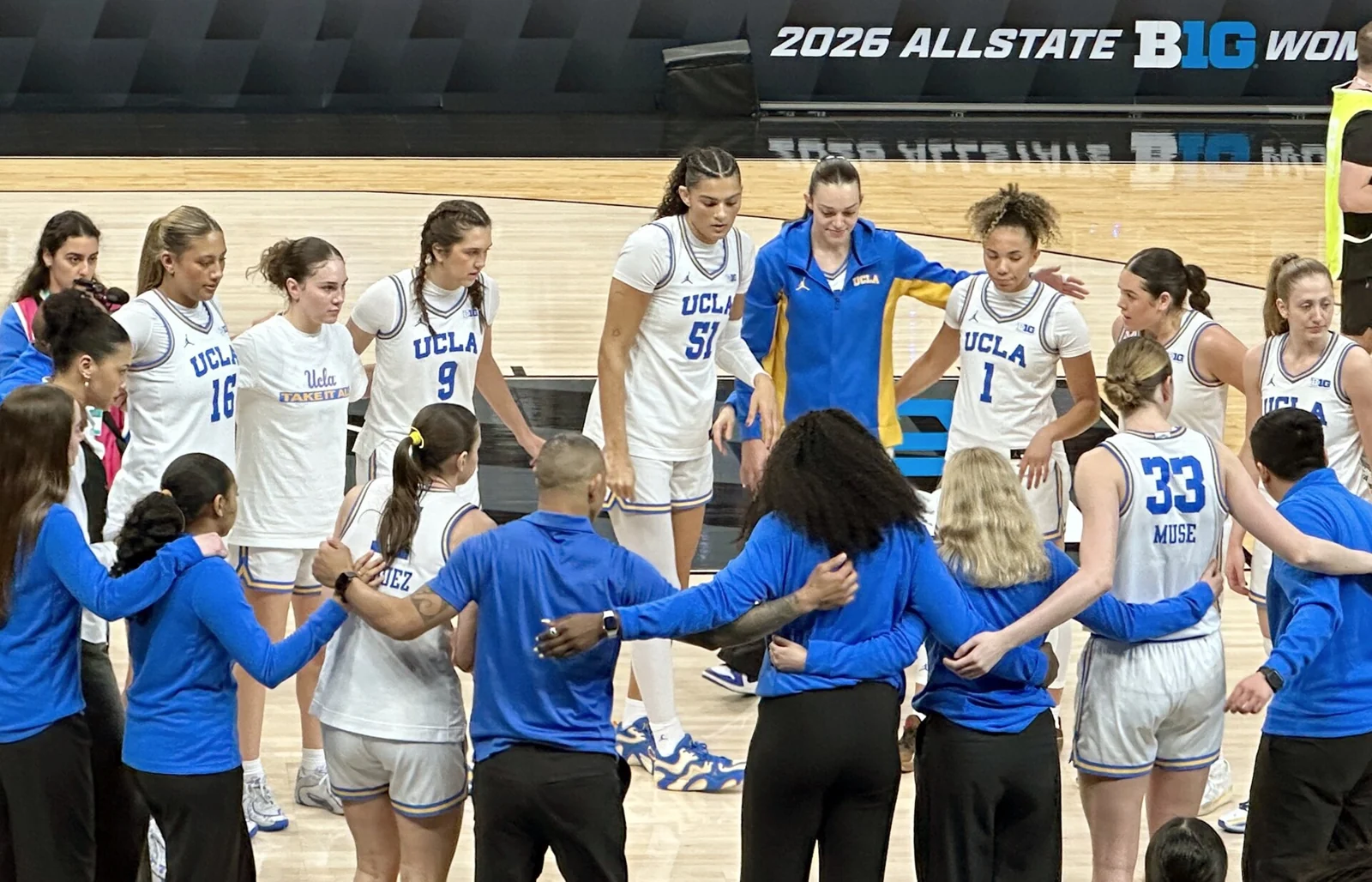
UCLA earned every part of its 37-1 championship season and overwhelmed South Carolina 79-51 in the final. It also begins this season without its six leading scorers. Lauren Betts, Kiki Rice, Gabriela Jaquez, Gianna Kneepkens, Angela Dugalic and Charlisse Leger-Walker are not on the current roster. The banner establishes Cori Close's program level; it cannot score this season's possessions.
The response was substantial. UCLA signed five transfers and two freshmen. Former Bruin Elina Aarnisalo returns after averaging 10.2 points, 3.4 rebounds and 2.9 assists at North Carolina; Addy Brown, Donovyn Hunter, KK Bransford and Bonnie Deas add college experience. Sienna Betts, Timea Gardiner and Amanda Muse preserve size. That collection gives UCLA top-five upside, but almost every closing role must be reassigned. No. 11 respects both the championship system and the scale of the reconstruction.
Risers from Oklahoma State through Rice
No. 12 North Carolina has enough veteran structure to support celebrated freshman Kate Harpring, though immediate perimeter creation is a projection. No. 13 Oklahoma State has the strongest leap case: Audi Crooks arrives after averaging 25.8 points on 64.9% shooting with 7.7 rebounds, and Liv McGill adds another top transfer. The Cowgirls call the group the nation's consensus No. 1 transfer class. Talent makes them dangerous; shared defensive habits determine how fast they climb.
No. 14 TCU has back-to-back Elite Eight credibility and new point guard Jadyn Wooten, but must replace veteran creation. No. 15 Notre Dame returns Hannah Hidalgo, the board's most reliable one-player engine outside the top 10, while its supporting cast has more to prove. No. 16 Ole Miss imported nine transfers; the ceiling is high and the early chemistry risk is obvious. No. 17 Washington returns Sayvia Sellers and adds needed size. No. 18 Minnesota brings back its leading scorers, making continuity its advantage in a volatile Big Ten middle.
Nos. 19-22: one swing skill
Kentucky needs its young guards to complement Clara Strack. Ohio State goes as Jaloni Cambridge organizes it. Maryland needs better health after four ACL absences. Illinois asks Berry Wallace to turn production into more wins.
Nos. 23-25: earn the schedule jump
Arizona State can build on a defense-led turnaround. Nebraska has Britt Prince, Amiah Hargrove and a health-dependent frontcourt. Rice returns American Player of the Year Victoria Flores after a school-record 29 wins and a 22-game streak.
Rice's final spot is not a prediction that it will suddenly become the 25th-most talented roster. It rewards a proven winning core while acknowledging that national ranking requires results against stronger opposition. The Owls' official season outlook confirms Flores and sixth-player honoree Louann Battiston return. That is enough to start on the board—and a clear standard for staying there.
The players most likely to reorder this board
A watch list should do more than repeat last season's awards. These players matter because a change in their role, availability or supporting cast can move an entire team tier. The numbers below establish what they have done; the projection identifies what to watch next.
Joyce Edwards and Sarah Strong set the player-of-the-year standard
Sarah Strong begins as the standard because her impact travels across every kind of game. She led UConn in points, rebounds, steals and blocks while shooting .594 from the floor and .404 from three at the time of her 2026 awards. Her 18.6 points and 7.6 rebounds matter, but 3.4 steals and 1.6 blocks explain why a quiet shooting night does not remove her influence. Strong already owns the AP, Naismith, Wade and USBWA national player honors; the next question is whether UConn can surround her with enough perimeter creation to punish repeated help.
Joyce Edwards carries a different assignment. Her 19.2 points and 6.8 rebounds lead a deeper South Carolina roster, so she does not have to control every possession. She does need to become the reliable answer when transition stops and a defense packs the lane. If Edwards adds more playmaking from the elbow and produces efficient late-clock possessions, the Gamecocks' current No. 1 ranking becomes harder to challenge. If the offense still stalls against elite length, depth alone may not solve April.
JuJu Watkins makes health the season's biggest variable
Watkins is the only player who could change both the top four and the national style conversation simply by resembling her last full season. In 2024-25 she averaged 23.9 points and 3.4 assists while also producing 2.18 steals and 1.76 blocks. USC's official bio records that she redshirted 2025-26 because of injury. It does not promise an opening-night workload, and neither should a ranking.
The useful checkpoints are observable: whether Watkins plays both ends in long stretches, creates separation late in games, and shares possessions with Jazzy Davidson without flattening the offense. A gradual return would not mean failure; it would mean fourth is appropriate while the evidence develops. A fully effective two-creator partnership would give USC a credible argument for first.
Madison Booker, Olivia Olson and Hannah Hidalgo can carry challengers
Madison Booker owns the best recent tournament scoring proof in this group. She set a Texas NCAA tournament game record with 40 points in the 2026 second round and took the Longhorns to a second straight Final Four. Her ability to create a clean midrange attempt is especially valuable in March. Texas rises when a second handler preserves Booker's energy and stops opponents from loading every possession toward her.
Olivia Olson supplies Michigan with volume and continuity. She averaged 19.6 points through the regular season, scored in double figures in every one of 29 games and earned consensus first-team All-Big Ten honors. The Wolverines already know their backcourt hierarchy. Olson's ranking test is efficiency against the longest defenses: if she turns the same usage into better shots rather than simply more shots, Michigan belongs with the top four.
Hannah Hidalgo gives Notre Dame the widest one-player range. HoopsHQ reports that she averaged 25.5 points, 11 rebounds, 7.3 steals and 4.5 assists across the 2026 NCAA tournament. That is a spectacular postseason stretch, not a season-long baseline. Hidalgo can drag the Irish upward through pressure defense and shot creation, but a deep run requires teammates to turn the advantages she creates into efficient possessions. Her performance is not the question; how much the lineup amplifies it is.
How and when this preseason ranking should change
The board should begin moving as soon as games answer its questions. It should not lurch because a favorite wins by 35 against an overmatched opponent or a contender misses shots for one night. The best updates connect new evidence to the reason a team was placed where it was.
Read movement as new evidence, not a verdict
First check availability. Did Watkins play a normal two-way workload? Did an injured veteran return, and was a supposed starter absent? Next check repeatable performance: shot quality, turnover creation, defensive rebounding and whether a second ball-handler survived pressure. Then add opponent and location. A neutral-site win over another contender says more than an effortless home opener.
The schedule will create unusually good comparison points. Duke plays UConn on November 28, South Carolina on December 3, UCLA on December 16, Texas on December 19 and USC on December 20. USC meets South Carolina on November 15 before facing Baylor, Notre Dame and Duke. Those games cross the exact tiers in this ranking and should reveal whether continuity, star health or transfer integration is winning early.
A four-question ranking update
- Who was actually available, and in what role?
- Did the offense create repeatable good shots against pressure?
- Did the defense finish possessions with rebounds?
- How strong was the opponent, and where was the game played?
By December, the women's NET begins adding current-season evidence. The NCAA stresses that it uses no prior-season or preseason inputs and combines opponent, location, results and adjusted efficiency. NET is not a replacement for watching teams, nor is this list a substitute for NET. Together with head-to-head results, schedule strength and availability, it helps replace September assumptions with performance.
That is the purpose of a useful preseason Top 25: set testable expectations, not defend a frozen order. South Carolina starts first, UConn supplies the safest challenger, and USC owns the widest range. The teams that answer their specific questions should rise—even when doing so makes this first board look wrong.
Join the conversation
Share a question or a thought about the women's game. Comments are reviewed before they appear. Keep it friendly, stay on topic and leave out personal information.
No comments yet. Start the conversation.
Sign in with Google to leave a comment. Your email address is not displayed with your comment.