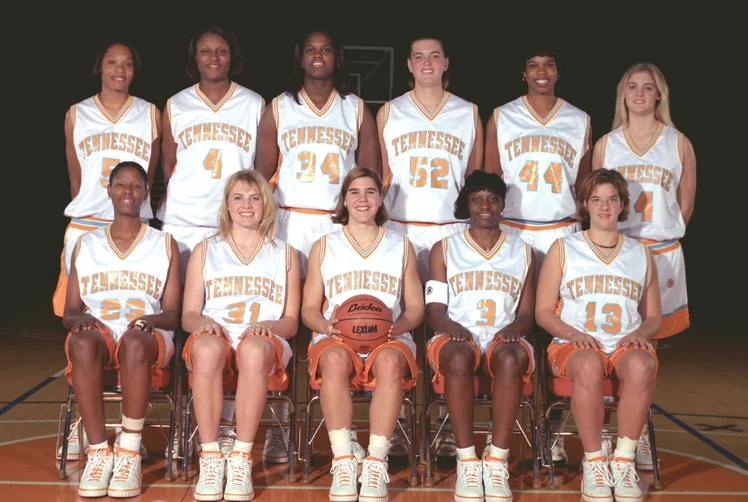
Who won the 1997 NCAA women's basketball championship?
Tennessee won the 1997 NCAA women's basketball championship, defeating Old Dominion 68-59 on March 30 in Cincinnati. Pat Summitt's Lady Vols finished 29-10 and earned the program's fifth national title. The season belongs to the 1996-97 team; the unbeaten Tennessee champions who followed a year later are a different edition of the same dynasty.
That distinction changes how this championship should be remembered. The 1997 team did not spend the whole season producing the results usually associated with a national champion. Tennessee's official season archive records an 8-4 Southeastern Conference finish, fifth in the league. A team can fall short of controlling its conference and still become the best team left in a national elimination tournament. This Tennessee season is a particularly clear example.
The final also reversed a result from earlier in the same season. Old Dominion had beaten Tennessee 83-72 in Norfolk on January 7. The Lady Vols' opponent history places the March rematch on a neutral court in Cincinnati and records a nine-point Tennessee victory. The championship was therefore a second examination against an opponent that already had demonstrated it could win this matchup.
A useful way to read that reversal is to keep two judgments separate. The January game was genuine evidence of Old Dominion's quality. The March game decided the national title. Neither result makes the other disappear, and the later victory does not mean every earlier Tennessee defeat was a necessary step toward winning. What the results establish is that the same pairing produced a different outcome when the stakes were highest.
Tennessee's championship record also deserves to remain intact. Calling this simply another dominant Lady Vol team erases the ten losses that make the run distinctive. Calling it merely an upset story erases the program and players capable of delivering six straight NCAA tournament wins. Its significance lies in the combination: an established champion, a difficult season and a successful response within the tournament.
The University of Tennessee Libraries' title history places 1997 after championships in 1987, 1989, 1991 and 1996. Tennessee was defending the national crown, even while its conference record gave little suggestion of an effortless repeat. Understanding both facts makes the bracket, the roster and the final more revealing than the score alone.
Tennessee's six-game route through the bracket
The Lady Vols won their championship across three locations: Knoxville for the first two rounds, Iowa City for the Midwest regional and Cincinnati for the Final Four. Every step required a win; reaching Cincinnati meant surviving four games before the two contests that tend to dominate championship memories. Tennessee's official NCAA tournament record book preserves the full sequence.
| Date | Round | Opponent | Tennessee score | Location |
|---|---|---|---|---|
| March 15 | First round | Grambling State | 91-54 | Knoxville |
| March 17 | Second round | Oregon | 76-59 | Knoxville |
| March 22 | Regional semifinal | Colorado | 75-67 | Iowa City |
| March 24 | Regional final | Connecticut | 91-81 | Iowa City |
| March 28 | National semifinal | Notre Dame | 80-66 | Cincinnati |
| March 30 | National championship | Old Dominion | 68-59 | Cincinnati |
The opening weekend in Knoxville
Tennessee began by beating Grambling State 91-54, then defeated Oregon 76-59 two days later. The margins were 37 and 17 points. Those results gave Tennessee a successful opening weekend on its home court, but the two scores describe different levels of separation. Oregon stayed much closer than Grambling State, and Tennessee advanced with a lower scoring total in the second game.
Oregon did make shots. Tennessee's opponent game statistics record the Ducks at 25 of 54 from the field, including five three-pointers in thirteen attempts. They nevertheless committed twenty turnovers and attempted only five free throws. Their fifty-nine points came from forty on two-point baskets, fifteen on threes and four at the line. Tennessee advanced against an opponent that shot 46.3 percent, rather than relying on an entire night of missed Oregon shots.
The Midwest breakthrough and the national semifinal
In Iowa City, Tennessee beat Colorado 75-67 before defeating Connecticut 91-81. The eight-point Colorado result was Tennessee's smallest winning margin of the entire tournament. That does not establish which game was hardest possession by possession, but it prevents the regional semifinal from disappearing behind the better-known regional final. Tennessee had to win that game before it could play for a Final Four place.
The Connecticut victory carried a particularly clear historical weight. Tennessee's archived rivalry notes confirm that UConn entered the regional final 33-0 and ranked first. They also record Connecticut's 72-57 win over Tennessee in Hartford on January 5. Tennessee therefore eliminated an unbeaten opponent that had already beaten it by fifteen points that winter.
Notice the round: the 91-81 game was the Midwest regional final, not the national championship game. It sent Tennessee to Cincinnati. The Lady Vols still needed to beat Notre Dame, 80-66 in the March 28 national semifinal, before meeting Old Dominion for the trophy. Treating the Connecticut result as the title itself skips two necessary victories and obscures the shape of the tournament.
Across the six wins, Tennessee succeeded with scoring totals ranging from 68 to 91. The final was its lowest scoring victory in the run. The route therefore offers more than a story about one spectacular offensive night: the champions also won when the score was tighter and their own total was lower. The next step is to identify the players who made those different outcomes possible.
The 1996-97 roster behind the championship
Chamique Holdsclaw was a sophomore forward on this team, not the senior who finished her Tennessee career in 1999. Kellie Jolly was a sophomore guard; Kyra Elzy and Niya Butts were freshmen. Seniors Abby Conklin and Pashen Thompson supplied an older frontcourt presence. Those class distinctions matter because the championship is often blended into memories of the following season.
The official 1996-97 roster lists eleven players. Tamika Catchings and Semeka Randall are absent: their famous partnership with Holdsclaw belongs to the next Tennessee championship team. Substituting that trio for the players who actually won in Cincinnati would change the basketball story as well as the names.
| Player | Position | Class |
|---|---|---|
| Niya Butts | Guard | Freshman |
| Tiffani Johnson | Center | Junior |
| Kyra Elzy | Guard/forward | Freshman |
| Laurie Milligan | Guard | Junior |
| Misty Greene | Guard/forward | Sophomore |
| Kellie Jolly | Guard | Sophomore |
| Chamique Holdsclaw | Forward | Sophomore |
| Brynae Laxton | Forward | Sophomore |
| LaShonda Stephens | Center | Freshman |
| Pashen Thompson | Center | Senior |
| Abby Conklin | Forward | Senior |
The work around Chamique Holdsclaw
Holdsclaw's two Final Four scoring lines establish her central role: 31 points against Notre Dame and 24 against Old Dominion. Together they account for 55 of Tennessee's 148 points in Cincinnati. That is a little over a third of the team's scoring across the weekend, calculated from the two game totals. It is a substantial share, but it also leaves 93 points scored by teammates.
The distribution changed between games. In the semifinal, Elzy contributed fourteen points and nine rebounds, while Conklin scored eleven. Thompson also collected nine rebounds. In the final, Conklin scored twelve and Johnson, Thompson and Butts each scored eight. Tennessee did not receive an identical supporting scoring line every night; different contributions complemented the same leading scorer.
Jolly's final illustrates why a points column alone gives an incomplete picture. She scored five points but delivered eleven assists. The NCAA's contemporary championship account identified that assist total as a championship-game record at the time. The same report explains that she returned on January 12 after an October knee ligament injury. Her place in the title run therefore included both creating baskets and regaining the opportunity to play.
There is a useful contrast in the final's frontcourt numbers, too. Johnson and Thompson both made all four of their field-goal attempts. Each finished with eight points, a modest total beside Holdsclaw's twenty-four, but neither required a missed shot to get there. Conklin made four of five, including both of her three-point attempts. Efficient supporting possessions helped Tennessee turn a limited number of shots into enough points to win.
The complete roster remains valuable even when a shorter list explains the biggest scoring contributions. A championship team is not simply its leading scorer plus interchangeable names. This one included senior interior players, a recovering sophomore guard and freshmen who contributed in the national semifinal or final. Keeping their actual season and roles in view gives the 1997 title an identity of its own.
How Tennessee beat Old Dominion 68-59
Tennessee won the final through a striking difference in shooting accuracy, while surviving a second-half comeback and a game full of turnovers. Old Dominion took more shots and collected more rebounds. The champions nevertheless made five more field goals. That combination explains why describing the result as a simple Tennessee rebounding victory would be wrong.
Scoring, rebounding and the value of second chances
The championship box score shows Tennessee making 29 of 49 field-goal attempts, or 59.2 percent. Old Dominion made 24 of 62, or 38.7 percent. Tennessee's accuracy was the decisive statistical contrast: the Lady Monarchs attempted thirteen more shots but finished with five fewer baskets.
That is a useful reminder that getting another attempt and converting it are different achievements. Old Dominion had sixteen offensive rebounds to Tennessee's seven and won the overall rebounding count 34-29. Those extra chances helped sustain its offense. They did not erase the gap in shooting. A rebound creates the possibility of points; the eventual shot still has to go in.
The scoring arithmetic is unusually clear. Tennessee made three three-pointers and Old Dominion made four. With twenty-six Tennessee two-point baskets and twenty Old Dominion two-point baskets, the field-goal points were 61-52. Each team added seven made free throws. The nine-point final margin therefore matches the nine-point difference in points from the field, rather than an advantage in made free throws.
Three-point selection contributed to that contrast. Tennessee made three of five from beyond the arc; Old Dominion made four of eighteen. The Lady Monarchs gained one additional made three while using thirteen more three-point attempts. That observation is arithmetic, not a claim that every miss was a poor decision. It does show why counting made threes without attempts would give a misleading account of the offensive exchange.
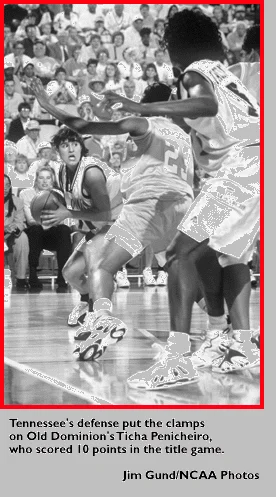
Old Dominion's interior players still produced substantial numbers. Clarisse Machanguana had sixteen points and ten rebounds, while Nyree Roberts added thirteen points and nine rebounds. Together they scored twenty-nine points. Tennessee's success did not depend on making every opposing player ineffective; it depended on producing a better overall scoring return while limiting enough of the remaining offense.
Why the final score does not tell the whole story
The contest was played in two halves. Tennessee led 34-22 at halftime, but that twelve-point cushion did not remain secure. The NCAA's contemporary report describes Old Dominion moving ahead 44-43 with 9:06 remaining and later leading 49-47. Tennessee answered with a 12-2 run that included six Holdsclaw points. The champions had to regain control after surrendering a substantial lead.
That sequence changes the meaning of the final nine-point margin. A reader who sees only 68-59 might imagine steady separation throughout the second half. In fact, Old Dominion had turned a twelve-point halftime deficit into a lead. Tennessee's decisive response came after the game had become a different problem: find productive possessions against an opponent that had already completed the comeback.
Ball security was complicated on both sides. Each team committed twenty-six turnovers. Jolly's eleven assists came alongside nine turnovers and five steals; Penicheiro finished with eight assists, eleven turnovers and eight steals. Those lines capture creation, disruption and mistakes in the same game. Neither guard's impact can be reduced to an assist total or to a turnover total alone.
Equal team turnover counts also prevent an easy explanation that Tennessee won simply by giving the ball away less often. It did not. The shooting advantage and the response to Old Dominion's second-half lead are better supported explanations. They can coexist with the fact that Tennessee itself struggled to protect possessions.
The final was therefore both an efficient Tennessee shooting performance and an uneven contest. The Lady Vols finished enough of their available shots to overcome disadvantages in attempts and offensive rebounds, then delivered the important scoring burst after Old Dominion went ahead. That combination is more informative than calling the victory either effortless or inexplicable.
Where the 1997 title fits in Tennessee history
The 1997 championship sits in the middle of Tennessee's three consecutive national titles from 1996 through 1998. The school's championship history lists all three years, alongside the Lady Vols' other titles in 1987, 1989, 1991, 2007 and 2008. Being part of a sequence does not make the three teams identical.
The neighboring seasons show why. Tennessee's 1996 champions finished 32-4 and defeated Georgia 83-65 in the final. The 1998 champions finished 39-0 and defeated Louisiana Tech 93-75. Between them stands the 29-10 team that beat Old Dominion 68-59. Those records describe very different journeys to the same national prize.
For fans comparing great teams, the distinction is essential. A championship answers who completed that year's tournament successfully. A discussion of the strongest full season asks a wider question about results across the entire schedule. Tennessee's ten defeats remain part of the 1997 evaluation, just as its six NCAA victories remain part of its achievement. There is no need to erase one set of results to appreciate the other.
The 1997 team is especially memorable because its tournament included meaningful reversals. It defeated Connecticut after losing the January meeting, then beat Old Dominion after losing in Norfolk. In the final itself, it recovered after giving up a halftime lead. These are specific results and moments, rather than a general claim that adversity inevitably produces champions.
When looking through the NCAA women's champions by year, keep this edition separate from the undefeated team immediately below it. For Summitt's wider place in the sport, the coaching championship comparison provides the broader record. The value of returning to 1997 is seeing the particular players, opponents and decisions behind one of those titles.
Tennessee's fifth championship was earned by the team that actually reached Cincinnati: Holdsclaw and Jolly, Conklin and Thompson, Johnson, Elzy, Butts and their teammates. Its place in the dynasty is secure. Its identity is more interesting when the imperfect season, the complete bracket path and the demanding final are allowed to stand together.
Join the conversation
Share a question or a thought about the women's game. Comments are reviewed before they appear. Keep it friendly, stay on topic and leave out personal information.
No comments yet. Start the conversation.
Sign in with Google to leave a comment. Your email address is not displayed with your comment.