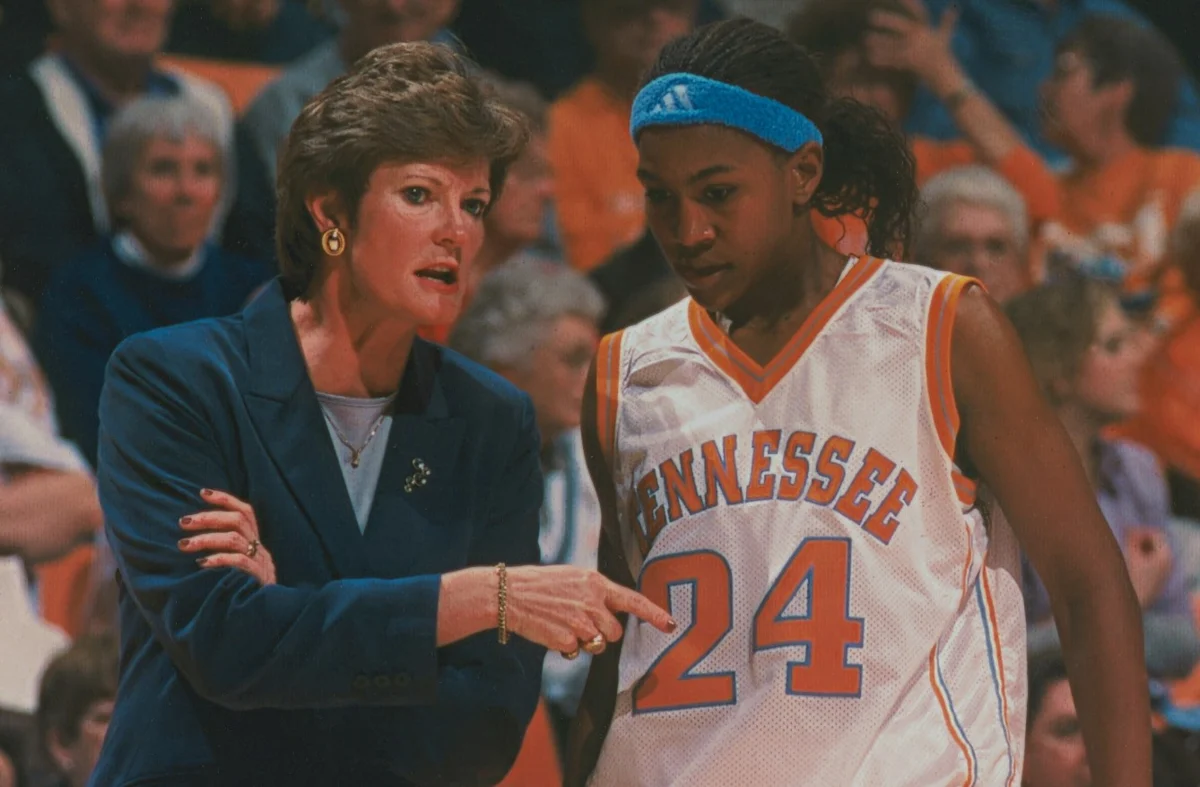
Tennessee's perfect finish in Kansas City
Tennessee won the 1998 NCAA women's basketball championship by beating Louisiana Tech 93-75 on March 29 at Kemper Arena in Kansas City, Missouri. Pat Summitt's Lady Vols finished 39-0, earned the program's sixth NCAA title and became the first Division I women's team to win three consecutive NCAA championships. The season was 1997-98; the championship was awarded in 1998.
The NCAA's contemporary championship report places that unbeaten finish alongside Texas in 1986 and UConn in 1995. Tennessee therefore joined a select group rather than inventing the perfect championship season. What distinguished the Lady Vols was the combination: no defeats across this season, plus a third consecutive tournament victory for a program already carrying the expectations of a champion.
Those two achievements deserve separate attention. The three-peat belonged to a program spanning three rosters. The 39 wins belonged to this particular group. Freshmen could help complete the streak without having played in its first two championships, while returning players had to establish new partnerships rather than simply repeat last spring's assignments. Treating 1998 as an automatic continuation misses much of the basketball achievement.
The contrast with the preceding season is especially revealing. The University of Tennessee Libraries' championship history records a 29-10 champion in 1997 and a 39-0 champion in 1998. Both won the six games that decided the NCAA trophy, but their complete records describe very different seasons. A ten-loss team became a perfect team without changing the head coach or abandoning its returning championship core.
For readers looking up the 1998 women's final, the central names are Chamique Holdsclaw, Tamika Catchings, Semeka Randall and Kellie Jolly. Yet the fuller explanation includes the rest of the roster, a regional final in which North Carolina threatened the unbeaten record, and a championship game whose individual statistics spread the credit. The champions-by-year guide supplies the wider timeline; this season deserves a closer look at how the team actually reached its perfect finish.
The 1997-98 Tennessee championship roster
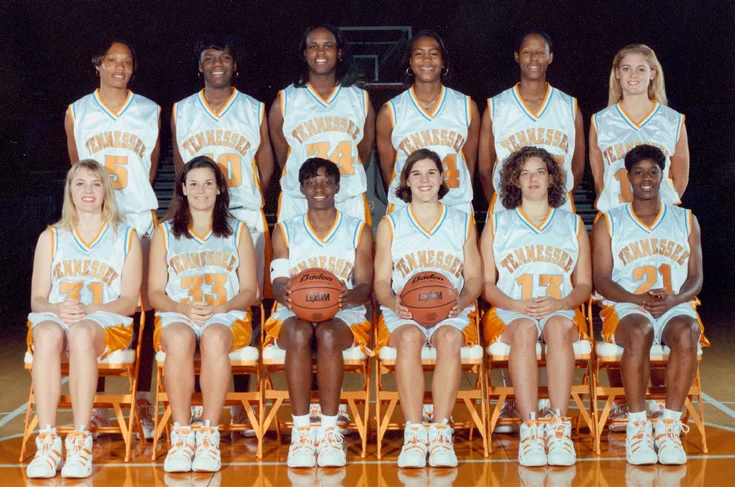
The official 1997-98 roster lists twelve players. It places the season's famous newcomers beside veterans whose championship experience predated them. Classes below are the school's listings for that season, rather than the later years in which some players became coaches or professional stars.
| No. | Player | Position | Class |
|---|---|---|---|
| 3 | Niya Butts | Guard | Sophomore |
| 5 | Kyra Elzy | Guard/forward | Sophomore |
| 11 | Laurie Milligan | Guard | Senior |
| 13 | Misty Greene | Guard/forward | Junior |
| 14 | Kellie Jolly | Guard | Junior |
| 21 | Semeka Randall | Guard | Freshman |
| 23 | Chamique Holdsclaw | Forward | Junior |
| 24 | Tamika Catchings | Forward | Freshman |
| 31 | Brynae Laxton | Forward | Junior |
| 33 | Kristen "Ace" Clement | Guard | Freshman |
| 34 | LaShonda Stephens | Center | Sophomore |
| 40 | Teresa Geter | Center | Freshman |
Holdsclaw and Jolly supplied the returning foundation
Holdsclaw and Jolly were juniors, with two NCAA championships already behind them. That experience did not give them identical jobs. Holdsclaw's final produced 25 points, ten rebounds and six assists: a substantial scoring load combined with possession work and distribution. Jolly's 20 points supplied a different kind of pressure on Louisiana Tech, including four three-pointers.
The previous final helps explain the distinction. Tennessee's official championship history and box scores show Jolly making eleven assists in the 1997 title game. Her value had already been evident when the scoring column was much smaller. In 1998 she could be both the experienced guard and a major scorer, giving the returning core a response that did not require Holdsclaw to finish every important possession.
Milligan supplied another form of continuity. Tennessee's account of Summitt's career identifies her as a participant in the program's Final Four years from 1995 through 1998, including all three championships. A complete roster should retain that history even when the championship box score assigns a player only a brief appearance. The trophy belongs to the season's team, rather than an invented five-player roster assembled from its highest scorers.
Four freshmen changed the team's possibilities
Catchings, Randall, Clement and Geter were all freshmen. Their contributions were sufficiently different that calling them simply a talented recruiting class understates what they added. Catchings led Tennessee with 27 points in the final, while Randall combined ten points with eight rebounds. Those are two substantial contributions from players beginning their college careers beside teammates already familiar with this stage.
Geter's championship line is especially helpful for understanding the rotation. Stephens started at center, but Geter played 34 minutes off the bench, collecting seven rebounds and four blocks while scoring three points. The starting designation and the largest minute allocation were therefore different. Geter's low point total conceals a major share of the team's interior work; it does not demonstrate that Tennessee used her only briefly.
Clement played fifteen minutes and contributed six points and two assists. Her presence gave the backcourt another useful participant behind the more prominent names. Together, these four freshmen expanded the range of responsibilities Tennessee could distribute. Some of that work appeared as scoring, some as rebounding or shot blocking, and some as additional guard minutes. The final provides concrete evidence of that balance without requiring a claim about an undocumented play or an imagined matchup.
The distinction between roster membership, starting status and a particular game's role is central to reading this team accurately. Butts, Elzy, Greene and Laxton also belong to the championship roster. Their place in its history should neither disappear behind the stars nor be inflated into a claim that everyone played equal minutes. Tennessee won with a complete group whose responsibilities varied.
Every game in Tennessee's NCAA tournament run
Tennessee won six NCAA tournament games over sixteen days. The school's archived season results and the tournament history in its official record book agree on the opponents and scores. The table presents Tennessee's score first throughout, so the sequence can be read without switching between different conventions.
| Date, 1998 | Round | Opponent | Tennessee win | City |
|---|---|---|---|---|
| March 14 | First round | Liberty | 102-58 | Knoxville |
| March 16 | Second round | Western Kentucky | 82-62 | Knoxville |
| March 21 | Regional semifinal | Rutgers | 92-60 | Nashville |
| March 23 | Regional final | North Carolina | 76-70 | Nashville |
| March 27 | National semifinal | Arkansas | 86-58 | Kansas City |
| March 29 | Championship | Louisiana Tech | 93-75 | Kansas City |
A Mideast route from Knoxville through Nashville
The first two games were played in Knoxville, followed by the Mideast Regional in Nashville. Tennessee therefore did not go directly from its home court to the national semifinals. Rutgers and North Carolina stood between those stages, and the North Carolina game decided the regional championship. The official tournament chronology on page 128 preserves those locations and distinguishes the regional final from the national final.
The opening three results appear overwhelming: Tennessee won by 44, 20 and 32 points. That sequence explains why the perfect record looked so secure before the regional final, but it also illustrates a limitation of final scores. A twenty-point win does not establish that every minute was easy. Nor does a large first-round margin remove the need to win again against an opponent with different personnel.
North Carolina reduced the fourth victory margin to six. Tennessee then finished with margins of 28 and eighteen at the Final Four. Adding the six margins gives 148 points, or about 24.7 per NCAA tournament game. That calculation describes the run's overall separation from its opponents; the six-point regional final identifies the result most likely to disappear inside the average.
The sequence also clarifies the 39-0 record. Tennessee entered NCAA play with 33 victories already secured, then added six. Counting only the national tournament understates the season's sustained consistency, while counting only the season record hides the separate elimination tests at its end. Both views matter: the Lady Vols maintained perfection across the winter and then protected it when one loss would have ended the championship pursuit.
For a reader reconstructing the bracket, keep the two final weekends distinct. Nashville determined whether Tennessee would reach Kansas City. Kansas City determined whether the regional winner would become the national champion. The locations are part of the path, and the dramatically different scores explain why the regional final deserves its own closer examination.
North Carolina came closest to ending the season
North Carolina gave Tennessee its closest game of the NCAA tournament. The six-point final margin was smaller than any of the Lady Vols' other five tournament victories, but even that comparison understates the danger. Tennessee had to recover from a twelve-point deficit with little more than seven minutes remaining to keep both its season and its championship pursuit alive.
In its official retrospective of the 1998 regional final, Tennessee records a 33-27 halftime lead that disappeared quickly after the break. North Carolina scored the second half's first seven points. By 7:19 remaining, the Tar Heels led 61-49. The deficit was therefore a late obstacle rather than a difficult opening that Tennessee had ample time to forget.
The response was a 27-9 finish. That arithmetic explains the final result directly: adding 27 to Tennessee's 49 produced 76, while North Carolina's additional nine produced 70. Tennessee made thirteen free throws during that closing stretch. Converting the opportunities mattered because defensive stops alone could not erase a twelve-point gap; the Lady Vols also had to turn their own possessions into dependable points.
Geter supplied a particularly important contribution. Tennessee's account credits her with seven points, five rebounds and a couple of blocks in the final seven minutes. Those are concrete reasons to include her when explaining the comeback, even though Holdsclaw finished with the largest scoring total. Geter's work affected the score, the recovery of the ball and North Carolina's ability to finish shots. The description does not require assigning her an undocumented defensive scheme.
Holdsclaw finished with 29 points and nine rebounds. Randall added twenty points, eight rebounds and three steals, while Catchings collected eleven points, seven rebounds, four steals and three assists. Tennessee also won the rebounding comparison 45-40 and recorded eleven steals as North Carolina committed 21 turnovers. These figures identify several ways the Lady Vols could affect a game when comfortable scoring separation had disappeared.
A second school account of the Nashville comeback confirms the 61-49 score and 7:19 remaining. That moment is central to understanding the perfect record. Tennessee's eventual unbeaten finish does not mean nobody challenged it. The regional final shows a team forced to solve an immediate problem, with a freshman center contributing alongside the established star and the other newcomers. It also keeps the stages in perspective: this was the game that secured the Final Four berth, with two further victories still required.
How Tennessee beat Louisiana Tech 93-75
Louisiana Tech reached the final with an 84-65 semifinal victory over North Carolina State. Tennessee arrived after beating Arkansas 86-58. The championship brought the Lady Vols together with a program that had already won NCAA titles of its own, and the game was played before 17,976 spectators. Its decisive feature was the separation Tennessee established before halftime.
A 55-point first half changed the final
Tennessee's official championship account describes an 8-6 advantage followed by a 34-11 run over the next seven minutes. That extended the lead to 42-17. By halftime, the Lady Vols were ahead 55-32. The first-half total was a championship-stage statement: Tennessee had created a 23-point cushion while still leaving an entire half to play.
Louisiana Tech scored 43 points to Tennessee's 38 after halftime, calculated by subtracting the halftime scores from the final totals. The Lady Techsters therefore won the second-half scoring comparison by five. They had too much ground to recover, but they continued to produce offense. The eventual eighteen-point margin came from preserving most of the advantage Tennessee had built before intermission.
That sequence makes the opening run more consequential than the final margin alone suggests. Louisiana Tech needed a sustained recovery while also stopping an offense that had already found several productive scorers. Tennessee could receive a major contribution from Catchings, another from Holdsclaw and an unusually large scoring night from Jolly. The opponent was chasing a team whose opportunities were distributed across different players.
The box score spreads the credit beyond one star
Catchings led Tennessee with 27 points, making eight of sixteen field-goal attempts and eleven of thirteen free throws. Holdsclaw added 25 points, ten rebounds and six assists, earning the tournament's most outstanding player award for a second consecutive year. Jolly scored twenty on seven-of-ten shooting, including four of five from three-point range. Randall supplied ten points and eight rebounds.
The NCAA championship box score shows why Jolly's shooting mattered so much. She made all four of Tennessee's three-pointers. The Lady Vols did not need a large team total from beyond the arc to reach 93 points; they combined that concentrated outside contribution with two-point scoring and nineteen made free throws. Catchings alone made more free throws than Louisiana Tech's entire team, which finished five of ten.
Tennessee shot 35 of 69 overall, or 50.7 percent, while Louisiana Tech made 32 of 73, or 43.8 percent. The Lady Techsters actually made more three-pointers, six to four, but Tennessee scored fourteen more points at the foul line. Those components explain how Louisiana Tech could make only three fewer field goals and still finish eighteen points behind.
Rebounding supplied another difference. Tennessee collected 47 rebounds to Louisiana Tech's 34, including seventeen offensive boards compared with fourteen. Holdsclaw, Randall, Catchings and Geter each contributed at least seven rebounds. Their work gave the scoring production a physical foundation: several players were involved in recovering the ball, rather than leaving that responsibility to a single center.
Louisiana Tech's main contributors deserve their place in the account. Tamicha Jackson scored 26 points, Alisa Burras added nineteen and ten rebounds, and Monica Maxwell scored fifteen. The challenger had genuine production. Tennessee's advantage was the greater total response across its lineup, combined with a first half that left Louisiana Tech pursuing a deficit it could reduce but never erase.
What made the 1998 championship different
Tennessee's perfect season extended well beyond six NCAA victories. The team went 14-0 in SEC play and won all thirty regular-season games. The official season schedule includes an 84-69 win over UConn on January 3 and an 85-61 victory over Old Dominion on February 7. The latter opponent had faced Tennessee in the previous NCAA final, making the new season a test against familiar national competition as well as its conference rivals.
The SEC tournament added three wins: 88-60 over Mississippi State, 106-45 over Vanderbilt and 67-63 over Alabama. The four-point championship game is a useful companion to the later North Carolina escape. Tennessee's path to 39-0 included close finishes, and the closest margin of these two postseason events came in the conference final. The dominant results and the narrow ones belonged to the same season.
That complete sequence gives the achievement its shape: thirty regular-season wins, three SEC tournament wins and six NCAA tournament wins. The Lady Vols combined sustained conference success, victories over prominent nonconference opponents and the ability to finish difficult postseason games. Their national championship was the final part of a season in which no opponent found a winning answer.
The team also remained significant to the people who played on it. Tennessee's 2022 announcement of the documentary CATCH98 describes the season through Catchings and the four-player freshman class that joined Holdsclaw and Jolly. That perspective preserves a feature easily lost in a record book: the perfect champion contained players at very different stages of their college careers.
For an all-time team comparison, 1998 Tennessee offers both a perfect record and a concrete account of shared responsibility. Holdsclaw supplied the established championship presence, Catchings led the final's scoring, Jolly supplied its outside shooting and Geter made consequential contributions with fewer points. The 39-0 finish captures their collective result; the roster and the games explain how they reached it.
Join the conversation
Share a question or a thought about the women's game. Comments are reviewed before they appear. Keep it friendly, stay on topic and leave out personal information.
No comments yet. Start the conversation.
Sign in with Google to leave a comment. Your email address is not displayed with your comment.