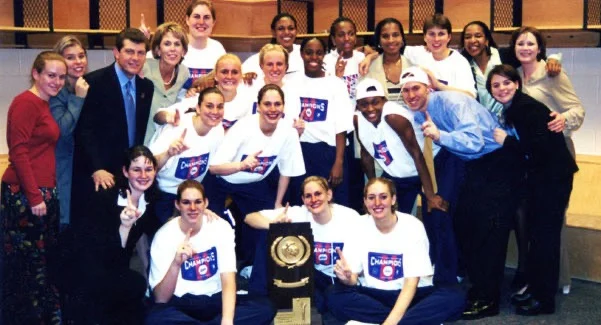
UConn won the 2000 NCAA women's basketball championship by defeating Tennessee 71-52 on April 2 at the First Union Center in Philadelphia. Geno Auriemma's Huskies finished 36-1 and captured the program's second national title, five years after their first championship.
UConn won the 2000 championship with a 36-1 season
The 2000 champion belonged to the 1999-2000 college season. Its final result and completed record identify the team precisely: Connecticut was the winner, Tennessee was the runner-up, and Philadelphia hosted the championship game. Those details matter when separating this tournament from other seasons in which the same schools reached the final.
Connecticut's record also needs its full label. This was a 36-1 championship team, rather than one of the program's unbeaten champions. Tennessee inflicted the only defeat, 72-71 on February 2. The Huskies had already beaten the Lady Vols in Knoxville in January, so the national final became their third meeting of the season. Winning it settled both the NCAA tournament and the season series, without changing the earlier loss.
The university's championship team profile records a season spent at No. 1 in the AP and USA Today polls. It also identifies national leads in field-goal percentage, 53.9%, and field-goal percentage defense, 33.9%. Those figures describe the wider team more usefully than the idea that Connecticut simply had a famous collection of names. The Huskies were efficient at making shots and unusually effective at preventing opponents from doing the same.
Those are season shooting percentages, not estimates of offensive or defensive efficiency per possession. They do not establish how fast Connecticut played, how many extra chances it created or what any individual defender caused. They do establish a substantial contrast between the quality of shots UConn converted and the shots opponents converted over the season. The final would provide a particularly clear example of that contrast.
Tennessee was a formidable opponent with its own championship expectations. Its contemporary account of the final notes that the Lady Vols were appearing in their twelfth Final Four and pursuing a seventh title. A 19-point victory over that opponent therefore carries a different meaning from a comfortable early-round win over a team making its first tournament appearance.
The most useful way to follow this championship is through three connected questions: which players supplied its different strengths, how the six tournament wins unfolded, and why Tennessee could not recreate its February result. Together they explain a champion whose defining final depended as much on the next available contributor as on its leading scorer.
The 1999-2000 roster had several different kinds of leaders
The names associated with UConn's later championships can make this team easy to misremember. The five players listed first in the 2000 championship box score were Svetlana Abrosimova, Swin Cash, Kelly Schumacher, Sue Bird and Shea Ralph. Asjha Jones and Tamika Williams were substantial contributors from the bench. A roster can include future stars without giving all of them the same assignment in every championship season.
Shea Ralph, Svetlana Abrosimova and Sue Bird
Ralph supplied the most complete individual line in the final: 15 points, seven assists and six steals. Her Final Four award reflects that influence, but the combination of categories makes the performance especially informative. She created points herself, helped teammates score and took away Tennessee possessions. Reading only the scoring column would miss much of the reason she mattered.
Abrosimova gave Connecticut another established source of offense and creation. She scored 14 in the final, and the school's following-season tournament notes calculate that she and Ralph supplied 31% of the team's points, 45% of its assists and 37% of its steals during the 2000 NCAA run. Those are tournament shares, rather than their share of every statistic over the full season.
The assist share is particularly useful. Two prominent scorers were also responsible for nearly half the recorded passes that immediately preceded teammates' baskets. That does not mean they created every good shot or controlled every possession. It does show why describing the team as a collection of isolated finishers would be misleading. Its leading players could contribute to somebody else's scoring as well as their own.
Bird's final tells the complementary story. She scored four points but played 35 minutes, longer than any teammate, and recorded four assists. A low scoring total did not remove her from the central rotation. Playing time, passing and the needs of the game provide context that a points-only ranking cannot. Her championship contribution should be assessed within that shared backcourt, rather than against expectations imported from her later career.
A frontcourt with more options than one starting five
Schumacher started the final and became its outstanding shot blocker. Cash added nine points in 18 minutes, while Jones produced 12 points and eight rebounds in 22 minutes off the bench. Williams supplied six points in 14 minutes. Their different workloads illustrate the distinction between starting a game and supplying one of its decisive performances. Jones did the latter without being in the opening five.
The bench contributed 23 of Connecticut's 71 points: Jones had 12, Williams six, Kennitra Johnson three and Paige Sauer two. That addition is a direct sum of the championship box score. It does not measure every reserve's defensive influence, but it gives depth a concrete meaning. Almost one third of the winning score came from players outside the final's starting group.
The other participants in that final were Stacy Hansmeyer, Christine Rigby and Marci Czel. With the five starters and four scoring reserves, they brought Connecticut's participation to 12 players. Keirsten Walters also appears in the 1999-2000 roster listing; appearing on a season roster and appearing in the championship box score are separate facts. The school's historical roster archive helps place those less frequently recalled names alongside the celebrated players.
Taurasi belongs to the next chapter. UConn's December 30, 2000 report explicitly describes her as a freshman in the following season. The championship won that April therefore should never be assigned the Bird-Taurasi-Cash-Jones-Williams starting five familiar from 2002. Keeping the years separate gives Ralph, Abrosimova, Schumacher and the rest of the 2000 rotation their proper place in the story.
Six tournament wins from Storrs to Philadelphia
Connecticut won all six NCAA tournament games by at least 15 points. The smallest margin came against LSU in the East Regional final, rather than in the national championship. The results show consistent separation at the finish, although the competitive stretches within individual games were quite different. The school's tournament history and box scores preserve the complete route.
| Date in 2000 | Round | Opponent | UConn result | City |
|---|---|---|---|---|
| March 17 | First round | Hampton | 116-45 | Storrs |
| March 19 | Second round | Clemson | 83-45 | Storrs |
| March 25 | Sweet 16 | Oklahoma | 102-80 | Richmond |
| March 27 | Elite Eight | LSU | 86-71 | Richmond |
| March 31 | National semifinal | Penn State | 89-67 | Philadelphia |
| April 2 | National championship | Tennessee | 71-52 | Philadelphia |
The opening weekend and the East Regional
The opening weekend at Gampel Pavilion produced two different demonstrations of control. Against Hampton, Connecticut made 44 of 62 field-goal attempts and recorded 30 assists. Bird supplied nine assists. Against Clemson, the Huskies limited the opponent to 10 baskets in 49 attempts. One game is especially striking for Connecticut's conversion and passing; the other for how little the opponent could convert.
Those results also explain why the opening score should be kept exact. The Hampton game ended 116-45, a 71-point margin. A result search that returns 115-45 is inconsistent with the school record. The size of the victory does not make a one-point difference consequential to who advanced, but accuracy matters when the game is also being used to describe historic tournament production.
Oklahoma offered considerably more offense in the Sweet 16, scoring 80 points. Connecticut still won by 22 because it converted 40 field goals and forced 33 turnovers, with 21 recorded steals. Jones and Williams each scored 16. Here the useful distinction is between points allowed and defensive activity: an opponent can score a substantial total while also losing many possessions before getting a shot.
LSU then made the regional final a much more serious challenge than the 15-point result might suggest. The Tigers' own account describes a deficit of only 48-46 early in the second half. Connecticut needed to create its separation during the game, rather than simply protect an enormous halftime lead. A final margin is the destination; it does not describe the entire journey there.
Abrosimova scored 25 on 9-for-13 shooting, while UConn made nine of 16 three-point attempts and outscored LSU 19-7 at the foul line. Those are distinct sources of pressure on an opponent. LSU could challenge Connecticut's interior defense and remain close, yet still lose ground through perimeter baskets and free throws. Abrosimova's production gave that regional championship an individual centerpiece different from the one the national final would have.
Penn State and Tennessee on the final weekend
Bird led the semifinal victory over Penn State with 19 points, including five three-pointers in seven attempts. Jones added 16, Abrosimova had 14 points and 10 rebounds, and Williams scored 10. That distribution makes the tournament's depth visible again: a reserve could be the second scorer, a wing could supply a double-double, and the point guard could lead the scoring without requiring the same pattern two nights later.
Connecticut shot 49.2% against Penn State, its first tournament game below 50%. The Huskies still scored 89 and won by 22. A team can fall below an unusually high shooting standard while continuing to play winning offense. The result gives useful perspective on the earlier percentages: they were an exceptional benchmark, rather than a threshold below which Connecticut could no longer function.
The last opponent was Tennessee, and the last result was 71-52. Across the route, Connecticut had won through several combinations of passing, shooting, forced mistakes and reserve production. The championship game did not need to repeat Bird's semifinal shooting or Abrosimova's regional scoring. It needed the right contributions for the opponent in front of the Huskies that evening.
How Connecticut took control of the Tennessee final
The championship combined disruption around the ball with protection near the basket. Tennessee struggled to establish offense, while Connecticut could score without relying on a strong three-point shooting night. The contrast between those two experiences explains the result more clearly than a general claim that the Huskies wanted the trophy more.
The opening defense made the first separation
UConn established a 21-6 lead and reached halftime ahead 32-19. Tennessee did generate a brief response, including a Catchings layup and three-pointer that cut a 25-10 deficit to 25-15. Ralph answered with a basket and free throw. That exchange matters because Connecticut's early advantage did not remove the need to respond when its opponent finally found some offense.
The 13-point halftime lead left Tennessee a route back into the game. Connecticut closed much of that route immediately after the break, moving ahead 40-19. The contemporary report of Ralph's final describes her scoring at the start of the half and finding Abrosimova for another basket. UConn's lead grew because it added productive offense to the defensive advantage already established.
There is a practical difference between an early lead and a decisive response after halftime. An opponent can adjust during the break, while a leading team can become cautious. Connecticut instead increased the margin by eight before Tennessee scored again. The pressure to erase a modest sequence of missed opportunities became the much larger task of recovering from a 21-point deficit.
Ralph's complete game and Schumacher's nine blocks
Schumacher blocked nine shots, accounting for nine of Connecticut's 11 recorded blocks. Melanie Jackson's original ESPN report on the center's performance records six in the first half and two more in the opening 30 seconds after halftime. Her influence was therefore present while Connecticut established its advantage and when it extended that advantage after the break.
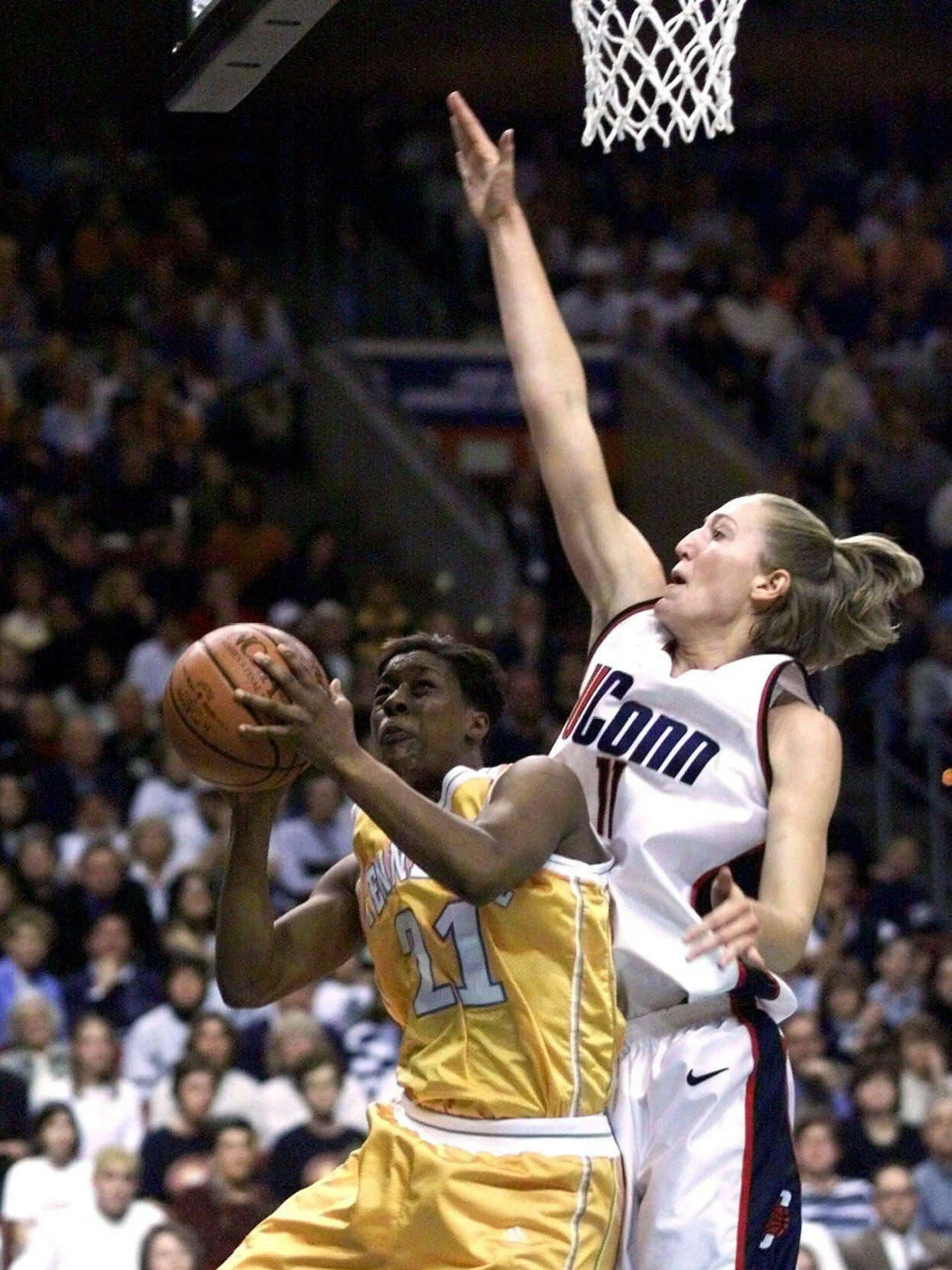
A blocked shot is not automatically a recovered possession: the ball can remain with the attacking team. Nine blocks should therefore not be converted into nine turnovers or a guessed number of saved points. The documented achievement is strong enough on its own. Tennessee repeatedly encountered a defender who could challenge attempts at the basket, while Ralph supplied six steals elsewhere in the defense.
At the other end, Ralph made seven of eight shots. Connecticut finished 31-for-61 from the field despite making only one of nine three-point attempts. Subtracting that one three-pointer leaves 30 two-point baskets, worth 60 points; the three-pointer and eight free throws complete the 71. The Huskies' win came through two-point production, rather than a barrage of long-range shots.
What Tennessee's numbers and missing guard explain
Catchings led Tennessee with 16 points, but Lawson and Randall each scored six. Lawson went 3-for-13 and Randall 1-for-11. Those are individual shooting results, rather than evidence that either player lacked effort. Together with Tennessee's 16-for-51 team shooting, they show how difficult it became to turn offensive possessions into baskets.
The archived school box score also records 26 Tennessee turnovers against 15 for UConn. The gap supplied another obstacle alongside the shooting difficulties. Tennessee could lose an opportunity before taking a shot, then face a contested attempt when it did get inside. Connecticut did not have to win every rebounding contest or make every perimeter attempt to benefit from that combination.
There was a personnel complication, too. Tennessee's report confirms that starting guard Kristen Clement injured her ankle in morning practice and could not play. Kyra Elzy started in her place and scored eight points. The absence reduced a planned option for defending Bird, but there is no way to calculate a different final score had Clement been available. The supported conclusion is narrower: Tennessee played with an altered guard rotation, and Connecticut executed well enough to exploit the game it actually faced.
Why the 2000 title deserves its own place in UConn history
The 1995 championship established that UConn could finish a national title run. The 2000 championship demonstrated that the program could return to the same achievement with a different collection of players. That is the historical significance of a second trophy: the first successful team no longer stood alone. The coaches and school remained, while the basketball responsibilities had passed to another group.
The full season extended beyond its six NCAA tournament victories. Connecticut went 16-0 in Big East regular-season play, won the league tournament and entered the NCAA bracket 30-1. Its last six victories completed a season in which the regular-season conference title, conference tournament title and national championship all belonged to the Huskies. Those were separate competitions, each requiring its own results.
When UConn announced the team's Huskies of Honor recognition in 2009, it named 13 players and four coaches. Auriemma's staff included associate head coach Chris Dailey and assistants Tonya Cardoza and Jamelle Elliott. The recognition placed the complete team alongside the program's first champions, rather than limiting the memory to one award winner or one championship photograph.
That collective identity remains useful when comparing UConn teams. The 2002 champions went 39-0 and defeated Oklahoma in the final. The 2000 champions went 36-1 and defeated Tennessee. Several players connected the teams, but the final lineups, leading performances and season records were different. Remembering one correctly should add detail to the other, rather than replace it.
The wider NCAA champions-by-year timeline locates the 2000 title between Purdue's 1999 championship and Notre Dame's first title in 2001. Within that sequence, Connecticut's achievement stands out for the clarity of its tournament finishes and the variety of players who supplied them. Ralph's all-around final, Schumacher's blocks, Abrosimova's regional scoring and Bird's semifinal shooting are different parts of the same championship, each worth remembering in its own right.
Join the conversation
Share a question or a thought about the women's game. Comments are reviewed before they appear. Keep it friendly, stay on topic and leave out personal information.
No comments yet. Start the conversation.
Sign in with Google to leave a comment. Your email address is not displayed with your comment.