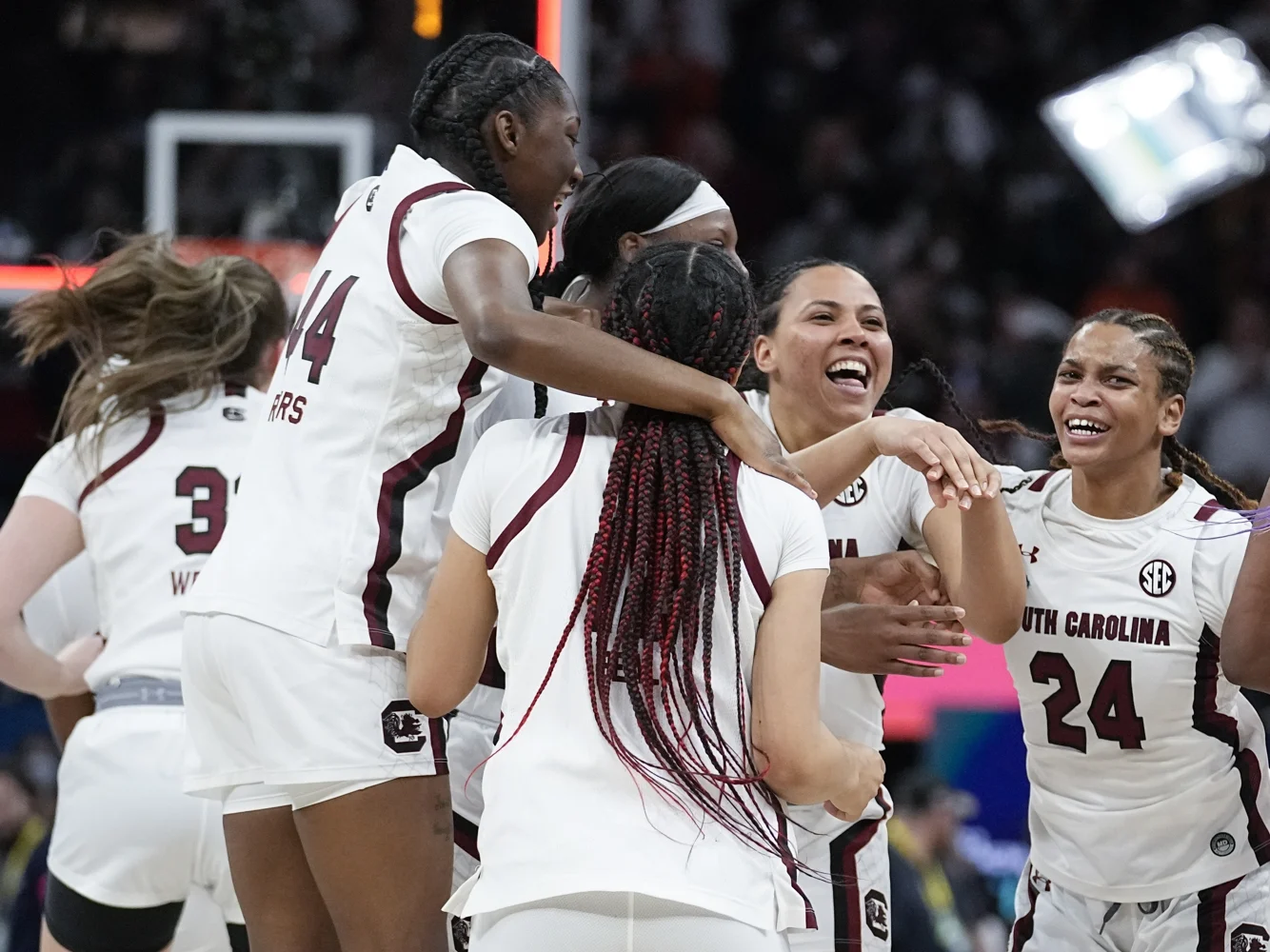
South Carolina won the 2022 NCAA women's basketball championship 64–49 over UConn. Destanni Henderson scored 26 points, Aliyah Boston collected 16 rebounds, and the Gamecocks turned a commanding opening quarter into their second national title. The final's decisive numbers show why South Carolina's advantages extended beyond shooting percentage.
Cover: South Carolina celebrates the 2022 national championship. AP photograph via NPR Illinois.
The 2022 champion and a final controlled from the start
South Carolina won the 2022 NCAA Division I women's basketball championship by defeating UConn 64–49 on April 3 at Target Center in Minneapolis, Minnesota. The Gamecocks finished 35–2 under Dawn Staley, while Geno Auriemma's Huskies ended 30–6. It was South Carolina's second national title, following the program's first championship in 2017.
The first quarter established the main problem UConn would face for the rest of the evening. South Carolina led 22–8 after ten minutes, putting the Huskies 14 points behind before the game had reached its first interval. In a final that ended with UConn scoring 49, that opening gap represented a considerable portion of the offense it could eventually produce. The Gamecocks gave themselves room to withstand a later answer.
UConn did respond. The Huskies' official final report records that they moved within six, although they never reduced the deficit further. Their 19–13 second quarter cut the halftime margin to eight, at 35–27. South Carolina's early command therefore did not make the remaining game irrelevant. The Gamecocks still needed to stop the recovery before it became a tie.
The third quarter finished 11–10 in South Carolina's favor, leaving the score 46–37. That period did not produce a dramatic separation, but it protected the position the Gamecocks had earned. A team trailing by eight at halftime needs to gain ground; matching the leader almost possession for possession leaves less time to finish the job. South Carolina then won the fourth quarter 18–12 to bring the final margin to 15.
Those quarter lines offer a more complete reading than calling the final simply a rout. South Carolina controlled the result, yet UConn won one quarter and threatened to make the closing stages more uncomfortable. The eventual champion answered the threat without needing a game-winning shot in the last few seconds. Its early lead, rebounding and late scoring were different pieces of the same successful game.
The result also ended UConn's perfect record in NCAA championship games. The Huskies had won their first 11 appearances in the final; after Minneapolis, their record in that game stood at 11–1. That milestone explains part of the historical attention surrounding the result, but it did not itself score a point for either side. South Carolina beat the team on the floor through the production of its 2021–22 roster.
For anyone locating the game in an archive, the championship belongs to the 2021–22 women's college season. A date on an official recap may display April 4 because it was posted after the Sunday evening game. The contest itself was played April 3. That distinction keeps the result, the tournament year and the contemporary reporting aligned when comparing it with other South Carolina and UConn seasons.
Henderson’s scoring and Boston’s control of the glass
Destanni Henderson scored 26 points in the final. Aliyah Boston had 11 points and 16 rebounds. Together, their production explains why South Carolina could win decisively without a spectacular team shooting percentage. The guard supplied the largest scoring total, while the center helped create and preserve the possessions in which that scoring could matter. Their contributions worked in different parts of the same game.
Why missed shots did not end South Carolina’s possessions
South Carolina won the rebounding count 49–24 and collected 21 offensive rebounds to UConn's six. The official championship statistics record a 22–5 advantage in second-chance points. A missed Gamecocks shot repeatedly became the beginning of another opportunity rather than the end of an attack. That distinction is central to understanding why field-goal percentage alone is misleading here.
Both teams made 22 field goals. UConn did so on 54 attempts and South Carolina on 60, leaving the Huskies with the better percentage. But a percentage describes conversion, not how many times a team can recover a miss or reach the foul line. South Carolina's work on the offensive glass let it remain productive through unsuccessful initial attempts. UConn could defend a shot well and still have to defend the continuation.
The first possessions demonstrate that pattern concretely. Henderson missed South Carolina's opening attempt; Victaria Saxton recovered the ball, and Henderson then made a three. Later in the opening quarter, Boston collected multiple offensive rebounds during a sequence that included a blocked attempt and another miss before she finished a layup. These were additional chances within attacks, not theoretical benefits inferred only from a final rebounding total.
Boston had five offensive rebounds. Saxton also had five, and Kamilla Cardoso collected three in nine minutes from the bench. The pressure on UConn's rebounding was therefore broader than one matchup. Several Gamecocks supplied the work, allowing South Carolina to maintain a physical source of offense even when the first shot failed. That shared production is why the starting center's scoring total alone cannot measure her team's interior advantage.
The guard who supplied the final’s biggest scoring night
Henderson made nine of 20 shots, including three of six from beyond the arc, and went five of six at the foul line. She added four assists and three steals. Her 26 points accounted for more than two fifths of South Carolina's 64, giving the Gamecocks a major scoring performance outside the frontcourt. Zia Cooke added 11, matching Boston's point total and providing another double-digit contributor.
The free-throw comparison completes the scoreboard explanation. South Carolina made 17 of 26, while UConn made one of four. Since the Huskies had four three-pointers and the Gamecocks three, UConn's 22 field goals produced 48 points and South Carolina's produced 47. The Gamecocks' 16-point free-throw advantage then turned that one-point deficit in field-goal scoring into the 15-point final margin.
That arithmetic does not make the 21 offensive rebounds irrelevant, nor does it imply that every free throw came from the same kind of possession. The glass helped South Carolina extend attacks; the line added points to attacks that ended with fouls. The combination gave the champion more ways to build its total than a simple comparison of made baskets would show.
Boston received the Final Four's Most Outstanding Player honor. Henderson's larger scoring night in the final and Boston's award are compatible observations. The award recognized the national weekend, while the final itself demanded distinct forms of production. The player who led the scoring and the player whose rebounding anchored the interior were both essential to the completed championship.
The six victories that completed South Carolina’s season
South Carolina's six NCAA tournament wins came against Howard, Miami, North Carolina, Creighton, Louisville and UConn. The first two were played in Columbia, the regional games in Greensboro, and the final two in Minneapolis. The order matters because the Gamecocks' championship was earned through changing competitive problems, rather than six identical demonstrations of the same strength.
The opener finished 79–21 against Howard. That result established a large margin, but it was not a promise that South Carolina would score comfortably in every later round. The next game produced a much smaller offensive total even as the Gamecocks continued to win. In a knockout bracket, advancing through an awkward performance can be as necessary as producing an attractive one.
A difficult second round before the regional breakthrough
Miami held South Carolina to 49 points and 29.5 percent shooting in the second round. The Hurricanes' official report identifies both as season lows for the Gamecocks at that point. South Carolina nevertheless won 49–33. That is an important combination: the Hurricanes made the favorite work for its offense, but could not create enough of their own to turn the difficulty into an upset.
The 16-point final margin therefore needs context. It was a substantial win on the scoreboard, while the shooting performance remained a concern South Carolina had to work through. Defense provided protection when the offense fell short of its usual standard. A championship team benefits from having a way to survive a game in which its preferred source of points is not functioning efficiently.
North Carolina then made the Sweet 16 competitive before South Carolina advanced 69–61. Boston's 28 points and 22 rebounds gave that eight-point victory a clearly identifiable centerpiece. Those numbers show a very different scoring responsibility from her 11-point national final. The same player could be the main scorer in one elimination game and a rebounding foundation while Henderson led the points in another.
The regional final finished 80–50 against Creighton. The Bluejays' official account places their defeat at the end of the deepest tournament run in school history. Creighton had earned that stage; South Carolina's 30-point win demonstrated how decisively the Gamecocks could finish once their offense and interior advantages aligned. The winner's performance and the opponent's breakthrough can both be true.
South Carolina beat Louisville 72–59 in the national semifinal. Boston supplied 23 points and 18 rebounds, another major performance before the championship game. The sequence from North Carolina to Louisville shows the repeated work underlying her Final Four honor: the eventual title was supported by substantial production in games that had to be won first. Henderson's final scoring explosion then gave the last game a different leading figure.
The complete route is preserved in South Carolina's official history archive. Its clearest lesson is the range of winning scores: 49 against Miami, 80 against Creighton, and 64 in the final. South Carolina did not need to duplicate one offensive total six times. It needed to produce enough points against each opponent while preventing that opponent from finding enough answers.
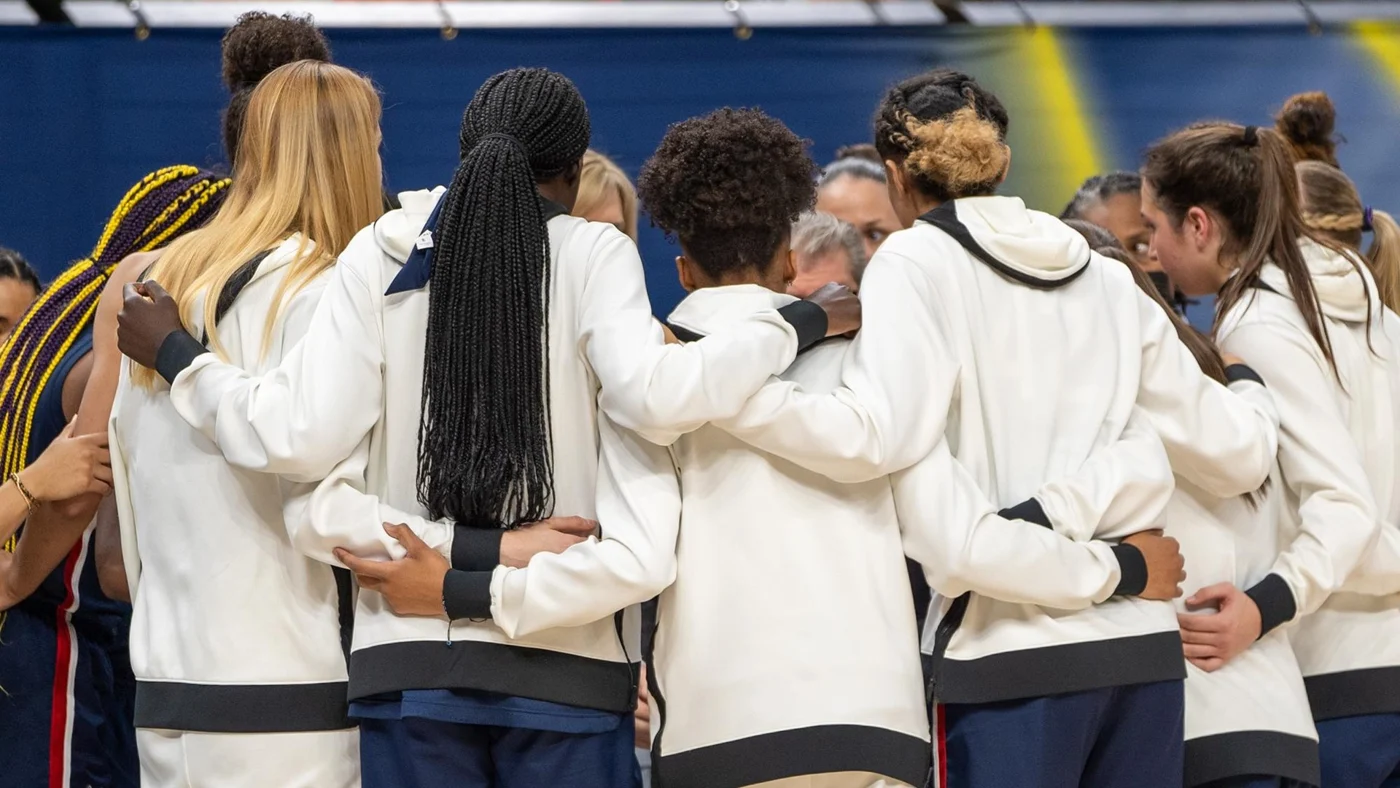
A second title for Staley and a different ending for UConn
South Carolina's 2017 championship had established that Staley could take the program all the way. The 2022 title showed that the first did not have to remain an isolated achievement. The teams belonged to different seasons and different championship stories: A'ja Wilson was central to the first title, while Boston, Henderson and their teammates supplied the second. The five-year interval makes continuity in the program meaningful without erasing the distinct work of either roster.
The 2017 championship account offers a useful comparison. That team won a first final; this group had the task of adding to an established title history. By 2022, opponents and fans knew South Carolina as a program capable of winning the national weekend. The Gamecocks still had to prove it through this particular bracket and this particular final.
Boston's 2021 semifinal disappointment gave the 2022 celebration an additional emotional connection. South Carolina had lost that earlier national semifinal to Stanford by one point. A year later, Boston and the Gamecocks finished as champions. That sequence explains why the celebration carried personal significance, but the new title was not an automatic correction of the old result. It came from a new set of six NCAA victories, including a very different final-game challenge against UConn.
UConn's season also deserves its complete shape. The Huskies beat NC State 91–87 in double overtime in the regional final, with Paige Bueckers scoring 27 points, 15 of them after regulation. The regional-final report records the performance that secured their 14th consecutive Final Four appearance. Reaching Minneapolis required surviving a game in which elimination remained possible for far longer than 40 minutes.
The Huskies then beat defending champion Stanford 63–58 to reach the final. Those wins over No. 1 seeds are part of the season even after a 15-point defeat to South Carolina. A runner-up finish can coexist with an outstanding tournament route. In UConn's case, the history of winning every previous national final made the loss especially striking, but it did not make the preceding wins ordinary.
The closing week is particularly revealing when kept in order: NC State on March 28, Stanford on April 1 and South Carolina on April 3. Against NC State, Bueckers scored more points in the two overtime periods than she would score in the entire national final. The comparison does not diminish her regional performance. It shows that a scoring solution against one elite opponent does not automatically reproduce itself against the next. South Carolina made the final a different contest, with a different balance of rebounds, attempts and free throws.
UConn's two successful late-round games also clarify the strength of South Carolina's finish. The Gamecocks were facing a team that had already found answers in a high-scoring, extended regional game and a lower-scoring national semifinal. Building a 14-point first-quarter lead against that finalist meant gaining control before its players could establish another successful closing-game scenario.
The official UConn final report also notes that eight players had missed at least three games with injury or illness during the season. That background helps explain a year of changing availability. It cannot convert the championship result into a hypothetical game with a different roster, and it does not reduce South Carolina's actual achievement. The Gamecocks beat the finalist that had earned its place by defeating NC State and Stanford.
The champions-by-year record gives the concise answer: South Carolina, 2022, 64–49 over UConn. The fuller answer begins with a commanding first quarter and runs through Henderson's scoring, Boston's rebounding and a team that kept recovering its misses. Those details explain how the second championship was earned and why it belongs to this group on its own terms.
Join the conversation
Share a question or a thought about the women's game. Comments are reviewed before they appear. Keep it friendly, stay on topic and leave out personal information.
No comments yet. Start the conversation.
Sign in with Google to leave a comment. Your email address is not displayed with your comment.