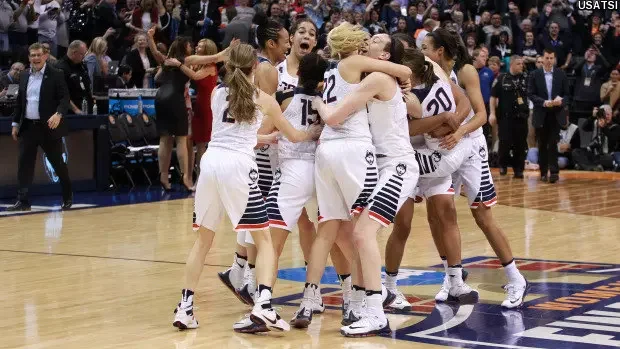
Ten great college careers, judged through peak performance, sustained production, two-way responsibility and championship contribution. This selection includes NCAA stars and AIAW pioneers while keeping professional achievements outside the comparison.
How this college-only all-time selection is judged
Breanna Stewart has the strongest championship-centered case among the best women's college basketball players of all time: four NCAA titles and four Final Four Most Outstanding Player awards. Cheryl Miller, Maya Moore, Chamique Holdsclaw and Caitlin Clark offer different arguments built on individual dominance, sustained production and what they made possible for their teams. There is no NCAA-issued all-time ranking that settles those comparisons.
This is an editorial selection of 10 great college players, grouped by the clearest part of their case. It considers four things: the player's best college seasons, sustained contribution across her college career, impact at both ends of the floor and performance against championship-level opposition. Those lenses are qualitative. They do not pretend that an arbitrary numerical score can put every era, position and schedule on precisely equal terms.
Professional championships, WNBA awards and Olympic medals do not add weight here. A player can become a greater professional than another without having had the greater college career. Equally, someone whose professional opportunities were limited can still belong near the center of college history. Miller's USC record and Stewart's completed UConn resume demonstrate how much evidence already exists within the college game.
The AIAW era is included because women's college basketball did not begin when the NCAA started sponsoring its women's championship in 1982. Lusia Harris and Nancy Lieberman earned their national titles in a different governing structure. Their championships must be labeled AIAW, but that label does not diminish their place in a college-only comparison. Statistical tables have boundaries; the history of great college players extends across them.
The selections are deliberately not a countdown with an unexplained order from second through tenth. Stewart is identified as the leading championship case, while the groups show why reasonable readers can favor another player under different priorities. A scorer, passer, rebounder and interior defender contribute through different responsibilities. An honest comparison explains those responsibilities before declaring a single career universally superior.
Four championship standards across the NCAA era
Championship success matters most when the evidence connects the player to the team accomplishment. A title count alone treats a reserve and the central performer as identical. These four players pair multiple championships with individual production and recognition that explain why their college careers remain reference points.
Breanna Stewart: four titles and four Final Four awards
Stewart's defining college achievement is unusually direct: four seasons, four national championships and four Final Four Most Outstanding Player awards. Her final college game supplied a fitting example. She scored 24 points and collected 10 rebounds as UConn beat Syracuse 82-51 in the 2016 championship game, documented in UConn's final report.
Her complete career included 2,676 points, 1,179 rebounds and a school-record 414 blocked shots. Those totals help explain why the championship argument is more than the benefit of playing for an outstanding program. She supplied scoring, possessions and protection around the basket, and her four Final Four awards identify repeated importance at the tournament's decisive stage.
Stewart's case is strongest when sustained excellence and postseason responsibility receive substantial weight. Other players may offer higher scoring totals or more extraordinary single-season averages. Few can combine her completed championship record with evidence that they were repeatedly the outstanding performer when the title was decided. Her teammates and coaching still belong in that story; acknowledging them makes the individual contribution clearer rather than smaller.
Cheryl Miller: a complete force at USC
Miller finished her USC career with 3,018 points and 1,534 rebounds, earned four All-America selections and won three consecutive Naismith college awards from 1984 through 1986. The USC Hall of Fame profile also records two national championships and three Final Four appearances. The breadth of that resume is why Miller belongs in any serious discussion of the greatest college player.
Her scoring and rebounding totals show that she affected more than the shot she took. Possession control is essential to an all-time comparison: a player who scores and repeatedly secures the ball gives her team value through multiple stages of a game. Miller's career makes that two-part impact visible without needing a modern statistical model to reconstruct every possession.
The national titles came in 1983 and 1984, while her three Naismith awards spanned the final three years of her college career. Those timelines are related without being identical. They show individual recognition continuing beyond the championship seasons. Her place here rests on what happened at USC, not on a hypothetical professional career or the fame of her basketball family.
Maya Moore: scoring within a dominant team
Moore's UConn career record combines 3,036 points, 1,276 rebounds, 544 assists and 310 steals. The Huskies went 150-4 during her four years and won the 2009 and 2010 national championships. That is substantial individual production inside a team whose normal standard was already exceptionally high.
Her perimeter shooting is another useful part of the case: 311 made threes at 40.4% across her college career. A large scoring total can come from several different responsibilities, and Moore's efficiency from outside adds detail to the number. She could contribute scoring without every valuable possession requiring a trip into the paint.
Moore also demonstrates why a successful team need not conceal individual greatness. Playing alongside excellent teammates can distribute shots and responsibilities. Maintaining broad production while fitting that structure is an achievement of its own. Her combination of shooting, rebounding and passing prevents the analysis from collapsing into either a championship-only argument or a simple career-points comparison.
Chamique Holdsclaw: the center of a Tennessee three-peat
Holdsclaw helped Tennessee win three consecutive NCAA championships from 1996 through 1998, including the undefeated 39-0 season in 1997-98. Tennessee's retired-jersey history records 3,025 career points, 1,295 rebounds and Final Four Most Outstanding Player honors in 1997 and 1998.
The three-peat supplies a different form of sustained pressure from one spectacular tournament. A returning champion is the opponent everybody wants to beat, and repeating requires a team to solve new matchups rather than replay the previous spring. Holdsclaw's production and individual tournament recognition make her a central figure in that run, not simply a name attached to the winning roster.
Her career also bridges the usual categories used in player debates. She belongs in a scoring discussion because of the 3,000-point threshold, in a possession discussion because of her rebounding and in a postseason discussion because of the repeated titles. That breadth is the reason her name remains prominent even when a reader places less emphasis on any single award or statistical record.
Four record setters with different routes to greatness
Championships provide one form of evidence, but a college-only comparison also needs room for players who changed the demands placed on a defense. These four careers offer distinct combinations of scoring, creation, leadership and protection of the basket. Their strengths should be compared directly rather than converted into a contest over one statistical column.
Caitlin Clark: scoring and creation at historic volume
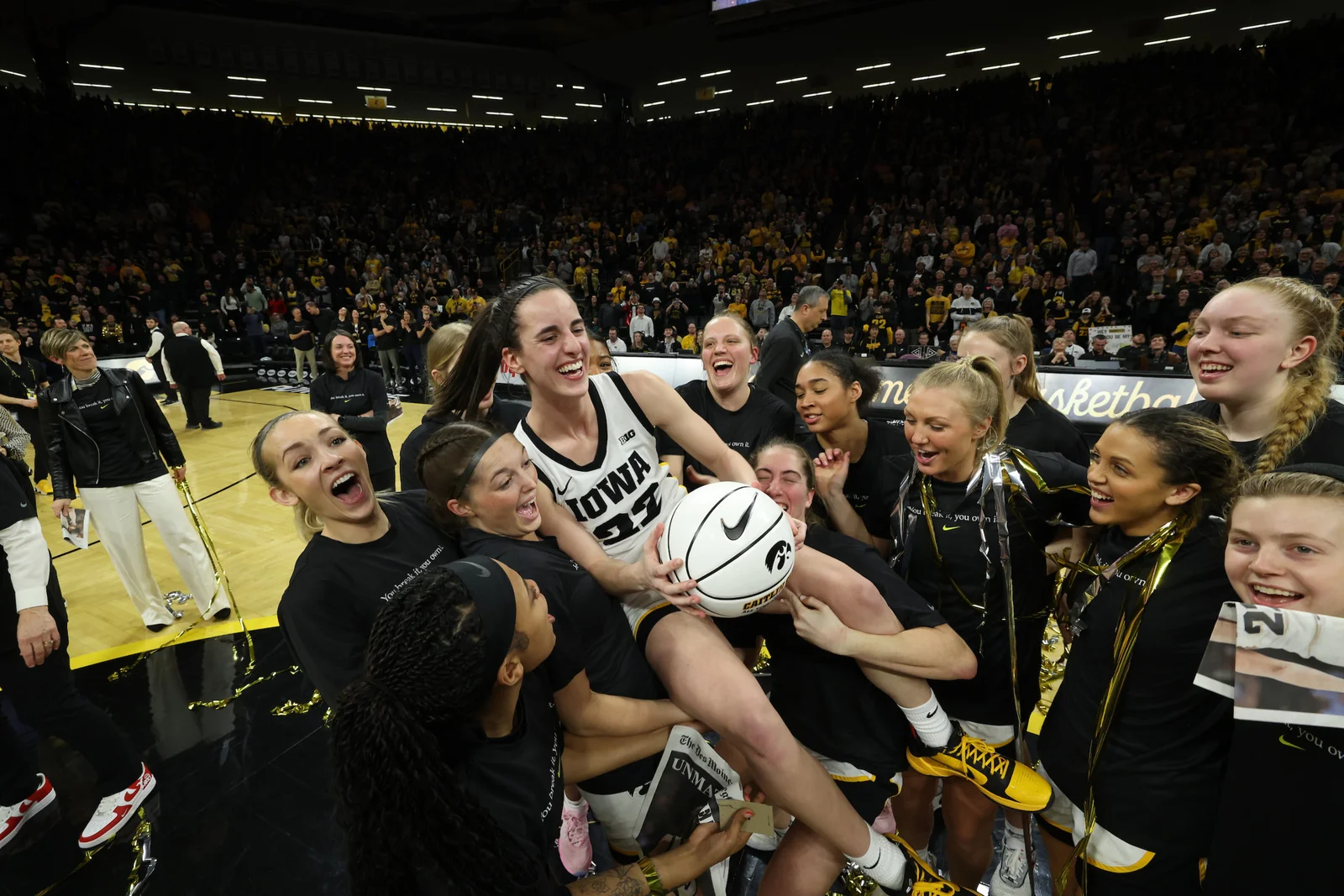
Clark finished at Iowa with 3,951 points and 1,144 assists. The scoring total is the NCAA Division I career record, while the assists show why her college case extends far beyond being a prolific shooter. The Iowa career biography documents the historic production that accompanied consecutive trips to the national championship game in 2023 and 2024.
Her 548 career three-pointers added a long-range dimension to that workload. Defending a player who can score from outside while also creating a teammate's shot presents two linked problems: allowing space can invite a shot, but committing more attention can free a receiver. That is the general basketball significance of combining scoring and passing at high volume. It does not require claiming every Iowa basket resulted from the same action.
Clark did not win an NCAA championship. That is a real distinction from Stewart or Holdsclaw, but it does not erase the value of leading Iowa to two finals or the scale of her individual college production. Readers who prioritize offensive creation can reasonably place her higher than readers who prioritize completed championships. The disagreement follows the criteria rather than requiring either side to deny an established fact.
Diana Taurasi: three titles as the floor leader
Taurasi's UConn career record includes three consecutive national championships from 2002 through 2004, 2,156 points and 648 assists. Her case is not built on owning the largest scoring total in this group. It is built on the combination of scoring, distribution and repeated success as a central player on championship teams.
A creator's influence is not exhausted by her own shot count. Passing creates opportunities for teammates, while being a credible scorer can make defensive attention costly. Taurasi's college production makes both parts of that role visible. Her career also demonstrates why an all-time discussion should avoid treating lower individual scoring than Clark or Miller as a complete argument against her.
The three championships belong to different seasons with changing team circumstances. Retaining a high level of influence through that sequence is part of the achievement. Her later professional career is unnecessary to make the college case; the UConn years already provide a substantial championship and playmaking resume.
Sheryl Swoopes: an extraordinary championship peak
Swoopes played two seasons at Texas Tech and delivered one of the defining peaks in college basketball history. In the 1993 national championship game she scored 47 points as the Lady Raiders beat Ohio State 84-82. Texas Tech's championship retrospective confirms the performance. The 47 is the championship-game record, a different category from the NCAA tournament single-game record.
A shorter Division I career changes how a player appears in career-total comparisons. Swoopes cannot accumulate four Texas Tech seasons when she played two, but she can still present an exceptional case through the quality of those seasons. Her final college campaign produced 955 points and a championship, connecting sustained season scoring to the most consequential game of the year.
She belongs in this selection because peak performance deserves a place beside longevity. A reader who values four years of contribution may prefer another player. A reader who asks who reached the highest championship-stage scoring level has a particularly strong reason to begin with Swoopes.
Brittney Griner: scoring beside unmatched shot blocking
Griner finished at Baylor with 3,283 points, 1,305 rebounds and 748 blocked shots. Baylor's Hall of Fame profile links that production to the 40-0 national championship season in 2011-12. The 748 blocks remain the NCAA Division I women's career standard.
Her case requires defensive attention as well as points. A blocked shot ends one attempted scoring opportunity if the defense secures possession afterward; the possibility of a block can also influence the shots an opponent is willing to attempt. The career total verifies an extraordinary number of actual rejections. The broader influence around the basket is a tactical implication, not an invented count of altered shots.
Pairing that defensive record with more than 3,000 points makes Griner unusually difficult to confine to one category. She was not merely a specialist added to a successful offense. The undefeated championship gives her college case a decisive team achievement while the scoring and blocks describe substantial responsibility at both ends.
The AIAW pioneers belong in the same conversation
An all-time college selection that starts in 1982 leaves out players who built the sport before the NCAA sponsored its women's championship. Their results need accurate labels, but their college achievements deserve consideration beside later careers. Harris and Lieberman are included here for what they accomplished in college, without borrowing weight from Olympic participation or later professional opportunities.
Lusia Harris and the Delta State championship run
Harris led Delta State to three consecutive AIAW national championships from 1975 through 1977. The school's Hall of Fame record credits her with 2,981 career points and three Kodak All-America selections. Those are substantial college accomplishments even though they sit outside the later NCAA championship structure.
Her case combines a sustained championship peak with repeated individual recognition. It would be incomplete to introduce her only through a pioneering biographical detail and then move back to modern scorers. The reason to include Harris in this basketball discussion is the college performance itself: a dominant center at the heart of a three-title run.
The historical distinction also changes how records should be read. Her points should not be inserted into an NCAA-era table without explaining the scope. At the same time, excluding those points from a specifically NCAA statistical record is not a reason to exclude Harris from a broader selection of the best college players. The boundaries of one record table do not define the limits of the sport's history.
Nancy Lieberman and Old Dominion's back-to-back titles
Lieberman helped Old Dominion win the 1979 and 1980 AIAW national championships and became the first player to win the Wade Trophy twice. The ODU retrospective records the two championships and repeated national recognition. Her case brings a point guard's responsibility into a group that could otherwise become dominated by scorers and interior players.
The team context is important. ODU's championship anniversary account identifies Inge Nissen and Anne Donovan alongside Lieberman among the great players on those teams. The champions finished 35-1 and 37-1. Recognizing that talent around her does not erase the point guard's influence; it explains the quality of the basketball structure within which she excelled.
Harris and Lieberman complete these 10 selections, but the conversation remains wider. Candace Parker, Sabrina Ionescu, Lynette Woodard, Lisa Leslie and many others have substantial college cases under different priorities. A reader emphasizing ball creation, a particular peak season or the demands of an earlier era can arrive at a different shortlist without changing the verified history.
That is the purpose of making the criteria visible. Stewart offers the strongest combination of repeated championship-stage recognition and completed titles; Clark offers a compelling scoring-and-creation case; Miller, Moore, Holdsclaw and the others contribute different evidence. The career scoring guide provides a more specific numerical comparison. This selection asks the broader basketball question and keeps the college career, rather than later fame, at the center of the answer.
Join the conversation
Share a question or a thought about the women's game. Comments are reviewed before they appear. Keep it friendly, stay on topic and leave out personal information.
No comments yet. Start the conversation.
Sign in with Google to leave a comment. Your email address is not displayed with your comment.