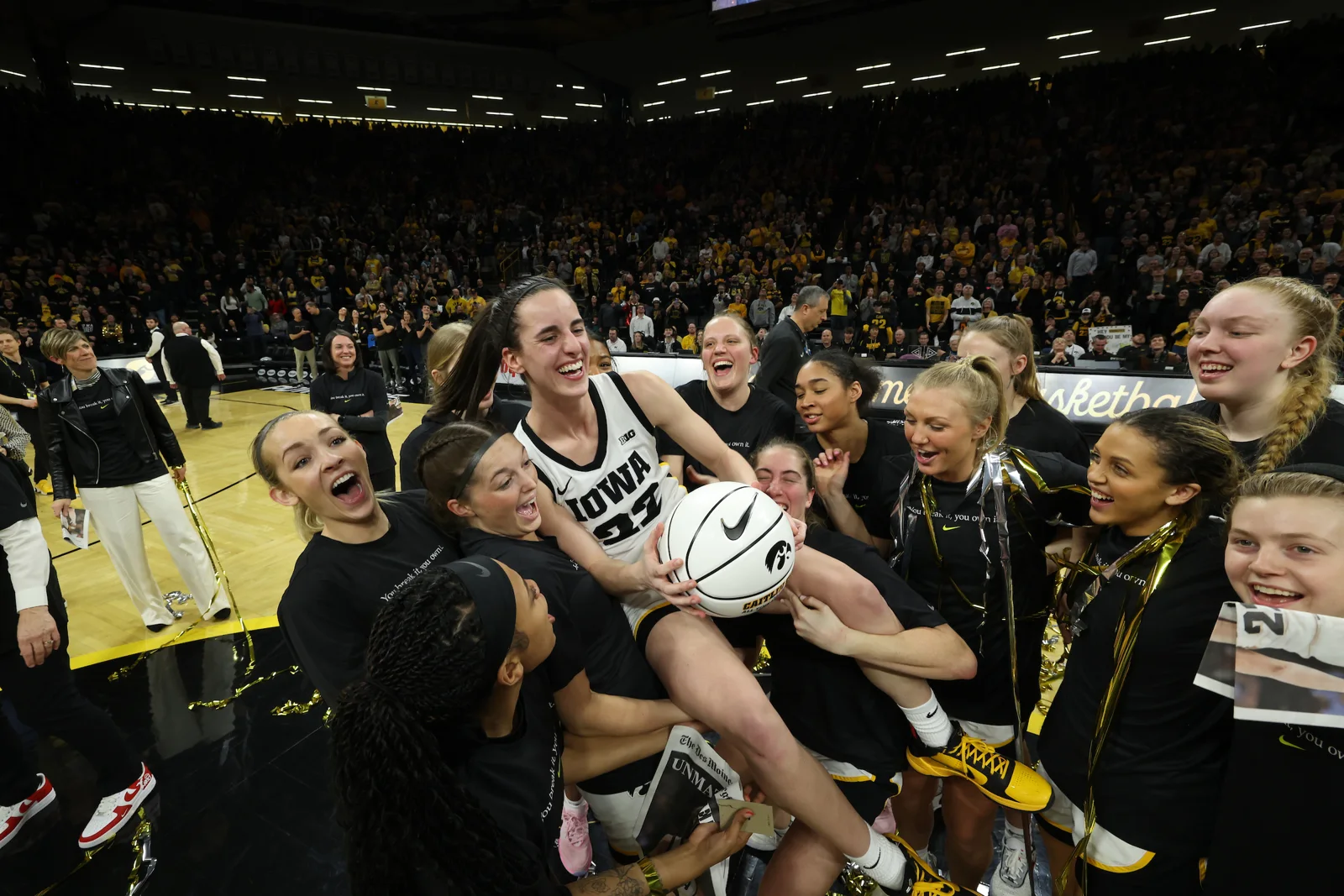
Cover: Caitlin Clark celebrates with Iowa teammates after the record-breaking Michigan game, February 15, 2024. Source: Iowa Athletics.
Caitlin Clark leads NCAA Division I women's basketball career scoring with 3,951 points, ahead of Kelsey Plum's 3,527. The top 10 below uses official NCAA career records checked on October 1, 2026, then explains the players, milestone games and historical boundaries behind those totals.
Which records belong on a Division I scoring list?
This guide covers NCAA Division I women's career scoring totals. A career total combines a player's points in eligible college games; it is different from a single-season total, a scoring average or NCAA tournament points alone. Caitlin Clark's 3,951 points are the leading figure in this category. Calling that the record for every form of women's college basketball would remove a qualification the historical evidence requires.
The NCAA Division I record book says official women's records began with 1981-82 and explains its career eligibility rules. The NCAA also maintains separate Division II, Division III and broader collegiate books. A larger total from another association does not automatically replace a Division I entry, because the competitions and recordkeeping boundaries differ.
Lynette Woodard and Pearl Moore belong in the broader history
Lynette Woodard scored 3,649 points at Kansas before the NCAA statistical era. Kansas's 2026 tribute places her career in the AIAW years and records that total. Her absence from an NCAA-era top 10 is a matter of the list's scope. It does not imply that her baskets counted less or that national women's basketball history began when the NCAA started its championship.
Pearl Moore's broader college total is 4,061. The Francis Marion history guide explains that it includes 177 points at Anderson Junior College and 3,884 at Francis Marion under the rules of that period. That is a useful reminder to examine what a total includes before putting it beside a modern Division I career.
The accurate description can honor both histories: Clark leads NCAA Division I women's scoring, while Woodard and Moore are central figures in the wider college game. A good comparison preserves their names and their contexts. It also helps a reader understand why two trustworthy sources can identify different “all-time” leaders without either source necessarily inventing a number.
The NCAA women's basketball career scoring top 10
The following top 10 was checked on October 1, 2026 against the NCAA collegiate record book through 2025-26 and its Division I career table. Only Division I entries are included here. “Final season” identifies the end of the college career, rather than a player's current professional team.
| Rank | Player | College | Final season | Points |
|---|---|---|---|---|
| 1 | Caitlin Clark | Iowa | 2023-24 | 3,951 |
| 2 | Kelsey Plum | Washington | 2016-17 | 3,527 |
| 3 | Dyaisha Fair | Buffalo / Syracuse | 2023-24 | 3,403 |
| 4 | Kelsey Mitchell | Ohio State | 2017-18 | 3,402 |
| 5 | Jackie Stiles | Missouri State | 2000-01 | 3,393 |
| 6 | Brittney Griner | Baylor | 2012-13 | 3,283 |
| 7 | Patricia Hoskins | Mississippi Valley State | 1988-89 | 3,122 |
| 8 | Lorri Bauman | Drake | 1983-84 | 3,115 |
| 9 | Jerica Coley | FIU | 2013-14 | 3,107 |
| 10 | Rachel Banham | Minnesota | 2015-16 | 3,093 |
Clark's advantage over Plum is 424 points: 3,951 minus 3,527. Farther down the list, Fair and Mitchell are separated by one point, while Mitchell and Stiles are separated by nine. Those margins show why a ranking position alone cannot describe the distance between careers. A one-place change can mean hundreds of points or a single made free throw's worth of difference.
The college column needs care for Fair. Her total spans Buffalo and Syracuse, so it should not be described as 3,403 points scored only in a Syracuse uniform. Stiles played when Missouri State was named Southwest Missouri State; the modern school name helps readers locate the program, while contemporary accounts may use the former name. Neither detail changes the points, but both prevent a misleading career description.
The list also reaches well beyond the schools most often associated with recent national titles. Hoskins, Bauman and Coley established major individual totals at Mississippi Valley State, Drake and FIU. Their inclusion makes the table a national career record rather than a retrospective ranking of the most televised teams. If a school is unfamiliar, that is an invitation to examine the career, not a reason to discount it.
This is a scoring list, not an overall player ranking. It does not weigh defense, passing, rebounding or championship performance into one score. The next sections show how actual milestone games and different career opportunities give those totals more meaning than an isolated ordered list can provide.
Caitlin Clark's record was built beyond one famous shot
Clark's record-breaking three-pointer against Michigan is the moment most fans associate with the career chase. It deserves that place in the story. Yet a four-season total is built from ordinary scoring possessions as well as spectacular ones: finishes, foul shots, repeated productive quarters and the ability to keep creating against opponents preparing specifically for you.
The Michigan game that passed Kelsey Plum
On February 15, 2024, Clark finished with 49 points, 13 assists and five rebounds in Iowa's 106-89 victory over Michigan. Iowa's contemporary game report records nine made three-pointers and 23 first-quarter points. The career record arrived early, but her scoring continued to influence a game that still had to be won.
The assists are central to interpreting the night. Kate Martin added 20 points and Hannah Stuelke 13; Iowa recorded 25 assists. That does not make every teammate's basket a consequence of Clark's scoring, but it shows that her role was broader than taking all the shots. A defense confronted a scorer who could also distribute. The box score supports that dual contribution without requiring us to invent a particular coverage or claim to have watched every possession.
The timing matters too. Passing Plum that night was a milestone within the career, not Clark's final total. Iowa's later games added to it, including the postseason. A headline describing the points after Michigan should therefore not be compared directly with the 3,951 figure from the completed career. Keep the date attached to an intermediate total.
Career totals and single-season records are separate
The NCAA book lists Clark's 2024 season at 1,234 points in 39 games, while her career finished at 3,951. Her Iowa senior-season profile distinguishes the single-season record from the career milestones against Michigan, Minnesota and Ohio State. Each achievement answers a separate historical question.
Her career shooting totals also show why “long-range shooter” is an incomplete description. The NCAA table credits 1,293 made field goals, including 548 threes, plus 817 free throws. The scoring can be reconstructed: 745 two-pointers produced 1,490 points, 548 threes produced 1,644, and the free throws supplied 817. Together they equal 3,951. This is a scoring breakdown, not a possession-efficiency calculation.
That balance gives fans a more precise appreciation of the record. Three-pointers contributed enormously, but more than half the total came from two-point baskets and free throws combined. The memorable logo shot symbolizes the chase; the full arithmetic shows the repeated production that made it possible.
Kelsey Plum and Jackie Stiles set different benchmarks
Plum finished her Washington career with 3,527 points. Stiles had set the earlier mark at 3,393 in 2001. Their places in the record chase connect two generations, but the games around those milestones are more revealing than treating each player as someone whose only purpose was to hold a number until the next scorer arrived.
Plum's 57-point farewell to the regular season
Plum entered Washington's February 25, 2017 game against Utah needing 54 points to pass Stiles. She scored 57 in an 84-77 Senior Day victory. Washington's game report records 19-of-28 shooting, six made threes and 13 free throws. A record that seemed to require an extraordinary night was reached through exactly such a performance.
The seven-point final margin gives the scoring a competitive context. Plum scored 19 of Washington's 22 fourth-quarter points, while Chantel Osahor contributed 14 points and 11 rebounds across the game. The milestone did not occur in a game with no meaningful stakes left. Her late production helped Washington complete the win while Utah stayed within reach.
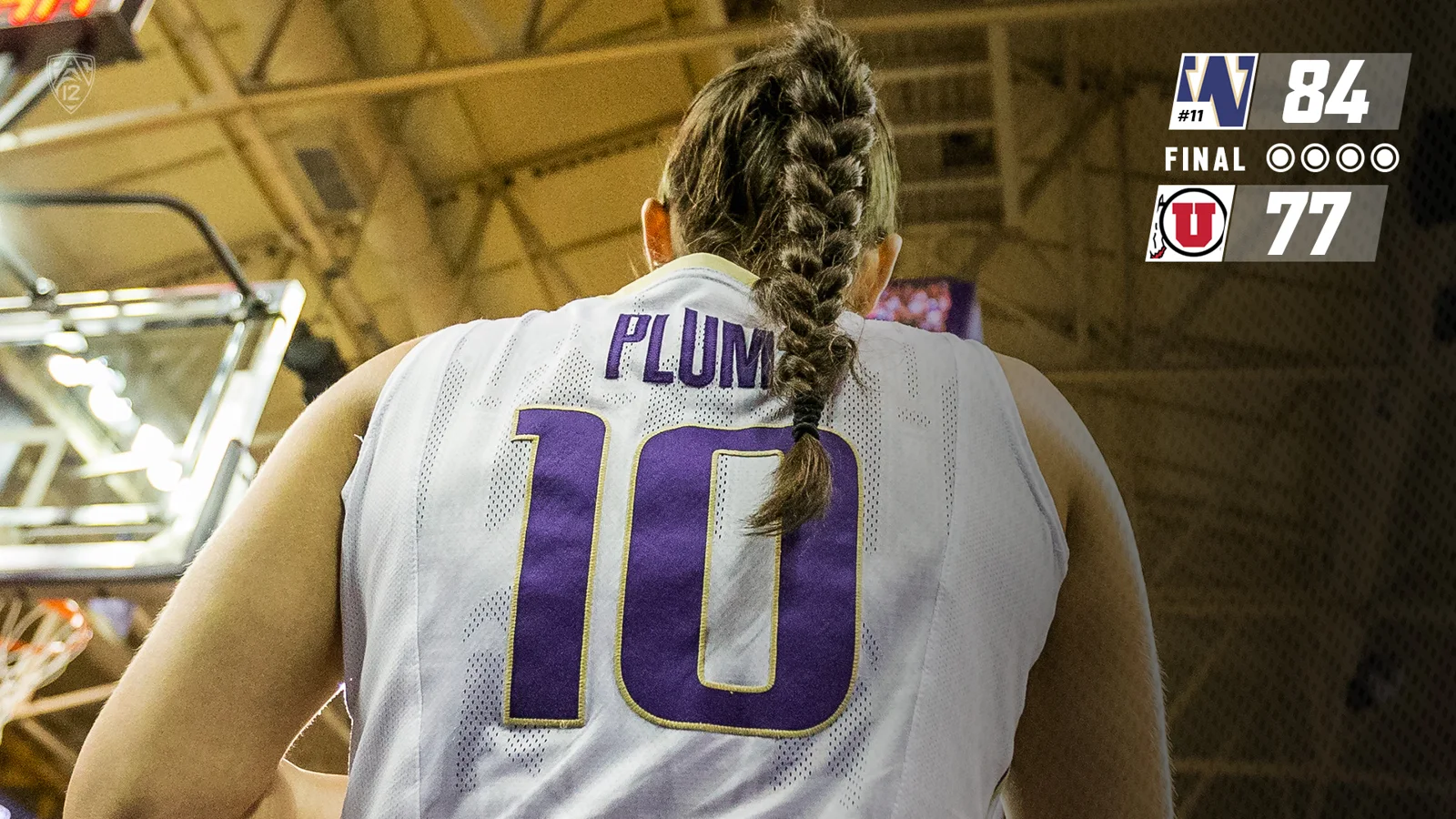
Her completed career also included 912 made free throws, listed in the NCAA book. That adds another dimension to a guard remembered for shot creation: trips to the line accumulated substantial points too. Comparing only three-point highlights would miss an important source of her career production. The record total rewards every eligible point, regardless of how memorable the basket looked.
Stiles connected scoring history with a Final Four run
Stiles's final college season ended with Missouri State reaching the 2001 Final Four. The school's team retrospective traces the NCAA run through Toledo, Rutgers, Duke and Washington, including a 104-87 regional-final win over the Huskies. That postseason success gives her scoring record a team setting rather than leaving it as a detached individual chase.
A Final Four appearance and a career points record remain different achievements. One depends on winning the relevant tournament games; the other accumulates across years. Stiles achieved both during her college career, making her a particularly useful case for readers who want to connect scoring volume with March results. Neither category has to be inflated into an unsupported claim that points alone determine winning.
Dyaisha Fair and Kelsey Mitchell finished one point apart
Fair's 3,403 points put her one ahead of Mitchell's 3,402. The decisive final addition came in Syracuse's 72-64 NCAA second-round defeat at UConn on March 25, 2024. Syracuse's game report credits Fair with 20 points and confirms her move into third on the career list. A loss can still contain a major individual historical milestone.
That result is a good antidote to the idea that a scoring list measures the whole game. Paige Bueckers scored 32 for UConn; Syracuse's Sophie Burrows and Georgia Woolley each added 18. Fair's final total belongs in the record book, but the Huskies' victory was determined by what both teams did that night. Career position and a tournament outcome are related stories, not interchangeable verdicts.
Fair's career spanned Buffalo and Syracuse. The NCAA's broader collegiate table credits 153 appearances, while Mitchell's total came in 139. Those are different opportunities to accumulate points. Dividing gives approximately 22.24 points per game for Fair and 24.47 for Mitchell. This simple arithmetic explains why ordering by career average would reverse their positions; it does not prove either player was better overall.
Mitchell's completed-career Ohio State tribute records her four All-America seasons and 497 made threes. At the end of her college career, that three-point total was a national record. Clark's later 548 illustrates why a contemporary report must be read with its date intact: a valid 2018 record claim is not automatically a current record claim.
The one-point gap is therefore meaningful for the table but small as a description of basketball ability. It settles which total is larger. It does not settle whose shooting, passing or decision-making you would prefer in a particular lineup. Keeping that distinction lets fans appreciate Fair's achievement without turning Mitchell's fourth-place entry into a criticism.
How to compare scorers across eras and opportunities
Scoring totals become more useful when you examine the opportunities and methods behind them. Games played, points per game and the kinds of baskets made add context without requiring an imaginary formula that converts every generation into the same circumstances. The record book preserves the achievement; analysis should explain it rather than rewrite it.
One particularly revealing comparison is Clark and Patricia Hoskins. The NCAA career-average table prints both at 28.4 points per game. Clark's 3,951 divided by 139 is approximately 28.424; Hoskins's 3,122 divided by 110 is approximately 28.382. The rounded display looks tied, while the underlying rates differ. The book specifically warns that rounding can create apparent ties.
A career total is only the start of the comparison
Clark played 29 more games than Hoskins in those official entries. Those extra appearances matter to the size of a career total, while the near-identical printed averages show the sustained scoring rate each achieved. Neither observation diminishes Clark's record or Hoskins's career. They simply answer two different questions: how much was scored in total, and how much was scored per appearance.
Basket types also differ substantially. Brittney Griner's 3,283 points included only two made threes in the NCAA career table. Clark made 548. Both accumulated exceptional totals, but those numbers describe very different scoring profiles. A comparison that only values three-point range would fail to explain why Griner ranks sixth. Conversely, a total alone does not show how a perimeter scorer creates space for teammates.
The national statistical treatment of three-pointers began in 1987-88, according to the record definitions. Earlier careers must be read in their own rules context. A dash in an old three-point column is not evidence that a player lacked touch or could never have adapted to a later game. It records the limits of the category and era, rather than a hypothetical evaluation of talent.
Other contributions remain visible in separate records. Griner also accumulated 748 career blocks; her scoring total does not capture that defensive production. Our guide to rebounds, assists, blocks and winning streaks supplies those different categories. The champions-by-year history answers the separate team-title question.
Efficiency requires another question again: how many attempts or possessions produced the points? A career total supplies the numerator but does not, on its own, provide a shooting percentage or points per possession. Two players can accumulate similar totals through different combinations of shot volume, accuracy and free throws. Before using the scoring table to call someone the more efficient player, seek the relevant attempts and specify the calculation. The same care applies to team offense. A pass creating a teammate's basket contributes to an attack without adding to the passer's career scoring column. These distinctions explain why a useful player evaluation returns to the wider statistics and actual games instead of making one historical leaderboard carry every possible judgment.
When following a new scorer, use the same discipline: verify the eligible career total, check the date, identify the competition and distinguish milestones from forecasts. An outstanding current season deserves attention on its own terms. It does not require promising that a player will eventually overtake Clark. The best historical comparison recognizes both the documented number and the basketball career that produced it.
Join the conversation
Share a question or a thought about the women's game. Comments are reviewed before they appear. Keep it friendly, stay on topic and leave out personal information.
No comments yet. Start the conversation.
Sign in with Google to leave a comment. Your email address is not displayed with your comment.