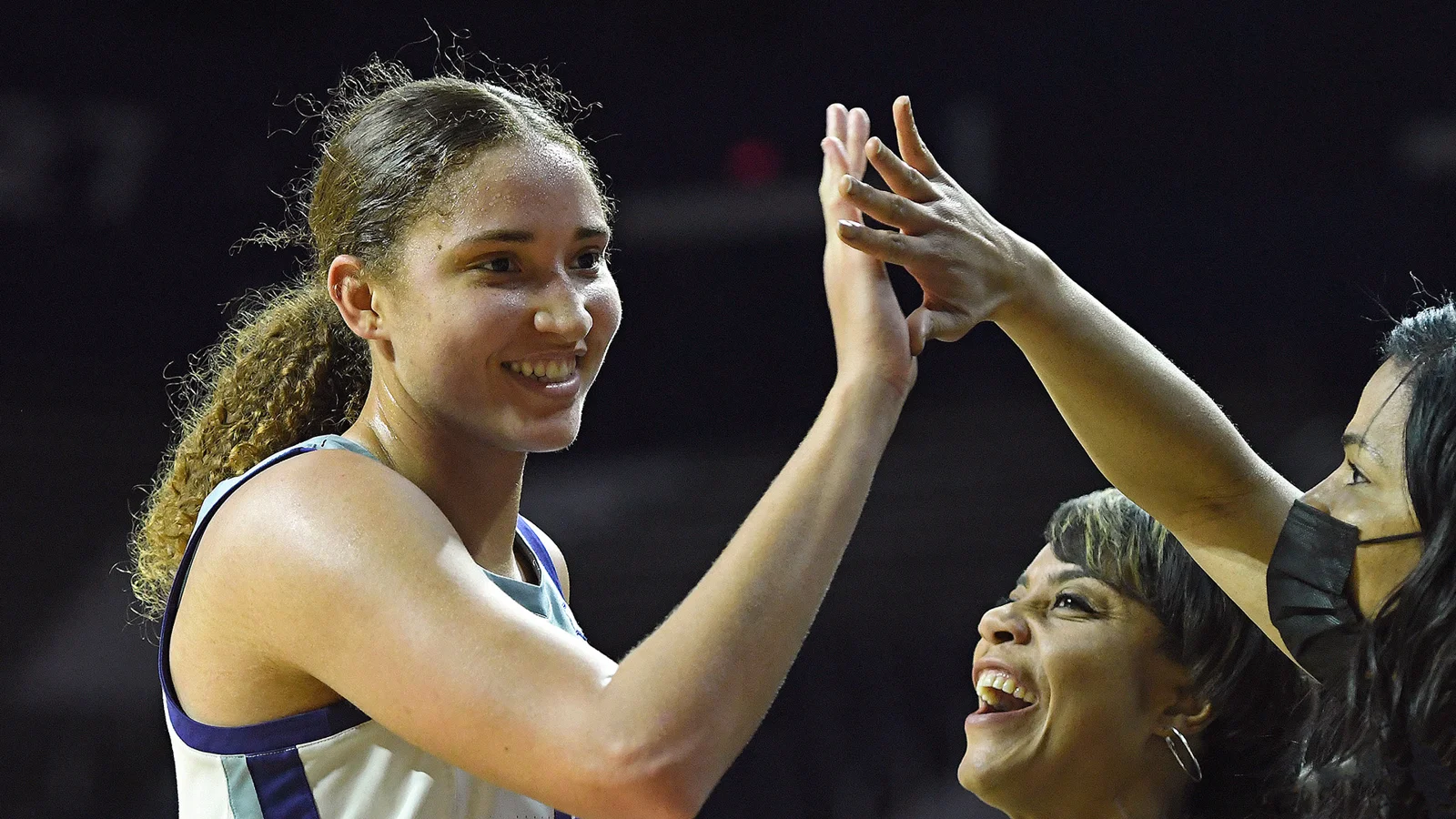
Ayoka Lee's 61 points against Oklahoma set the Division I women's single-game record. Understanding that performance means separating it from the tournament record, the all-division record and other remarkable scoring nights.
Ayoka Lee's 61 points remain the Division I standard
Ayoka Lee holds the NCAA Division I women's basketball single-game scoring record with 61 points for Kansas State against Oklahoma on January 23, 2022. The Wildcats won 94-65 at Bramlage Coliseum in Manhattan, Kansas. The current NCAA Division I record book, checked on October 20, 2026, still lists that performance as the record. It was a regular-season Big 12 game, rather than an NCAA tournament game.
That last distinction answers much of the confusion around this search. "NCAA" can describe the organization and its member schools, or it can refer casually to the national tournament. Lee's performance counts in the full Division I record book. The tournament has its own single-game scoring record, and the wider college game has other records across different divisions. A useful answer starts with the scope before comparing the numbers.
The record game against Oklahoma
Oklahoma entered the game ranked 14th, making this a conference upset as well as an extraordinary individual total. Kansas State's contemporary game report describes a wire-to-wire win. The Wildcats led 19-11 after the first quarter and added 32 points in the second, reaching halftime ahead 51-27. The record therefore developed inside an emphatic team performance, rather than a succession of overtime periods.
Lee played 35 minutes. Her final record-breaking basket came on a layup with 2:53 left in the fourth quarter. There was no need to extend the game beyond regulation or wait for a final possession after the result had been decided. That timing is helpful context: a 61-point game in 35 minutes asks a different scoring-frequency question from the same total accumulated across a regulation game and multiple overtimes.
She also collected 12 rebounds. Those rebounds should not be treated as decorative additions to a scoring line, although the box score alone does not tell us the quality of every rebound opportunity. They show that her afternoon contained work beyond finishing possessions with a shot. The safest description is still the concrete one: a record scoring total, a double-double and a decisive team win against a ranked opponent.
The opponent's perspective confirms the scale of what happened. Oklahoma's later game notes carry the same 61-point total and shooting line. Consulting both programs matters because a memorable school story can otherwise become detached from the actual result. Here the historical date, opponent, score and record all line up.
How 23 baskets became 61 points
Lee made 23 of 30 field-goal attempts and 15 of 17 free throws. She did not need a three-pointer. The scoring arithmetic is straightforward: 23 two-point baskets produced 46 points, then 15 free throws brought the total to 61. Her field-goal percentage was 76.7%, calculated as 23 divided by 30, and her free-throw percentage was 88.2%, calculated as 15 divided by 17.
That breakdown is the distinctive feature of the game. Many fans picture a modern scoring explosion as a run of deep three-pointers, but Lee reached the national ceiling through repeated two-point finishes and foul-line conversion. The free throws were consequential, too. They accounted for almost a quarter of her total. The record was not simply a matter of making a large number of baskets while leaving points unused at the line.
Her share of the team offense can be calculated without estimating possessions. Lee scored 61 of Kansas State's 94 points, or about 64.9%. Everybody else combined for 33. That does not mean her teammates were irrelevant: a scorer can dominate the point column while depending heavily on others to get her the ball, preserve spacing and keep the offense organized. The player receiving the points and the players helping create the opportunity can have very different box-score footprints.
Freshman guard Serena Sundell supplied an especially clear example, finishing with 11 points, eight assists and no turnovers. Those numbers do not prove that every assist led to a Lee basket; the play-by-play would be needed to trace each connection. They do establish productive ball distribution alongside the record. The useful reading of the afternoon is a dominant interior scorer supported by an offense that continued finding workable possessions, rather than a single player somehow scoring outside a team structure.
The other scoring records that need their own labels
Lee's 61 makes sense within a broader history of huge scoring games. It does not erase the players who established the previous standard, nor does it replace records from different competitions. The most useful comparisons keep the relevant labels attached: Division I game, NCAA tournament game, Division III game and all-division NCAA game. Once those categories are clear, apparently competing answers can all be correct.
Cindy Brown and Rachel Banham reached 60 first
Cindy Brown scored 60 points for Long Beach State against San Jose State on February 16, 1987. Long Beach State's Hall of Fame account records 20 made field goals and 20 made free throws. Her scoring equation was 40 points from baskets plus 20 at the line. The NCAA collegiate record table confirms the date and opponent.
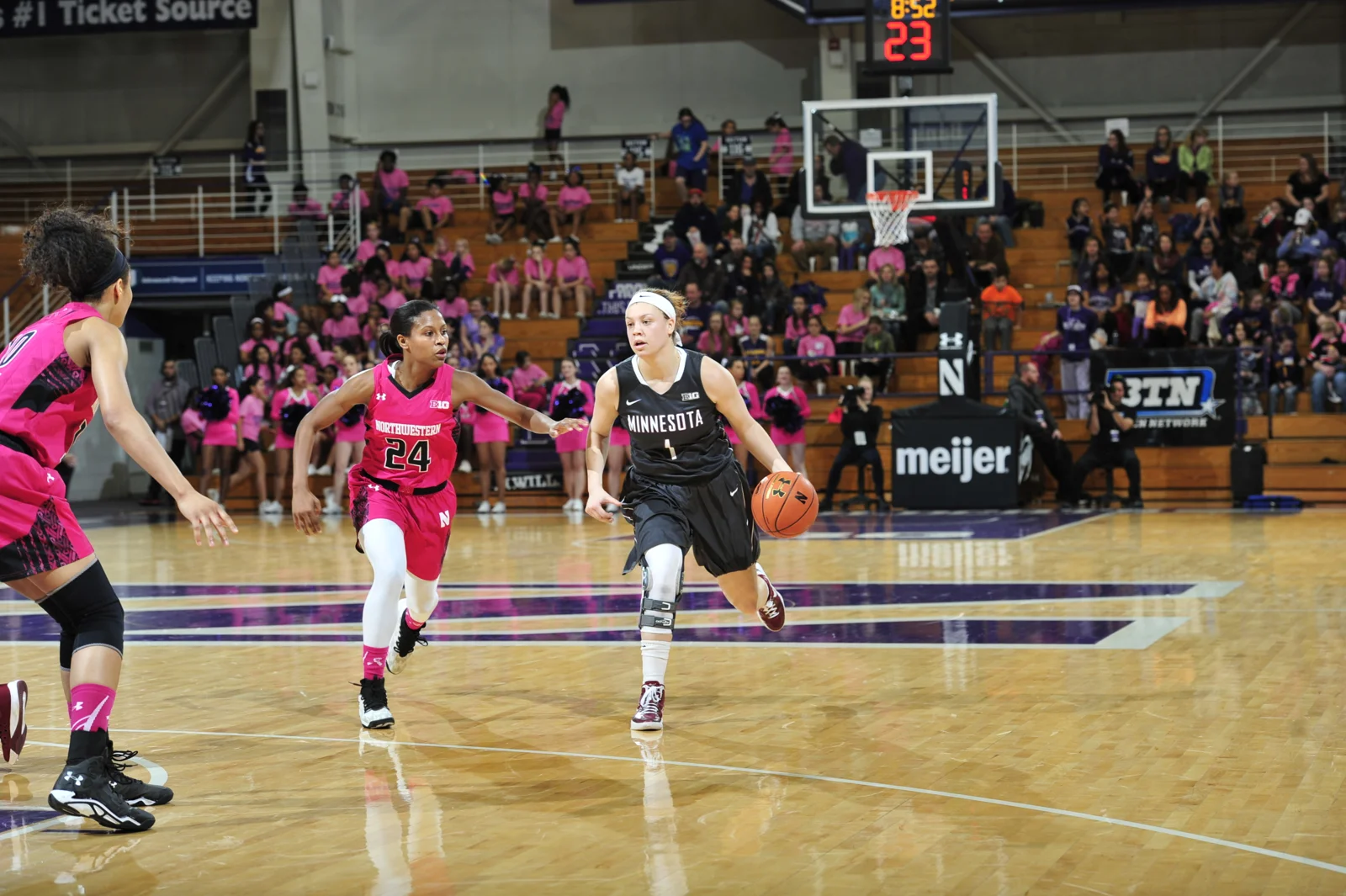
Brown's record then survived until a very different game. On February 7, 2016, Rachel Banham scored 60 in Minnesota's 112-106 double-overtime win at Northwestern. The Minnesota game report records 19 made field goals, including eight three-pointers, and 14 made free throws. Eleven two-pointers, eight threes and 14 foul shots produce the same 60-point result through a different scoring mix.
Banham scored 42 points during regulation and 18 in the overtime periods. That distinction is essential context without diminishing the achievement. Minnesota needed the extra periods to finish the contest, and her scoring helped keep the team alive long enough to win it. Lee's record, by contrast, came without overtime. Both totals belong in the official list; the circumstances explain what kind of game each player had to solve.
The comparison also highlights how little a total reveals about playing style on its own. Brown's 20 free throws, Banham's eight threes and Lee's 23 two-point baskets each indicate a different route toward an enormous afternoon. It would be misleading to describe all three as equivalent shooting exhibitions. Their performances show that exceptional scoring can come from interior finishing, perimeter range, foul-line accuracy or a combination of those tools.
Lorri Bauman owns the NCAA tournament game record
Lorri Bauman of Drake scored 50 against Maryland in the 1982 NCAA West Regional final. Drake's account of her jersey retirement identifies that NCAA tournament record, which remains separate from Lee's full Division I game mark. A regional final is the round that determines a Final Four participant, so the setting carried an immediate consequence beyond the statistical total.
The distinction is particularly easy to see within Bauman's own career. Drake also records a 58-point game against Missouri State on January 6, 1984. That total exceeds her famous tournament 50, yet it does not replace the tournament record because it occurred outside the NCAA championship. The same player can therefore hold a lower tournament best and a higher ordinary-season best without any inconsistency.
For a fan searching during March Madness, identifying the competition is often the entire answer. Ask whether the question means a game played by an NCAA member school or a game inside the national championship bracket. Then identify the division. A headline shortened to "NCAA record" can lose that context, especially when a historic performance circulates years after the game. Restoring the context is more useful than forcing every achievement into one undifferentiated leaderboard.
Why a college-wide record is a different comparison
The current NCAA collegiate record book lists Jackie Givens of Division II Fort Valley State with 67 points against Knoxville on February 22, 1991. It also lists Division III Thomas More's Sydney Moss with 63 against Waynesburg on February 28, 2014. Those games explain why Lee's 61 should always carry its Division I qualification.
Division labels describe the statistical comparison; they are not judgments about whether a performance deserves celebration. Different programs, schedules and competitive structures produce different record tables. NAIA and junior-college basketball have their own histories as well. The NCAA-wide 67, Division III 63, Division I 61 and Division I tournament 50 answer four related questions. Keeping those answers separate makes the sport's history larger and more accurate, instead of making one record appear to invalidate another.
What made the performance more than a points total
Lee's record was built inside a decisive team performance. Kansas State established control early, kept finding its center and answered Oklahoma's strongest stretch. The surrounding players had distinct responsibilities: delivering the ball, disrupting the Sooners' tempo and finishing defensive possessions. Those contributions explain how an extraordinary individual total became a comfortable conference victory.
Post entries, free throws and the supporting offense
The official play-by-play begins with an Emilee Ebert assist on a Lee layup at 9:49 of the first quarter. Serena Sundell supplied the assist on Lee's next basket at 9:14. That opening sequence captures the basic relationship: different teammates could deliver the ball, while Lee supplied the finish. A record centered on post scoring depended on repeated connections between the perimeter and the interior.
Sundell finished with eight assists and no turnovers. Jaelyn Glenn contributed seven assists, while Ebert had six despite scoring only two points. Together, those three accounted for 21 of Kansas State's 28 assists. Their scoring totals alone would give an incomplete picture of their offensive value. The Wildcats kept a productive scorer involved through several distributors, giving Oklahoma more than one passing combination to defend.
Glenn's role extended beyond delivering the ball. In his postgame explanation, coach Jeff Mittie credited her pressure on Oklahoma's point guard with slowing the advance and buying Lee time to establish her defensive position. That account makes the connection between guard defense and a center's workload unusually concrete. Lee was being asked to dominate one end while still being ready at the other; the work in front of her helped make those responsibilities compatible.
Mittie had been concerned about Oklahoma's pace before the game. His comments describe a deliberately short preparation session and an emphasis on transition defense, rather than treating the matchup as an uncomplicated opportunity to feed a bigger player. He also discussed defensive switches and Lee's willingness to defend away from the basket. Those coaching details explain why the afternoon impressed him as a complete performance, even though the points total became its most enduring headline.
The first half gave the offense a foundation. Kansas State led 51-27 after a 32-point second quarter in which it made 11 of 16 field-goal attempts. Lee had 32 points herself at halftime. Oklahoma therefore faced two problems at once: stopping the central scoring threat and recovering from a substantial team deficit. Continuing to find Lee was a basketball decision within a successful attack, as well as the route toward an individual record.
Oklahoma did generate a response. The quarter-by-quarter scoring in the Sooners' later official game notes shows a 24-19 Oklahoma advantage in the third period. That narrowed a 24-point halftime gap to 19 entering the fourth. It was a better quarter for the visitors, but it did not erase the opening half. Kansas State then won the fourth quarter 24-14, extending the final margin to 29.
That sequence also explains the decision to keep attacking. In the postgame discussion, Mittie pointed to Oklahoma's three-point threat as a reason to continue feeding Lee with a large lead. A few perimeter makes could change the shape of a game quickly. Taylor Robertson finished with 19 points and three made threes for Oklahoma. The Wildcats' approach was to maintain their own source of efficient offense while continuing to contest the comeback.
The foul line reinforced the interior attack. Lee's 15 makes in 17 attempts produced 15 points without requiring another made field goal. Kansas State as a team went 25 for 27, meaning her teammates made all 10 of their attempts. That calculation is a useful companion to the headline: the star converted a heavy workload, and the rest of the lineup supplied flawless foul shooting around her. Oklahoma could not count on missed free throws to reduce the damage.
The physical work also appeared in the rebounding totals. Kansas State collected 44 rebounds to Oklahoma's 26, with Lee and Glenn combining for 23. Glenn's 11 included 10 defensive boards, an especially useful contribution from a guard. Ending a defensive trip with the rebound gave the Wildcats a chance to organize the next attack. Her five steals added another way to interrupt possessions before Oklahoma could create the shot it wanted.
Lee's scoring was remarkable for its concentration, but the team's result had several foundations. Kansas State scored 58 points in the paint and 22 points off turnovers, while the Sooners committed 17 turnovers. These categories overlap: a basket can be both a paint finish and a score following a turnover. They should not be added together as separate scoring totals. Instead, they describe the locations and circumstances through which the Wildcats imposed themselves.
For a fan revisiting the record, the most useful comparison joins scoring method, competition and team outcome. Lee's interior finishes differ from Banham's eight-three-pointer route to 60; both belong in the Division I regular-season record discussion. Our career scoring guide considers production across seasons, while the current scores page tracks new games. The single-game standard remains 61, supported by a specific afternoon of accurate finishing and coordinated team play.
Join the conversation
Share a question or a thought about the women's game. Comments are reviewed before they appear. Keep it friendly, stay on topic and leave out personal information.
No comments yet. Start the conversation.
Sign in with Google to leave a comment. Your email address is not displayed with your comment.