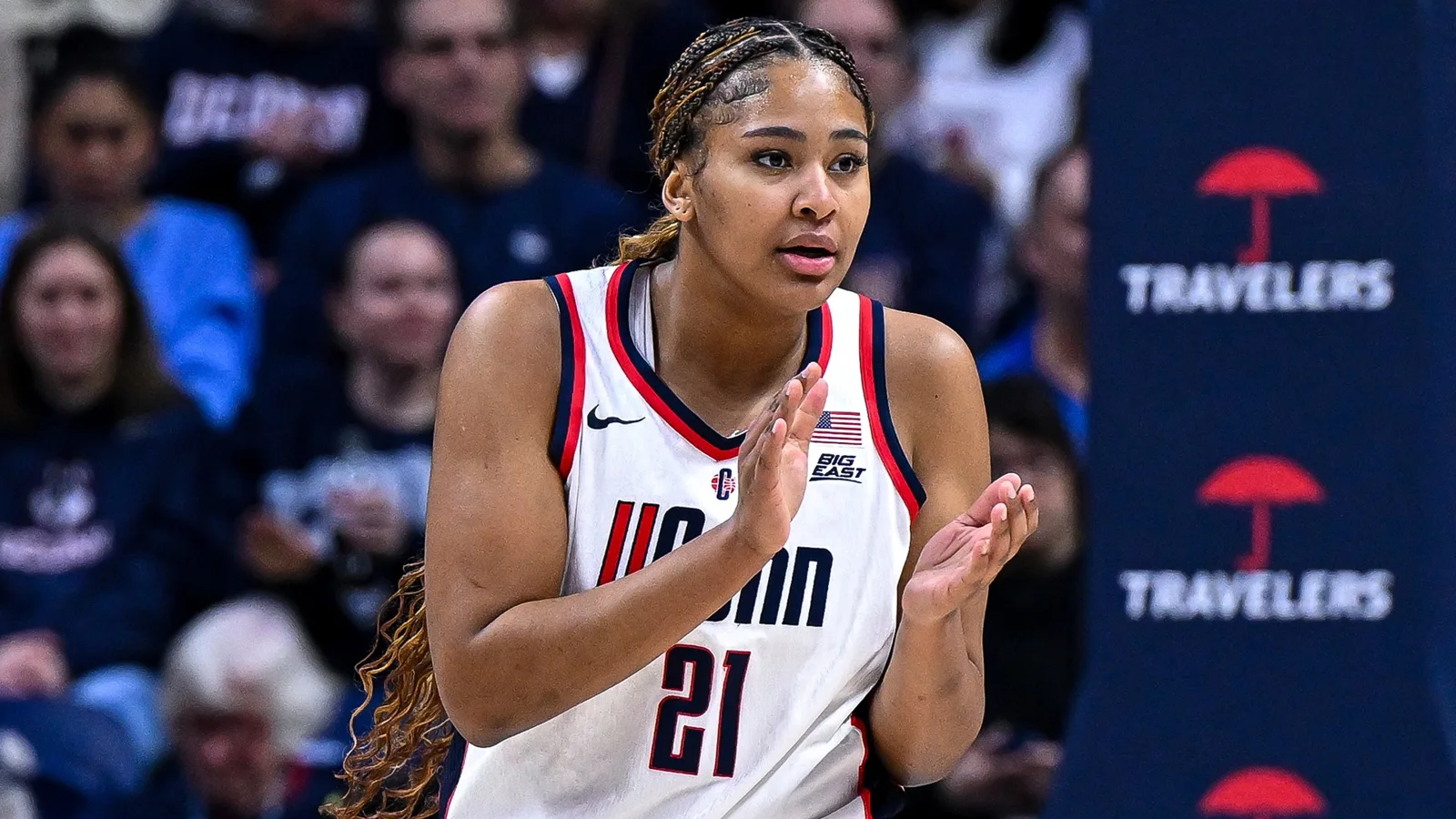
Cover archive photo: Sarah Strong during UConn's February 22, 2026 game against Providence. Photo: Simon Asher / University of Connecticut Athletics.
Sarah Strong and Joyce Edwards head our 2026-27 women's college basketball player rankings. This ten-player editorial board explains the evidence behind each place, the questions that can change the order and why JuJu Watkins needs a separate preseason watchlist assessment.
What this 2026-27 player ranking measures
This is our editorial ranking of projected NCAA Division I college impact for 2026-27, checked on October 1, 2026. Sarah Strong leads the board, with Joyce Edwards second. The numbered places below compare players who have already established themselves in college; incoming freshmen deserve their own evaluation because high-school dominance is a different body of evidence. This is neither an ESPN list nor an official NCAA award ballot.
We value efficient offense, the ability to create an advantage for teammates, defensive responsibility and a role that should translate against strong opponents. Those categories do not form a hidden mathematical score. They guide a judgment that readers can challenge. A forward who finishes, passes and protects the rim can rank above a guard with a higher scoring average. A creator carrying difficult late-clock possessions deserves credit that a raw field-goal percentage may miss.
Every statistical line belongs to its stated season or publication date. For example, UConn's April 2 announcement describes Strong's 2025-26 production at the time of her AP award. That snapshot is useful evidence; it does not describe games that had not yet happened. Current school assignments are checked against 2026-27 team pages, including UConn's roster.
Treat adjacent spots as a discussion within a tier. Blakes, Hidalgo and Booker solve different problems for their teams; the order is a projection of overall college influence, rather than a prediction that one must win every individual matchup. Team success contributes context but does not settle the comparison. A deep supporting cast can improve efficiency, while an isolated creator may face harder shots every night.
Availability needs a separate treatment. We do not turn a roster listing into medical clearance or guess a recovery date. JuJu Watkins therefore has a dedicated watchlist discussion after the ten-player board. That distinction preserves her extraordinary ceiling without pretending that an October forecast can establish her coming workload.
Sarah Strong and Joyce Edwards set the two-way standard
The first two places reward forwards who contribute in several phases of a possession. Their scoring matters, but the separation comes from what remains when the defense takes away a first option. Rebounding, defensive range and quick decisions give a team ways to win without demanding the same shot every trip.
No. 1 Sarah Strong, UConn
Strong's official UConn bio lists 699 points, 293 rebounds, 146 assists, 130 steals and 62 blocks in 38 appearances in 2025-26. The current roster lists her as a junior. Those totals describe a player whose influence extends beyond finishing a designed scoring opportunity. The 146 assists are especially useful in a forward comparison: scoring and connecting the offense can coexist.
The bio records 16 points, 20 rebounds, six assists and four blocks against Michigan on November 21, 2025. That example supports the breadth of her game more convincingly than an isolated scoring high. It does not establish a tactical claim about every possession, but it demonstrates multiple contributions against a major opponent. A ranking that valued only points would miss much of that performance.
Our No. 1 projection rests on that breadth. Against a packed paint, a frontcourt player must choose between forcing a shot and moving the ball before the defense resets. Against a small lineup, defensive rebounding is what allows size to become an advantage rather than a vulnerability in space. Strong has evidence in both areas; the next question is how much additional responsibility she can take while preserving efficient decisions.
A larger scoring role is not automatically an improvement. Watch whether UConn gets good shots after opponents commit extra help to her, and whether she continues contributing defensively when the ball is elsewhere. That is a tougher standard than demanding another award. For the distinction between her past honors and other national recognitions, see our 2026 player-of-the-year guide.
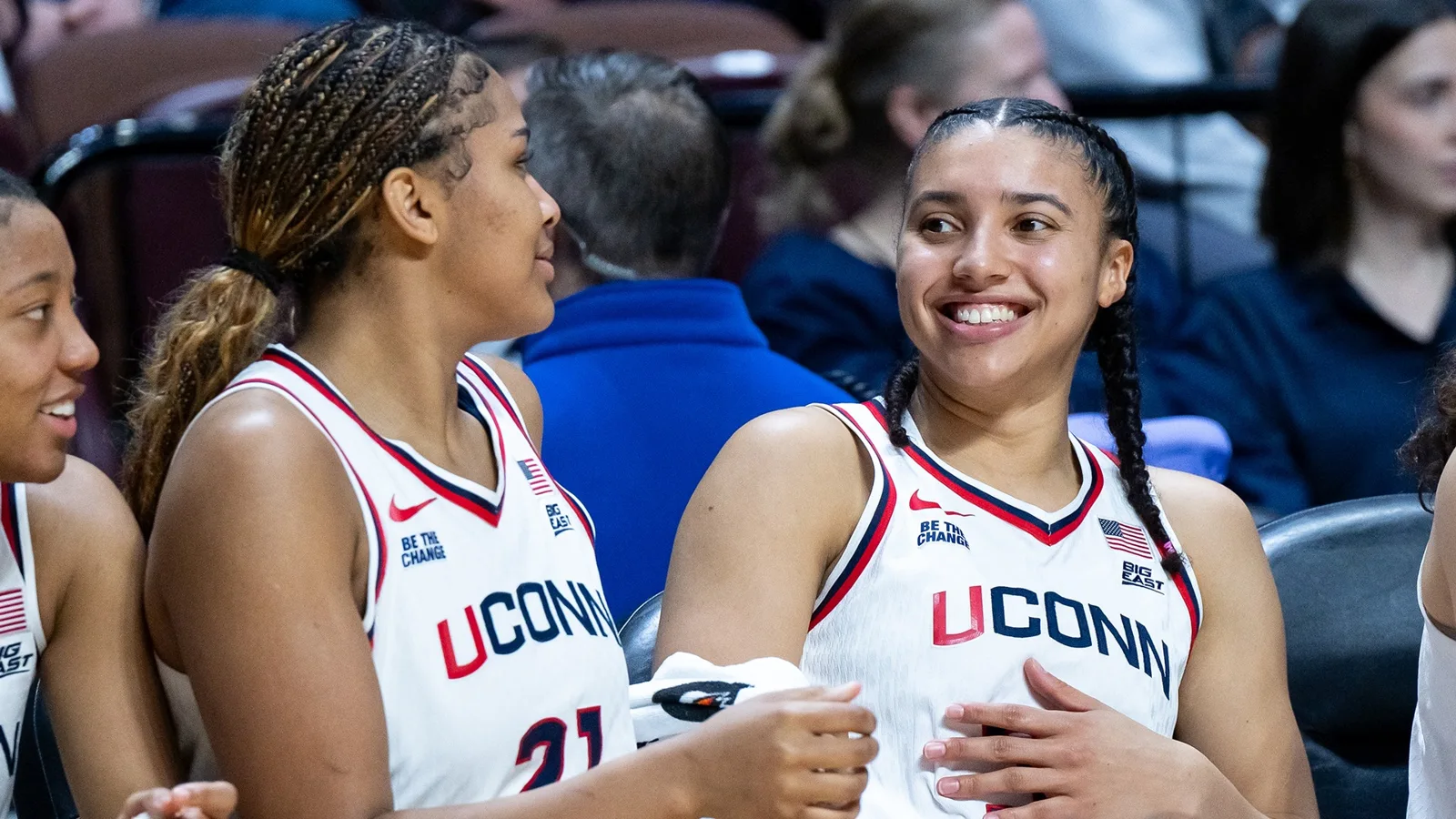
No. 2 Joyce Edwards, South Carolina
South Carolina's current bio lists Edwards as a junior and records 19.2 points and 6.8 rebounds per game on 57.1% shooting in 2025-26. She contributed 2.9 offensive rebounds per game. Her 24 points and 12 rebounds in the Elite Eight against TCU are also confirmed in the opponent's official report.
Offensive rebounding helps explain why we place her above several spectacular perimeter scorers. A missed first attempt can become another scoring opportunity without asking the offense to manufacture a new advantage from a standing start. Edwards' established efficiency gives that extra chance real value. Her influence therefore includes both the original finish and the possibility of recovering a possession that appeared lost.
The difference from Strong is a close editorial judgment about the breadth of creation. Edwards can take first place if she makes increasingly difficult half-court touches productive: finish when single-covered, recognize help early and preserve the spacing needed for the next pass. Those are evaluation questions for the coming season, not claims that every coverage has already been solved. Strong and Edwards begin in the same leading tier.
Three creators can change a game in different ways
The next tier brings the ranking's most interesting comparison. How should a national scoring leader, a guard with extraordinary defensive disruption and a forward who can organize possessions compare? Their teams ask different things from them. We prefer to explain the problem each can solve before treating a one-place gap as a precise measurement.
No. 3 Mikayla Blakes, Vanderbilt
Vanderbilt lists Blakes as a junior and records a nation-leading 27.0 points per game and 918 total points in 2025-26. The SEC-only average was 30.5, a separate sample. She scored at least 30 in 13 games and had 25 points and 10 rebounds in the NCAA second-round victory over Illinois. Her scoring case is established across much more than one headline performance.
That burden moves her ahead of the other creators here. An offense with a player capable of producing difficult points has a way out when the initial action stalls. There is a difference between finishing an open shot and being responsible for finding a workable attempt when the defense has removed the first two options. The latter responsibility deserves weight even before a box score reveals who received the final assist.
Her next-season test is the quality of decisions when opponents start their help earlier. A quick pass out of a double can be the best offensive play even if it lowers her scoring total. Equally, declining a difficult attempt does little good if a teammate receives the ball too late to act. We will look for a sustainable balance between aggression and the timing of the release, rather than ask her to increase an already immense average.
Ranking Blakes third expresses confidence in the value of proven scoring responsibility. It does not say she must lead every statistical category or that the points automatically make Vanderbilt the third-best team. Individual creation and the quality of the surrounding lineup are related questions, with different answers.
No. 4 Hannah Hidalgo, Notre Dame
Notre Dame's 2026-27 Hidalgo bio lists a senior guard and full 2025-26 averages of 25.3 points, 6.9 rebounds, 5.2 assists and 5.6 steals. In the March 27 NCAA game against Vanderbilt, she had 31 points, 11 rebounds and 10 steals. That single-game line illustrates her unusual scope; it should never be confused with a season average.
Steals provide both a stopped possession and the chance to attack before a defense becomes organized. That is why disruptive defense can add offensive value beyond the points a player personally scores. Hidalgo's scoring and passing evidence means the extra opportunities need not end with a single predetermined finish. Her ranking rewards a combination of creation and possession-changing events.
Still, evaluating defense requires looking past steals. A gamble that fails can create a difficult rotation for the rest of the team; a disciplined possession may produce no individual statistic at all. The practical question is whether pressure continues improving team possessions against opponents who protect the ball. Fans should examine the sequence after both a successful swipe and an unsuccessful attempt, rather than tally highlights alone.
We place her close to Blakes because their strengths can tilt the same matchup in different directions. Hidalgo can rise if she combines that pressure with efficient half-court choices against size. A big scoring night that requires many difficult attempts would be less persuasive than a game in which she creates clean chances for several teammates while maintaining defensive responsibility.
No. 5 Madison Booker, Texas
Booker's senior-season bio includes a Texas NCAA tournament record of 40 points against Oregon in the March 22, 2026 second round. The final 2025-26 statistics show 18.9 points and 6.7 rebounds per game, 144 assists and 50.9% field-goal shooting. Her three-point line was 23-for-81, or 28.4%; an older season's percentage should not replace it.
Her appeal in this tier is that frontcourt size and playmaking do not need to be traded against each other. A forward who makes the next pass can help an offense survive pressure without immediately substituting a smaller handler. That creates possibilities for lineup balance, but the surrounding spacing still matters. Extra defenders can crowd a creator whose teammates cannot punish the help.
The perimeter number gives us a specific development question rather than a reason to dismiss her. Watch the attempts as well as the makes: are shots available in rhythm, does the defense respect them, and does that respect create better driving or passing opportunities? A few hot games against modest opposition should not settle the answer. Sustained decision quality against strong defenses would make a more convincing case for Booker to move into the top three.
The next tier rewards backcourt growth and frontcourt versatility
These three players have already moved beyond a prospect label. The question is how much more responsibility their established strengths can support. A national top-ten projection should require college evidence, while leaving room for growth that has a recognizable basketball purpose.
Nos. 6 and 7 Jaloni Cambridge and Olivia Olson
Ohio State's Cambridge bio lists the current junior with 2025-26 averages of 23.2 points, 5.6 rebounds and 4.4 assists in 35 starts. She scored 41 against both Illinois and Notre Dame. We rank her sixth because that scoring and playmaking combination establishes a high floor, with room to influence more than her own shot total.
Cambridge's next step should be judged when the first advantage disappears. The ability to score quickly is valuable, but an opponent that gets back and protects the paint changes the assignment. A guard must then preserve the possession, shift the defense and decide when to restart an action. Those choices are where a strong scorer can become a more complete offensive organizer. A lower-scoring game with cleaner team possessions can provide better evidence than another huge total.
Olson takes seventh. Michigan's March 3 award announcement recorded 19.6 points per game through 29 appearances and her game-winning layup with three seconds left in the February 25 overtime win at Ohio State. This is a regular-season snapshot. The current roster lists Olson, Syla Swords and Mila Holloway as returning juniors.
That surrounding continuity makes shared responsibility a useful evaluation lens. Olson does not need to dominate every possession to become more influential. Watch whether she attacks a defense after the first teammate has moved it, and whether Michigan can produce efficient attempts when opponents deny her preferred initial touch. The late-game example supplies proof of a decisive outcome; it does not justify predicting a game-winner every week. Cambridge's larger full-season creation sample earns the slight edge in our order.
No. 8 Toby Fournier, Duke
Duke's current Fournier bio records 17.3 points and 7.9 rebounds per game, 78 blocks and 36 starts in 2025-26. It also records 22 points and nine rebounds in the March 27 Sweet Sixteen win over LSU. The evidence supports a frontcourt player with substantial scoring responsibility and influence around the basket, rather than a ranking built on highlight potential alone.
Her development question concerns the decisions surrounding the finish. If a defense brings a second player to the ball, the first pass must preserve the advantage rather than simply remove pressure. If she protects the rim, the possession still needs a rebound to become a completed stop. We will weigh those sequences together. The 78 blocks matter, but a broader evaluation asks whether her defensive presence leaves Duke in good position after the contest.
Fournier sits below the leading creators because our board gives extra weight to proven responsibility for organizing an offense. She can narrow that gap through more effective decisions under crowded coverage while retaining her frontcourt value. That is a specific route upward, with no need to invent a new position or assume an unverified change in Duke's system.
New context can reshape the last two places
The end of a top-ten board should reward evidence without assuming identical circumstances. A transfer can retain her strengths while changing shot volume. A returning player can contribute more effectively with a different distribution of offensive responsibility. Those changes require observation once games begin.
No. 9 Audi Crooks and No. 10 Jazzy Davidson
Oklahoma State's current roster lists Crooks as a senior center. Her 2025-26 production came at Iowa State: 25.8 points and 7.7 rebounds per game on 64.9% field-goal shooting. Readers who remember her in a Cyclones uniform should distinguish that historical record from her coming Cowgirls role. The established efficiency is central to her ninth-place ranking.
A productive post scorer gives a defense a choice. Single coverage risks a quality attempt close to the basket; help creates the possibility of an open teammate. The pass out is where individual production can become team value. For Crooks, watch how quickly the new offense recognizes those opportunities and how well the lineup completes stops at the other end. We do not assume a new team automatically fixes every constraint attached to a center's role.
Davidson ranks tenth after a freshman season with several responsibilities. USC lists her as a sophomore. Its final 2025-26 table records 574 points, 132 assists, 64 steals and 63 blocks in 32 games. She shot 40.0% from the field and 29.6% from three. That combination establishes broad involvement while leaving a clear efficiency question.
A changed distribution of touches could help or hurt the projection. More support may produce easier attempts, yet contributing without the ball demands different timing and choices. Track whether she remains involved in the advantage after passing: relocate into space, become available for the next decision and defend the ensuing possession. Her ranking can improve through better offensive efficiency while her scoring average stays level. That possibility is why we evaluate the whole job rather than forecast another identical box score.
Why JuJu Watkins belongs on a separate watchlist
Watkins has a demonstrated college ceiling high enough to challenge the first place on this board. Her placement here is a decision about the uncertainty of a preseason projection. We are keeping the performance case visible while waiting for competitive evidence about her coming role. She is an additional watchlist player, outside the numbered ten.
USC's current bio lists her on the 2026-27 roster and states that she redshirted 2025-26 because of injury. The last played college season in that record is 2024-25, when she averaged 23.9 points and 3.4 assists, made 63 three-pointers and converted 218 free throws. USC's September 28, 2025 announcement explained the decision to spend the following season on recovery.
That scoring history is substantial. The combination of perimeter attempts and free throws gives several possible routes to pressure a defense; it is a stronger foundation than simply assuming a familiar star must reclaim a past award. But repeating those numbers would require actual playing opportunities and a suitable offensive role. Neither a roster appearance nor an optimistic general description of a team supplies a future minutes total.
USC's June 2026 outlook includes Watkins, Davidson and incoming Saniyah Hall in its offensive talent discussion. Sharing the ball among several creators could reduce one player's volume while improving the quality of the group's possessions. The opposite is also possible if responsibilities remain unclear. That is a basketball fit question to study after lineups become observable.
Fans can evaluate the actual role without attempting a diagnosis. Follow confirmed team announcements, then look at the minutes she plays, the responsibility she receives and the efficiency of those possessions over several games. A single highlight or one early box score cannot establish a season-long workload. Once competitive evidence supports the comparison, she can enter the ranked board at a level consistent with that evidence, including its very top.
What should move these rankings after games begin
A useful preseason board offers questions that can be answered, not permanent positions to defend. Start with actual responsibility: who begins possessions, who takes the decisions after help arrives and who is trusted to finish close games? Then study whether that role remains productive against a stronger opponent. November points alone will not resolve every comparison.
One confirmed early opportunity is UConn at Ohio State on November 12, 2026. Strong and Cambridge play different positions, so the matchup should not become a simplistic individual winner-and-loser contest. It can still show how each handles the demands created by a strong opposing lineup. Review the quality of the possessions, including the decisions after a star draws help.
Use three checks when assessing a possible riser. First, separate more shots from better offense: Crooks can benefit from cleaner touches without repeating every old scoring total. Second, credit the pass that creates an advantage even when another teammate makes the final assist. Third, finish the defensive evaluation with a rebound or an opponent's shot outcome; a block or attempted steal is only part of the possession.
Give those checks several games. One unusually hot perimeter night can exaggerate improvement, just as one poor shooting night can hide good decisions. The more persuasive change is a repeatable role against different coverages and good opponents. For a player carrying Blakes' scoring burden, creating easier attempts for teammates may be the development that matters most. For Davidson, a more efficient shot diet could be more meaningful than a higher average.
Use the women's college basketball TV schedule to choose the next viewing opportunity and the scores page to find the result. Return to the official box score for the statistical details. By conference play, demonstrated responsibilities should carry more weight than this October order.
Join the conversation
Share a question or a thought about the women's game. Comments are reviewed before they appear. Keep it friendly, stay on topic and leave out personal information.
No comments yet. Start the conversation.
Sign in with Google to leave a comment. Your email address is not displayed with your comment.