The complete 2025-26 UCLA championship roster
UCLA's 2026 women's basketball championship roster was its 2025-26 team: twelve players coached by Cori Close. Lauren Betts, Kiki Rice, Gabriela Jaquez, Charlisse Leger-Walker and Gianna Kneepkens formed the experienced core, with Angela Dugalić and Sienna Betts also listed in the frontcourt. The complete roster included Christina Karamouzi, Lena Bilić, Timea Gardiner, Amanda Muse and Megan Grant.
These Bruins finished 37-1 and won the program's first NCAA women's basketball championship. UCLA also won an AIAW national title in 1978, a separate achievement from the NCAA-era trophy. The university's championship report identifies Close's fifteenth season as the one that produced the NCAA breakthrough.
The table uses the official archived 2025-26 roster, including that season's classes and positions. A graduate designation describes the player's listed academic class; it does not imply that she arrived at UCLA that particular year.
| No. | Player | Position | Height | 2025-26 class |
|---|---|---|---|---|
| 1 | Kiki Rice | Guard | 5-foot-11 | Senior |
| 3 | Christina Karamouzi | Guard | 5-foot-11 | Freshman |
| 5 | Charlisse Leger-Walker | Guard | 5-foot-10 | Graduate |
| 8 | Gianna Kneepkens | Guard | 6-foot | Graduate |
| 9 | Lena Bilić | Guard/forward | 6-foot-3 | Freshman |
| 11 | Gabriela Jaquez | Guard | 6-foot | Senior |
| 16 | Sienna Betts | Forward | 6-foot-4 | Freshman |
| 30 | Timea Gardiner | Forward | 6-foot-3 | Senior |
| 32 | Angela Dugalić | Forward | 6-foot-4 | Graduate |
| 33 | Amanda Muse | Forward | 6-foot-4 | Redshirt sophomore |
| 43 | Megan Grant | Guard/forward | 5-foot-10 | Senior |
| 51 | Lauren Betts | Center | 6-foot-7 | Senior |
Eight of the twelve players were listed as seniors or graduate students. Karamouzi, Bilić and Sienna Betts were freshmen, while Muse was a redshirt sophomore. The class distribution shows how much college experience the roster contained alongside its first-year players. It also explains why the two players named Betts must be distinguished: Lauren was the senior center, Sienna the freshman forward.
The useful roster question is how the players' roles fitted together across the championship season, from the starting lineup to the reserves. The separate 2026 NCAA bracket article covers the game-by-game title run. Here, the complete list supplies the starting point for understanding the personnel behind those results.
The starting five began with Betts and two lead guards
UCLA's principal starting group paired Lauren Betts with Rice, Leger-Walker, Kneepkens and Jaquez. Their season starting totals show the continuity: Leger-Walker and Jaquez started all 38 games, Betts and Kneepkens started 37 each, and Rice started 36. The combination joined an interior scorer and defender with several players capable of passing, shooting and making decisions around her.
Lauren Betts anchored the interior
The official Lauren Betts biography identifies her as UCLA's leading scorer and rebounder. She started all 37 games in which she appeared, shot 58.2 percent from the field and averaged 2.1 blocks. Her 27.7 minutes per game represented a substantial interior assignment without requiring her to play every minute available.
Betts also averaged a career-high 3.2 assists. That figure broadens the description of her offensive role. A center who can convert chances near the basket and move the ball to teammates gives the surrounding guards more to work with than a finishing target alone. Her passing contribution belongs beside her scoring efficiency when explaining how this roster functioned.
Her season included at least 600 points, 300 rebounds, 100 assists and 75 blocks, a combination UCLA's biography places alongside seasons by Breanna Stewart and Cheryl Miller. Those four categories show the range of her contribution: scoring, recovering the ball, creating baskets and contesting shots. Betts finished with fourteen double-doubles and earned both Big Ten Player of the Year and Defensive Player of the Year.
The defensive award and blocks support describing her as the interior anchor. They do not require turning every possession into a claim about a particular coverage. Her documented production already shows why a 6-foot-7 center was central to the team's structure, while the assist total explains why her influence continued when somebody else finished the play.
Kiki Rice and Charlisse Leger-Walker shared creation
Rice was UCLA's second-leading scorer at a career-high 14.9 points per game. She shot 49.0 percent overall, 38.5 percent from three and 90.2 percent at the foul line. Her completed season biography records a 2.55 assist-to-turnover ratio, the best in the Big Ten that season. Her value combined scoring with the ability to create opportunities while limiting the possessions lost through her own turnovers.
Rice's season-high performance at Minnesota provides a specific scoring example: 25 points on eight-of-nine shooting, including all three of her three-point attempts. Across her four UCLA seasons, she reached at least one hundred assists every year. The championship backcourt therefore retained an organizer with several seasons of responsibility in the same program.
Leger-Walker supplied another lead decision-maker. She started all 38 games, played 28.0 minutes per game and led UCLA with 213 assists and sixty steals. Dividing those assists by her appearances gives about 5.6 per game. Her official UCLA biography also records 35.5 percent three-point shooting overall and 39.7 percent during Big Ten games.
That shooting contribution meant Leger-Walker's role extended beyond delivering passes. She scored a season-high twenty against Duke, making five three-pointers. Rice could score efficiently, Leger-Walker could distribute at a high volume, and both could contribute away from their most familiar assignment. Their partnership gave UCLA several routes to begin an attack rather than placing every decision on one guard.
Jaquez and Kneepkens connected the inside and outside
Jaquez and Kneepkens gave UCLA two more substantial scoring threats around Betts and the lead guards. Jaquez averaged a career-high 13.5 points and 5.5 rebounds, while Kneepkens averaged 12.8 points, 3.1 rebounds and 2.9 assists. Both scored in double figures in 31 games. Their contributions were sustained features of the season rather than isolated additions on championship weekend.
Jaquez's official senior-season biography records improvements across all three shooting categories: 53.9 percent from the field, 39.0 percent from three and 86.0 percent from the foul line. She made 48 three-pointers. Describing her only through energy or effort would miss the measurable expansion of her offense.
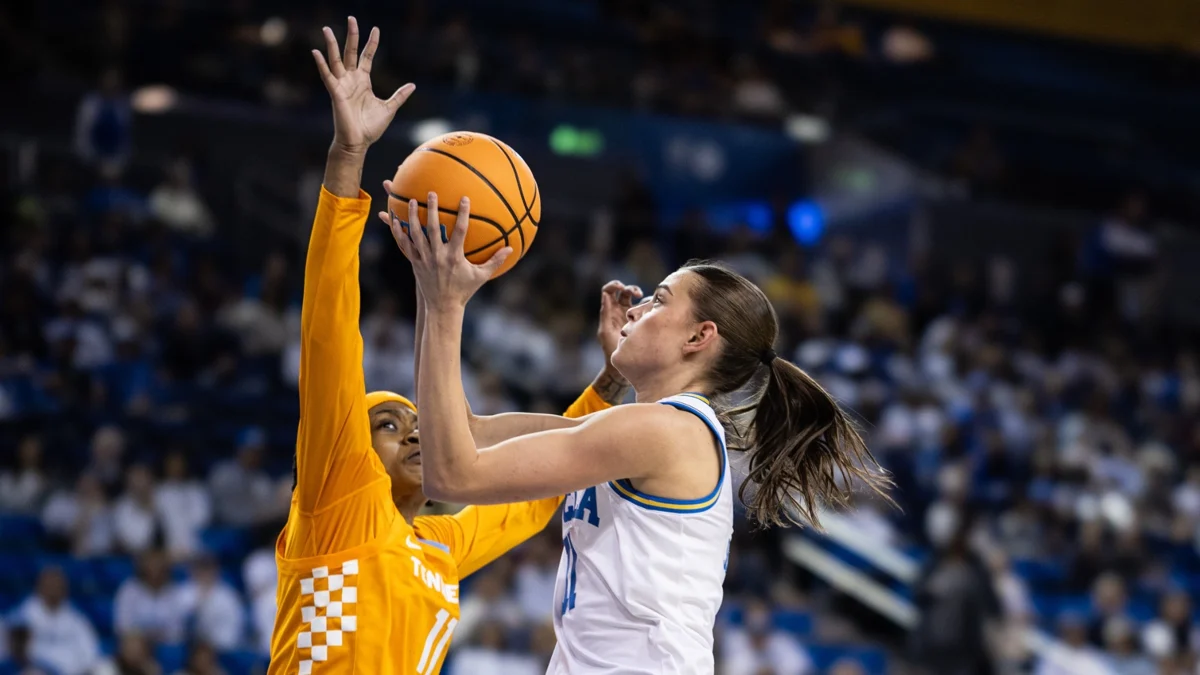
The Tennessee game on November 30 offers a concrete example. Jaquez scored a season-high 29 points and made five of six three-pointers. UCLA's official game account also describes her scoring in transition and identifies three assists. That range made her a productive participant both when the ball reached her outside and when the Bruins created opportunities closer to the basket.
Kneepkens supplied even greater three-point volume. She made 87 during the season, second most in the Big Ten, while converting 42.9 percent from long range. Her full shooting line was 49.3 percent overall and 93.3 percent at the foul line. Those numbers help explain why the Utah graduate transfer was an important addition beside a roster with an established center and returning guards.
Her UCLA season biography also records 110 assists, the first season of her college career reaching one hundred. She finished with a 2.4 assist-to-turnover ratio and twelve games without a turnover. The shooting was the most obvious threat, but her passing allowed an attack to continue when she did not take the shot.
Jaquez and Kneepkens combined for 135 made three-pointers, calculated from their respective totals of 48 and 87. That outside production supported a team whose leading scorer played center. Their own scoring threats required attention away from Betts, while their passing and finishing gave the lead guards several potential recipients rather than a single destination.
The two players also illustrate different ways to become part of a championship lineup. Jaquez developed through four seasons at UCLA and started every game of her senior year. Kneepkens joined for her final college season and started 37 times. The roster gained value from both paths: familiarity with the program on one side, and a substantial new shooting and playmaking contribution on the other.
Dugalić and Sienna Betts gave the bench different strengths
UCLA's depth included two 6-foot-4 forwards at very different stages of their college careers. Dugalić was a graduate student with substantial starting experience. Sienna Betts was a freshman whose debut came in December. Their contributions gave the Bruins additional scoring and rebounding options beyond the principal starting group.
Angela Dugalić supplied experienced production
Dugalić appeared in all 38 games but made only three starts. That was a significant role change after starting 34 of 35 appearances the previous season. Her production remained substantial: a career-high nine points per game, 5.6 rebounds and 50.2 percent shooting. The official season biography records seventeen double-figure scoring games and the Big Ten Sixth Player of the Year award.
The move to the bench therefore did not make her a marginal contributor. Her 214 rebounds were a single-season career best, and her scoring average improved. UCLA could introduce a player accustomed to major college minutes while retaining the size needed to contribute around the basket. Her season shows why a reserve designation describes a lineup decision rather than a fixed limit on a player's importance.
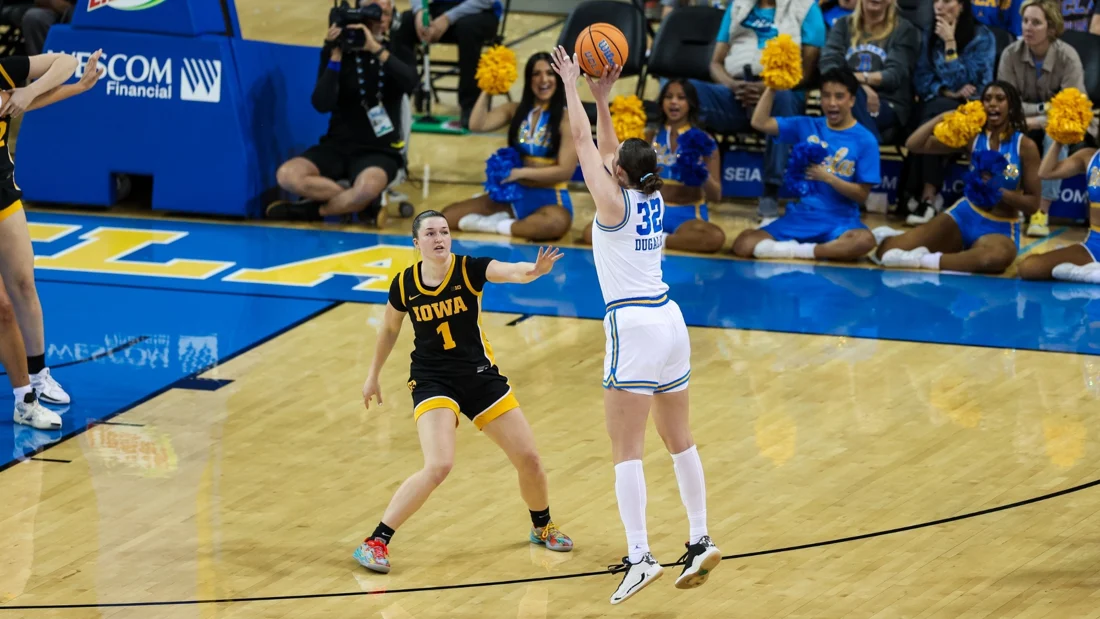
Against Iowa on February 1, Dugalić tied her career scoring high with 22 points, making nine of thirteen field-goal attempts and three of four three-pointers. She also collected a career-high five steals. The school's game report gives that performance a concrete setting: a top-ten conference matchup in which a reserve led all scorers.
Sienna Betts expanded the frontcourt rotation
Sienna's first UCLA appearance came against Cal Poly on December 16 after she recovered from a preseason injury. She played ten minutes, scored five points and recorded two assists. Her completed freshman biography records 28 appearances, averages of six points and four rebounds, and 52.9 percent shooting in 14.1 minutes per game.
Those figures distinguish her season from Lauren's. The older Betts was a senior center with 37 starts; Sienna was a first-year forward entering after the season had begun. Sharing a surname and a frontcourt does not make their responsibilities identical. Sienna gave UCLA another productive option within a shorter, developing role.
Her fourteen points against Iowa in the Big Ten title game came on seven-of-eight shooting, with seven rebounds and five assists. The passing contribution is particularly useful to the roster explanation: her work was not limited to finishing the ball when a teammate delivered it. She also produced her first college double-double with ten points and twelve rebounds against California Baptist.
Dugalić and Sienna gave the bench both established experience and a growing freshman contribution. One had already been a regular starter; the other was learning her place after a delayed debut. UCLA's championship rotation could draw on both, adding scoring, rebounding and passing without requiring the same five players to supply every useful possession.
The remaining roster and the availability picture
Bilić supplied another freshman option on the perimeter and wing. She appeared in 33 games and averaged 12.1 minutes. Her official freshman biography records a season-high fourteen points against Southern, including four three-pointers, along with six rebounds. She also scored thirteen in the Big Ten opener, showing that her contribution included productive stretches beyond a place on the roster list.
Karamouzi appeared in 26 games. The first-year guard scored her first college points against Cal Poly on December 16 and reached a season high of five at Penn State on December 31. Her season summary also records a three-pointer against Minnesota as her first postseason basket. Her role was smaller than those of the principal guards, but it was part of the same championship season.
Muse added frontcourt minutes in 34 games, averaging 9.2 per appearance. She made seventeen of 31 field-goal attempts and collected a career-high seven rebounds in the season opener against San Diego State. The official Muse biography distinguishes this playing season from 2024-25, when she did not appear. Her presence gave the roster another experienced-size option around its more prominent forwards and center.
Grant brought a different background. UCLA listed her as a senior guard/forward wearing No. 43, and her university biography identifies her as a dual-sport athlete who suited up for the championship basketball team. She was also a prominent softball player. Her inclusion completes the twelve-player basketball roster without assigning her the same playing responsibility as the starting guards.
Timea Gardiner missed the championship season
Gardiner remained on the 2025-26 roster but did not appear in a game. Her completed season biography records the medical-redshirt announcement on January 31. She should therefore be included in the championship roster and distinguished from the players who logged minutes during its games.
That distinction is particularly relevant because Gardiner had been an important reserve the previous year. In 2024-25 she averaged 7.6 points and shot 39.5 percent from three-point range. Fans remembering her shooting during UCLA's first NCAA Final Four run are remembering a different playing season. Those previous contributions do not become 2025-26 statistics simply because her name remained familiar.
UCLA's depth consequently had two dimensions: the full group representing the program and the players available to contribute on the floor. The complete twelve-name list preserves the former, while the actual appearances, minutes and medical-redshirt record explain the latter.
How Cori Close brought the roster together
The championship roster was assembled through several seasons of recruiting, retention and transfers. Rice and Jaquez were already Bruins when UCLA announced Lauren Betts's signing on April 21, 2023. Betts arrived after one season at Stanford, joining UCLA ahead of the 2023-24 campaign. Her place in the eventual championship team developed across three UCLA seasons, rather than one hurried addition before the title run.
The original signing announcement explains the basketball fit in Close's own terms. The coach wanted interior defense and scoring, and also valued Betts's passing and versatility. Those stated needs connect directly with the center's later championship-season responsibilities. The roster decision had an identifiable basketball purpose before the results supplied its reward.
Other additions followed different timelines. Leger-Walker came from Washington State, did not appear for UCLA in 2024-25 and then started every game of the championship season. Kneepkens played at Utah through 2024-25 before joining the Bruins as a graduate transfer. Their roles cannot be understood accurately by treating every transfer as a new arrival in the same summer.
The team also integrated three freshmen while maintaining a heavily experienced core. Sienna Betts entered the rotation after a delayed debut, Bilić contributed wing minutes, and Karamouzi gained opportunities in a smaller guard role. Dugalić's shift from regular starter to award-winning reserve demonstrates another kind of adaptation within the same program. Close's fifteenth UCLA season brought those different paths together.
The resulting roster had a center who scored, defended and passed; multiple guards who could organize; wings who supplied reliable shooting; and reserves capable of meaningful production. The Big Ten tournament account shows one stage of that group's season. Its full identity remains the twelve-player 2025-26 roster: returning Bruins, experienced additions and first-year players whose different responsibilities contributed to the same championship.
Join the conversation
Share a question or a thought about the women's game. Comments are reviewed before they appear. Keep it friendly, stay on topic and leave out personal information.
No comments yet. Start the conversation.
Sign in with Google to leave a comment. Your email address is not displayed with your comment.