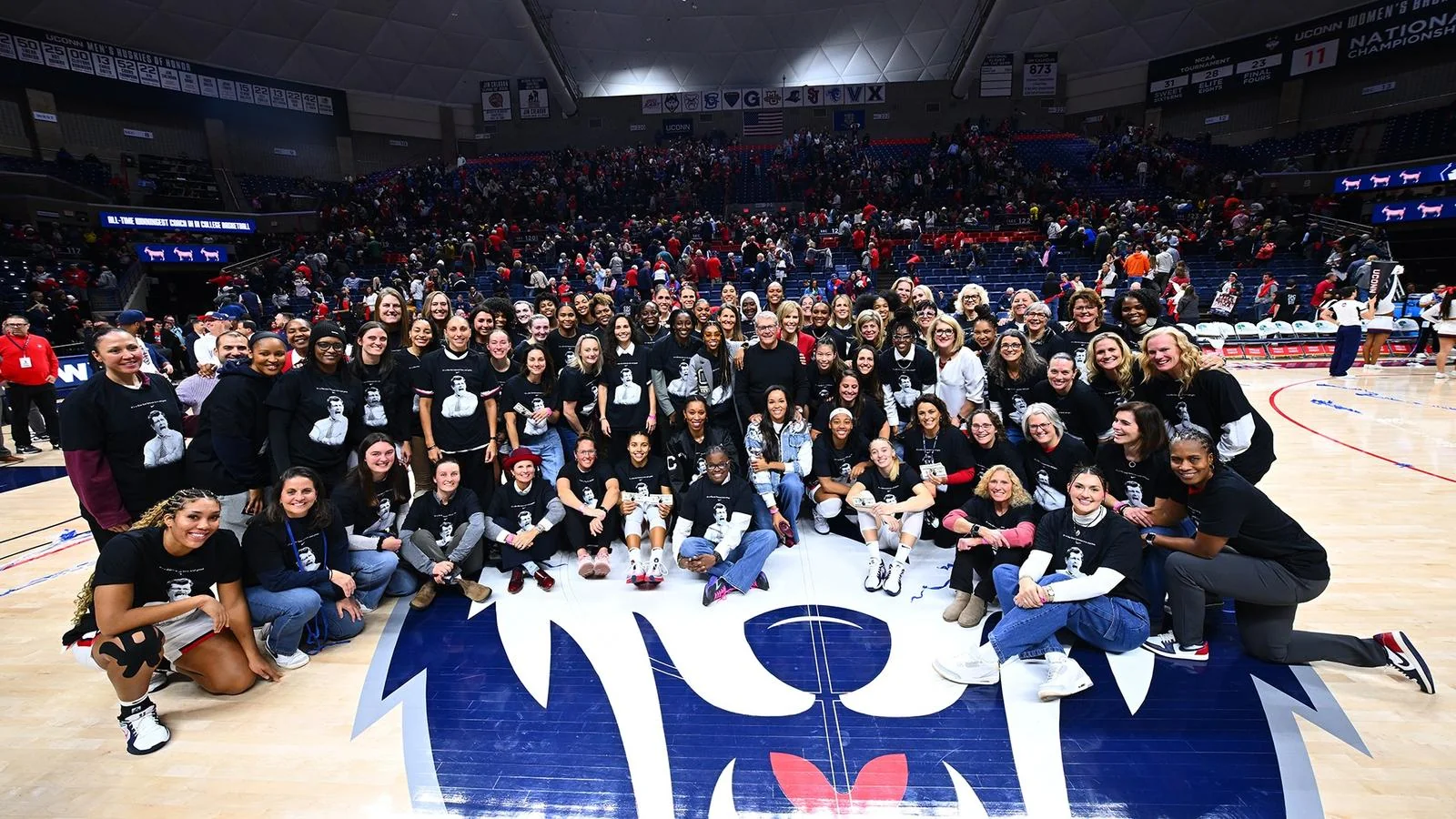
Geno Auriemma is the winningest women's college basketball coach by career victories in the all-college snapshot through the completed 2025-26 season. UConn lists his record at 1,288-166 over 41 seasons. Tara VanDerveer is second with a completed 1,216-win career, followed by Pat Summitt at 1,098, Barbara Stevens at 1,058 and C. Vivian Stringer at 1,055.
That answer needs a label. Career wins are not the same as winning percentage, NCAA tournament wins or NCAA championships. Auriemma also leads Division I women's head coaches with 12 NCAA titles, but the order changes farther down the list: VanDerveer accumulated more career wins than Kim Mulkey, while Mulkey won more championships as a head coach.
This guide separates those measurements, explains the division and era boundaries behind them, and gives fans a practical way to read future updates. All active totals are frozen at the end of 2025-26 rather than presented as live numbers.
What “winningest” actually measures
Calling someone the winningest coach sounds simple until two leaderboards give different answers. In women's college basketball, the word can refer to the largest number of career victories, the highest winning percentage, the most NCAA tournament wins or the most national championships. Each is a legitimate record, but each asks a different question. A useful comparison begins by naming the statistic, the competition level and the date through which games are counted.
Career wins and NCAA titles answer different questions
Career wins count every game a coach won in an eligible head-coaching career: November nonconference games, league play, conference tournaments and postseason games all contribute. The total therefore captures sustained success and longevity. A coach who averages 28 wins for 35 seasons has many more opportunities to build a large total than a coach who wins at the same rate for 20 seasons. Raw victories are valuable precisely because they measure production over time, but they are not a rate statistic.
Winning percentage changes the lens by dividing victories by all decisions. It helps compare efficiency across careers of different lengths, although it still reflects schedule strength, competition level and program resources. NCAA championships narrow the question much further: how many times did a head coach's team win the NCAA tournament in its division? The NCAA Division I championship history awards one champion for each completed tournament and begins with Louisiana Tech in 1982. A title is a season-ending achievement, not a synonym for every win accumulated on the way there.
The short version
Career wins reward the volume of successful seasons. Winning percentage describes the rate of success. NCAA titles count completed championship runs. One coach can lead more than one category, but the margins and the order will not necessarily match.
Scope can change the leaderboard
The level matters before any names are sorted. The NCAA coaching records book separates all-divisions records from Division I, Division II and Division III lists. An all-college table can recognize a long, dominant Division II or Division III career beside Division I careers. A Division I-only table answers a narrower question. Neither approach is inherently better; an unlabeled mixture is the problem.
Governing body and role matter too. Women's programs competed for national championships before the NCAA sponsored its first tournament in 1982. For example, the NCAA's account of UCLA's championship history distinguishes the Bruins' 1978 AIAW title from their NCAA-era achievements. That earlier championship remains part of the sport's history, but it should not be relabeled as an NCAA title. The same discipline applies to wins earned as an assistant, a player or a head coach: an article must count the role it says it counts.
This guide therefore uses an all-college career-wins snapshot through the completed 2025-26 season, then compares those totals with NCAA Division I championships credited to head coaches. Stating those boundaries makes the answer reproducible—and leaves room to appreciate achievements that fall outside this particular count.
The all-time career wins leaders after 2025-26
Using the broad all-college scope and stopping after the completed 2025-26 season, Geno Auriemma leads the women's coaching wins list with 1,288 victories. Tara VanDerveer, Pat Summitt, Barbara Stevens and C. Vivian Stringer complete the top five. The cutoff is essential: Auriemma remains active entering 2026-27, while the other four records are complete.
The top five and what their totals represent
| Rank | Coach | Seasons | Record | Pct. | College programs |
|---|---|---|---|---|---|
| 1 | Geno Auriemma | 41 | 1,288-166 | .886 | UConn |
| 2 | Tara VanDerveer | 45 | 1,216-271 | .818 | Idaho, Ohio State, Stanford |
| 3 | Pat Summitt | 38 | 1,098-208 | .841 | Tennessee |
| 4 | Barbara Stevens | 43 | 1,058-291 | .784 | Clark, UMass, Bentley |
| 5 | C. Vivian Stringer | 50 | 1,055-426 | .712 | Cheyney State, Iowa, Rutgers |
The first row comes from UConn's current Auriemma biography, which lists 1,288-166 over 41 seasons. Stanford's retirement announcement for VanDerveer fixes her final total at 1,216 wins across 45 seasons. Tennessee's official Summitt record gives 1,098-208 in 38 seasons. Those institutional records explain why a live list must not keep describing VanDerveer as the current record holder after Auriemma passed her total.
The season column adds another useful check. VanDerveer's total was built over four more seasons than Auriemma had completed at this cutoff, while Summitt reached 1,098 in three fewer seasons than Auriemma. Games per season also expanded across the history of the sport, so dividing a total by seasons is only a rough descriptive tool, not an era-adjusted ranking. The records describe what happened; they do not pretend every coach received the same number of dates, tournament rounds or institutional advantages.
The table also reveals why percentage deserves its own column. Summitt won fewer games than VanDerveer but posted the higher career rate. Auriemma combines the largest total with the highest percentage among these five. That does not erase the scheduling and era differences behind the records; it simply shows that “most wins” and “won most often” are related but separate claims.
Why an all-college list is broader than Division I
Barbara Stevens is the row that makes the scope visible. An NCAA profile credits her with 1,058 wins over 43 years in Divisions I, II and III. Most came during 34 seasons at Bentley, where her 2014 team finished 35-0 and won the Division II championship. Ranking fourth on an all-college wins list does not turn those games into Division I results. It recognizes successful head coaching across the divisions where the games were played.
Stringer's career shows a different kind of breadth. Rutgers' retirement account records 1,055 wins over 50 years at Cheyney State, Iowa and Rutgers. She became the first coach in men's or women's basketball to take three different schools to the Final Four. Her total therefore measures repeated program building across institutions as well as longevity.
That context also guards against treating fourth and fifth as lesser versions of first. Stevens' record contains a perfect Division II championship season; Stringer's contains Final Four runs with three programs. A single sorted column cannot express either achievement. It can reliably answer who won more college games within the stated scope, then invite the reader to investigate how those wins were distributed.
Neither example is an exception that should be hidden. They explain what the leaderboard is designed to do. An all-college ranking honors accumulated wins across eligible college careers; a Division I-only ranking, a single-school ranking or a titles table would answer different questions. Read the label first, then the number.
How Geno Auriemma moved to the top of the wins list
The record did not move straight from Pat Summitt to its current holder. Tara VanDerveer passed Summitt in December 2020, finished her career at 1,216 victories in 2024 and briefly held the all-time college basketball mark. Auriemma then tied her and moved ahead early in the next season. That sequence matters because an undated page can preserve an answer that was once correct long after the leaderboard changed.
Passing Tara VanDerveer changed the record holder
Auriemma earned victory No. 1,217 on November 20, 2024, when No. 2 UConn beat Fairleigh Dickinson 85-41 at Gampel Pavilion. The UConn game report says the win broke his tie with the retired VanDerveer. It was also a basketball game with a clear turning point: FDU trailed only 14-12 before UConn closed the first quarter on a 9-2 run. The Huskies eventually won the rebound count 45-29 and committed six turnovers to FDU's 18.
Freshman Sarah Strong scored 20 points, while Paige Bueckers added 16 points, nine rebounds and five assists. More than 60 former UConn players attended as the program celebrated the 40th seasons of Auriemma and associate head coach Chris Dailey. Those details put a human setting around the number: the record was the product of generations of teams, yet one current roster still had to win the game that moved it.

Longevity and winning percentage tell different parts of the story
By the end of 2025-26, Auriemma's official UConn record had reached 1,288-166 over 41 seasons, a .886 winning percentage. VanDerveer finished 1,216-271 across 45 seasons, a .818 rate. The raw gap was 72 wins. Yet the season counts show that the two careers were not built on an identical calendar: VanDerveer coached four more seasons, while Auriemma's teams played 33 fewer total decisions by this cutoff.
VanDerveer's completed Stanford biography also shows why one-school and full-career totals should not be confused. She won 1,064 games in 38 Stanford seasons after beginning at Idaho and Ohio State. Auriemma's college head-coaching wins all came at UConn. One career demonstrates sustained success across three institutions; the other pairs exceptional continuity with an unusually high rate at one program.
Percentage supplies scale, not a final verdict. Auriemma lost 166 of 1,454 decisions through 2025-26; VanDerveer lost 271 of 1,487. That helps explain how Auriemma overtook her despite starting his head-coaching career seven years later. It does not adjust for every change in schedule length, tournament size, recruiting landscape or conference strength across nearly half a century. The honest conclusion is narrower: Auriemma owns the dated wins record and the higher rate in this comparison, while VanDerveer's 1,216 remains the finished standard that he had to pass.
Why NCAA championships produce a different order
Career victories and NCAA championships overlap at the very top, but they quickly reorder the field. The reason is built into the statistics. A career-wins total adds every successful night across decades. A championship count gives the same single unit to each completed title run, whether the champion went unbeaten or survived several narrow games. Titles are harder to win and more concentrated; career wins reward the full body of work.
Auriemma and Summitt lead both measures, but by different margins
Auriemma ranks first in this career-wins snapshot with 1,288, 190 more than Summitt's 1,098. He also leads the NCAA Division I title count 12-8. The order stays the same, but the margin tells a different story. Those four extra championships represent four seasons in which UConn finished the bracket; the 190-win gap reflects many more regular-season and postseason results spread across their careers.
Summitt's Tennessee biography records 31 consecutive NCAA tournament appearances, 18 NCAA Final Fours and a 112-23 tournament record. Those figures help connect the categories. Her eight titles were the peaks of repeated postseason opportunities, while the 1,098 career wins also include the work required to keep returning. Auriemma's UConn record similarly lists 146 NCAA tournament wins alongside 12 titles. The tournament record sits between the broad career total and the narrow championship count.

VanDerveer and Mulkey reverse places when titles become the metric
VanDerveer finished second in career wins at 1,216 and won three NCAA titles at Stanford: 1990, 1992 and 2021. Kim Mulkey stood well outside the five highest career totals at 783 wins through 2025-26, but her four championships as a head coach move her ahead of VanDerveer when the table is sorted by titles. Mulkey won at Baylor in 2005, 2012 and 2019, then at LSU in 2023.
That comparison also shows why roles must be labeled. LSU's Mulkey biography describes championships she won as a Louisiana Tech player and assistant as well as a Baylor and LSU head coach. Those achievements belong in her complete biography, but only four count in a ranking of NCAA championships won as a head coach. VanDerveer's Olympic coaching record likewise does not add games to her college total.
High win totals can describe impact beyond championship count
Stringer did not win a Division I NCAA title, yet her 1,055 wins include four Final Four trips and a landmark no other coach had reached: taking Cheyney State, Iowa and Rutgers to the Final Four. Stevens' 1,058 victories include the 2014 Division II championship at Bentley, not a Division I crown. Removing them from a Division I title table is statistically correct. Treating that omission as a complete judgment on their careers would not be.
Championships depend on reaching a single-elimination tournament with a roster healthy and strong enough to beat a sequence of elite opponents. Career wins also reflect recruiting, teaching, adapting across generations and sustaining a program through ordinary conference nights. Fans do not have to choose one measure and discard the other. They should use the statistic that matches the question.
For the complete head-coach title ranking and the championship years behind it, see our guide to the women's coaches with the most NCAA championships. That article answers the title question in depth. This one keeps career wins in the foreground and uses titles to show why “winningest” needs a definition.
How to compare coaching records without flattening them
A leaderboard is most useful when a reader can reproduce its logic. Before sharing a “winningest coach” answer, run five checks. They take less time than resolving a debate built on two incompatible lists, and they keep a current record from being mistaken for a permanent one.
- Choose the category. Decide whether the question means total head-coaching wins, Division I wins, winning percentage, NCAA tournament wins or NCAA championships. Do not switch categories after seeing which name finishes first.
- Read the eligibility note. The NCAA's all-divisions record-book language can specify minimum seasons and four-year-college records. A list with a 600-win threshold is not claiming that no coach below 600 exists; it is defining what it displays.
- Confirm division, program and role. Stevens' multi-division record, VanDerveer's three-school career and Mulkey's player-assistant-head coach championship résumé show how easily labels can blur. Keep head-coach results in a head-coach table and Division II titles out of a Division I column.
- Attach a through-date. Auriemma's 1,288 wins are accurate for the end of 2025-26. Once UConn begins another season, a new victory changes the live total without making the dated figure false. Retired coaches' completed totals remain fixed unless a record correction is issued.
- Add context after the count. Use exact wins and losses, then consider percentage, seasons, competition level, Final Fours, titles and program-building. The NCAA has warned in its records books that rounded percentages can appear tied even when the underlying values are not, another reason to keep the full record beside the rate.
This method also improves era comparisons. Schedule lengths, tournament fields and the resources available to women's programs changed substantially during careers that began in the 1970s and continued into the 2020s. No simple adjustment resolves every difference. Naming the limits is more honest than inventing a precision the data cannot support.
Answer at the 2025-26 cutoff
Geno Auriemma is the winningest women's college basketball coach by career victories in this all-college snapshot, with a 1,288-166 record. He also leads the Division I head-coach championship count with 12, but those remain two separately defined achievements.
During the season, follow the site's women's college basketball scores to see which games may add to active records, or open today's schedule before tipoff. For historical comparisons, return to the source record, note its cutoff and preserve the category printed above the table.
Join the conversation
Share a question or a thought about the women's game. Comments are reviewed before they appear. Keep it friendly, stay on topic and leave out personal information.
No comments yet. Start the conversation.
Sign in with Google to leave a comment. Your email address is not displayed with your comment.