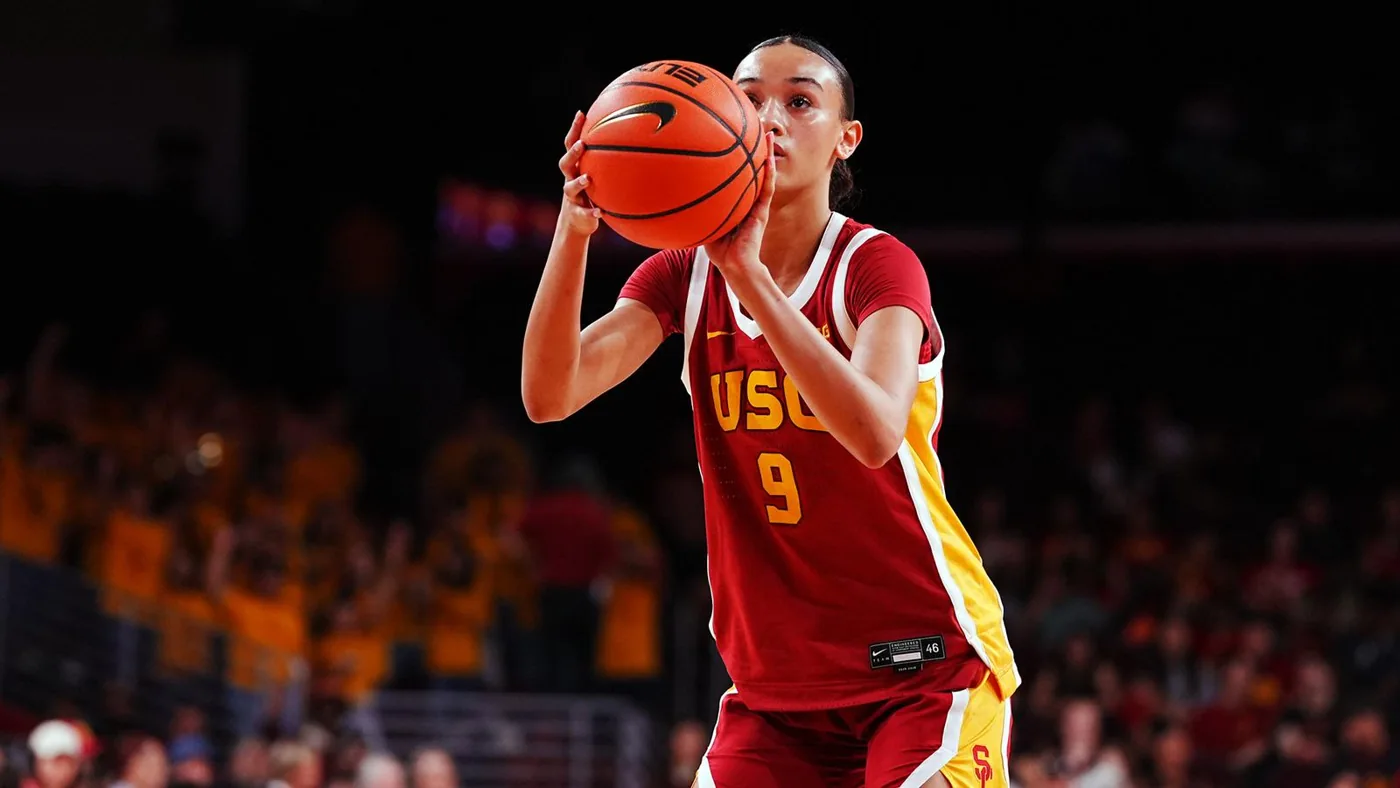
Jazzy Davidson won the major 2026 national freshman honors
USC guard Jazzy Davidson won the USBWA Tamika Catchings Award and the WBCA NCAA Division I Freshman of the Year award for the 2025-26 season. The USBWA announcement came on March 25, 2026; USC reported the WBCA honor on April 1. For the common search “NCAA women's basketball Freshman of the Year 2026,” Davidson is the name to know, with the awarding organization identified alongside the result.
The season label is essential. These honors evaluate a player's first college season, which began in 2025 and ended in 2026. They are not rankings of high school prospects graduating in 2026. A recruiting list, a preseason newcomer projection and a completed-season freshman award answer different questions, even when their headlines contain the same calendar year.
The U.S. Basketball Writers Association's announcement names Davidson as the Tamika Catchings winner. The USC announcement of her WBCA recognition establishes the second honor. Naming both avoids treating a collection of independently selected awards as one trophy issued by a single organization.
That distinction does not weaken the answer. Agreement between separate national awards adds context to Davidson's season. It shows that her impact was recognized beyond one conference or one editorial list. It also gives a reader a precise way to compare this result with previous years, when different organizations may have made different choices or used different award names.
Davidson also earned Big Ten Freshman of the Year recognition. That league award evaluates a different pool from a national Division I honor. A player can be the leading freshman in a conference without necessarily winning a national award, just as an excellent freshman can appear on an all-conference team alongside experienced players. The labels describe the scope of the judgment.
The central basketball explanation is her range of responsibility. USC asked Davidson to create points, involve teammates and contribute defensively during a season without injured star JuJu Watkins. The award announcements frame her season around that broader contribution. The following sections examine the specific honors, the statistics behind them and the NCAA tournament performance that made the argument especially clear.
What the USBWA and WBCA awards actually recognize
“Freshman of the Year” sounds self-explanatory until two announcements use different names. In women's college basketball, the award body matters. The USBWA represents basketball writers and other media professionals; the Women's Basketball Coaches Association is a separate organization. Their choices can be discussed together, but the names and histories should remain distinct.
The Tamika Catchings Award has its own history
The USBWA has selected a national women's freshman player of the year since 1991-92. The award took the Tamika Catchings name in 2020-21. Catchings won the association's freshman honor at Tennessee in 1997-98, connecting the current award name to a player who had herself been recognized at the same stage of her college career. The history appears in USC's USBWA award announcement.
The name change creates a small research trap. A list headed only “Tamika Catchings Award winners” may emphasize recent seasons, while the association's freshman-award lineage extends further back. A comparison with an older player should therefore state whether it covers the full USBWA honor or only the period under its current name. Otherwise, a reader can mistake a renamed award for a recently created category.
Davidson's 2026 selection belongs to that continuing freshman-award history. It does not mean she received Catchings' college statistics, played the same position in the same way, or has been projected to reproduce her professional career. Award names establish a tradition; evidence from Davidson's own season explains the individual selection.
WBCA recognition is a separate coaches' award
The WBCA honor recognizes the leading NCAA Division I freshman or redshirt freshman. USC's account of the award states that conference freshman players of the year are considered, while a conference without such an award may nominate a player. That is a defined newcomer category, rather than an unrestricted award for every player in the country. It also explains why a league freshman award is relevant to the national process.
The phrase “NCAA Division I” identifies the competition being evaluated. The full title still identifies the WBCA as the awarding organization. That is different from a national tournament Most Outstanding Player award, which concerns performance in a specific championship competition. A first-year player could excel over a season without reaching the Final Four, and a veteran could earn tournament recognition without being eligible for a freshman honor.
For an accurate historical note, record three things together: Davidson, 2025-26, and the particular organization. That makes comparisons meaningful and prevents a future recruiting projection from displacing a completed award result. No published vote margin is needed to explain why the two national honors are separate achievements; their identities and criteria already establish the distinction.
The all-around season behind Davidson's selection
Davidson finished her freshman season with 574 points, 179 rebounds, 132 assists, 64 steals and 63 blocks across 32 appearances, according to USC's completed-season award report. The familiar averages were 17.9 points, 5.6 rebounds and 4.1 assists. The combination is more revealing than a scoring rank alone: she supplied offense, helped finish defensive possessions and produced recorded disruptions at both the passing and shooting stages.
Her role developed under unusual pressure. USC played the 2025-26 season without injured All-American JuJu Watkins, and Davidson assumed a central place in the lineup. That context helps explain why an award case built around responsibility was persuasive. It does not mean one player replaced every aspect of Watkins' game. A team redistributes opportunities and duties across its rotation, while Davidson's totals show how much of that work she personally carried.
USC reported that Davidson led the team outright in points, rebounds, assists, steals and blocks during the regular season. Keep that scope attached to the claim. It is a regular-season distinction, while the final totals above include her completed campaign. Mixing the two without a label would make a useful achievement less precise. The school's season summary supplies both pieces of information.
Read the rounded averages alongside the season totals
The defensive averages deserve a small but meaningful calculation. Sixty-four steals divided by 32 games is exactly 2.0 per game. Sixty-three blocks divided by 32 is 1.96875, which rounds to 2.0 at one decimal place. Thus the published line of 2.0 steals and 2.0 blocks is a rounded statistical description. It should not be rewritten as proof that both unrounded averages were at least two.
That clarification preserves the significance of her production. Nearly two blocks per game from a guard is part of an unusually broad contribution, and it can be discussed without stretching the arithmetic. Blocks and steals also record particular successful defensive events; they do not count every rotation, contested shot or correctly executed possession. An award assessment can acknowledge those strengths while avoiding a claim that two columns measure the whole of defense.
Assists require similar care. Davidson's 132 assists establish substantial creation for teammates, but they are not the number of possessions she initiated or the total quality of every decision. Rebounds do not reveal where she started each possession. The strongest reading is the combined one: several categories show that her contribution did not disappear when her own shot missed. That range gives fans a concrete explanation for the national recognition beyond the phrase “talented freshman.”
Her NCAA tournament debut made the case concrete
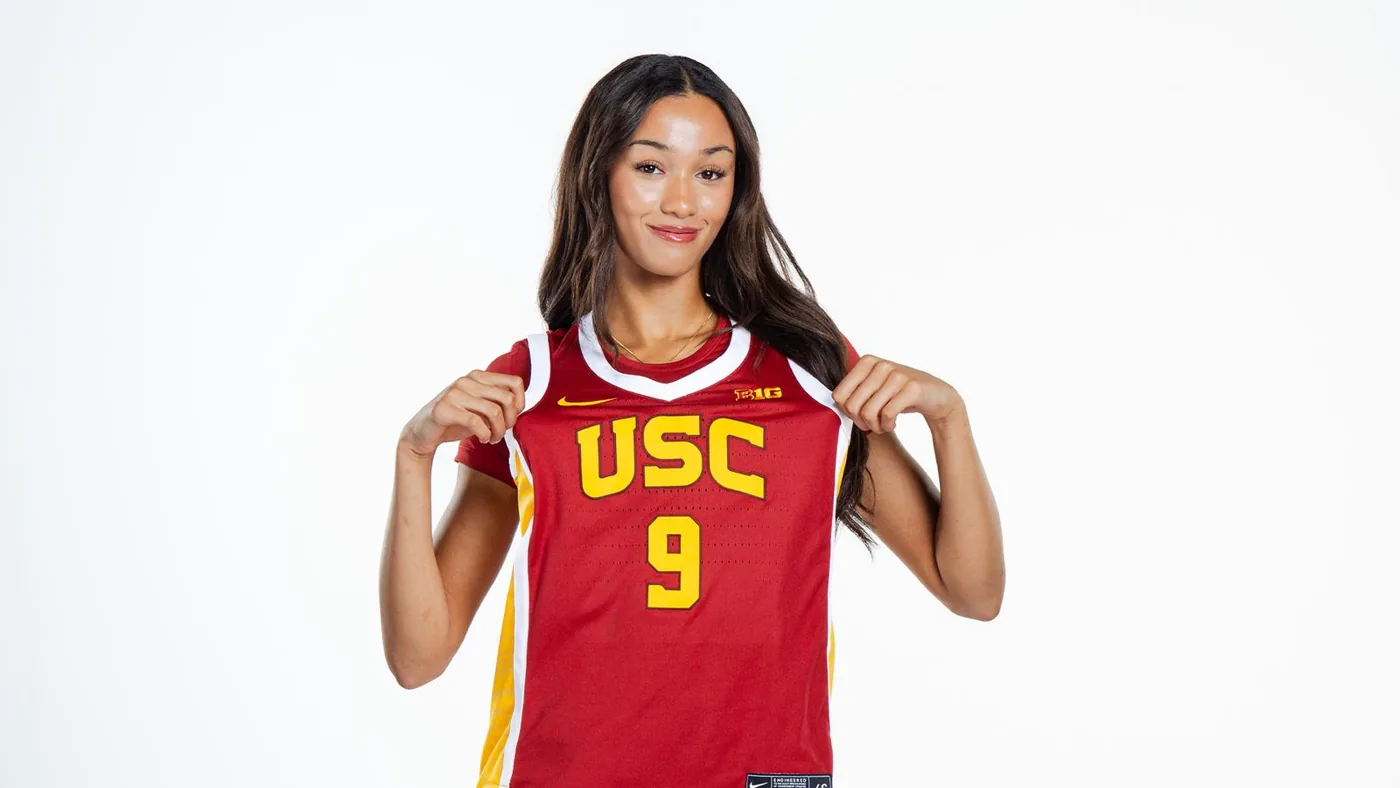
Davidson's first NCAA tournament game turned the season-long argument into a specific elimination-game example. On March 21, USC beat Clemson 71-67 in overtime in Columbia, South Carolina. Davidson scored 31 points, collected six rebounds and delivered five assists. The Trojans' game report records a debut in which the freshman carried substantial scoring responsibility while USC's season was on the line.
The score's progression matters. USC trailed 43-39 after three quarters, then outscored Clemson 22-18 in the fourth to reach overtime. The Trojans won the extra period 10-6. This was not a high-scoring cameo after the outcome had been settled. Davidson's contribution accumulated through a game that required 45 minutes and remained competitive into the added period.
The official box score credits her with all 45 minutes, 13 made field goals in 28 attempts and four threes in ten attempts. Thirty-one of USC's 71 points is approximately 43.7 percent, calculated by dividing 31 by 71. That measures her share of the team's recorded scoring; it does not include an invented estimate of every point she influenced through passing or off-ball movement.
There were costs alongside the production. Davidson also had six turnovers. Keeping that number in the picture produces a more useful assessment than treating a freshman-award performance as flawless. A player handling major creation duties can produce both important baskets and possessions that fail. The box score establishes the balance of recorded outcomes without allowing a reader to infer the precise cause of each mistake.
Clemson's report of the same contest confirms Davidson's 31-point night from the other side of the matchup. That cross-check is especially helpful for a player-centered article: the achievement was central to the game itself, rather than only to an award announcement that revisited it later.
The performance strengthens the explanation for her recognition, but it should not replace the season. One NCAA game cannot independently establish who was the best freshman across an entire winter. Its value is as a concrete demonstration of responsibilities already visible in Davidson's season totals: create offense, remain involved beyond scoring and keep making decisions in a game without a comfortable margin. The national honors recognized the broader campaign that gave that debut its context.
How to place the award in USC and college basketball history
Davidson followed a recent USC winner without simply repeating the same season. JuJu Watkins received the USBWA freshman award for 2023-24; Vanderbilt's Mikayla Blakes won for 2024-25; Davidson won for 2025-26. The association's award history connects those names within one specific honor. It is a useful lineage, rather than a complete ranking of their college careers.
For USC, the connection is especially striking because Watkins and Davidson were teammates in 2025-26, even though Watkins was unavailable through injury. Two highly regarded newcomers arriving in nearby seasons did not encounter identical circumstances. Davidson's responsibility grew within that particular roster situation. Comparing their awards is reasonable; assuming their opportunities, supporting casts and game-to-game duties were interchangeable is less informative.
Davidson's league recognition also preceded her NCAA debut. USC announced the Big Ten freshman honor on March 3, before the March 21 Clemson game. Its conference-award report documents an established case from the regular season. The NCAA performance added a vivid example to a body of work that was already recognized, rather than creating her reputation in a single afternoon.
A freshman honor is a completed-season judgment
Award history works best when its boundaries remain visible. The USBWA shared its 2020-21 freshman honor between Paige Bueckers and Caitlin Clark, illustrating that the record can contain a joint selection. Other organizations maintain their own lists. Combining those lists into one supposed unanimous sequence would erase information about how the sport recognized different players.
The award is also not an all-time career ranking or a guarantee about the next season. A freshman has only one opening college campaign, while improvement, injuries, teammates and responsibilities can change after it. Davidson's honors establish what she achieved in 2025-26. Assessing her 2026-27 role requires current evidence, and identifying the 2027 freshman winner requires that newer class to actually play its season.
That separation is useful for fans following rising talent. A recruiting ranking asks about expected potential before college performance has accumulated. A freshman award asks what a first-year player contributed within an observed season. A national player award compares a wider group that includes experienced players. Each can be meaningful without being substituted for the others.
For the current player landscape, the site's 2026-27 players guide provides the next-season context. For this completed award question, the answer remains specific: Jazzy Davidson, USC, the 2025-26 campaign, with both USBWA and WBCA national freshman recognition. The statistics and Clemson performance explain why that answer carries more substance than a name alone.
Conference history adds another reason to preserve the exact label. USC's announcement places Watkins' earlier league newcomer honor in the Pac-12, while Davidson's came in the Big Ten. Both are USC achievements, but they were earned within different conference settings. A school record can connect them without pretending the surrounding competition and award process were identical. The national USBWA list provides the more consistent organization-specific comparison across that change.
Two regular-season performances show the range behind those honors. In her first college double-double, against Tennessee Tech, Davidson combined 20 points and 16 rebounds with four assists and two blocks. The rebounding total was USC's highest by a freshman since 2021, according to the school's March 3 award report. Against Ohio State, her production took a different form: a career-high 32 points with six three-pointers. USC identified it as the program's first 30-point freshman performance since Watkins in 2024. Those examples give the statistical breadth a basketball shape. One night featured substantial work on the boards alongside passing and rim protection; the other featured a major perimeter-scoring contribution. Both occurred before the 31-point Clemson tournament debut, helping explain why her freshman-award case was already established when the NCAA tournament began.
Join the conversation
Share a question or a thought about the women's game. Comments are reviewed before they appear. Keep it friendly, stay on topic and leave out personal information.
No comments yet. Start the conversation.
Sign in with Google to leave a comment. Your email address is not displayed with your comment.