Find every women's Naismith college winner since 1983 and compare the Wooden, AP and USBWA selections since 2004. The organization names matter because several memorable seasons produced different winners.
Which national player of the year award do you mean?
Women's college basketball does not have one universal NCAA player of the year trophy. The Naismith Trophy, John R. Wooden Award, Associated Press award and USBWA national honor are separate selections. They frequently recognize the same player, but a list that merges them into a single unnamed winner for every season will sometimes give the wrong answer.
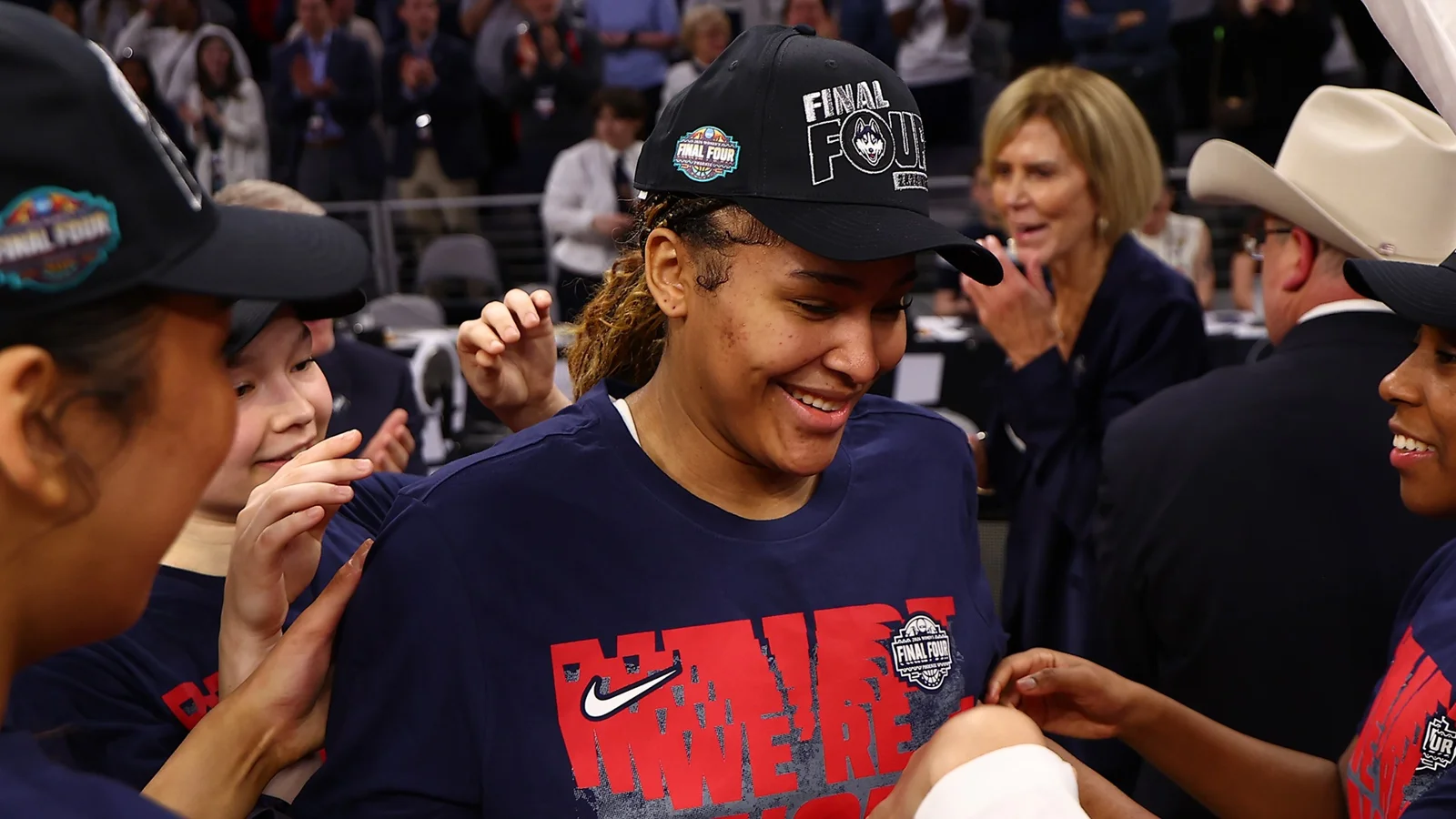
The most recent completed award year in this guide is 2026. Sarah Strong of UConn won all four honors discussed here for the 2025-26 season. Her selection is confirmed by the award organizations and UConn's announcements, including the April 11 Wooden Award report. As of October 20, 2026, a 2027 national player of the year prediction is still a prediction. It does not belong in a winners table.
Four major honors with different voting bodies
The Atlanta Tipoff Club presents the Naismith women's college player award. The Los Angeles Athletic Club administers the Wooden Award. The Associated Press makes its own media selection, and the U.S. Basketball Writers Association presents its women's national player honor under the Ann Meyers Drysdale Award name. A player can win one, several or all of these awards without the organizations surrendering their separate choices.
The USBWA award page is especially helpful about its scope: it honors the national Division I women's player of the year. Its current namesake is a former great player, not the winner being listed for each season. Similarly, a trophy's sponsor may change without creating a new historical award every time the commercial name changes. Follow the award itself when comparing years.
These honors also sit beside other legitimate awards. The Wade Trophy, position awards, national defensive player awards and conference player awards answer related but different questions. This guide concentrates on four widely cited national honors so that its tables remain readable and its labels remain precise. Leaving an award outside that defined comparison does not make it unimportant; it simply prevents a historical lookup from silently changing scope halfway through.
Award years identify the completed college season
An award labeled 2021 ordinarily refers to the 2020-21 season; 2022 refers to 2021-22; 2023 refers to 2022-23. Under that convention, Paige Bueckers won the four featured honors in 2021, Aliyah Boston in 2022 and Caitlin Clark in 2023. Those are particularly useful years to clarify because the award announcement happens in the spring, several months after the season began.
Do not mix a season award with the Final Four's Most Outstanding Player award. One recognizes a broader body of college performance under its organization's selection process; the other concerns a particular championship stage. High school Naismith winners also occupy their own category. A player may eventually win both prep and college honors, but her high school year does not become a college award year.
A reliable historical answer therefore has three parts: the season or award year, the organization and the winner's college at that time. Those details prevent a later professional team, a current coaching role or an unrelated award from being attached to an old result. They also make it possible to discuss genuine disagreement between voters without treating it as a mistake in the sport's record.
Naismith women's college winners, 1983-2026
The Naismith women's college award began in 1983. The list below follows the Atlanta Tipoff Club's official winners archive, with college names standardized for readability. It contains every award year from 1983 through 2026, rather than treating a selection of famous winners as the complete history.
The complete winners table
| Year | Winner | College |
|---|---|---|
| 2026 | Sarah Strong | UConn |
| 2025 | JuJu Watkins | USC |
| 2024 | Caitlin Clark | Iowa |
| 2023 | Caitlin Clark | Iowa |
| 2022 | Aliyah Boston | South Carolina |
| 2021 | Paige Bueckers | UConn |
| 2020 | Sabrina Ionescu | Oregon |
| 2019 | Megan Gustafson | Iowa |
| 2018 | A'ja Wilson | South Carolina |
| 2017 | Kelsey Plum | Washington |
| 2016 | Breanna Stewart | UConn |
| 2015 | Breanna Stewart | UConn |
| 2014 | Breanna Stewart | UConn |
| 2013 | Brittney Griner | Baylor |
| 2012 | Brittney Griner | Baylor |
| 2011 | Maya Moore | UConn |
| 2010 | Tina Charles | UConn |
| 2009 | Maya Moore | UConn |
| 2008 | Candace Parker | Tennessee |
| 2007 | Lindsey Harding | Duke |
| 2006 | Seimone Augustus | LSU |
| 2005 | Seimone Augustus | LSU |
| 2004 | Diana Taurasi | UConn |
| 2003 | Diana Taurasi | UConn |
| 2002 | Sue Bird | UConn |
| 2001 | Ruth Riley | Notre Dame |
| 2000 | Tamika Catchings | Tennessee |
| 1999 | Chamique Holdsclaw | Tennessee |
| 1998 | Chamique Holdsclaw | Tennessee |
| 1997 | Kate Starbird | Stanford |
| 1996 | Saudia Roundtree | Georgia |
| 1995 | Rebecca Lobo | UConn |
| 1994 | Lisa Leslie | USC |
| 1993 | Sheryl Swoopes | Texas Tech |
| 1992 | Dawn Staley | Virginia |
| 1991 | Dawn Staley | Virginia |
| 1990 | Jennifer Azzi | Stanford |
| 1989 | Clarissa Davis | Texas |
| 1988 | Sue Wicks | Rutgers |
| 1987 | Clarissa Davis | Texas |
| 1986 | Cheryl Miller | USC |
| 1985 | Cheryl Miller | USC |
| 1984 | Cheryl Miller | USC |
| 1983 | Anne Donovan | Old Dominion |
Use the school column as historical identification. Dawn Staley's winning college was Virginia, even though many current fans know her primarily through South Carolina. Anne Donovan's first award belongs to Old Dominion. Keeping the college attached to the year makes the table useful for readers discovering earlier generations, not merely for those already familiar with the modern names.
What repeated winners tell us
Cheryl Miller won three consecutive Naismith college awards from 1984 through 1986. USC's Hall of Fame profile independently confirms that run. Breanna Stewart later matched the three-year sequence from 2014 through 2016; UConn's 2016 announcement identifies her third college Naismith Trophy.
Other repeat winners reveal different patterns. Maya Moore won in 2009 and 2011, with teammate Tina Charles winning in between. Clarissa Davis won in 1987 and 1989, separated by Sue Wicks' 1988 award. Those sequences show why a two-time winner need not have consecutive trophies and why reading just the first and last year of a career can obscure another player's exceptional season.
A repeated name is evidence of repeated recognition under this award's process. It does not supply an automatic ranking of every player who competed before or after her. Different award histories begin at different points, and colleges do not all play identical schedules. The list is strongest when used for the question it can answer precisely: who won this specific national honor in a given year.
The newest entries also belong to completed seasons. Clark's 2023 and 2024 awards, Watkins' 2025 award and Strong's 2026 award form a historical sequence. They should not be rewritten according to a later championship result, a professional rookie season or a player's future availability. Those later events can change a career's broader story, but they do not change who received the college trophy at the time.
Wooden, AP and USBWA winners in the shared modern era
The women's Wooden Award began in 2004, which makes that year the natural starting point for a shared comparison with the other major honors. The table uses the Wooden Award's winners archive, the AP award announcements and school histories and the USBWA's updated winners history. Award year is shown consistently throughout.
| Year | Wooden | AP | USBWA |
|---|---|---|---|
| 2026 | Sarah Strong | Sarah Strong | Sarah Strong |
| 2025 | JuJu Watkins | JuJu Watkins | JuJu Watkins |
| 2024 | Caitlin Clark | Caitlin Clark | Caitlin Clark |
| 2023 | Caitlin Clark | Caitlin Clark | Caitlin Clark |
| 2022 | Aliyah Boston | Aliyah Boston | Aliyah Boston |
| 2021 | Paige Bueckers | Paige Bueckers | Paige Bueckers |
| 2020 | Sabrina Ionescu | Sabrina Ionescu | Sabrina Ionescu |
| 2019 | Sabrina Ionescu | Megan Gustafson | Megan Gustafson |
| 2018 | A'ja Wilson | A'ja Wilson | A'ja Wilson |
| 2017 | Kelsey Plum | Kelsey Plum | Kelsey Plum |
| 2016 | Breanna Stewart | Breanna Stewart | Breanna Stewart |
| 2015 | Breanna Stewart | Breanna Stewart | Breanna Stewart |
| 2014 | Chiney Ogwumike | Breanna Stewart | Breanna Stewart |
| 2013 | Brittney Griner | Brittney Griner | Brittney Griner |
| 2012 | Brittney Griner | Brittney Griner | Brittney Griner |
| 2011 | Maya Moore | Maya Moore | Maya Moore |
| 2010 | Tina Charles | Tina Charles | Tina Charles |
| 2009 | Maya Moore | Maya Moore | Maya Moore |
| 2008 | Candace Parker | Candace Parker | Candace Parker |
| 2007 | Candace Parker | Courtney Paris | Candace Parker |
| 2006 | Seimone Augustus | Seimone Augustus | Ivory Latta |
| 2005 | Seimone Augustus | Seimone Augustus | Seimone Augustus |
| 2004 | Alana Beard | Alana Beard | Alana Beard |
Several rows deserve a closer look. In 2004 Alana Beard received the Wooden, AP and USBWA selections, while Diana Taurasi received the Naismith Trophy. Duke's contemporary announcement identifies Beard as the first women's Wooden recipient. A page that lists only Taurasi for an unnamed 2004 national honor would erase Beard's equally real awards; the reverse would erase Taurasi's Naismith selection.
The 2007 row is an even clearer reason to retain the organization names. Courtney Paris won AP, Candace Parker won Wooden and USBWA, and Lindsey Harding won Naismith. Oklahoma's Courtney Paris archive confirms the AP distinction. This is a season with several recognized winners, not a data problem waiting for one name to replace all the others.
In 2014 Chiney Ogwumike won Wooden while Stewart won the other three featured awards. In 2019 Ionescu won Wooden while Gustafson won Naismith, AP and USBWA. These splits are not marginal footnotes. They are central to understanding why two reliable biographies can both describe a player as a national player of the year for the same season.
Other rows show broad agreement. Boston's 2022 season, Clark's 2023 and 2024 seasons, Watkins' 2025 season and Strong's 2026 season produced matching winners across these four honors. "All four featured awards" is a precise description of that agreement. It should not be expanded automatically into a claim about every award given by every publication, position panel or coaches' organization.
The different starting dates also matter when making historical comparisons. An empty Wooden entry before 2004 would mean the women's award did not yet exist; it would not mean the best players of that era failed to win an available trophy. Earlier AP and USBWA histories likewise belong to their own timelines. A career comparison that simply adds all national trophies without considering which honors existed creates an advantage for players who competed when more awards were available.
How to read a split award season
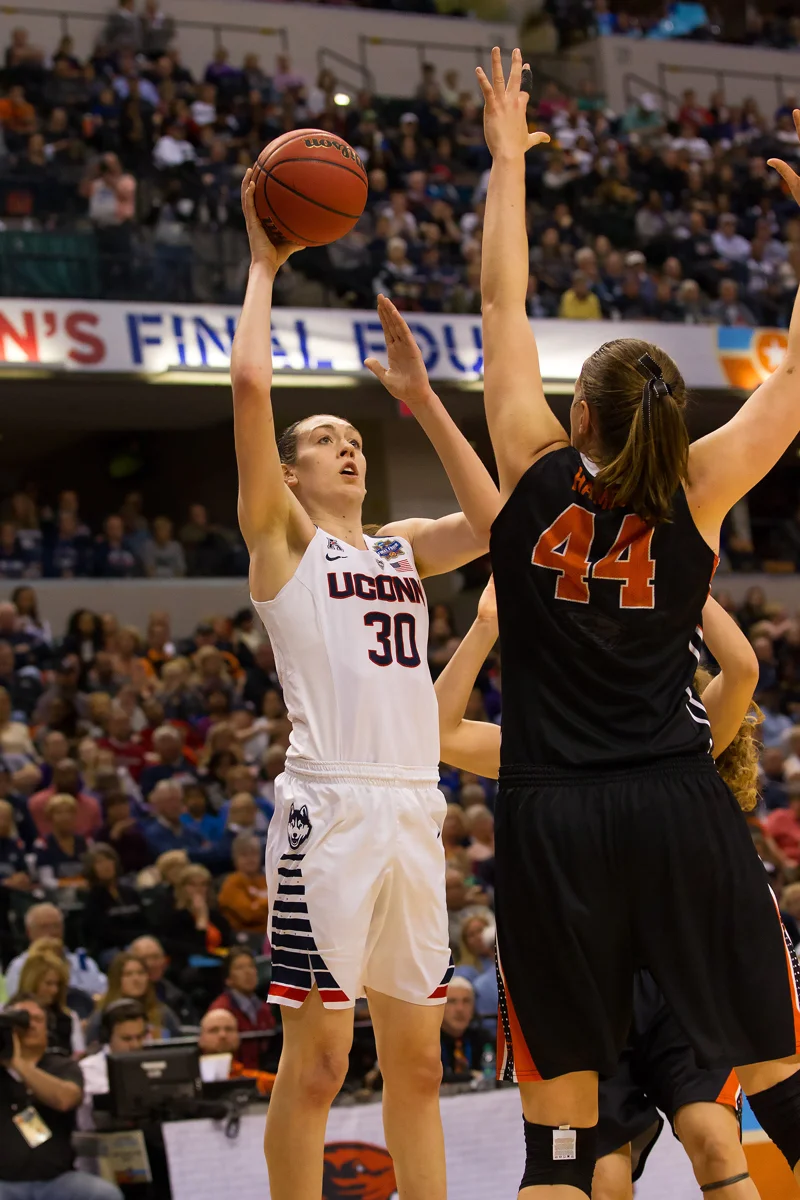
A split award season is a reason to be more precise, not a reason to choose a preferred trophy and erase the rest. In 2014, Ogwumike was the Wooden winner and Stewart was the Naismith, AP and USBWA winner. In 2019, Ionescu won Wooden and Gustafson won the other three featured honors. Each sentence describes an actual selection. Neither needs a claim that there was one official NCAA winner whom another organization somehow failed to recognize.
The Stanford announcement for Ogwumike and the Iowa announcement for Gustafson show how to read a school biography carefully: look for the full award name and the date. A later summary may shorten that language to national player of the year. The complete description preserves which organization reached that judgment.
A season award is different from a championship award
The national tournament is central to a college career, but it is a distinct competition within the season. A player can carry a team through months of elite performance and lose one elimination game. Another can deliver the outstanding Final Four performance without having received a season player award. Those achievements should be recorded separately so a fan can see both the long body of work and the decisive championship moment.
Stewart provides a useful example even though her career contains success in both categories. UConn's account of her 2016 Wooden Award identifies her second Wooden honor and her third Naismith, AP and USBWA selections. Three of one award and two of another is the accurate summary. Writing that she won every major trophy three times would turn a remarkable record into an inaccurate one.
The 2020 season makes the distinction even more obvious. Ionescu received national season honors although the NCAA tournament was canceled. The absence of a championship does not create a blank in the player award list. Equally, a year with a tournament champion does not require that team's leading player to occupy every national individual award row.
Comparing careers requires more than counting trophies
Trophies offer valuable evidence of how a player was regarded during her college years. They are not an all-purpose measurement scale. The number of awards available has changed; the women's Wooden history begins more than two decades after the Naismith history. The national statistical record has its own starting dates. An older player cannot win a trophy that had not yet been established, and a modern player can appear in more separate award lists for a single season.
Role matters too. A high-volume scoring guard, a rim-protecting center and a versatile forward may all build persuasive cases through different kinds of contribution. The winners table records who was selected; explaining why one player should outrank another across eras requires examining the actual college performance. Scoring, passing, defense, availability, opponents and postseason contribution all add evidence beyond an award count.
Nor should agreement be confused with unanimity. Matching winners across four organizations means four selections aligned. It does not show that every voter in each process picked the same player. Unanimity is a specific voting result that needs its own confirmation. Likewise, disagreement between award bodies does not establish what any individual voter valued without evidence from that voter or the published voting process.
For a quick historical answer, start with the year and read across the named columns. For a deeper comparison, use the awards as an entry point into the player's season. Our career scoring guide supplies another piece of that history, while the teams directory helps connect unfamiliar colleges to the present game. The best award history keeps the names, seasons and organizations intact so the reader can make a fair comparison.
Join the conversation
Share a question or a thought about the women's game. Comments are reviewed before they appear. Keep it friendly, stay on topic and leave out personal information.
No comments yet. Start the conversation.
Sign in with Google to leave a comment. Your email address is not displayed with your comment.