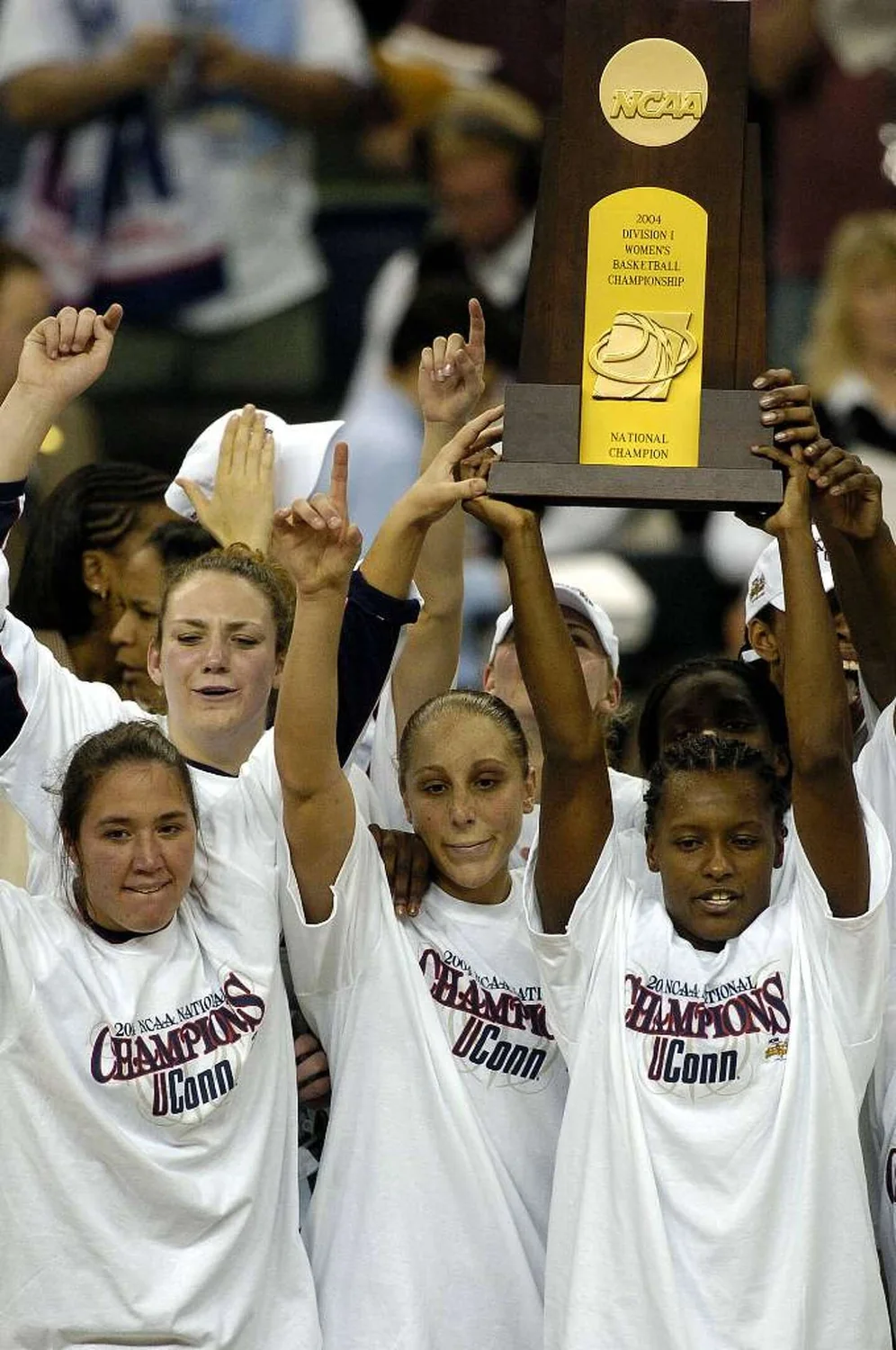
UConn entered the 2004 NCAA women’s tournament with a different record and seed from the teams that had won its first two consecutive titles. Diana Taurasi remained at the center of the run. The final in New Orleans also depended on the players around her, especially when Tennessee turned a big deficit into a two-point game.
Who won the 2004 NCAA women’s basketball championship?
Connecticut beat Tennessee 70–61 on April 6, 2004, at New Orleans Arena to win its third consecutive NCAA Division I women’s basketball championship. Geno Auriemma’s Huskies finished 31–4, the same final record as Pat Summitt’s Lady Vols. UConn went into the tournament as a No. 2 seed. Tennessee was a No. 1 seed. Their meeting in the title game was the fourth between the schools and the second in two years. Official championship box score · NCAA championship history
Diana Taurasi led UConn with 17 points in her last college game. She earned the Final Four’s Most Outstanding Player award for the second straight year. Tennessee’s Shanna Zolman scored 19 to lead all players in the final. Those two facts give a better sense of the night than a single scoring number. Taurasi was the leading scorer for an offense that got double figures from four players. Zolman helped Tennessee make the game competitive again after UConn took an early lead. The award honored the Final Four, which also included Taurasi’s semifinal against Minnesota. April 6 game report
The result put a different ending on a familiar matchup. The Huskies had edged the Lady Vols 73–68 in Atlanta in April 2003. The following April they met in New Orleans, where Connecticut led by six at halftime and won by nine. A date alone can be misleading in this rivalry because the teams also played during the regular season. For this championship, the record to look up is the April 6 finish attached to the 2003–04 season. The school’s matchup archive lists it at a neutral site. Official UConn–Tennessee series history
Three straight titles put this team at the end of a run that started with a perfect season in 2002. The 2004 team took a more varied route. Its path explains how the Huskies arrived in New Orleans and why the final still depended on several players after Tennessee drew close.
UConn’s six-game road to the championship
The 2004 women’s bracket sent No. 2 seed UConn through two Connecticut venues before the Final Four. The Huskies played Penn and Auburn in Bridgeport, then UC Santa Barbara and Penn State in Hartford. Minnesota and Tennessee followed in New Orleans. Four of the opponents were seeded seventh or lower, and the Huskies eventually had to beat two No. 1 seeds. The Sweet 16 win over UC Santa Barbara was the closest game in the run by final margin. Official UConn season results
| Date | Round | Opponent | UConn win | City |
|---|---|---|---|---|
| Mar. 21 | First round | No. 15 Penn | 91–55 | Bridgeport, CT |
| Mar. 23 | Second round | No. 7 Auburn | 79–53 | Bridgeport, CT |
| Mar. 27 | Sweet 16 | No. 11 UC Santa Barbara | 63–55 | Hartford, CT |
| Mar. 29 | Elite Eight | No. 1 Penn State | 66–49 | Hartford, CT |
| Apr. 4 | Semifinal | No. 7 Minnesota | 67–58 | New Orleans, LA |
| Apr. 6 | Championship | No. 1 Tennessee | 70–61 | New Orleans, LA |
The first two rounds in Bridgeport
Connecticut opened at the Arena at Harbor Yard against Ivy League champion Penn. It had been almost two weeks since UConn’s loss to Boston College in the BIG EAST tournament semifinal. Taurasi scored 18, and the Huskies took a 51–23 lead into halftime. They ultimately scored 44 points in the paint, compared with 14 for Penn. The 30-point difference inside helps explain the margin. Connecticut had a second way to pile up points when the pace ran in its favor, scoring 24 off Penn turnovers. UConn’s first-round recap
Auburn gave UConn a closer first half two days later. The Tigers scored 36 before halftime and only 17 after it. UConn’s season review credits the Huskies with keeping Auburn without a field goal for more than 16 minutes to open the second half. Taurasi scored 17 against Auburn and three teammates joined her in double figures. The 79–53 final looks routine at a glance. The halftime split shows how much of the gap opened after the teams came back out. UConn’s season review, page 101
The East Regional in Hartford
UC Santa Barbara kept the Sweet 16 game within one possession into the second half at the Hartford Civic Center. The Gauchos were within two at 36–34 with 11:40 left. Ashley Battle hit a three and later made two free throws to complete a 9–0 UConn run. Taurasi scored 21 and set the school career-assist record by passing Jen Rizzotti during the game. Both schools’ records agree on 63–55. The final eight-point margin followed a stretch in which Battle helped restore a cushion while the Gauchos were still in reach. UConn’s Sweet 16 recap · UC Santa Barbara record book
The East Regional final went through two separate UConn responses. With Penn State trailing by six early in the second half, Barbara Turner scored 11 points during a 14–2 burst. Penn State later got within nine before Taurasi hit a three that started a second 9–0 run. Turner scored 26 and Taurasi had 27. More than half of the team’s 66 points came from those two players, and their key bursts arrived at different points. Connecticut earned its fifth straight Final Four appearance. UConn’s East Regional final recap
The semifinal against Minnesota
Minnesota was three points behind late in the national semifinal. Ann Strother ended a scoring drought with a three, sending UConn from 58–55 to 61–55 with about 3:20 left. Taurasi finished with 18, Maria Conlon had ten, and Willnett Crockett scored six of her nine points on putbacks. UConn’s 36–25 edge on the glass mattered in that kind of game because an offensive rebound could produce another chance while the margin was still short. Minnesota’s Lindsay Whalen made three field goals and supplied seven assists, while Connecticut gave Janel McCarville an experienced matchup in Jessica Moore. The 67–58 win put UConn into its third straight final. UConn’s semifinal recap, page 102
How Connecticut held off Tennessee in the final
Tennessee finished with 39 rebounds to UConn’s 31 and took ten more shots from the field. Connecticut still scored more efficiently from those chances. It made 24 of 51 field goals to Tennessee’s 22 of 61. Seven of UConn’s makes were threes, compared with four for Tennessee. The Huskies scored 55 points from the field and added 15 free throws. The Lady Vols generated extra chances through their 17 offensive rebounds. Their 36.1 percent field-goal shooting helps explain why the extra attempts still produced only 48 points from the floor. April 6 official team totals
The pressure that put UConn in front
The Huskies threatened to put the game away before halftime. They used an 18–4 run to build a 30–13 lead with about six and a half minutes left in the half. During the first thirteen and a half minutes, Connecticut made 11 of 16 shots and Tennessee made five of 23. That mismatch gave UConn a substantial early margin, which it needed when the scoring stopped. Tennessee scored the final 11 points of the half to get within 30–24. The Lady Vols made the first basket after halftime to shrink the lead to four. The NCAA’s April 2004 game account
Jessica Moore gave UConn a way to stop the drought after Tennessee’s surge. The UConn season review records her reverse layup early in the second half as the club’s first score in more than seven minutes of game time. Moore kept scoring close to the basket, and a Taurasi three later put the Huskies up 48–38. Having an inside option mattered as the Lady Vols trimmed the lead. Connecticut could go to Moore for a close shot and still keep its shooters on the floor. Four different Huskies ultimately scored at least 12 points. Connecticut’s season review, page 102
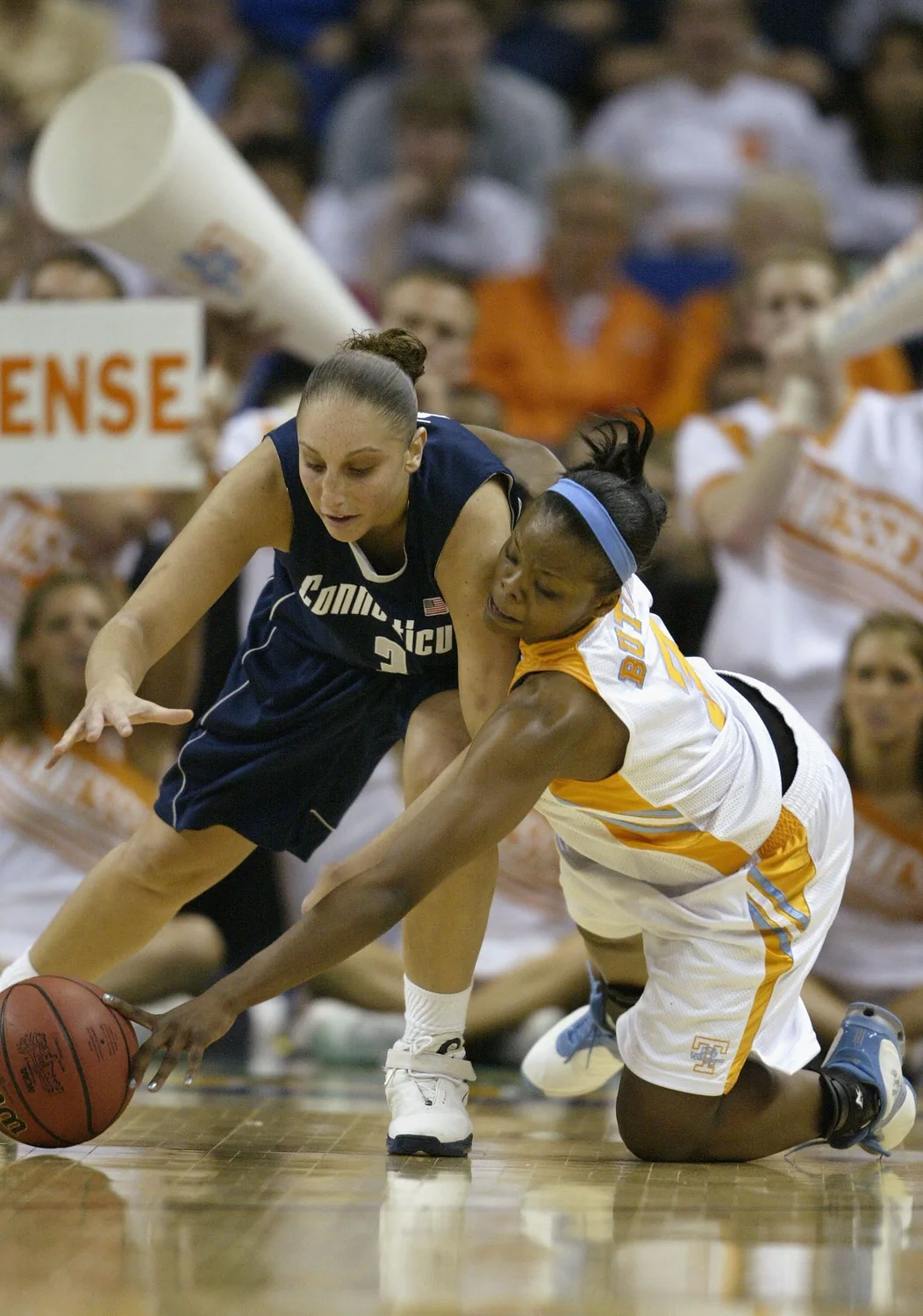
What changed when Tennessee cut the gap
Brittany Jackson’s long three brought Tennessee within 50–48 with 9:50 to go. UConn increased its lead to six on close-range scores by Moore and Ann Strother. Strother then converted all three free throws after a foul on a three-point attempt to make it 57–49. That stretch gave UConn more room before Tennessee mounted another rally. It also explains why looking only at Taurasi’s three-point totals misses some of the offense. A pair of layups and one trip to the line did a large share of the work once the lead was down to a basket. NCAA game report
There was one more late swing. Tennessee’s Ashley Robinson blocked a Turner shot and then made a layup off a Zolman pass at the other end. That got the Lady Vols within 59–55. Willnett Crockett scored her only three points on a basket and a foul shot, moving the lead back to seven. Tennessee needed several scoring possessions and defensive stops in the final minutes. Connecticut protected the lead with free throws. The final was a nine-point UConn win, but those possessions explain how close Tennessee was to making the last minutes a different game. Tennessee’s archived title-game report
The lineup around Diana Taurasi
UConn used seven players in the final. Seniors Diana Taurasi and Maria Conlon started in the backcourt with sophomore Ann Strother. Junior Jessica Moore started at center and sophomore Barbara Turner at forward. The same roster also included contributors beyond those who appeared on April 6. For this particular game, Ashley Battle and Willnett Crockett were the two reserves in the box score. They each played 15 minutes. The five starters scored 64 of UConn’s 70 points. Official 2003–04 UConn roster · Final game participation and stats
| UConn player | Role | PTS | REB | AST |
|---|---|---|---|---|
| Diana Taurasi | Starter | 17 | 3 | 2 |
| Maria Conlon | Starter | 7 | 2 | 5 |
| Ann Strother | Starter | 14 | 2 | 2 |
| Jessica Moore | Starter | 14 | 9 | 1 |
| Barbara Turner | Starter | 12 | 9 | 4 |
| Ashley Battle | Reserve | 3 | 1 | 0 |
| Willnett Crockett | Reserve | 3 | 2 | 1 |
There were two main sources of ball movement in the final alongside Taurasi’s scoring. Conlon had five assists, the most for UConn, and committed just one turnover. Turner added four assists and no turnovers in 33 minutes. Together they accounted for nine of Connecticut’s 15 assists. Taurasi averaged 16.2 points and about 4.9 assists per game during the season, so she routinely generated shots for herself and others. The championship game’s assist totals show how the other starters could help do that work when Taurasi’s most visible contribution was scoring. UConn’s full-season statistics
Moore and Turner both grabbed nine rebounds. They did different work on the glass. Six of Moore’s came at the offensive end. Eight of Turner’s came at the defensive end. Moore shot 61.8 percent for the season and averaged 7.1 rebounds, evidence that she had been a dependable interior option before the final. Strother offered another kind of pressure. She made 61 three-pointers in 35 games that season. In the final, she got to the line when Tennessee challenged her from outside. Her scoring in the final included five field goals and three made free throws on a single trip. Official title-game player numbers
The two reserves finished with six points combined. Their role is easier to appreciate across consecutive games than in that total. In the semifinal against Minnesota they scored 17 between them, and Battle made all four of her free throws. Two nights later Crockett’s three-point play had more impact on a four-point lead than a season average can capture. Auriemma had a compact championship rotation that could still get a meaningful late possession from a player outside the starting five. Official NCAA Final Four box scores
Where the 2004 title fits in UConn history
The 2004 win gave the Huskies five national championships and five victories in their first five NCAA title games. Tennessee still had six championships at that point and had put together its own three straight from 1996 through 1998. UConn’s achievement put both programs in a very short historical group. Their head-to-head results told a more specific story. By the end of April 6, Connecticut had won all four NCAA championship games the two schools had played, including the consecutive meetings in 2003 and 2004. NCAA News on the 2004 rivalry record
The last of the 2002–04 titles
Each title came from a team with a different season. The 2002 Huskies went 39–0 and defeated Oklahoma 82–70. Swin Cash had 20 points and 13 rebounds in that championship game, and sophomore Taurasi scored 13. After four players from that roster went in the first round of the WNBA draft, UConn finished 37–1 in 2002–03. Taurasi scored 28 against Tennessee in that year’s final. By 2004 she was a senior on a 31–4 team that earned a No. 2 seed and had to beat two top regional seeds to finish the title run. UConn’s 2002 championship recap · UConn’s championship reunion account
That progression makes it worth looking at the 2002 championship and 2003 championship in sequence. Taurasi remained part of the lineup through all three. By New Orleans, the program’s younger players were starters who could pull a game back from the edge of a Tennessee run. The consecutive trophy years capture how long that group kept winning in the NCAA tournament while the team around Taurasi evolved.
Two UConn champions in two nights
On April 5 in San Antonio, Jim Calhoun’s Connecticut men beat Georgia Tech 82–73 at the Alamodome. Emeka Okafor scored 24 and Ben Gordon scored 21. A night later, Auriemma’s women finished their own championship game in New Orleans. That made Connecticut the first school to win both NCAA Division I basketball tournaments in the same season. The sequence matters because the two games had different opponents, venues and brackets. UConn’s April 5 championship report · UConn women’s historical timeline
The two titles were an unusual coincidence in the calendar. The women’s own achievement took three seasons to build and six wins to close in 2004. In New Orleans, the game came down to a group that had multiple ways to earn a score when its early margin slipped. That April finish belongs beside the other Connecticut title runs in the women’s championship history.
Join the conversation
Share a question or a thought about the women's game. Comments are reviewed before they appear. Keep it friendly, stay on topic and leave out personal information.
No comments yet. Start the conversation.
Sign in with Google to leave a comment. Your email address is not displayed with your comment.