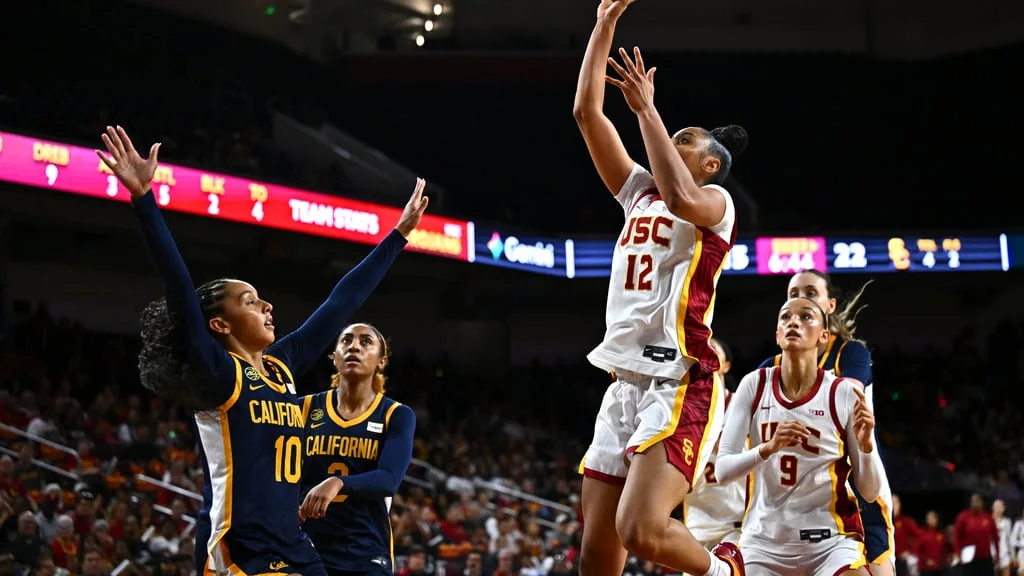
JuJu Watkins returned to USC competition on October 25, 2026, and the Trojans beat Cal 78–76 at Galen Center. The headline was her comeback; the more useful basketball story was how much help she had, and how much work USC still has to do. Saniyah Hall scored 23 points, Watkins and Jazzy Davidson added 18 each, and Davidson supplied seven assists.
This was an exhibition, with both teams still awaiting their regular-season opener. It offered a first competitive look at the new combination without settling its ceiling. USC could turn defensive disruption into easy baskets, yet Cal stayed within one possession at the finish. As of October 30, the sound reading is encouraging offensive possibility alongside specific defensive questions. A close preseason score can contain both.
Watkins returned to competition, with room for the basketball to grow
The most substantial fact was simple: Watkins was playing against another college team again. USC's current biography records her injury redshirt in 2025–26. Her previous playing season produced 23.9 points and 3.4 assists per game across 33 appearances in 2024–25. Those numbers explain the attention around her return, but they are historical context rather than a standard she needed to reproduce immediately.
Against Cal, her contribution extended beyond the scoring column. Eighteen points came with three steals and two blocks. That combination matters because USC's strongest version needs Watkins involved at both ends. A comeback built only around the number of shots she takes would leave out much of the value that made her central to the program. The exhibition supplied examples of production in several categories, giving fans more to discuss than whether her first basket went in.
Read the minutes as a game sample
Watkins played about 23 minutes, according to USC's recap. That gives the performance a useful boundary. Fans saw a substantial competitive appearance, rather than a ceremonial entrance, but it was still one afternoon in a preseason setting. Minutes describe participation; they do not reveal medical clearance criteria, the demands of successive road games or how her workload will develop. None of those questions can be resolved by a final score.
Her six made free throws in six attempts are a more concrete starting point for basketball analysis than an assertion about looking fully recovered. Getting points while the clock is stopped can stabilize a difficult shooting stretch. At the same time, two missed three-point attempts are far too small a sample to define her perimeter shooting for the season. A fan can acknowledge both facts without turning the makes into a guarantee or the misses into a warning sign.
There is also a useful distinction between returning to a role and recreating an old offense. Watkins is joining a group that includes a productive returning Davidson and an incoming Hall. The interesting question is how often she can attack an advantage someone else has created, then return that favor on the next possession. That is a basketball question about sharing creation, not a demand that she immediately carry every difficult trip down the floor.
Our preseason player guide provides the wider talent context. This exhibition adds a dated competitive sample to that picture. It should change what fans know about her participation while leaving room for the season to establish the rest.
Hall and Davidson make the offense bigger than one comeback
The three leading scorers combined for 59 of USC's 78 points: 23 plus 18 plus 18, or approximately 75.6 percent of the total. That calculation describes how the offense was distributed on this afternoon. It also sets up the central question for the season: can three productive players make one another's jobs easier when an opponent has time to prepare for them?
Hall supplied efficient scoring and disruptive hands
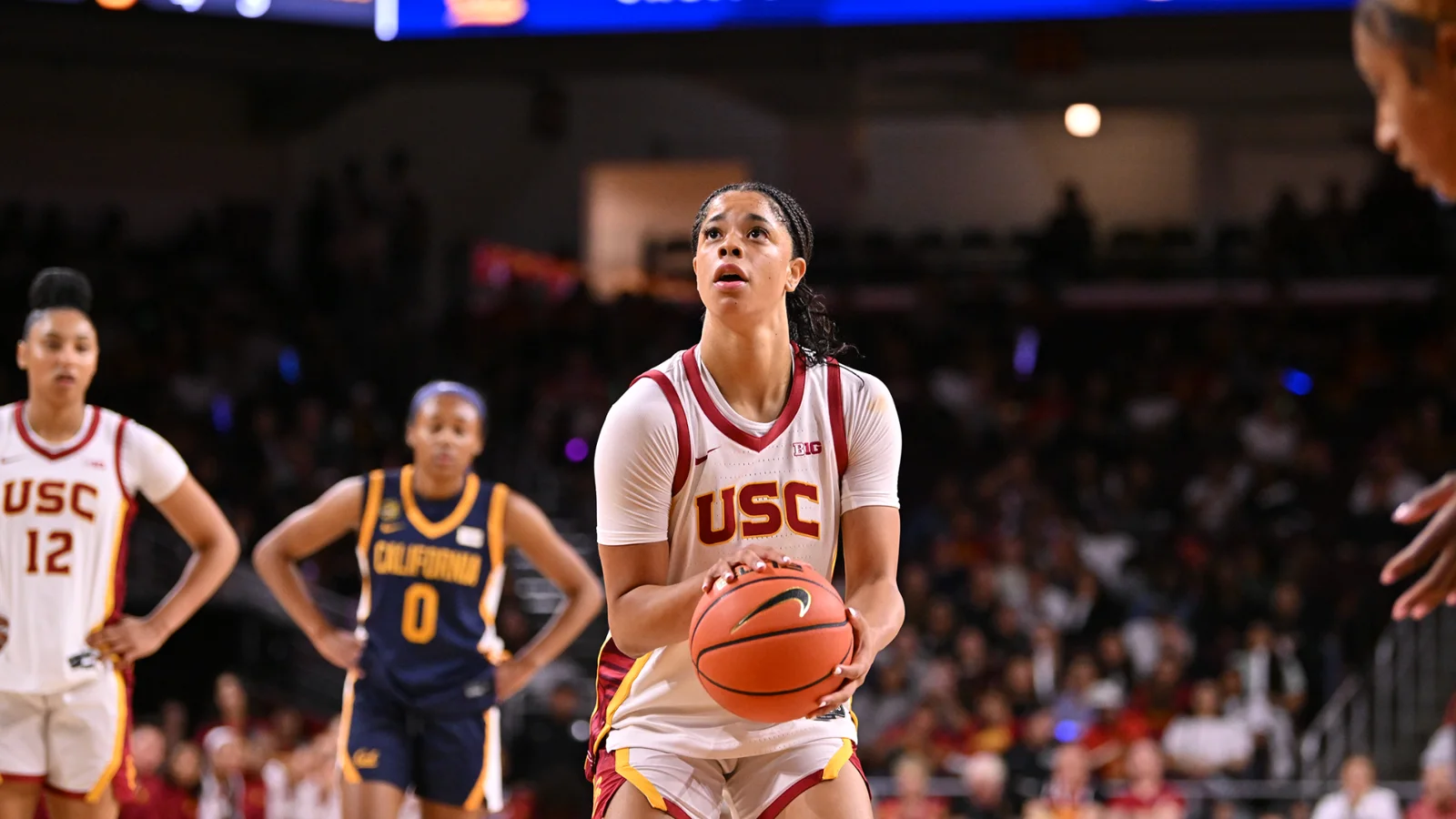
Hall's debut offered an immediate reason to treat that question seriously. USC's official game report lists nine makes in 13 shots, including two three-pointers in three attempts, along with five steals and six rebounds. She supplied efficient scoring without needing an enormous volume of attempts. That is a particularly useful contribution alongside two players who also need opportunities to initiate offense.
The steals are significant for a different reason. A live-ball takeaway can create an attack before an opponent has established its half-court defense. That reduces the need for every scoring opportunity to begin with a difficult individual creation. It does not mean all of Hall's steals became baskets, or that the same rate will continue. It means her recorded contribution included a way to influence the game before USC needed to run an organized possession.
Her USC biography supplies useful background: she was the 2025 FIBA U19 Women's World Cup MVP. That is evidence of significant experience before college, rather than a promise that every freshman adjustment has disappeared. Cal gave USC a glimpse of the immediate value Hall can provide while the regular season will test its repeatability against changing opponents.
Davidson connected the finishers
Davidson's seven assists are as important to this combination as her 18 points. A roster can have several accomplished scorers and still struggle if each attack starts from a standstill. Passing that converts a teammate's movement into a finish is one way to make those scorers function together. It rewards players for staying involved when somebody else has the ball.
Her role should not be reduced to feeding Watkins. The threat of Davidson's own scoring is part of what makes a pass meaningful: a defender has to consider more than one outcome. Equally, Hall's finishing can make a useful Davidson decision show up as an assist. Those relationships are possibilities supported by the production, rather than proof of any specific coverage Cal used or any particular play USC will favor.
The remaining Trojans contributed 19 points. That concentration is a reason to watch the supporting cast, not a sufficient basis to declare the team shallow. Players can contribute by protecting the rim, moving the ball or completing a defensive possession. The stronger test is whether those contributions keep the offense functional when one of the leading scorers sits, misses shots or faces extra attention. The Cal result establishes the starting combination; it leaves that next layer open.
Cal showed why forcing a miss is only half a defensive possession
Cal shot 34.3 percent from the field and still scored 76 points. That is the clearest reason to resist judging USC's defense by opponent field-goal percentage alone. The official box score records several different ways the Golden Bears stayed productive: second chances, perimeter baskets and points at the free-throw line. The result was close because the game contained more than the first shot of each possession.
The rebounding gap kept the game alive
Cal collected 19 offensive rebounds and finished with a 45–39 advantage on the boards. Its second-chance scoring edge was 17–6. Those figures make possession completion a more useful concern than a broad assertion that USC could not defend. A team can contest an initial attempt successfully and still give its opponent another opportunity a moment later.
Albina Syla had five offensive rebounds individually. The team total also includes six offensive rebounds credited to the team rather than a named player. That distinction matters when evaluating responsibility. It would be misleading to assign all 19 to one interior matchup or suggest that every one was a clean individual putback. The concrete conclusion is that Cal repeatedly retained opportunities after misses; identifying the exact technical cause on each play would require a closer possession review.
For fans watching the next game, the useful focus is the moment after the shot goes up. Who has contact with a potential rebounder? Which guard comes back into the play? Does the ball get secured, or merely touched? Those are viewing questions rather than claims about footage from this exhibition. They help distinguish the defensive work that creates a miss from the collective work that actually ends the possession.
Twidale made the perimeter matter
Lulu Twidale led Cal with 25 points and nine rebounds. She was an active participant in the game's competitiveness, not background scenery for a USC comeback story. Taylor Barnes added 15 points and Shannon Dowell 17. Giving the opponent credit produces a better explanation of the margin than describing every Cal scoring stretch as a failure of USC's concentration.
The team comparison shows Cal making nine three-pointers to USC's three. Six extra makes are worth 18 points in that scoring category. That is a meaningful counterweight to USC's advantages closer to the basket. It does not establish that every three was uncontested, or that the same shooting distribution will persist; it explains why a better overall field-goal percentage did not produce a comfortable USC victory.
There is a temptation to add every statistical edge together until the score seems fully explained. Resist it: fast-break points, paint points and points after turnovers can describe the same basket. These are overlapping views of the contest. The stronger conclusion is directional. USC found value in disruption and transition, while Cal kept finding ways to extend or increase the value of its opportunities. Finishing possessions would make the Trojans less dependent on generating another steal to regain control.
The final two minutes tested more than USC's star power
The finish provides the best corrective to an account concerned only with three scoring totals. Cal tied the game at 71 with 2:13 remaining. Hall restored USC's lead at the line; Laura Williams supplied a late block; Davidson found Kennedy Smith for a basket; and Davidson's free throws helped close the game. USC's recap of the closing sequence makes the range of contributions clear.
Williams' intervention matters because a game can turn on a job that never requires a player to lead the scoring. Her four points were a small part of USC's offense, but her three blocks describe a different kind of involvement. Smith, similarly, did not need a large scoring total to finish a crucial play. Evaluating those players only by whether they reached double figures would miss part of why USC won.
The play-by-play adds an especially revealing detail: Cal continued to retrieve misses late, before Williams eventually secured the defensive rebound and Smith scored at the other end. The issue was not abstract. The same possession-completion problem visible in the overall rebounding figures was still relevant when the margin was narrow and the remaining clock was short.
In that setting, a successful defensive action and a successful transition action belong to one connected task. A block can delay an opponent without delivering possession. A rebound creates the chance to move the ball. A pass has to reach a teammate, and that teammate has to finish. USC completed enough of that chain to create a small cushion. Each link explains why a supporting player can be important even when the final headline names someone else.
The ending also gave Davidson a different kind of responsibility from creating a shot in open play. Free throws require a player to convert with the defense removed from the immediate attempt and the scoreboard pressure still present. Her three makes in four attempts over the final ten seconds were a recorded part of the result. They are useful evidence of what happened, without establishing that every future close game will end the same way.
That is the appropriate scale for the conclusion. USC got a competitive rehearsal in which Hall, Davidson, Williams and Smith all had meaningful late jobs. It does not yet have a season's worth of proof about its preferred closing lineup or its execution against conference opponents. The exhibition showed why those questions are worth watching, and why their answers will involve more than the comeback alone.
What to watch when the games start counting
USC's official schedule lists UNLV next, on Monday, November 2, at T-Mobile Arena in Las Vegas. The announced tipoff is 1 p.m. Pacific on CBS Sports Network. That game remains in the future as of October 30, and it begins a different kind of evidence: regular-season competition that counts toward USC's record.
The first thing to watch is whether the Trojans finish their good defensive possessions. A lower opponent shooting percentage will be more valuable if it ends with a secured USC rebound. Notice the whole group rather than only the nearest forward. A successful stop may require a perimeter player to retrieve a long miss while somebody else keeps an opposing rebounder away from the ball. That small sequence can tell you more about improvement than a spectacular block that goes back to the offense.
The second question is what happens when transition chances are scarce. USC's production against Cal showed the appeal of running, but future opponents will try to control the terms of the game. Watch whether Hall, Davidson and Watkins remain involved after an initial action produces no shot. Does the next decision create an advantage for someone else? Does a possession end with a workable attempt, or become an extended wait for one player to solve the defense?
Third, assess the supporting players by the jobs the game asks them to perform. A reliable rebound, a timely cut and a pass that preserves an advantage can help the leading scorers without generating a large individual total. Williams and Smith already offered examples of why that matters in the Cal finish. Repeated contributions across several games would provide stronger evidence than any immediate label about depth.
Use the women's basketball TV schedule to plan the viewing, checking the selected date and displayed time zone. Our preseason Top 25 guide places USC in the broader field, but the useful next step is watching this team answer its own questions rather than trying to settle the national hierarchy from an exhibition margin.
Watkins' return gives the season a compelling opening. Hall's debut and Davidson's playmaking make the basketball around it just as interesting. The two-point win should leave fans attentive to both parts of that picture: USC has several ways to generate offense, and it will benefit greatly from making the defensive work last until the ball is actually its own.
Join the conversation
Share a question or a thought about the women's game. Comments are reviewed before they appear. Keep it friendly, stay on topic and leave out personal information.
No comments yet. Start the conversation.
Sign in with Google to leave a comment. Your email address is not displayed with your comment.