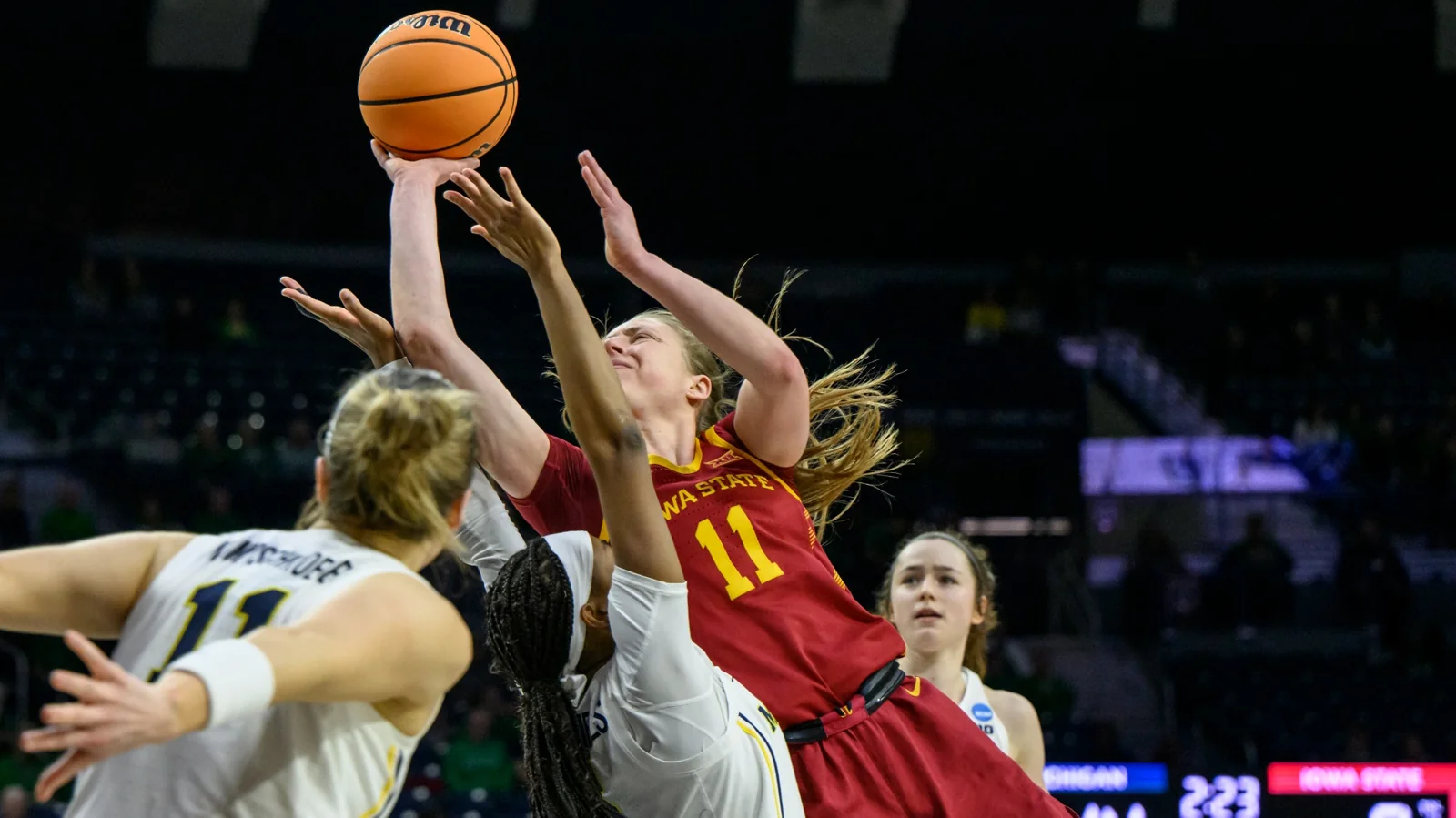
Suzie McConnell holds the Division I women's basketball career assists record with 1,307 at Penn State. Andrea Nagy, Caitlin Clark, Courtney Vandersloot and Sabrina Ionescu follow. This career top 25 combines the posted NCAA table with an explicitly identified school-verified addition, then explains totals, game counts and the distinct per-game record.
The Division I women's basketball career assists top 25
Suzie McConnell leads Division I women's college basketball with 1,307 career assists for Penn State. The table below follows the career totals in the NCAA Division I record book, with Georgia Amoore's combined 869 added from Kentucky's final career biography. It covers completed careers through 2025-26 and was checked October 14, 2026. The tie at 869 is shown explicitly.
| Rank | Player | College program or programs | Games | Assists |
|---|---|---|---|---|
| 1 | Suzie McConnell | Penn State | 128 | 1,307 |
| 2 | Andrea Nagy | FIU | 125 | 1,165 |
| 3 | Caitlin Clark | Iowa | 139 | 1,144 |
| 4 | Courtney Vandersloot | Gonzaga | 136 | 1,118 |
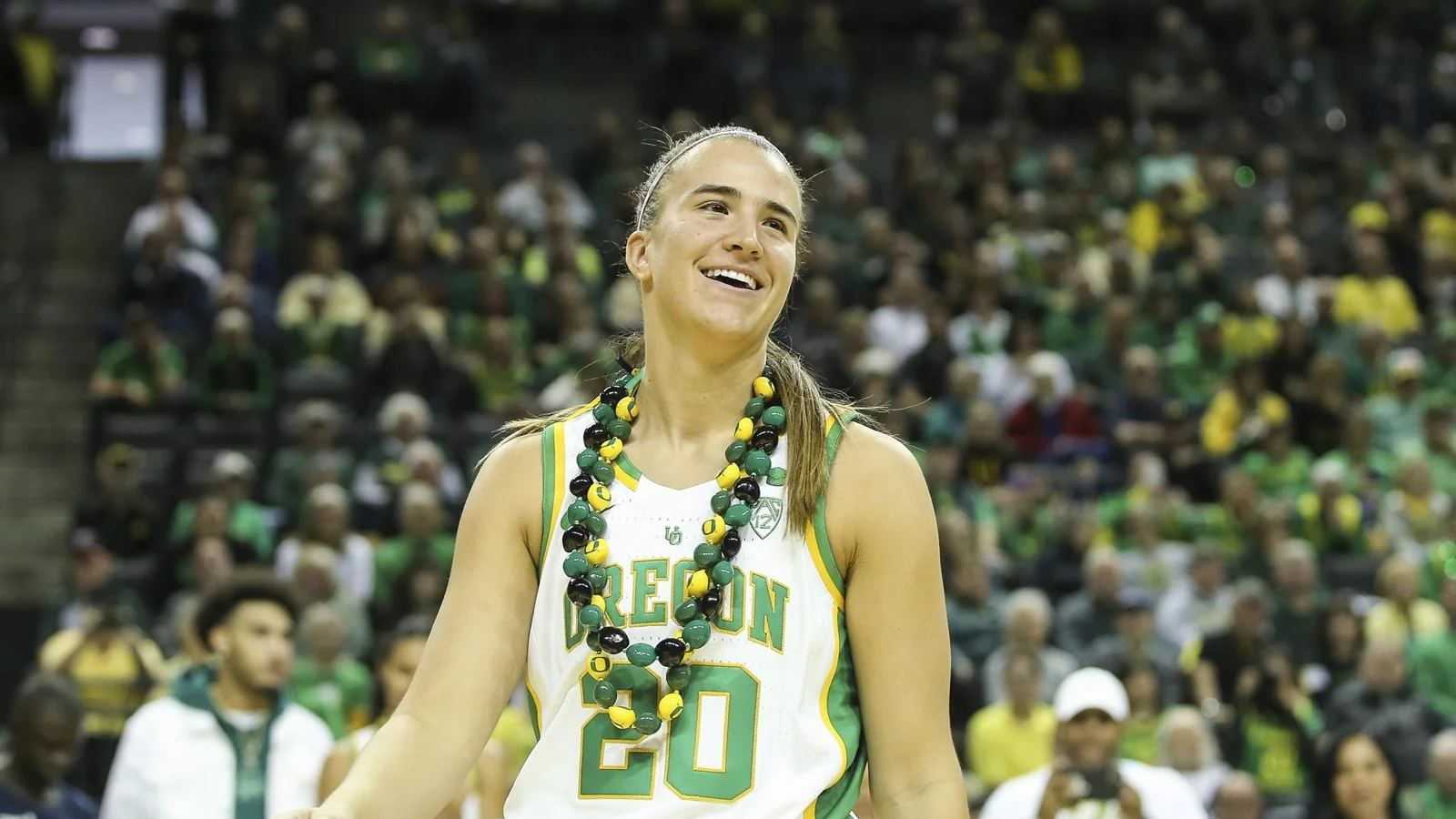
| 5 | Sabrina Ionescu | Oregon | 142 | 1,091 |
| 6 | Tine Freil | Pacific | 111 | 1,088 |
| 7 | Emily Ryan | Iowa State | 153 | 993 |
| 8 | Niya Johnson | Baylor | 146 | 988 |
| 9 | Shanya Evans | Providence | 121 | 987 |
| 10 | Rori Harmon | Texas | 157 | 977 |
| 11 | Temeka Johnson | LSU | 129 | 945 |
| 12 | Ticha Penicheiro | Old Dominion | 133 | 939 |
| 13 | La'Terrica Dobin | Northwestern State | 113 | 921 |
| 14 | Lauren Park-Lane | Seton Hall / Mississippi State | 155 | 911 |
| 15 | Olivia Miles | Notre Dame / TCU | 139 | 906 |
| 16 | Yolanda Paige | West Virginia | 120 | 902 |
| 17 | Samantha Prahalis | Ohio State | 133 | 901 |
| 18 | Jackie Kemph | Saint Louis | 132 | 899 |
| 19 | Samantha Logic | Iowa | 135 | 898 |
| 20 | Dalma Ivanyi | FIU | 106 | 896 |
| 21 | Nancy Kennelly | Northwestern | 116 | 892 |
| 22 | Jamierra Faulkner | Southern Miss | 124 | 883 |
| 23= | Neacole Hall | Alabama State | 84 | 869 |
| 23= | Georgia Amoore | Virginia Tech / Kentucky | 157 | 869 |
| 25 | Teresa Weatherspoon | Louisiana Tech | 131 | 858 |
What the NCAA career table includes
These are college career totals for the women's Division I category. They are not a list of WNBA assists, a men's basketball ranking or an NCAA tournament-only table. A player's college postseason assists belong to the career total, but the total also includes the other qualifying games in that career.
The NCAA dates official women's records to 1981-82 and says assists were added in 1985-86. Its qualifying career rules allow the historical entries shown here. That scope matters: an earlier player missing from the table is not necessarily being judged as a less accomplished passer. Historical coverage and qualification rules are part of what makes a record official.
Two details prevent common misreadings. First, Amoore's total combines two colleges; it is not a Kentucky-only record. Second, the posted NCAA career table and final school records must be read together where a recent graduate is absent from that table. The addition is identified above so the reader can understand exactly how this version was assembled.
Games are included because opportunities matter. Hall's 869 in 84 games and Amoore's 869 in 157 games occupy the same total-assists position, but they describe different career rates. That does not invalidate either career. It tells us that a totals table answers how much was accumulated, while a separate comparison is needed to discuss how quickly it was produced.
Why Suzie McConnell's 1,307 assists still stand apart
McConnell's total was built across four Penn State seasons, from 1984-85 through 1987-88. The important number beside 1,307 is 128: that is the game count in the NCAA career table. Dividing the two gives approximately 10.21 assists per game. Her total is not simply the product of a longer playing career than everyone who followed.
Penn State's Hall of Fame account records 71 double-digit assist games. That detail makes the career easier to picture: repeated high-assist performances underlie the large total. A spectacular single game can introduce a passer to a national audience, but a career record requires those contributions to continue over many schedules and opponents.
The 142-assist distance between McConnell and second-place Andrea Nagy is substantial. It is the difference between 1,307 and 1,165, not an estimate of how many additional seasons someone would need. Nagy's total came in 125 games, close to McConnell's 128, while other players on the list accumulated their numbers in different samples. Keep the actual game counts beside the totals rather than imagining everyone received the same opportunities.
Her college career also had a team context. Penn State's 2011 historical profile describes four consecutive NCAA tournament appearances and a 95-33 team record. Those facts place the passing achievement inside a sustained competitive career. They do not allow us to assign a precise share of every team win to one player's assists.
There is another record distinction worth preserving. McConnell's 355 assists in 1986-87 were a remarkable season, but Courtney Vandersloot later recorded 367 in 2010-11. The career leader and the single-season total leader are therefore different players. An older tribute can accurately describe what was a record when it was published while no longer describing the present record in that category.
For fans, this is part of the appeal of a historical leaderboard. It keeps a creator from an earlier era visible even when more recent players dominate the surrounding conversation. McConnell remains first because the qualifying total remains unmatched. That fact does not settle every debate about passing skill, offensive responsibility or overall greatness, but it is a clear answer to the career-assists question.
Read her record as both accumulation and consistency. The total establishes the place in history; the game count and repeated double-digit performances explain why it is difficult to approach. Neither needs invented possession data or a claim that every era played the same style to make the achievement meaningful.
Clark, Vandersloot and Ionescu combined creation with scoring
An assist leaderboard should not force every player into the image of a guard who mainly passes while teammates do the scoring. Three of its most familiar names also carried substantial scoring responsibility. Their college records show how creation and finishing can coexist, although a large assist total cannot by itself describe the exact way a defense responded to them.
Caitlin Clark's place beside the scoring record
Clark finished Iowa with 3,951 points and 1,144 assists. The school's final career announcement confirms both totals. Her third-place position here belongs alongside her college scoring achievement, not underneath a claim that passing was a minor part of her role.
A defense facing a scorer has to decide when and where to help. That can create passing opportunities, but the pass still has to be delivered and the teammate still has to finish. Clark's paired totals illustrate why evaluating an offensive creator solely by her own shot attempts misses part of the work. They do not allow us to reconstruct every possession from a career summary.
The numbers also answer two different historical questions. Clark did not finish first in career assists, despite finishing first in the NCAA Division I women's career scoring category. An extraordinary all-around offensive career does not need to occupy the top position in every individual statistic. Fans can recognize both her scoring distinction and McConnell's passing total without combining separate records into one vague label.
Two different paths through Gonzaga and Oregon
Vandersloot's Gonzaga career account records 2,073 points and 1,118 assists. Her 367 assists in 2010-11 set the single-season total standard, and the Bulldogs reached their first Elite Eight that season. Her place in this table therefore includes both a long career and a particularly productive final year.
Ionescu finished Oregon with 2,562 points, 1,091 assists and 1,040 rebounds, according to the Ducks' final-season account. The rebounding total is a useful extra dimension. It reminds fans that a creator can contribute to gaining possession as well as distributing the ball once her team has it.
Her official biography separates career production from her senior season, when she averaged 9.1 assists and had a 3.05 assist-to-turnover ratio. Those are not interchangeable figures. A particularly strong final season can lift a career total without making the career average equal to the final-year rate.
These three careers are best read as different examples of broad offensive responsibility. Compare their documented contributions and opportunities, then use actual game evidence for a closer discussion of style. A total can establish a ranking; it cannot replace the decisions and teammate interactions that produced it.
Recent graduates have changed the lower half of the leaderboard
A career table can become stale even when its leading name stays the same. Recent graduates add completed totals, move other players down and create new comparisons around familiar thresholds. The most useful reference is a final career record, rather than a midseason milestone post that accurately described a player's place at an earlier point.
Emily Ryan and Rori Harmon near the 1,000-assist threshold
Ryan finished Iowa State with 993 assists. The report of her final game, an 80-74 NCAA tournament loss to Michigan on March 21, 2025, records five assists that day and the completed career total. She finished seven short of 1,000, a simple subtraction rather than a judgment about the quality of her passing.
A round number makes a milestone easy to recognize, but it does not create a sudden change in basketball value. The pass that produces assist number 993 is credited under the same basic statistical framework as the pass that produces number 1,000. Career thresholds help organize history; they should not turn a small numerical difference into an unsupported claim about an entirely different caliber of player.
Harmon's Texas biography gives 977 career assists across 157 games, matching the NCAA career table. Her final season included 246 assists in 39 games. The agreement is useful because some secondary leaderboards display a different career figure. The school and NCAA totals are the basis for the number used here.
Transfers and combined college totals
Miles' 906 assists combine Notre Dame and TCU. TCU's final-season announcement confirms 252 assists in her sole season in Fort Worth. The national career total consequently answers a broader question than the TCU single-season record. Labeling all 906 as TCU assists would confuse a player's complete career with one institution's portion of it.
Amoore provides another clear example. Her Kentucky biography identifies 869 career assists across Virginia Tech and Kentucky, including 213 in her Kentucky season. The combined number belongs in a national college career discussion. It should not be described as a Kentucky-only accumulation.
Park-Lane's entry similarly identifies both Seton Hall and Mississippi State. These labels matter because a fan might encounter one player's name in several school record books. The national career table follows the player across qualifying college appearances; a school table follows the statistics credited to that program. Read which question a source is answering before deciding that two different totals conflict.
Recent additions make this history more interesting, not less stable in principle. The ranking should move when completed evidence changes, with its date and scope stated clearly. That is how a career leaderboard remains useful without pretending that every old search snippet describes the final version of a player's record.
How to compare assist leaders without confusing the records
An assist is a credited contribution to a made field goal, rather than a count of every good pass. The NCAA statisticians' manual assigns the decision to the scorer's judgment and allows only one assist on a field goal. A useful pass that ends with a missed shot does not become a recorded assist simply because it created an attractive opportunity.
That distinction matters when watching a game. Passing can help an offense in ways a career assist total does not capture. The teammate's finish is part of the recorded outcome, and an earlier pass can help create the eventual opening. An assist statistic measures a particular credited event, not every decision that moved the defense or improved the possession.
Consider a simple hypothetical example. A guard creates two equally open looks on successive possessions, but her teammates make only one shot. The box score might credit one assist, even though the two passes had similar practical value. This is an illustration of how the measurement works, not a claim about a named player's missed opportunities or an estimate of unrecorded assists.
Career totals, per-game production and turnovers
Hall holds the NCAA qualifying career assist-average record at approximately 10.35 per game, based on 869 assists in 84 games. McConnell leads the total-assists category but averages approximately 10.21, from 1,307 in 128. The two records can belong to different players because the questions are different: total accumulation and production per appearance.
Freil's 1,088 in 111 games gives approximately 9.80 per game. Clark's 1,144 in 139 gives approximately 8.23, while Vandersloot's 1,118 in 136 gives approximately 8.22. Rounding both latter averages to one decimal would produce 8.2, but the underlying rates are not identical. Use the numerator and denominator when a comparison depends on a small difference.
Turnovers provide another useful dimension, provided the samples match. A hypothetical 100 assists and 40 turnovers in the same set of games yields a 2.5 assist-to-turnover ratio. Dividing a player's full career assists by only her final-season turnovers would produce a number with no coherent sample. A valid calculation is not automatically a fair comparison if it combines unrelated periods.
Minutes, role and team circumstances still belong beside those figures. Per-game production does not adjust for every difference in playing time or offensive responsibility. A career total does not adjust for pace or the number of chances teammates had to convert. Without measured evidence, those limitations should remain limitations rather than excuses to invent a new ranking.
The women's basketball records guide separates more statistical categories, while the career scoring list offers another view of offensive history. This assists table is most useful when its scope stays clear: a dated record of qualifying college production, with enough context to appreciate the people who created it.
Join the conversation
Share a question or a thought about the women's game. Comments are reviewed before they appear. Keep it friendly, stay on topic and leave out personal information.
No comments yet. Start the conversation.
Sign in with Google to leave a comment. Your email address is not displayed with your comment.