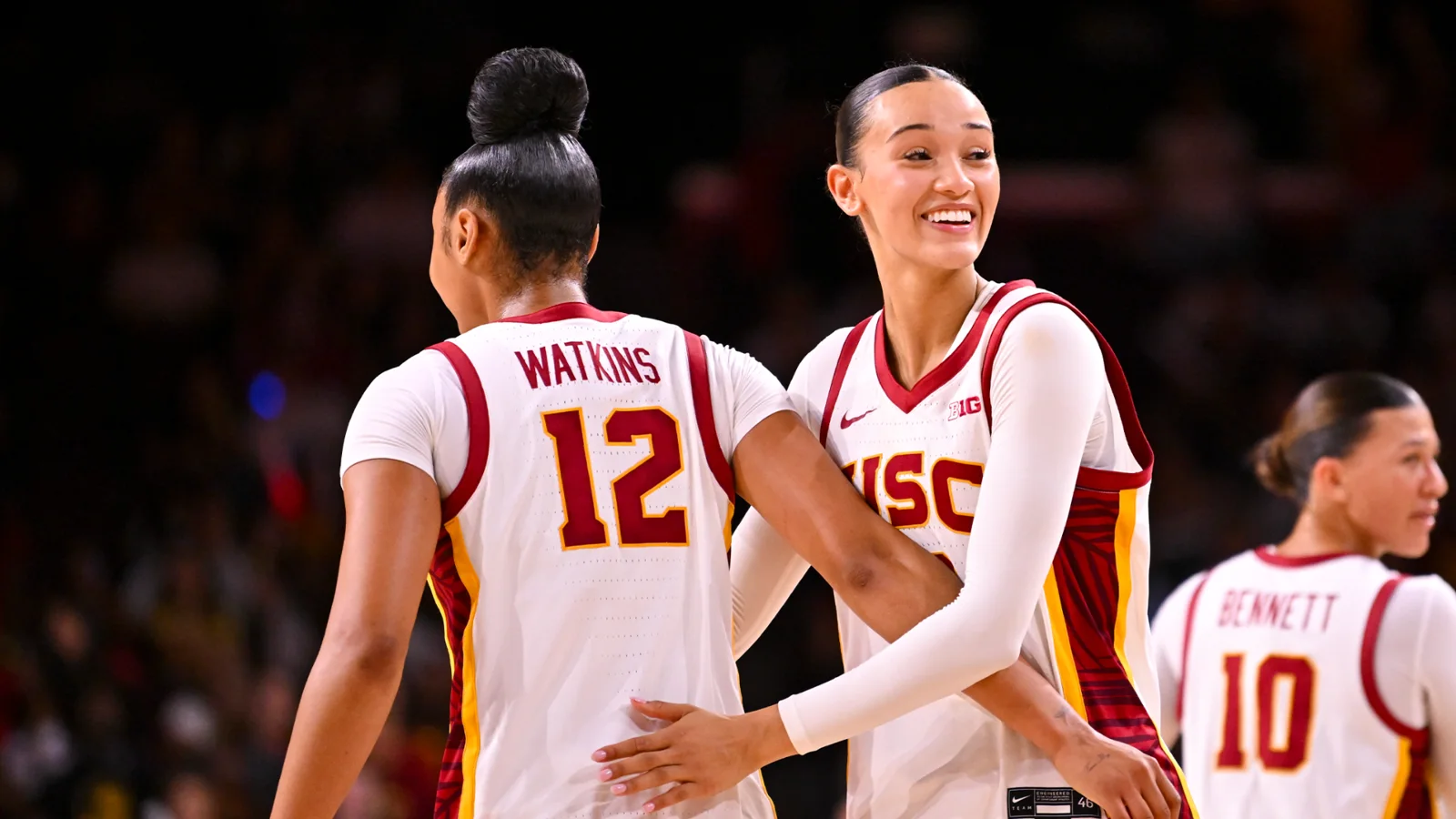
The 2027 women's Naismith Trophy race began its public preseason stage with a 50-player watch list released on October 29, 2026. It recognizes candidates for the Atlanta Tipoff Club's women's college player of the year award. It is a starting field, rather than a numbered ranking or an announcement of the eventual winner.
The complete official list includes USC's JuJu Watkins and Jazzy Davidson, Iowa's Ava Heiden and Dani Carnegie, and candidates across the country. As of October 30, the meaningful next steps remain ahead: regular-season performances, later lists and a winner announcement scheduled for March 31, 2027. The best way to use the release is to identify players worth following and understand which award each subsequent headline actually concerns.
The 50-player watch list is a starting field, not a ranking
The Atlanta Tipoff Club's official release presents 50 players with columns for name, class, position, school and conference. There is no rank column. The names run alphabetically by surname, beginning with KK Arnold and ending with the Williams entries. A player's position on that page therefore does not describe her place in an award race.
That makes a watch list different from a forecast. It tells fans whom the award has recognized at this stage. It does not assign a probability of winning or establish an order among the candidates. If two players appear far apart on the page, the gap is not a judgment that one has a much stronger case. The list's format is an organizing choice, not a hidden ballot.
The conference distribution is useful context without being a league table of quality. The field contains 14 Big Ten players, 12 from the SEC and 11 from the ACC. USC's October 29 announcement independently reports those leading counts. They indicate where many of the recognized candidates will play, but they are not a formula for deciding which conference has the best teams.
Use the current school beside the name
The school column is especially important after an offseason of roster movement. Dani Carnegie appears with Iowa, and Audi Crooks with Oklahoma State. An old highlight or previous-season statistical page can still be useful historical evidence while pointing you toward the wrong team for a current viewing plan. Start with the current affiliation before choosing a game to follow.
Also keep a player's prior production attached to its original season and school. A transfer's earlier scoring total does not become a statistic accumulated for the new team. It is evidence of what she has done in a different setting. The coming season will show how her opportunities, teammates and responsibilities change that contribution.
Multiple candidates from one program create a further viewing opportunity. Watch how they share possessions, rather than assuming that having more names automatically means a better offense or an easier path to the trophy. One player's creation can make another player's finishing more efficient; their counting totals can also reflect different jobs. The list identifies people to examine, while the games provide the relationships.
For an explicitly ordered opinion, our preseason player ranking serves a different purpose. An editorial ranking and an official award watch list can both be useful, provided their labels stay visible. Neither should be presented as the other organization's judgment.
The USC and Iowa pairs show different kinds of award cases
Four confirmed names provide a useful way to turn the list into basketball questions: Watkins and Davidson at USC, Heiden and Carnegie at Iowa. They are examples of the variety within the field, rather than a claim that these are the four leaders. Their histories show why two players can reach the same preseason list through quite different kinds of evidence.
Past recognition creates context, not a reserved place
Watkins won the Naismith Trophy following the 2024–25 season, then missed 2025–26 because of injury. Davidson enters her sophomore season after national freshman-of-the-year recognition. Those details, confirmed in USC's award announcement, explain why the pair arrives with considerable attention. They do not remove the need to evaluate what each produces in 2026–27.
For Watkins, the interesting basketball question is how her contribution develops within a team that has changed around her. For Davidson, it includes how her own creation works alongside a returning high-profile teammate. Watching that relationship is more informative than treating their previous awards as a fixed order within the current race. The new season can create a different balance of responsibilities even when the names are familiar.
Past winners can help fans understand the award's history without making this season a replay. Our year-by-year winners guide supplies that background. The current list has a different job: it opens a new season's conversation, including candidates whose strongest evidence may still be ahead.
Different roles make raw scoring comparisons incomplete
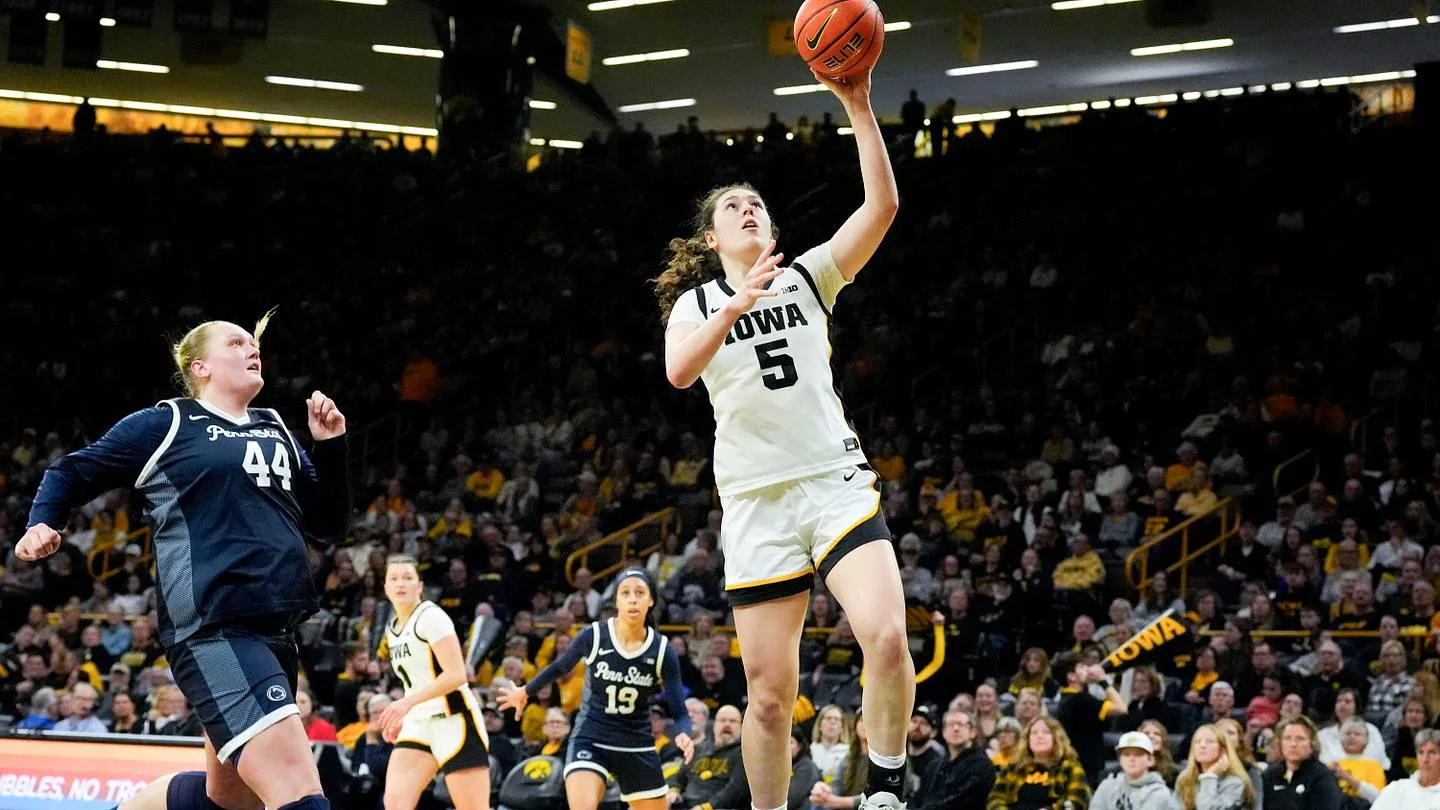
Iowa's official release describes Heiden's 2025–26 production as 18.0 points and 7.2 rebounds per game, with 64.1 percent field-goal shooting. Carnegie averaged 17.8 points, 5.2 rebounds and 3.2 assists at Georgia while making 84 three-pointers. Those are prior-season figures, attached to the team for which each player actually produced them.
The near match in scoring averages is a useful illustration of what a single number leaves out. A center's finishing opportunities and a guard's perimeter attempts can place different demands on an offense. The relevant questions include who creates the advantage, how the ball arrives and what a player contributes when the first option disappears. A two-tenths difference in scoring average does little to answer those questions.
Heiden's efficiency invites fans to watch how Iowa creates her catches and what happens when an opponent commits extra attention inside. Carnegie's three-point production invites a different focus: how her shooting affects the space available to teammates, and whether the next pass preserves an advantage. These are viewing priorities drawn from their recorded roles and production, not claims that a particular Iowa action has already succeeded in the new season.
Playing together also changes the context in which an individual is evaluated. An efficient interior finish may depend on a guard delivering the ball at the right time. A perimeter shooter may benefit from the attention paid to an inside target. Both contributions can be valuable even when the final statistic attaches to only one of them. That is why following a few complete possessions can improve an award discussion more than comparing isolated scoring totals.
None of this defines a secret voting formula. It is a way for fans to build a more complete judgment about players the award has already recognized. Watch the production, the responsibilities and the opposition together. The field becomes much more interesting when it is treated as a collection of different basketball cases rather than fifty versions of the same scoring contest.
The women's Naismith dates to save for 2027
The official 2026–27 calendar, checked on October 30, separates the women's college player trophy from men's, high school, coaching and defensive awards. For this specific race, the published sequence is:
| Announcement | Field | Scheduled date |
|---|---|---|
| Preseason watch list | 50 players | October 29, 2026 |
| Midseason team | 30 players | February 9, 2027 |
| Semifinalists | 10 players | March 18, 2027 |
| Finalists | 4 players | March 24, 2027 |
| Winner | 1 player | March 31, 2027 |
Only the first of these announcements has occurred as of this article's October 30 snapshot. The later dates are plans on the award's calendar, so they should be described as scheduled rather than completed. A preseason candidate has not already become a semifinalist, and a four-player finalist group has not yet been selected.
The stages change the scale of the recognition. Being among fifty identified players is meaningful preseason attention, but it leaves a broad field. A later, smaller group provides a more concentrated statement at that later point in the season. Fans should attach the stage to the name when sharing news: watch-list selection, midseason selection and finalist status describe different accomplishments.
That also makes the midseason date a useful opportunity to revisit an early opinion. By February, fans will have regular-season performances to examine rather than relying chiefly on historical production and preseason expectations. The question becomes what each player has added to her current team and how often that contribution has held up across different opponents.
Take care when another Naismith date appears in a headline. The women's defensive player watch list, for example, is scheduled for February 2, while the main women's college player midseason group follows on February 9. Seeing a different count or an earlier announcement does not necessarily mean the main trophy's schedule changed. It may be a different award category.
The site's basketball calendar tools help organize the games that build a player's season. Keep the award dates alongside that viewing plan as separate reminders. The games supply the evidence; the announcements reveal how the award's recognition develops. Checking the organizer's current calendar near each milestone is the clearest way to keep those two timelines aligned.
Naismith, AP, Wooden and position awards answer different questions
A player can appear in several award announcements in one week because the organizations are recognizing different things. The Naismith Trophy is the Atlanta Tipoff Club's award. Associated Press recognition belongs to AP. The John R. Wooden Award has its own program and selection process. Similar names in the releases do not turn them into stages of a single competition.
The clearest immediate example is the AP preseason All-America team announced October 22. It includes Watkins, Sarah Strong, Hannah Hidalgo, Madison Booker and Mikayla Blakes. That is a five-player preseason honor. The Naismith release a week later identifies a much larger field for a different organization's individual player award. Being outside one group cannot simply be interpreted as a vote total in the other.
Even within one organization's coverage, player of the year and All-America are different labels. A team selection recognizes several players; an individual trophy identifies a recipient. Preseason and end-of-season recognition also answer different temporal questions. One concerns expectations entering the schedule, while the other evaluates a season that has actually unfolded. Keep both the organization and the timing attached to any comparison.
The Wooden Award's official description identifies the Los Angeles Athletic Club as its administrative home and describes both player-of-the-year and All-America honors. Its published criteria and selection process belong to that program. A fan should not import a Wooden voting rule, academic requirement or announcement date into the Naismith race simply because both honor outstanding college players.
For a historical example of how the honors can overlap, our 2026 award-winners guide keeps the organizations distinct. Overlap is interesting evidence of broad recognition, but it does not mean one award committee is bound by another's conclusion. A player can have a strong case in several conversations without the conversations becoming identical.
The Hall of Fame's Starting Five is a separate program
The Naismith Basketball Hall of Fame's women's position awards are another separate set of honors. Its current Cheryl Miller Award announcement, issued in partnership with the Women's Basketball Coaches Association, identifies a 20-player watch list for the top Division I women's small forward. That is not the fifty-player Atlanta Tipoff Club Trophy field.
The women's Starting Five covers point guard through center: the Nancy Lieberman, Ann Meyers Drysdale, Cheryl Miller, Katrina McClain and Lisa Leslie awards, respectively. These distinctions let fans discuss outstanding players within positional roles. A guard and a center can both be recognized in that program without competing for the same positional award.
The shared Naismith name makes the distinction easy to miss, but the organizers and award titles resolve it. Read the full title before interpreting the candidate count, selection stage or fan-voting instructions. A procedure published for the Hall of Fame's Cheryl Miller Award should not be assumed to govern the Atlanta Tipoff Club's Trophy. The same care prevents a positional finalist announcement from being mistaken for the national player trophy's four finalists.
Used accurately, the different honors make the season richer. They encourage discussion of different skills, roles and judgments. The confusion begins only when several separate announcements are compressed into a claim that a player has already secured a place in every national award race.
Follow the performances before predicting the trophy
The release is most useful when it sends fans toward games they would otherwise miss. Choose a few candidates whose roles differ and follow them for more than one afternoon. A guard who creates a shot late in a possession, a center who converts an interior advantage and a forward who completes a defensive stop can all contribute in ways a single scoring comparison obscures.
Start with the women's basketball TV schedule, selecting the relevant date and checking the displayed time zone. A player's name on a watch list is not a promise that every game will have the same broadcast outlet. Follow the current school's matchup and announced channel, particularly when a transfer has changed the team you need to find.
After watching, connect an impression to the actual game result and the official player statistics. A productive night can be impressive while still coming in a different set of circumstances from another candidate's game. Consider the opponent, the player's opportunities and the jobs she performed before turning the total into a national conclusion.
Do the same with an inefficient scoring night. A player may still have helped create good attempts for teammates, completed defensive possessions or contributed in a role that required fewer shots. That does not make missed shots irrelevant. It means the evaluation should ask what happened across the performance rather than using one statistic as an automatic verdict.
What if a favorite player is absent from the initial fifty? The October 29 release establishes the announced preseason field; it does not publish an express rule declaring every unlisted player permanently excluded. This guide does not promise a later place for anyone or transfer another award's entry rules into this race. Check the subsequent official announcements for the field actually recognized at each stage. Absence from this release alone is an insufficient basis for claiming a permanent ban from consideration.
There is no need to invent a snub controversy to make that uncertainty interesting. A player can give fans a compelling season to follow whether or not a preseason announcement includes her. The strongest discussion explains the contribution and then compares it with the relevant award news, rather than assuming that an October label settles a March question.
The 2027 trophy conversation now has its starting list and a set of scheduled milestones. Between them lies the part worth watching: players adjusting to teammates, opponents testing their strengths and performances accumulating across the season. Use the list to widen that attention, keep the award names accurate and let the basketball give the eventual argument its substance.
Join the conversation
Share a question or a thought about the women's game. Comments are reviewed before they appear. Keep it friendly, stay on topic and leave out personal information.
No comments yet. Start the conversation.
Sign in with Google to leave a comment. Your email address is not displayed with your comment.